kottke.org posts about politics
Trump just kicked Ukrainian President Volodymyr Zelenskyy out of the White House after berating him for being “disrespectful” in the Oval Office.
The astonishing turn of events could scramble international affairs in Europe and around the globe. During his visit with Trump, Zelenskyy had planned to sign the deal allowing the U.S. greater access to Ukraine’s rare earth minerals, then hold a joint news conference.
Instead, Ukraine’s leader left the White House shortly after Trump shouted at him, showing open disdain. Untouched salad plates and other lunch items were being packed up outside the Cabinet room, where the lunch between Trump and Zelenskyy and their delegations was supposed to have taken place.
The White House said the Ukraine delegation was told to leave.
“You’re gambling with World War III, and what you’re doing is very disrespectful to the country, this country that’s backed you far more than a lot of people say they should have,” Trump told Zelenskky.
My god, Trump and Vance are just total fucking assholes. The US is openly aligning themselves with Russia against Ukraine and Europe, a major shift in international relations that dates back to the 1940s. I am so embarrassed to be an American right now.
Update: The NY Times has some key excerpts from the meeting in the White House.
Vance: And do you think that it’s respectful to come to the Oval Office of the United States of America and attack the administration that is trying to prevent the destruction of your country?
Zelensky: A lot of questions. Let’s start from the beginning.
Vance: Sure.
Zelensky: First of all, during the war, everybody has problems, even you. But you have nice ocean and don’t feel now, but you will feel it in the future.
Trump: You don’t know that.
Zelensky: God bless, you will not have a war.
Trump: Don’t tell us what we’re going to feel. We’re trying to solve a problem. Don’t tell us what we’re going to feel.
Zelensky: I’m not telling you.
Trump: Because you’re in no position to dictate that. Remember this: You’re in no position to dictate what we’re going to feel. We’re going to feel very good.
Zelenskyy’s English is obviously not super strong but Trump sounds like a 4-year-old in full “you’re not the boss of me” mode here. So glad he has control of America’s armed forces and nuclear arsenal!
This is excellent reporting by the Times (although at times it makes Musk’s actions sound heroic rather than unconstitutional, criminal, and treasonous) on how Elon Musk took over a huge chunk of the US government, which he still controls today. It began at a Republican fundraiser in September of 2023:
Mr. Musk made clear that he saw the gutting of that bureaucracy as primarily a technology challenge. He told the party of around 20 that when he overhauled Twitter, the social media company that he bought in 2022 and later renamed X, the key was gaining access to the company’s servers.
Wouldn’t it be great, Mr. Musk offered, if he could have access to the computers of the federal government?
Just give him the passwords, he said jocularly, and he would make the government fit and trim.
Musk, motivated by the Biden administration’s regulation of his companies, went to work:
Seasoned conservative operatives like Stephen Miller and Russell Vought helped educate Mr. Musk about the workings of the bureaucracy. Soon, he stumbled on an opening. It was a little-known unit with reach across the government: the U.S. Digital Service, which President Barack Obama created in 2014 after the botched rollout of healthcare.gov.
Mr. Musk and his advisers — including Steve Davis, a cost cutter who worked with him at X and other companies — did not want to create a commission, as past budget hawks had done. They wanted direct, insider access to government systems. They realized they could use the digital office, whose staff had been focused on helping agencies fix technology problems, to quickly penetrate the federal government — and then decipher how to break it apart.
They would call it the U.S. DOGE Service, and they would not even have to change the initials.
They began their move on the digital service unit earlier than has previously been reported, The Times found, while President Joseph R. Biden Jr. was still in office — giving them the ability to operate on Mr. Trump’s first day.
And now here we are, an unelected private citizen in charge of the US government:
The team is now moving faster than many of the legal efforts to stop it, making drastic changes that could be hard to unwind even if they are ultimately constrained by the courts. Mr. Musk’s associates have pushed out workers, ignored civil service protections, torn up contracts and effectively shuttered an entire agency established by Congress: the U.S. Agency for International Development.
A month into Mr. Trump’s second term, Mr. Musk and his crew of more than 40 now have about all the passwords they could ever need.
His swift success has been fueled by the president, who handed him the hazy assignment of remaking the federal government shortly after the billionaire endorsed him last summer. Flattered that Mr. Musk wanted to work with him, Mr. Trump gave him broad leeway to design a strategy and execute it, showing little interest in the details.
Read the rest of it for how it was all hurriedly planned out ahead of time.
The central point of Dr. Brooke Harrington’s essay about the destabilization of “basic systems we count on to make our society function” over the past month is bang on:
This promises to be a tough way for Americans to learn a critical fact too often overlooked: that one of our country’s greatest and least-appreciated assets has been public faith and trust in a variety of highly complex systems staffed by experts whose names we’ll never know. In fact, high levels of trust used to be one of our superpowers in the United States: specifically, that meant trust in our government to operate with reasonable competence and stability and without the kind of corruption that has hobbled other societies.
In this video, David Lynch talks about the effect of depression on creativity:
It stands to reason: the more you suffer, the less you want to create. If you’re truly depressed, they say you can’t even get out of bed, let alone create. It occupies the whole brain, poisons the artist, poisons the environment; little room for creativity.
But his assertion can be easily extended to how instability in one’s life leads to an inability to live fully. Stability and lack of corruption allows people to live their lives, make art, engage in commerce with each other, build families, and strive to be their best, authentic selves. The US has never been completely stable or uncorrupt, but we’re at real risk of losing something incredibly valuable here…and it’ll be difficult to get it back when it’s too far gone.
From David Wallace-Wells, a reminder that those who were considered alarmists at the beginning of the pandemic were ultimately proved right — it actually was an alarming situation.
Today, the official Covid death toll in the United States stands at 1.22 million. Excess mortality counts, which compare the total number of all-cause deaths to a projection of what they would have been without the pandemic, run a little higher — about 1.5 million.
In other words, the alarmists were closer to the truth than anyone else. That includes Anthony Fauci, who in March 2020 predicted 100,000 to 200,000 American deaths and was called hysterical for it. The same was true of the British scientist Neil Ferguson, whose Imperial College model suggested that the disease might ultimately infect more than 80 percent of Americans and kill 2.2 million of us. Thankfully, the country was vaccinated en masse long before 80 percent were infected…
I’m also going to point out that those who were labeled alarmists about the impact of Donald Trump’s presidencies were also “closer to the truth than anyone else”, certainly closer than all those centrist “pundits”. I’m particularly thinking of those who knew when they woke up on November 9th to a Trump victory that Roe v Wade was toast and that Americans’ civil rights would be taken away and were called “hysterical” (there’s that word again) for saying so.

NPR’s Embedded podcast has a three-episode series from reporter Zach Mack about a year-long effort to convince his dad that all the conspiracy theories he (his dad) believes are bogus, in an attempt to save his family.
Reporter Zach Mack thinks his dad has gone all in on conspiracy theories, while his father thinks that Zach is the one being brainwashed.
In 2024, after the latest round of circular arguments, they decided to try something new, an attempt to pull each other out of the spell each of them thinks the other is under.
Can one family live in two realities?
You can listen to all three episodes at the NPR website for Embedded or wherever you get your podcasts. This abridged companion article covers the same ground as the podcast.
When I asked my dad whether he feels like the odd man out, he answered somberly, “It’s painful at times. It’s very sad for me.”
So what happens when your family and your friends don’t respect your beliefs? Perhaps you reach for a higher purpose — something existential.
This came up in a conversation with Charlie Safford, a researcher who designs therapeutic techniques for people who believe in far-right conspiracy theories. He believes that conspiracy theories are fundamentally emotional coping mechanisms.
“Even if your father doesn’t put the pieces together, there is some awakening of his own mortality that might be contributing to all of this,” he told me. “One of the ways that you come to terms is to look back and say, ‘Did my life have meaning?’”
See also:
Oh and me in a tweet from July 2020:
The appeal of QAnon & conspiracy theories is simple: they turn politics & public health (boring things that happen *to* you) into something active and engaging: your own personal Da Vinci Code hunt for a secret truth.
(thx, tra)
Whoa, HBO has made a third installment of Eyes on the Prize, the landmark series on the American Civil Rights Movement. The trailer is above and you can watch the six-part series on HBO or Max right now.
The first two series, which are amongst the best television ever aired, covered events from 1954–1965 (part one) and 1965–1985 (part two). Eyes on the Prize III covers significant events from 1977-2015, including:
- Community activists in the South Bronx and Philadelphia fighting for fair housing and healthcare during the Carter administration
- Reaganomics and the AIDS crisis
- How the criminal justice system affected the Black community from 1989-1995 in Washington DC and South Central Los Angeles (the LA Uprising).
- The Million Man March in 1995.
- The environmental movement (1982-2011)
- “The complexities of affirmative action policies and how a changing demographic landscape affected school desegregation in new ways.”
- The soaring police brutality of the Obama years.
- The birth of the Black Lives Matter movement.
Featured participants include Angela Davis, Al Sharpton, congressman Kweisi Mfume, Kimberlé Crenshaw, Al Gore, Black Lives Matter co-founders Alicia Garza and Patrisse Cullors, and dozens of other activists, scholars, and politicians.
In a review for the Hollywood Reporter, Daniel Fienberg writes:
Eyes on the Prize III is, as the title suggests, a formal sequel to Eyes on the Prize II, a six-hour exploration of the “aftermath” of the Civil Rights Movement that makes it very clear that the movement has never ended, just as its real concerns were never fully resolved. It’s an emotional, inspiring and righteously angry series of vignettes that looks backward, while very clearly intending to reflect upon and instigate conversations about our fraught current moment.
The series isn’t perfect, but it’s utterly essential, sometimes feeling disheartening for the immediacy of that necessity.
In a post on Bluesky, Fienberg says “nothing you could watch this week is better”.
From @existennialmemes on Tumblr:
Listen, if a Bad President can come in and take away our rights and we’re dependent on a Good President replacing them in four years to give us back our rights, then we do not have any rights.
If politicians can take or distribute them, then they’re not “inalienable” and they’re not “rights.”
We don’t have inalienable rights we have conditional privileges, divvied out according to the whims of whoever currently holds the reins.
And if we want to have actual rights, then we must build a system in which no one has the power to take them away to begin with.
I am wondering what a system like that would actually look like… (via @halaylah.bsky.social)

The Guardian profiled a number of people fired from the agencies that manage federal lands - the US Forest Service, Bureau of Land Management, etc. — purged from their jobs by the Trump/Musk administration.
Victoria Winch, US Forest Service wilderness forestry technician, Flathead national forest, Spotted Bear ranger district, adjacent to Glacier national park, Montana:
People come on to these lands to hunt, to feed their families. People are allowed to get firewood. Outfitters, who are a big part of the local economy, use these trails.
But every single field person at Spotted Bear was terminated. Those trails won’t get cleared this year. And it takes less than one season for them to be totally impassable.
Nick Massey, USFS wilderness Ranger, Pisgah national forest, North Carolina:
We were very, very busy with public interaction, conversations, giving directions, educating. I would come up on folks quite often who were either lost or having some sort of emergency, and I’m also a member of two mountain rescue teams in the area.
I really loved seeing so many different people from different walks of life. Being able to be a part of that wilderness experience that people are having was really, truly magical.
Other fired federal land and National Park employees have been sharing their stories with media and on social media, highlighting how little these purges are about saving money and much more about all the services and benefits that Americans will be losing that we paid for. (Their stories also highlight the lies about employees not being fit for their jobs being used as the pretext to fire them. And the lack of due process. And, and, and…) Here are a few of those stories.
Brian Gibbs, Educational Park Ranger at Effigy Mounds National Monument:
I am a father, a loving husband, & dedicated civil servant.
I am an oath of office to defend and protect the constitution from all enemies foreign and domestic.
I am a work evaluation that reads “exceeds expectations.”
I am the “fat on the bone.”
I am being trimmed as the consequence of the popular vote
I am the United States flag raiser & folder
I am my son’s “Junior Ranger” idol
I am a college kid’s dream job
Alex Wild, park ranger:
Today I lost my dream job as a permanent park ranger in the NPS. I’m still in shock, and completely devastated. I have dedicated my life to being a public servant, teacher, and advocate for places that we ALL cherish. I have saved lives and put my own life at risk to serve my community.
I honestly can’t imagine how the parks will operate without my position. I mean, they just can’t. I am the only EMT at my park and the first responder for any emergency. This is flat-out reckless.
The NY Times published an overview of the firings and their effect on federal land management, including interviews with purged employees:
Arianna Knight, 29, of Bozeman, Mont., the wilderness trails supervisor for the Yellowstone District of the Custer Gallatin National Forest, was let go on Feb. 14 along with more than 30 other Custer Gallatin employees. Ms. Knight said she and two workers under her supervision typically cleared 4,000 downed trees and logs from hundreds of miles of trails each year, often hiking and using hand tools for a week at a time in wilderness areas, where federal law prohibits motorized vehicles and mechanized tools like chain saws.
Now those trails won’t be cleared, Ms. Knight said, adding, “People are going to suffer.”
And:
While it may seem as if the cuts will mean fewer people trampling through the parks, allowing ecosystems to regenerate, some fear the opposite: that less oversight and control over huge crowds may damage the parks for seasons to come.
Adam Auerbach, 32, a former park ranger at Rocky Mountain National Park, said visitor numbers at the park has been climbing consistently for decades, to more than four million in 2023 from 2.6 million in 1990. The park has had to institute a timed-entry permit system to control the numbers.
With the new cuts, he said, “There will be fewer rangers on the ground to enforce regulations and fewer public educators to help the public even understand the regulations and the reasons for them in the first place.”
From a news release by the Association of National Park Rangers:
Rick Mossman, president of the Association of National Park Rangers (ANPR) said, “These actions will hurt visitors and the parks they travelled to see across the United States. If a visitor is involved in an automobile accident in Badlands National Park in South Dakota, or has their car broken into at a trailhead in Rocky Mountain National Park in Colorado, there will be a delay in the response by a ranger to investigate — or perhaps no response at all. If a visitor suffers a medical emergency while hiking in Grand Canyon National Park in Arizona, ranger response could be delayed.”
Mossman went on to say that visitors are likely to experience reduced hours or days — and even closures — of visitor centers and other public-use facilities. Ranger-led educational programs will be reduced or eliminated. Trash and litter may accumulate, and restrooms will be dirtier because of reduced maintenance and fewer custodial workers. There could even be complete closures of some parts of parks to protect visitors and those park resources.
From the National Parks Conservation Association:
In a phone interview, Moxley said she had to walk away from a year’s worth of research and work on wetland restoration, invasive plant documentation and funding efforts to save Harper Ferry’s remaining hemlock trees from a devastating invasive insect called a woolly adelgid.
Adding that she speaks on behalf of herself and not Harpers Ferry or the National Park Service, Moxley said parks — large and small — have behind-the-scenes staff who work to protect natural habitats, historic structures and museum objects and exhibits.
“Visitors don’t usually encounter us, but without us, there would not be sites to enjoy,” Moxley said. “Without staff, the National Park Service will be unable to carry out its 100+ year mission to leave the parks unimpaired for the enjoyment of future generations. This is a mission my colleagues and I take seriously.”
In the most recent issue of Garbage Day, Ryan Broderick writes about how Steve Bannon’s “flood the zone with shit” has been embraced by the Trump administration in both governance and in messaging.
The brain-breaking feeling you get watching something like the ASMR video or the time you waste trying to determine whether the image Musk shared is real or not is, like with Project 2025 and the executive orders, by design. It’s meant to initially trigger you and ultimately wear you down.
Stuff like this always makes me think of Hannah Arendt’s comments in this 1974 interview, particularly the last line (emphasis mine):
The moment we no longer have a free press, anything can happen. What makes it possible for a totalitarian or any other dictatorship to rule is that people are not informed; how can you have an opinion if you are not informed? If everybody always lies to you, the consequence is not that you believe the lies, but rather that nobody believes anything any longer. This is because lies, by their very nature, have to be changed, and a lying government has constantly to rewrite its own history. On the receiving end you get not only one lie — a lie which you could go on for the rest of your days — but you get a great number of lies, depending on how the political wind blows. And a people that no longer can believe anything cannot make up its mind. It is deprived not only of its capacity to act but also of its capacity to think and to judge. And with such a people you can then do what you please.
And of Toni Morrison on the true function of racism:
It’s important, therefore, to know who the real enemy is, and to know the function, the very serious function of racism, which is distraction. It keeps you from doing your work. It keeps you explaining over and over again, your reason for being. Somebody says you have no language and so you spend 20 years proving that you do. Somebody says your head isn’t shaped properly so you have scientists working on the fact that it is. Somebody says that you have no art so you dredge that up. Somebody says that you have no kingdoms and so you dredge that up. None of that is necessary. There will always be one more thing.
Timothy Snyder writing in the aftermath of January 6th:
When we give up on truth, we concede power to those with the wealth and charisma to create spectacle in its place. Without agreement about some basic facts, citizens cannot form the civil society that would allow them to defend themselves. If we lose the institutions that produce facts that are pertinent to us, then we tend to wallow in attractive abstractions and fictions.
Russell Vought is a Christian nationalist, a significant contributor to Project 2025, the policy director of the RNC’s platform committee for the 2024 election, and is currently the director of the Office of Management and Budget and the Consumer Financial Protection Bureau.
In 2023, he gave a private speech at a meeting of his Center for Renewing America think tank in which he describes the goal of the purge of governmental employees that’s happening right now. A short clip of the speech obtained by ProPublica:
A transcript:
We want the bureaucrats to be traumatically affected. When they wake up in the morning, we want them to not want to go to work because they are increasingly viewed as the villains. We want their funding to be shut down so that the EPA can’t do all of the rules against our energy industry because they have no bandwidth financially to do so. We want to put them in trauma.
From the accompanying article:
In his 2024 speech, Vought said he was spending the majority of his time helping lead Project 2025 and drafting an agenda for a future Trump presidency. “We have detailed agency plans,” he said. “We are writing the actual executive orders. We are writing the actual regulations now, and we are sorting out the legal authorities for all of what President Trump is running on.”
Vought laid out how his think tank is crafting the legal rationale for invoking the Insurrection Act, a law that gives the president broad power to use the military for domestic law enforcement. The Washington Post previously reported the issue was at the top of the Center for Renewing America’s priorities.
“We want to be able to shut down the riots and not have the legal community or the defense community come in and say, ‘That’s an inappropriate use of what you’re trying to do,’” he said. Vought held up the summer 2020 unrest following George Floyd’s murder as an example of when Trump ought to have had the ability to deploy the armed forces but was stymied.
In another video, Vought stated that the “entire apparatus” of the US government was vulnerable and “exposed to our strategy”. And in this one, he talks about the president’s need to be able to ignore laws.
Over at Vox, Zack Beauchamp wrote about Vought today too: The obscure manifesto that explains the Trump-Musk power grab.
In 2022, Vought published an essay in the American Mind, a publication of the arch-Trumpist Claremont Institution, that provides an answer to some of these questions. Read properly, it serves as kind of a Rosetta stone for the early days of the Trump administration — explaining the logic behind the contemptuous lawbreaking that has become its trademark.
Beauchamp continues:
Vought believes that executive agencies have, with Congress and the courts’ blessing, usurped so much power that the Constitution is no longer in effect. He believes that presidents have a duty to try and enforce the true constitution, using whatever novel arguments they can dream up, even if the rest of the government might reject them. And he believes that threatening to ignore the Supreme Court isn’t a lawless abuse of power, but rather the very means by which the separation of powers is defended.
Russell Vought can call this whatever he wants, but it’s fairly clear what it amounts to: a recipe for a constitutional crisis. And it’s one the president currently appears to be following to a tee.
You should read both articles in their entirety.
Part of what this underscores for me is that this is not just Elon Musk’s coup. Musk seems to be following his own playbook but it’s clear that there are multiple, intersecting, mutually beneficial things going on there with Trump, Musk, Vought, and many Republican members of Congress. As Osita Nwanevu wrote recently in the Guardian:
Democratic republican governance will never be secured in America without turning our attention to the structure of our economic system as well. Dismantling the federal government to prevent that from happening was a key object of the conservative project before Trump. It has remained so with him at the head of the Republican party and will remain so whenever his time is up.
Not sure what else to say about this…their plan is all laid out in Vought’s remarks and in Project 2025. They’ve crossed some of this stuff off of the checklist already, so I guess we should be on the lookout for the rest of it, e.g. when/if protesting ramps up as the weather warms, we should expect Trump to invoke the Insurrection Act and attempt to use the US military to quell dissent.
This afternoon on Twitter, the official White House account posted an ASMR video of an immigrant deportation flight. Elon Musk quoted-tweeted the video with “Haha wow 🧌🏅”. Here’s a screen recording I made of the video & tweet:
A popular genre on YouTube, ASMR videos are designed to trigger feelings of relaxation and low-grade euphoria through sounds and imagery. In this video, the Trump White House invites us to relax to the clinking of handcuffs, the rattling of chains, and other sounds of immigrants being shackled like criminals and placed on flights out of the country. Some of those being deported are not criminals, are being imprisoned in countries other than their own, could be sent to a detention center in Guantanamo Bay, or might be sent back to countries with autocratic regimes to face persecution or death.
This is unfathomably cruel and monstrous. Vile. Evil. The stuff of sadistic dictators and terrorists. Nazis. People who killed cats for fun when they were kids. From the top down, the people serving in the Trump administration are sick, inhuman, heartless. This video absolutely gutted me. I am so very ashamed to be an American today. (via @rebeccasolnit.bsky.social)
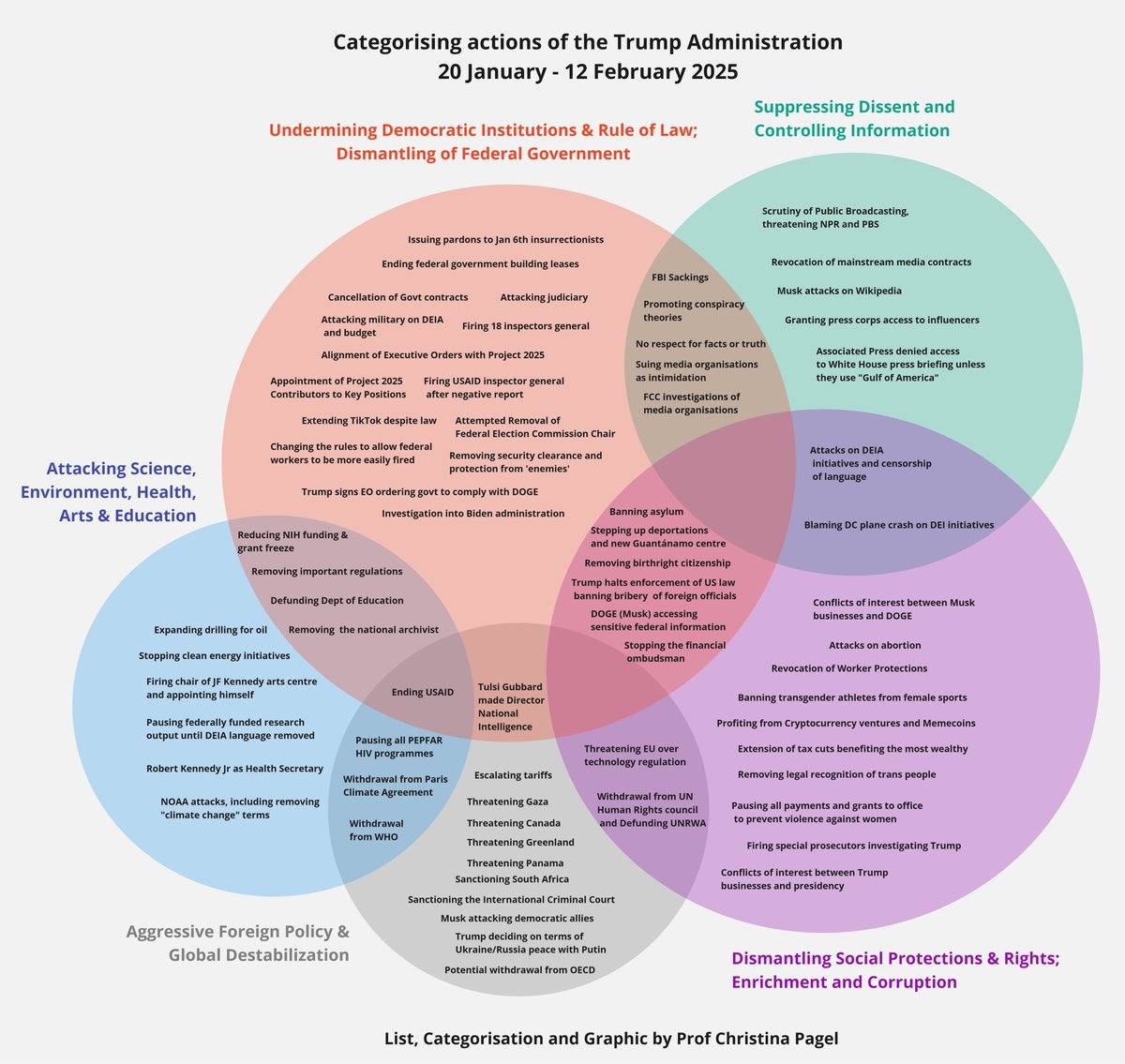
Professor Christina Pagel of University College London has mapped the actions of the Trump administration’s first few weeks into a Venn diagram (above) with “five broad domains that correspond to features of proto-authoritarian states”:
- Undermining Democratic Institutions & Rule of Law; Dismantling federal government
- Dismantling Social Protections & Rights; Enrichment & Corruption
- Suppressing Dissent & Controlling Information
- Attacking Science, Environment, Health, Arts & Education
- Aggressive Foreign Policy & Global Destabilization
This diagram is available as a PDF and the information is also contained in this categorized table. Links and commentary from Pagel can be found on Bluesky as well.
Also very helpful is this list of authoritarian actions that the Trump administration has taken, each with a link to the relevant news story. I will be referring back to this list often in the coming weeks.
Jessica Valenti on why there’s no room for compromise or middle ground on abortion rights.
Anyone still holding out hope for a ‘compromise’ on abortion rights needs to give it up. Right now.
Over the past few days, a Louisiana mother was arrested for getting abortion pills for her teenager, abortion reports became public records in Indiana, and Arkansas advanced a bill mandating an anti-abortion propaganda video be shown in public school classrooms.
Also in the last week, the new Trump administration erased information on reproductive health and privacy rights from government websites, Missouri Republicans moved to overturn a pro-choice amendment that voters approved in November, Idaho legislators proposed a bill that could punish abortion patients with the death penalty, and South Carolina lawmakers pushed legislation that wouldn’t just ban pro-choice websites—it would make it a felony to even talk about abortion with a pregnant person.
In the short amount of time Donald Trump has been in office, anti-abortion extremists have been told they can attack clinics without fear of arrest, and the Republican party who once claimed they’d never punish women for abortion now say bills to prosecute patients as murderers “inspire healthy dialogue.”
Do these sound like people interested in ‘compromise’? We’re watching conservatives dismantle democracy and force women back into the home — killing quite a few of us along the way. In what universe is the appropriate response finding common ground?
You don’t ask the guy with the boot on your neck to wear a softer shoe. You rip his fucking foot off.
This is a paywalled article but it includes the entire text — “It’s past time to act like it.” is the last line of the piece.
See also Rebecca Solnit: On Not Meeting Nazis Halfway and A.R. Moxon’s essay that reminds us the center between fascism and democracy is fascism. (thx, meg)
Jamelle Bouie has started posting video essays on his YouTube channel about the current US political crisis. His latest one is an adaptation of his NY Times piece, There Is No Going Back.
Now, even if Musk had been elected to office, this would still be one of the worst abuses of power in American history. That is unquestionable. No one in the executive branch has the legal authority to unilaterally cancel congressional appropriations. No one has the legal authority to turn the Treasury payment system into a means of political retribution. No one has the authority to summarily dismiss civil servants without cause. No one has the authority to take down and scrub Americans’ data unilaterally. And no private citizen has the authority to access some of the most sensitive data the government collects on private citizens for their own unknown and probably nefarious purposes.
Bouie has also regularly been posting videos to his Instagram (bio: “National program director of the CHUM Group”) and TikTok.
Speaking of Timothy Snyder, Literary Hub published the first chapter (the one on not obeying in advance) of his 2017 book On Tyranny. It begins:
Do not obey in advance.
Most of the power of authoritarianism is freely given. In times like these, individuals think ahead about what a more repressive government will want, and then offer themselves without being asked. A citizen who adapts in this way is teaching power what it can do.
Anticipatory obedience is a political tragedy. Perhaps rulers did not initially know that citizens were willing to compromise this value or that principle. Perhaps a new regime did not at first have the direct means of influencing citizens one way or another. After the German elections of 1932, which permitted Adolf Hitler to form a government, or the Czechoslovak elections of 1946, where communists were victorious, the next crucial step was anticipatory obedience. Because enough people in both cases voluntarily extended their services to the new leaders, Nazis and communists alike realized that they could move quickly toward a full regime change. The first heedless acts of conformity could not then be reversed.
It’s also worth reading the original list posted by Snyder in November 2016 that became the basis of On Tyranny: Fighting Authoritarianism: 20 Lessons from the 20th Century.
10. Practice corporeal politics. Power wants your body softening in your chair and your emotions dissipating on the screen. Get outside. Put your body in unfamiliar places with unfamiliar people. Make new friends and march with them.
11. Make eye contact and small talk. This is not just polite. It is a way to stay in touch with your surroundings, break down unnecessary social barriers, and come to understand whom you should and should not trust. If we enter a culture of denunciation, you will want to know the psychological landscape of your daily life.
12. Take responsibility for the face of the world. Notice the swastikas and the other signs of hate. Do not look away and do not get used to them. Remove them yourself and set an example for others to do so.
13. Hinder the one-party state. The parties that took over states were once something else. They exploited a historical moment to make political life impossible for their rivals. Vote in local and state elections while you can.
Newer posts
Older posts





Socials & More