kottke.org posts about politics
As Britain lumbers towards Brexit, other parts of Europe seem to be weighing, electorally and otherwise, if the European Union is something worth keeping or whether it belongs on the trash heap of history next to The League of Nations and the Roman Empire. In this video, Kurzgesagt takes a look at some of the benefits and criticisms of the EU and considers whether the former outweigh the latter.
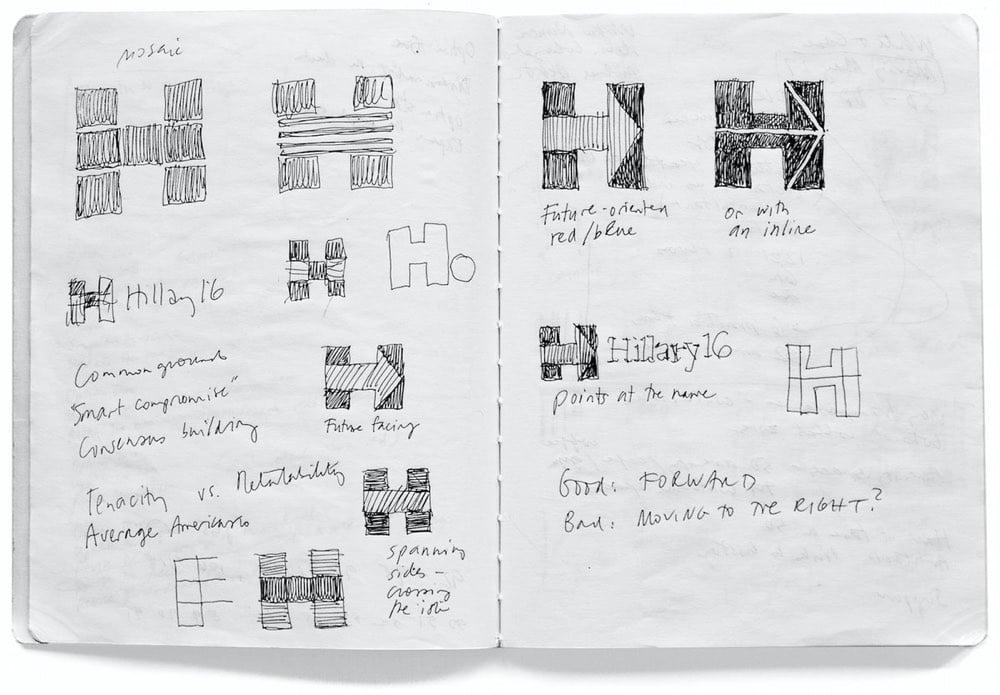
Pentagram’s Michael Bierut and his team designed the identity for Hillary Clinton’s 2016 Presidential campaign (of which I was not initially a fan but came around later). Here’s how it happened.
I put together a three-person team: me, designer Jesse Reed, and project manager Julia Lemle. We would work in secret for the next two months. Our first meeting with the Clinton team began with a simple statement: “Our candidate has 100 percent name recognition.” There is a well-known marketing principle that is often credited to midcentury design legend Raymond Loewy. He felt that people were governed by two competing impulses: an attraction to the excitement of new things and a yearning for the comfort provided by what we already know. In response, Loewy had developed a reliable formula. If something was familiar, make it surprising. If something was surprising, make it familiar.
That same principle applies to political campaigns. In 2008 Sol Sender, Amanda Gentry and Andy Keene were faced with the challenge of branding a candidate who had anything but name recognition. Barack Obama’s design team responded with a quintessentially professional identity program, introducing — for the first time — the language of corporate branding to political marketing. Obama’s persona — unfamiliar, untested, and potentially alarming to much of the voting public — was given a polished logo and a perfectly executed, utterly consistent typographic system. In short, they made a surprising candidate seem familiar.
We faced the opposite problem. Our candidate was universally known. How could we make her image seem fresh and compelling?
This is a great look at how a designer at the top of his game approaches a problem…and reckons with failure. Even this little bit:
It wasn’t clever or artful. I didn’t care about that. I wanted something that you didn’t need a software tutorial to create, something as simple as a peace sign or a smiley face. I wanted a logo that a five-year-old could make with construction paper and kindergarten scissors.
Leading up to the election, how many photos did you see of Hillary logos hand-drawn by kids on signs and t-shirts? Lots and lots…my kids even got into the act.
Anyway, a huge contrast to the process and impact of the Trump campaign’s identity.
This video from Vox explains how Vladimir Putin took advantage of the post-Soviet political and economic chaos in Russia to become its leader in a very short period of time and what’s he done with that leadership since then.
Vladimir Putin has been ruling Russia since 1999. In that time he has shaped the country into an authoritarian and militaristic society. The Soviet Union dissolved into 15 new countries, including the new Russian Federation. In Putin’s eyes, Russia had just lost 2 million square miles of territory. But Putin’s regime has also developed and fostered the most effect cyber hacker army in the world and he’s used it to wreak havoc in the West. But the election of Donald Trump brings new hope for the Putin vision. Trump’s rhetoric has been notably soft on Russia. He could lift sanctions and weaken NATO, potentially freeing up space for Putin’s Russia to become a dominant power once again.
Watching this, it’s easy to see how Putin’s progress in Making Russia Great Again, not to mention the authoritarian methods he employs, would be appealing to Trump.
See also Here are 10 critics of Vladimir Putin who died violently or in suspicious ways.
In 1993, Robert Putnam, who later went on to write Bowling Alone (which inspired Meetup), wrote a piece for The American Prospect called The Prosperous Community: Social Capital and Public Life about social capital and its contribution to political and economic well-being of a society. Much has changed since then, but Putnam’s piece is solidly relevant to the political situation in America today.
How does social capital undergird good government and economic progress? First, networks of civic engagement foster sturdy norms of generalized reciprocity: I’ll do this for you now, in the expectation that down the road you or someone else will return the favor. “Social capital is akin to what Tom Wolfe called the ‘favor bank’ in his novel, The Bonfire of the Vanities,” notes economist Robert Frank. A society that relies on generalized reciprocity is more efficient than a distrustful society, for the same reason that money is more efficient than barter. Trust lubricates social life.
Networks of civic engagement also facilitate coordination and communication and amplify information about the trustworthiness of other individuals. Students of prisoners’ dilemmas and related games report that cooperation is most easily sustained through repeat play. When economic and political dealing is embedded in dense networks of social interaction, incentives for opportunism and malfeasance are reduced. This is why the diamond trade, with its extreme possibilities for fraud, is concentrated within close-knit ethnic enclaves. Dense social ties facilitate gossip and other valuable ways of cultivating reputation—an essential foundation for trust in a complex society.
This quote by 18th-century Scottish philosopher David Hume that leads off the piece succinctly sums up the challenges involved and the potential consequences in not addressing them properly:
Your corn is ripe today; mine will be so tomorrow. ‘Tis profitable for us both, that I should labour with you today, and that you should aid me tomorrow. I have no kindness for you, and know you have as little for me. I will not, therefore, take any pains upon your account; and should I labour with you upon my own account, in expectation of a return, I know I should be disappointed, and that I should in vain depend upon your gratitude. Here then I leave you to labour alone; You treat me in the same manner. The seasons change; and both of us lose our harvests for want of mutual confidence and security.
(via @timoreilly)
Adam Gopnik writes about three books — Age of Anger by Pankaj Mishra, A Culture of Growth by Joel Mokyr, and Homo Deus by Yuval Noah Harari — that address the tension between liberalism and conservatism, going back to Voltaire v. Rousseau during the Enlightenment (and even further back, to Plato).
For Mishra, elements in modernity that seem violently opposed, Zionism and Islamism, Hindu nationalism and Theosophical soppiness — not to mention Nazi militarism — share a common wellspring. Their apostles all believe in some kind of blood consciousness, some kind of shared pre-rational identity, and appeal to a population enraged at being reduced to the hamster wheel of meaningless work and material reward. Mishra brings this Walpurgisnacht of romanticized violence to a nihilistic climax with the happy meeting in a Supermax prison of Timothy McVeigh, perpetrator of the Oklahoma City bombing, and Ramzi Yousef, perpetrator of the World Trade Center bombing: the fanatic, child-murdering right-wing atheist finds “lots in common” with the equally murderous Islamic militant — one of those healing conversations we’re always being urged to pursue. (“I never have [known] anyone in my life who has so similar a personality to my own as his,” Yousef gushed of McVeigh.)
Very interesting context and a stimulating argument for the middle way by Gopnik — in his estimation, Betteridge’s law applies to the title. He didn’t care much for Homo Deus, and I have to admit, as a big fan of Sapiens, that I’ve run out of steam with this new one and found myself nodding my head at Gopnik’s objections. I’m gonna get back to it, I’m sure, but with less enthusiasm than before.
In college, Gregory Watson got a C on a paper in a government class about an ancient proposed amendment to the US Constitution written by James Madison in 1789.
Gregory was intrigued. He decided to write his paper about the amendment and argue that it was still alive and could be ratified. He got to work, being very meticulous about citations and fonts and everything. He turned it in to the teaching assistant for his class — and got it back with a C.
Motivated by what he considered an unfair grade, Watson spent the next 20 years working to get the amendment ratified. In 1992, Watson’s hard work paid off and the proposed amendment became the 27th Amendment to the US Constitution.
No law, varying the compensation for the services of the Senators and Representatives, shall take effect, until an election of representatives shall have intervened.
Now his former teacher thinks he deserves an A+. What a heartwarming story.
Or perhaps a terrifying one. If you look at the maps for the past 5 Presidential elections, you’ll notice that the red states outnumber the blue ones. Republicans dominate governorships and state legislatures too. The consolidation of liberal voters into fewer and fewer states (and cities) is likely to continue, making the state counts more lopsided. If you can get a proposed amendment out of Congress (or a national convention called for by 2/3 of the states), then 3/4 of the states (currently 38) are needed to ratify the amendment and make it the law of the land. Now, this doesn’t seem very likely, does it? Well, Gregory Watson got it done. Just imagine if he had resuscitated a half-ratified amendment outlawing immigration or something.
The #1 bestselling book on Amazon right now is called Reasons To Vote For Democrats: A Comprehensive Guide. It’s by Michael Knowles, costs $8.03, and is filled with 266 blank pages. I have to admit, that’s pretty damn funny.
The most exhaustively researched and coherently argued Democrat Party apologia to date, “Reasons To Vote For Democrats: A Comprehensive Guide” is a political treatise sure to stand the test of time. A must-have addition to any political observer’s coffee table.
The follow-on joke is never as funny as the original, but you can also buy a blank book called Reasons to Vote for Republicans. (via buzzfeed)
Update: We’ve got some prior art, folks. David King published a blank book called Why Trump Deserves Trust, Respect & Admiration back in November 2016 (there’s a Kindle version, LOL). And this copy of All I Know About the Ladies by R.V. Harris looks significantly older than that. (via @alexhern & @typeter)
Update: One more round of prior art: The Wit and Wisdom of Spiro T. Agnew and Everything Men Know About Women. (via @MattyPKing & @EdwardGoodmann)
Maria Guadalupe, an economics and political science professor, and Joe Salvatore, a professor of educational theater, recently put on a pair of performances that restaged the three Presidential debates between Donald Trump and Hillary Clinton. But this time, they had a woman play the Trump role (as “Brenda King”) and a man play the Clinton role (as “Jonathan Gordon”), with each attempting to portray the precise mannerisms, styles, and speech of the respective candidates. How would audiences react to the gender-switched candidates?
Salvatore says he and Guadalupe began the project assuming that the gender inversion would confirm what they’d each suspected watching the real-life debates: that Trump’s aggression — his tendency to interrupt and attack — would never be tolerated in a woman, and that Clinton’s competence and preparedness would seem even more convincing coming from a man.
But the lessons about gender that emerged in rehearsal turned out to be much less tidy. What was Jonathan Gordon smiling about all the time? And didn’t he seem a little stiff, tethered to rehearsed statements at the podium, while Brenda King, plainspoken and confident, freely roamed the stage? Which one would audiences find more likeable?
The audience’s reaction to the performances was surprising.
We heard a lot of “now I understand how this happened” — meaning how Trump won the election. People got upset. There was a guy two rows in front of me who was literally holding his head in his hands, and the person with him was rubbing his back. The simplicity of Trump’s message became easier for people to hear when it was coming from a woman — that was a theme. One person said, “I’m just so struck by how precise Trump’s technique is.” Another — a musical theater composer, actually — said that Trump created “hummable lyrics,” while Clinton talked a lot, and everything she was was true and factual, but there was no “hook” to it. Another theme was about not liking either candidate — you know, “I wouldn’t vote for either one.”
Here’s a clip from one of the rehearsals:
I think it’s important not to take away too much from this experiment (and perhaps the same should be said of televised political debates in general) but after watching that short clip and hearing about the audience’s reaction, I couldn’t help but think of Al Gore. In the lead-up to the election, I’d never thought of Clinton that way — meaning very smart, compassionate, and supremely qualified but ultimately a bit dull and uninspiring a la Gore — but maybe she did lack a critical charisma compared to Trump.
Since the Kennedy/Nixon debates, we’ve known that how candidates handle themselves on television — in debates, interviews, televised speeches, etc. — is critical to the voters’ perceptions of them. Gore, Jimmy Carter, Michael Dukakis, Mitt Romney, Bob Dole, Walter Mondale, John Kerry…they all were bested by more charismatic candidates (Reagan, Obama, Bill Clinton) that were in some cases not as qualified on paper. Even the Bushes (especially Dubya) had an aw shucks-y folksiness that could charm people sympathetic to their message. Perhaps Hillary Clinton belongs on that list as well. (via mr)

After leaving office in 2009, George W. Bush famously turned his attention to painting. That pursuit has now resulted in a book of portraits of post-9/11 US veterans painted by Bush called Portraits of Courage: A Commander in Chief’s Tribute to America’s Warriors.
Growing out of President Bush’s own outreach and the ongoing work of the George W. Bush Institute’s Military Service Initiative, Portraits of Courage brings together sixty-six full-color portraits and a four-panel mural painted by President Bush of members of the United States military who have served our nation with honor since 9/11 — and whom he has come to know personally.
The author proceeds from the book will be donated to the George W. Bush Presidential Center, “a non-profit organization whose Military Service Initiative works to ensure that post-9/11 veterans and their families make successful transitions to civilian life with a focus on gaining meaningful employment and overcoming the invisible wounds of war”. There’s a certain — I don’t know, let’s call it irony — in Bush honoring those whom he personally caused to be put in the harm’s way in the first place, under false pretenses no less.
Ezra Edelman’s fantastic documentary OJ: Made in America won the Oscar for best documentary this year. In a video for Fandor, Joel Bocko explains while the film’s focus is on Simpson, it also explores seven broader themes about contemporary America: sports, the media, Los Angeles, class, domestic abuse, policing, and race.
OJ: Made in America emerges not simply as a brilliant biography, it’s also a stunning social portrait that can stand beside any novel, epic film, or piece of longform journalism.
And in this video for The Atlantic, Edelman explains how, before murdering his ex-wife, Simpson was an advertising pioneer, the first black athlete to become a nationally known product pitchman, appearing in commercials for Hertz, Chevy, and Schick.
One of the most interesting aspects of Edelman’s film is how Simpson’s feelings about being black shifted after his arrest. For most of his life, he distanced himself from the black community, famously declaring “I’m not black, I’m OJ.” He didn’t get involved in the politics of the day or speak out like Muhammed Ali and other prominent black athletes did. He enjoyed preferential treatment by the LAPD, who help him keep his abuse of women under wraps. Black America had nothing to offer a man who enjoyed being rich and famous in white America. But then the trial happened and he hired Johnny Cochran, who made race into the central issue of the case, deftly aligning Simpson with a black community who had endured decades of racism and brutality in LA at the hands of society and the police.
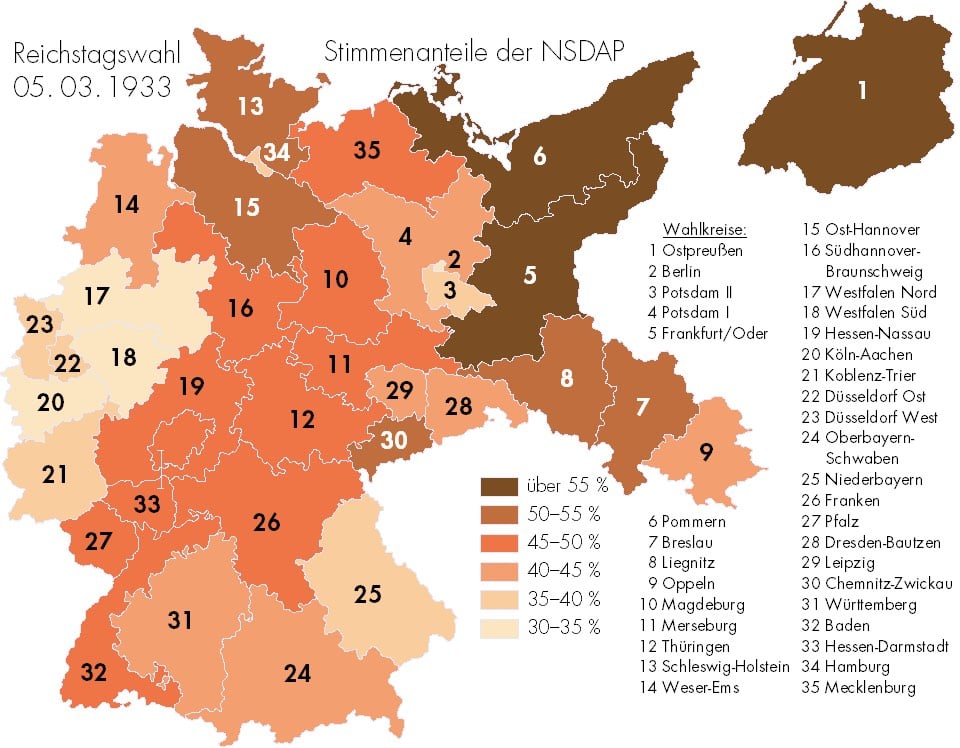
In March 1933, a unified Germany held its last relatively free election before WWII. Hitler had already become Chancellor but he held one last election, seeking a mandate under which to rule. This map shows which areas of Germany supported the Nazi Party most strongly.
However, it’s also important to note that while the Nazis won the most seats in 1933, they did not win a majority of them or the popular vote.
Support varied widely across the country. It was highest in the former Prussian territories in the north-east of Germany (with the exception of Berlin) and much weaker in the west and south of the country, which had, up until 1871, been independent German states.
Across Germany as a whole, the Nazis won 43.91% of the popular vote and got 44.51% of the seats. This made them by far the largest party in the German Reichstag, but still without a clear majority mandate.
I know history doesn’t repeat itself, but this sure is rhyming like Kanye.
Jason Ditzian writes about how the Nazis used new technological advances — high-fidelity microphones, public address systems, magnetic tape recording — to rise to power.
And since this amplification invention was new, the novelty added to the mesmerizing effects of a little man shouting atop the biggest soapbox that had ever existed. The quality of sound had a mystical effect upon listeners. It imbued Hitler with godlike powers, making him a deity who could project himself everywhere at once, whether one was standing amid a vast audience or sitting in one’s living room listening to the radio. Sometimes the voice was live; sometimes the voice was recorded in life-like clarity by another cutting-edge German innovation — a reel of magnetic tape.
He compares it to Donald Trump’s use of Twitter, which allows him to instantly soapbox to his millions of followers at all hours of the day and night — “a deity who could project himself everywhere at once” indeed.
With Twitter, every moment is a Trump rally. Everyone in the connected world knows what this unhinged narcissistic compulsive liar is thinking at any given moment. More time, energy, thought and commentary have been given to his minute-by-minute inane bullshit than any other issue of the last two years. And a lot of important things happened in the last two years.
Among the requirements that all immigrants must meet to become a naturalized US citizen is a civics test covering US history and government. The test contains 100 questions, 10 of which are verbally posed by a Citizenship and Immigration Services officer…no multiple choice. Applicants must answer 6 out of 10 correctly to pass. The questions include:
What is the supreme law of the land?
What is freedom of religion?
What stops one branch of government from becoming too powerful?
The House of Representatives has how many voting members?
What is the name of the President of the United States now?
Under our Constitution, some powers belong to the states. What is one power of the states?
What are two ways that Americans can participate in their democracy?
The Federalist Papers supported the passage of the U.S. Constitution. Name one of the writers.
When must all men register for the Selective Service?
Name one war fought by the United States in the 1800s.
What was one important thing that Abraham Lincoln did?
Why does the flag have 13 stripes?
Before he was President, Eisenhower was a general. What war was he in?
Name one of the two longest rivers in the United States.
Name two national U.S. holidays.
You can take a 20-question multiple choice test on the USCIS website or if you want to see how many you can answer out of 100 with no multiple choice, I knocked up a Google Sheets version here — access is read-only but you can make a copy and take the test by choosing File / Make a copy… from the menu. Here’s a full list of the questions and suggested answers to check your work. Without studying, some of the questions are more difficult than you’d think, particularly if your last political science and American history classes were 25 years ago in high school.
And like all tests, this one is imperfect.1 In 2001, Dafna Linzer wrote about her test-taking experience.
Then there is Question 12: What is the “rule of law”?
I showed it to lawyers and law professors. They were stumped.
There are four acceptable answers: “Everyone must follow the law”; “Leaders must obey the law”; “Government must obey the law”; “No one is above the law.”
Judge Richard Posner, the constitutional scholar who serves on the U.S. Court of Appeals in Chicago, was unhappy. “These are all incorrect,” he wrote me. “The rule of law means that judges decide cases ‘without respect of persons,’ that is, without considering the social status, attractiveness, etc. of the parties or their lawyers.”
The Simpsons lampooned this aspect of the test in 1996 when Apu answered a question about the Civil War2 during his civics test.
Examiner: “Alright, here’s your last question: What was the cause of the Civil War?”
Apu: “Actually there were numerous causes. Aside from the obvious schism between the abolitionists and the anti-abolitionists, economic factors both domestic and international…”
Examiner: “Hey, hey…”
Apu: “Yep?”
Examiner: “Just… just say ‘slavery’”.
Apu: “Slavery it is, sir.”
This would never happen in a million years, but I would love for someone to sit down with Donald Trump to see how many of these he could answer. Like I said, if you haven’t studied, some of the questions are not that easy. But surely the President of the United States should be able to get almost all of them correct…

Not wanting to listen to the news on inauguration day, artist Kara Walker painted. The result is a Trumpian take on Emanuel Leutze’s famous work “Washington Crossing the Delaware”, a copy of which is on display at the Met Museum. I hope I get to see Walker’s version in a museum or gallery someday soon.
Voracious reader Tyler Cowen has been reading about fascism recently and shares his thoughts on some specific books. It seems as though A History of Fascism, 1914-1945 and The Anatomy of Fascism are the two to start with.
Stanley G. Payne, A History of Fascism 1914-1945. One of the classics, readable and comprehensive and one of the best places to start. One thing I learned from this pile of books is how hard some of those leaders worked to have the mid-level bureaucracy on their side. The centralization often occurred at higher levels, for instance Mussolini had 72 cabinet meetings in 1933, but only 4 in 1936. The Italian Fascist party, by the way, was disproportionately Jewish, at least pre-1938.
Cowen’s conclusion after his reading? The US is not headed toward fascism:
Overall I did not conclude that we Americans are careening toward fascist outcomes. I do not think that notion is well-suited to the great complexity of contemporary bureaucracy, nor to our more feminized and also older societies. Furthermore, in America democracy has taken much deeper roots and the system of checks and balances, whatever its flaws, has stood for a few hundred years, contra either Italy or Germany in their fascist phases.
Looking over Umberto Eco’s 14 Features of Eternal Fascism, I might disagree with that. So far, the Trump administration has been working quickly to consolidate its power and the Republican-majority Congress has shown little interest in stopping them — e.g. the so-called confirmation hearings are little more than formalities when Republicans are voting as a bloc in most cases. The judicial branch has been more attentive thus far in making sure the Republicans are operating within the law (e.g. the rulings against Trump’s travel ban and the NC governor’s limitation of powers), providing the essential “checks and balances” Cowen speaks of. But the law…well, let’s just say that plenty of bad and immoral things are legal, particularly when powerful people and the governmental bodies responsible for making laws are concerned, and much depends on the intelligence and resourcefulness of the lawyers and political viewpoints of the judges involved. All it would take is a little more thoughtfulness1 on the part of Trump’s team in writing his executive orders and they can probably get much of what they want legally.
Anyway, on a broader authoritarian note, Brendan Nyham of Dartmouth College has compiled a reading list for understanding the authoritarian turn in US politics.
Newer posts
Older posts





Socials & More