kottke.org posts about politics
As part of a longer post on the role of capitalism in bringing about gay rights in America, staunch libertarian and Cato Institute executive VP David Boaz writes:
All the advances in human rights that we’ve seen in American history — abolitionism, feminism, civil rights, gay rights — stem from our founding ideas of life, liberty, and the pursuit of happiness. The emphasis on the individual mind in the Enlightenment, the individualist nature of market capitalism, and the demand for individual rights that inspired the American Revolution naturally led people to think more carefully about the nature of the individual and gradually to recognize that the dignity of individual rights should be extended to all people.
This passage has been bugging me ever since I saw a link to it on Marginal Revolution in a post titled “Independence Day”. There’s this undercurrent in libertarian writing that suggests that if we just let capitalism rip, unfettered, unregulated, everyone will be automagically free. Independence Day, amirite?!
What’s interesting is that the way all of those freedoms Boaz talks about — abolitionism, feminism, civil rights, gay rights — were attained is through collective action that resulted in government protection. Capitalism is not Miracle Grow for individual rights. People organized and fought for their freedoms. Economic activity is taxed in order to protect our freedoms. Unchecked capitalism led to slavery, child labor, unfair labor practices, monopoly, and the ruin of the environment. Gosh, it’s almost like a system of capitalism combined with liberal democracy would be a fairly good way to both gain and protect individual freedoms. Yes, harness the incredibly useful engine of capitalism but make sure it doesn’t grind humanity up in the process.
At the recent Aspen Ideas Festival, legal scholar and former Obama advisor Cass Sunstein shared some views on his understanding of and some misconceptions about impeachment, namely that it doesn’t need to involve an actual crime and “is primarily about gross neglect or abuse of power”. Or as he put it more formally in a 1998 essay in the University of Pennsylvania Law Review:
The simplest is that, with respect to the President, the principal goal of the Impeachment Clause is to allow impeachment for a narrow category of egregious or large-scale abuses of authority that comes from the exercise of distinctly presidential powers. On this view, a criminal violation is neither a necessary nor a sufficient condition for impeaching the President. What is generally necessary is an egregious abuse of power that the President has by virtue of being President. Outside of this category of cases, impeachment is generally foreign to our traditions and is prohibited by the Constitution.
The “distinctly presidential powers” bit is a high bar to clear. Examining the case for Nixon on that basis, and only some of the reasons for wanting to impeach him hold up.
Richard Nixon nearly faced four counts. One failed count, for tax evasion, was completely inappropriate, Sunstein argued: Though an obvious violation of law, it had no bearing on Nixon’s conduct of the presidency. A second charge, for resisting subpoena, is possibly but not necessarily valid, since a president could have good reasons to resisting a subpoena. A third is more debatable: Nixon was charged with covering up the Watergate break-in. Nixon might have been more fairly prosecuted for overseeing the burglary, Sunstein argued, but nabbing him for trying to use the federal government to commit the cover-up was “probably good enough.” Only the fourth charge, of using the federal government’s muscle to prosecute political enemies, is a clear slam-dunk under the Founders’ principles.
Clinton’s impeachment, argued Sunstein in that same Penn Law Review essay, was less well-supported:
I suggest that the impeachment of President Clinton was unconstitutional, because the two articles of impeachment identified no legitimate ground for impeaching the President.
Sunstein explained the intent of the members of the Constitutional Convention in a Bloomberg article back in February. It’s interesting in the light of the Russian collusion investigation that the debate about impeachment at the convention centered around treason.
James Madison concurred, pointing to cases in which a president “might betray his trust to foreign powers.” Gouverneur Morris added that the president “may be bribed by a greater interest to betray his trust; and no one would say that we ought to expose ourselves to the danger of seeing the first Magistrate in foreign pay without being able to guard against it by displacing him.”
So what about Trump? Sunstein doesn’t offer much (no apparent mention of collusion with Russia):
Sunstein, having scolded legal colleagues for playing pundit, was reluctant to address the question directly. Setting aside the impossibility of impeaching Trump under the present circumstances of GOP control of Congress, Sunstein said he was wary of trying to remove the president simply for being bad at his job. Nonetheless, he said Trump’s prolific dishonesty might form a basis for trying to remove him.
“If a president lies on some occasions or is fairly accused of lying, it’s not impeachable — but if you have a systematic liar who is lying all the time, then we’re in the ballpark of misdemeanor, meaning bad action,” he said.
If I were a betting person, I would wager that Donald Trump has a better chance of getting reelected in 2020 than he does of being impeached (and a much better chance than actually being removed from office through impeachment) if the Republicans retain their majority in Congress. Although their healthcare bill has hit a hiccup due to public outcry (and it’s only a hiccup…it will almost surely pass), Congressional Republicans have shown absolutely no willingness to do anything not in the interest of their agenda…so why would they impeach a Republican President who is ticking all of the far right’s action items thus far?
Produced by Square, Made In Iowa tells the story of what happened after the Electrolux plant closed in the small town of Webster City, Iowa in 2011. The company had decided to move those jobs to Mexico and in the years after the closing, the unemployment rate in the town rose from about 3% to 10%. The video shows how the town rallied around the reopening of the movie theater and pursued an entrepreneurial strategy of revitalizing downtown through opening a number of small businesses. That approach brought the town’s unemployment rate back up to 3%.
But that’s not the entire story. The new jobs are mostly non-union and pay less than Electrolux jobs did. The town’s pivot was not entirely a bootstrap effort…the former workers had the government’s assistance and the advantage of their union’s negotiation of benefits. From a 2013 NPR story about the plant closure:
On March 31, 2011, Electrolux shut its washer-dryer plant in Webster City and sent the jobs to Juarez, Mexico. The employees were warned more than a year in advance of the closure, and many used the time to pay off debt and begin thinking about a new career.
Because their jobs had left the country, the laid-off workers qualified for federally funded retraining. A large number enrolled in two-year programs at community colleges and have been living off unemployment benefits as they learn new skills.
And those new businesses downtown are possible in part because people have access to healthcare through the ACA.
It seems relevant at this point to mention that in the 2016 election, the county in which Webster City is situated went for Trump 58.6% (to Clinton’s 35.8%). I mean, bootstrap all you want, but just don’t forget the massive governmental safety net that makes it possible for communities to recover when shit like this goes down and which party wants to dismantle it.
According to a recently conducted survey by the Pew Research Center, the election of Donald Trump has sharply eroded the confidence of other world nations in the United States and its ability to “do the right thing when it comes to international affairs”.
Confidence in President Trump is influenced by reactions to both his policies and his character. With regard to the former, some of his signature policy initiatives are widely opposed around the globe.
His plan to build a wall along the U.S.-Mexico border, for example, is opposed by a median of 76% across the 37 countries surveyed. Opposition is especially intense in Mexico, where more than nine-in-ten (94%) oppose the U.S. government erecting a wall.
Similar levels of global opposition greet Trump’s policy stances on withdrawing from international trade agreements and climate change accords. And most across the nations surveyed also disapprove of the new administration’s efforts to restrict entry into the U.S. by people from certain Muslim-majority nations.
Trump’s intention to back away from the nuclear weapons agreement with Iran meets less opposition than his other policy initiatives, but even here publics around the world disapprove of such an action by a wide margin.
Trump’s character is also a factor in how he is viewed abroad. In the eyes of most people surveyed around the world, the White House’s new occupant is arrogant, intolerant and even dangerous. Among the positive characteristics tested, his highest rating is for being a strong leader. Fewer believe he is charismatic, well-qualified or cares about ordinary people.
This chart is pretty remarkable:
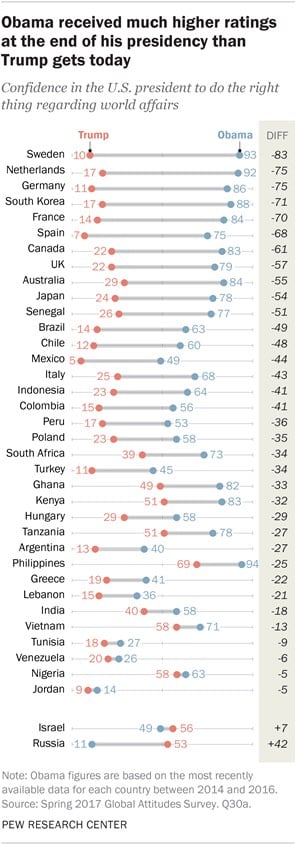
It took George W. Bush more than half of his presidency to reach confidence rates as low as Trump has right out of the gate. Usually in these situations you say something like “there’s nowhere to go but up” but unfortunately there’s plenty of room at the bottom here.
The scuttlebutt around the tech/media internet water cooler over the past few months is that Facebook CEO Mark Zuckerberg is going to run for President in 2020. This feeling has been fueled by Zuck’s goal for this year of visiting the remaining 30 or so US states that he has yet to visit and the way in which he’s been documenting his trips. Nathan Hubbard argues that Zuck actually has other things on his mind as he tours America:
Zuck isn’t running for President. He’s trying to understand the role the product he created played in getting this one elected.
Facebook has undergone two major evolutionary events in its history, both of which were driven by what Zuck saw as existential threats.
The incredible revenue growth in mobile (probably the greatest biz execution of our generation) helped Facebook survive a platform shift.
And the fearless acquisitive streak of Instagram, WhatsApp and others helped Facebook survive a shift in how we communicate and organize.
Zuck woke up on Nov 9th acutely aware that FB had facilitated a new shift he didn’t foresee or understand; that’s terrifying to a founder.
He’s the head of product. So he’s ventured out into the world beyond his bubble to do field research and inform how FB will evolve again.
I am also sympathetic to the argument that Zuckerberg doesn’t need to run for President because he’s already the leader of the largest group of people ever assembled in the history of humanity (aside from possibly the British Empire). Facebook doesn’t possess many necessary qualities of a sovereign country, but it also has many advantages that countries don’t. Zuckerberg is already among the world’s most important people and with Facebook still growing, he could one day soon be the most powerful person in the world.
Yesterday, Grover Norquist shared a short parable about taxes on Twitter:
How Republicans are born…
Daughter, 8, has been savings up to buy her first Guitar.
Found it for $35. She had 35 exact.
Then…sales tax
Norquist has famously been on a quest to stop tax increases in the US…in 2015 he wrote a book called End the IRS Before It Ends Us.1 Many people took Norquist to task over his remarks:
Did you mention that you drove her to the guitar store on roads that were partly funded by sales taxes?
In a car which only has seat belts preventing you from being badly injured in the event of a crash due to taxpayer funded regulations?
or those same taxes that pay for emergency services that will respond if you do get in an accident?
These responses remind me of a pair of posts written several years ago about the contributions to society of both taxpayer-funded and corporate goods & services. From the liberal version:
After spending another day not being maimed or killed at work thanks to the workplace regulations imposed by the department of labor and the occupational safety and health administration, enjoying another two meals which again do not kill me because of the USDA, I drive my NHTSA car back home on the DOT roads, to my house which has not burned down in my absence because of the state and local building codes and fire marshal’s inspection, and which has not been plundered of all its valuables thanks to the local police department.
And from the conservative viewpoint:
When my Motorola-manufactured Cable Set Top Box showed the appropriate time, I got into my Toyota-manufactured Prius vehicle and set out to my graphic design workplace and stopped to purchase some gasoline refined by the Royal Dutch Shell company, using my debit card issued to me by Bank of the West. On the way to my workplace, I dropped off a package at the local UPS store for delivery, and dropped my children off at a local private school.
Except for the top three, I’m not sure I could have come up with most of the top 10 largest US cities by population. I’ll give you minute to guess…
…
…
1. NYC
2. LA
3. Chicago
4. Houston
5. Phoenix
6. Philadelphia
7. San Antonio
8. San Diego
9. Dallas
10. San Jose
I dunno, San Antonio at #7 really threw me for a loop. Bigger than Dallas? Bigger than San Francisco (by more than 600,000 people)? Of course, when metropolitan areas are taken into account, the picture changes. The San Antonio area drops to #30 while the Bay Area hits #5.
When I was a kid, the list looked a little different…LA had not yet passed Chicago for #2 and Texas had only two cities in the top 10 (and no Austin creepin’ in 11th place):
1. New York
2. Chicago
3. Los Angeles
4. Philadelphia
5. Houston
6. Detroit
7. Dallas
8. San Diego
9. Phoenix
10. Baltimore
That list still carries more weight in my brain than the current ranking. The facts you learn in school influence how you view your country. And some of those facts, dubbed mesofacts by Sam Arbesman, change slowly, so slowly that you’re tricked into thinking they haven’t changed at all. The average age of the US Senate right now is 62. The version of the population list that many Senators learned in school was probably from the 1950 census (or perhaps the 1960 one) and our current President, at 70 years of age, was possibly taught the list from the 1940 census. The entries on those older lists look much more like the industrial America celebrated by truck and beer commercials and represented by classic baseball and football teams — the America that is to be made great again: Detroit, Cleveland, St. Louis, and Pittsburgh.
Another instructive list to look at in this regard is the list of cities that had populations of at least 100,000 people but have since dropped below that threshold. On the list (with the % drop in parentheses) are:
Canton, Ohio (-39%)
Gary, Indiana (-59%)
Scranton, Penn (-46%)
Flint, Michigan (-50%)
Erie, Penn (-29%)
Utica, NY (-40%)
That the idea embodied by those kinds of cities still holds much sway in American politics shouldn’t be so surprising.
That’s the title of a forthcoming book edited by Cass Sunstein (Harvard professor, former Obama regulatory administrator). On Twitter, Sunstein says he’s the editor not the author and that the essays will “offer diverse views”. But by the time this book comes out in March 2018, we might already know the actual answer to the title’s question. (via @tylercowen)
Last week, journalist Jules Suzdaltsev wrote:
Just wanna make sure you all know there is a Russian handbook from 1997 on “taking over the world” and Putin is literally crossing shit off.
The book in question is The Foundations of Geopolitics: The Geopolitical Future of Russia by neo-fascist political scientist Aleksandr Dugin, whose nickname is “Putin’s Brain”. The book has been influential within Russian military & foreign policy circles and it appears to be the playbook for recent Russian foreign policy. In the absence of an English language translation, some relevant snippets from the book’s Wikipedia page:
The book declares that “the battle for the world rule of [ethnic] Russians” has not ended and Russia remains “the staging area of a new anti-bourgeois, anti-American revolution.” The Eurasian Empire will be constructed “on the fundamental principle of the common enemy: the rejection of Atlanticism, strategic control of the USA, and the refusal to allow liberal values to dominate us.”
The United Kingdom should be cut off from Europe.
Ukraine should be annexed by Russia because “Ukraine as a state has no geopolitical meaning, no particular cultural import or universal significance, no geographic uniqueness, no ethnic exclusiveness, its certain territorial ambitions represents an enormous danger for all of Eurasia and, without resolving the Ukrainian problem, it is in general senseless to speak about continental politics”.
The book stresses the “continental Russian-Islamic alliance” which lies “at the foundation of anti-Atlanticist strategy”. The alliance is based on the “traditional character of Russian and Islamic civilization”.
Russia should use its special services within the borders of the United States to fuel instability and separatism, for instance, provoke “Afro-American racists”. Russia should “introduce geopolitical disorder into internal American activity, encouraging all kinds of separatism and ethnic, social and racial conflicts, actively supporting all dissident movements — extremist, racist, and sectarian groups, thus destabilizing internal political processes in the U.S. It would also make sense simultaneously to support isolationist tendencies in American politics.”
Ukraine, Brexit, Syria, Trump, promotion of fascist candidates in European elections (Le Pen in France), support for fascism in the US…it’s all right there in the book. And they’ve done it all while barely firing a shot.
In the wake of World War II, after the establishment of the United Nations, the international community drew up an international bill of rights that became known as The Universal Declaration of Human Rights (UDHR). The founding document of the UN, the United Nations Charter, contained language about universal human rights, but as the abuses of Nazi Germany became more apparent after the war, the UN felt that a stronger and more explicit declaration was necessary.
The UDHR, adopted by the UN in December 1948, contains 30 articles that cover issues like freedom, legal protections, employment, property rights, leisure, and health. Here are a few of them:
Article 2. Everyone is entitled to all the rights and freedoms set forth in this Declaration, without distinction of any kind, such as race, colour, sex, language, religion, political or other opinion, national or social origin, property, birth or other status. Furthermore, no distinction shall be made on the basis of the political, jurisdictional or international status of the country or territory to which a person belongs, whether it be independent, trust, non-self-governing or under any other limitation of sovereignty.
Article 7. All are equal before the law and are entitled without any discrimination to equal protection of the law. All are entitled to equal protection against any discrimination in violation of this Declaration and against any incitement to such discrimination.
Article 9. No one shall be subjected to arbitrary arrest, detention or exile.
Article 17. (1) Everyone has the right to own property alone as well as in association with others. (2) No one shall be arbitrarily deprived of his property.
Article 20. (1) Everyone has the right to freedom of peaceful assembly and association. (2) No one may be compelled to belong to an association.
Article 23. (1) Everyone has the right to work, to free choice of employment, to just and favourable conditions of work and to protection against unemployment. (2) Everyone, without any discrimination, has the right to equal pay for equal work. (3) Everyone who works has the right to just and favourable remuneration ensuring for himself and his family an existence worthy of human dignity, and supplemented, if necessary, by other means of social protection. (4) Everyone has the right to form and to join trade unions for the protection of his interests.
Article 24. Everyone has the right to rest and leisure, including reasonable limitation of working hours and periodic holidays with pay.
Article 25. (1) Everyone has the right to a standard of living adequate for the health and well-being of himself and of his family, including food, clothing, housing and medical care and necessary social services, and the right to security in the event of unemployment, sickness, disability, widowhood, old age or other lack of livelihood in circumstances beyond his control. (2) Motherhood and childhood are entitled to special care and assistance. All children, whether born in or out of wedlock, shall enjoy the same social protection.
Reading through them, it’s instructive to think about places in the world where these rights are not being upheld, either explicitly or implicitly, almost 70 years after the UDHR’s adoption. And lest you think I’m referring exclusively to places like Saudi Arabia, the Philippines, Syria, or Sudan, consider the treatment of Native Americans, women, people of color, the prison population, LGBT+ people, and the poor here in the United States, the treatment of people in other countries because of US military actions, and how the political goals of the Trump administration and the Republican majority in Congress would further erode those rights both in the US and around the world.
This is the most depressing video I have seen in a long time. The premise is devastating in its simplicity: a collection of clips of news programs and politicians (mostly Republicans) talking about climate change next to a pair of charts showing rising global temperatures and falling Arctic sea ice coverage.
I found it striking that before the 2008 election of Obama and (especially) the 2010 midterm election that resulted in a Republican majority in the House, Republican politicians spoke clearly and publicly that climate change was happening and that something needed to be done about it. And now? Republicans deny climate change is happening and Trump is on the verge of pulling the US out of the Paris Agreement.
Update: See also How G.O.P. Leaders Came to View Climate Change as Fake Science.
Those divisions did not happen by themselves. Republican lawmakers were moved along by a campaign carefully crafted by fossil fuel industry players, most notably Charles D. and David H. Koch, the Kansas-based billionaires who run a chain of refineries (which can process 600,000 barrels of crude oil per day) as well as a subsidiary that owns or operates 4,000 miles of pipelines that move crude oil.
Government rules intended to slow climate change are “making people’s lives worse rather than better,” Charles Koch explained in a rare interview last year with Fortune, arguing that despite the costs, these efforts would make “very little difference in the future on what the temperature or the weather will be.”
History, I hope, will not be kind to the Koch brothers. The ruin they have brought upon America for their own personal gain will be felt for decades.
Over the past couple of years, Foursquare has used their location data to accurately predict iPhone sales and Chipotle’s sales figures following an E. coli outbreak. Their latest report suggests that leisure tourism to the United States was way down year-over-year over the past 6 months (relative to tourism to other countries).
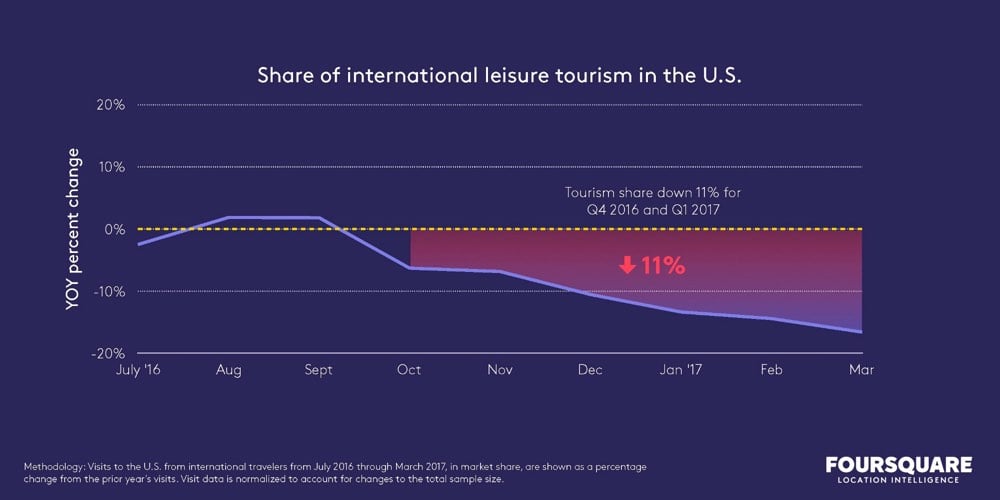
Our findings reveal that America’s ‘market share’ in international tourism started to decline in October 2016, when the U.S. tourism share fell by 6% year-over-year, and continued to decrease through March 2017, when it dropped all the way to -16%. Currently, there is no sign of recovery in the data.
And business travel to the US is suffering as well, relative to other countries:
Business trip activity is up in the U.S. by about 3% (as a share of international traveler global activity), but that trend line is not as high as elsewhere in the world, where YoY trends are closer to 10%. Relative to business travel gains globally, business travel to the U.S. is suffering.
As Foursquare notes, correlation is not causation and there are other factors at play (e.g. a stronger US dollar), but it’s not difficult to imagine that our xenophobic white nationalist administration and its travel & immigration policies have something to do with this decline.
In his new book, The Vanishing Middle Class: Prejudice and Power in a Dual Economy, MIT economics professor Peter Temin says that the US “is coming to have an economic and political structure more like a developing nation” and that the US is really two countries at this point:
In one of these countries live members of what Temin calls the “FTE sector” (named for finance, technology, and electronics, the industries which largely support its growth). These are the 20 percent of Americans who enjoy college educations, have good jobs, and sleep soundly knowing that they have not only enough money to meet life’s challenges, but also social networks to bolster their success. They grow up with parents who read books to them, tutors to help with homework, and plenty of stimulating things to do and places to go. They travel in planes and drive new cars. The citizens of this country see economic growth all around them and exciting possibilities for the future. They make plans, influence policies, and count themselves as lucky to be Americans.
The FTE citizens rarely visit the country where the other 80 percent of Americans live: the low-wage sector. Here, the world of possibility is shrinking, often dramatically. People are burdened with debt and anxious about their insecure jobs if they have a job at all. Many of them are getting sicker and dying younger than they used to. They get around by crumbling public transport and cars they have trouble paying for. Family life is uncertain here; people often don’t partner for the long-term even when they have children. If they go to college, they finance it by going heavily into debt. They are not thinking about the future; they are focused on surviving the present. The world in which they reside is very different from the one they were taught to believe in. While members of the first country act, these people are acted upon.
This whole piece on the book by Lynn Parramore is worth a read. Another small tidbit:
In the Lewis model of a dual economy, much of the low-wage sector has little influence over public policy. Check. The high-income sector will keep wages down in the other sector to provide cheap labor for its businesses. Check. Social control is used to keep the low-wage sector from challenging the policies favored by the high-income sector. Check. Mass incarceration. Check. The primary goal of the richest members of the high-income sector is to lower taxes. Check. Social and economic mobility is low. Check.
The members of the two large writing guilds representing more than 12,000 Hollywood writers recently voted to strike.
Leaders of the Writers Guild of America, East, and the Writers Guild of America, West, announced the results of an online strike authorization vote in an email to members. The unions said that 6,310 eligible members voted; 96 percent of the vote was in favor of a strike.
A three-year contract between the guilds and the Alliance of Motion Picture and Television Producers, which represents the makers of films and TV series, expires at midnight on May 1. Negotiators were set to resume talks on Tuesday, with funding of a failing union health care plan a sticking point.
Last time there was a writers strike in 2007, networks moved to replace their scripted shows with reality programs, including the resurrection of a fading reality show called The Apprentice.
During the last work stoppage, CBS ordered additional seasons of its flagship reality competition shows to fill airtime. And then there’s NBC.
Trump’s “The Apprentice” had been removed from the network’s lineup amid low ratings. But a new programming chief came aboard in 2007, and the network decided to revive the competition show, but with a twist. And when the writers’ strike meant no more new episodes of “The Office” and “Scrubs,” NBC replaced the Thursday night shows in 2008 with “The Celebrity Apprentice.”
That’s a curious butterfly effect. The writers strike made room for The Celebrity Apprentice on TV. The Celebrity Apprentice gave Trump seven more seasons of primetime TV visibility. Trump parlayed that visibility into the highest political office in the land.
Science in America is an impassioned video from Neil deGrasse Tyson about the threat we face from the political uncoupling of science from the truth in America today.
How did America rise up from a backwoods country to be one of the greatest nations the world has ever known? We pioneered industries. And all this required the greatest innovations in science and technology in the world. And so, science is a fundamental part of the country that we are. But in this, the 21st century, when it comes time to make decisions about science, it seems to me people have lost the ability to judge what is true and what is not, what is reliable what is not reliable, what should you believe what you do not believe. And when you have people who don’t know much about science standing in denial of it and rising to power, that is a recipe for the complete dismantling of our informed democracy.
Newer posts
Older posts





Socials & More