I always liked the way poet Frank O’Hara walked up to the manifesto:
Everything is in the poems, but at the risk of sounding like the poor wealthy man’s Allen Ginsberg I will write to you because I just heard that one of my fellow poets thinks that a poem of mine that can’t be got at one reading is because I was confused too. Now, come on. I don’t believe in god, so I don’t have to make elaborately sounded structures. I hate Vachel Lindsay, always have; I don’t even like rhythm, assonance, all that stuff. You just go on your nerve. If someone’s chasing you down the street with a knife you just run, you don’t turn around and shout, “Give it up! I was a track star for Mineola Prep.”
But what do we call it, Frank? We need a name.
Personism, a movement which I recently founded and which nobody knows about… was founded by me after lunch with LeRoi Jones on August 27, 1959, a day in which I was in love with someone (not Roi, by the way, a blond). I went back to work and wrote a poem for this person. While I was writing it I was realizing that if I wanted to I could use the telephone instead of writing the poem, and so Personism was born. It’s a very exciting movement which will undoubtedly have lots of adherents. It puts the poem squarely between the poet and the person, Lucky Pierre style, and the poem is correspondingly gratified. The poem is at last between two persons instead of two pages. In all modesty, I confess that it may be the death of literature as we know it. While I have certain regrets, I am still glad I got there before Alain Robbe-Grillet did. Poetry being quicker and surer than prose, it is only just that poetry finish literature off.
LeRoi Jones eventually changed his name to Amiri Baraka. Alain Robbe-Grillet was an proto-postmodern French novelist associated with the nouveau roman, or “new novel.” It’s probably better if I let you figure out what a Lucky Pierre is for yourself.
Because O’Hara dated his poems, we know what poem he wrote between lunch with Jones and picking up the telephone; appropriately, it’s called “personal poem”:
Now when I walk around at lunchtime
I have only two charms in my pocket
an old Roman coin Mike Kanemitsu gave me
and a bolt-head that broke off a packing case
when I was in Madrid the others never
brought me too much luck though they did
help keep me in New York against coercion
but now I’m happy for a time and interested
I walk through the luminous humidity
passing the House of Seagram with its wet
and its loungers and the construction to
the left that closed the sidewalk if
I ever get to be a construction worker
I’d like to have a silver hat please
and get to Moriarty’s when I wait for
LeRol and hear who wants to be a mover and
shaker the last five years my batting average
is .016 that’s that, and LeRol comes in
and tells me Miles Davis was clubbed 12
times last night outside BIRDLAND by a cop
a lady asks us for a nickel for a terrible
disease but we don’t give her one we
don’t like terrible diseases, then
we go eat some fish and some ale it’s
cool but crowded we don’t like Lionel Trilling
we decide, we like Don Allen we don’t like
Henry James so much we like Herman Melville
we don’t want to be in the poet’s walk in
San Francisco even we just want to be rich
and walk on girders in our silver hats
I wonder if one person out of the 8,000,000 is
thinking of me as I shake hands with LeRol
and buy a strap for my wristwatch and go
back to work happy at the thought possibly so
Here is a photo of Davis after being beaten:

One reason Davis’s assault and arrest alarmed O’Hara as much as it did was the increasing police violence at bars and clubs where gay men gathered — which culminated in the Stonewall Riots, five years after his accidental death in 1964.
O’Hara’s poetry got a boost in sales and pop-culture recognition recently, when it was prominently featured in the Season Two premiere of Mad Men. Don Draper reads from Meditations In An Emergency’s “Mayakovsky”:
Now I am quietly waiting for
the catastrophe of my personality
to seem beautiful again,
and interesting, and modern.
The country is grey and
brown and white in trees,
snows and skies of laughter
always diminishing, less funny
not just darker, not just grey.
It may be the coldest day of
the year, what does he think of
that? I mean, what do I? And if I do,
perhaps I am myself again.
I don’t know why I always think of this mode of literature in terms of media history. Maybe that’s just the way I think. Or it’s O’Hara picking up the telephone, that black-and-white photo of Davis’s blood-spattered suit, Don Draper dropping his copy of a book into a suburban corner mailbox.
Elsewhere in Personism, O’Hara says, “Nobody should experience anything they don’t need to, if they don’t need poetry bully for them. I like the movies too. And after all, only Whitman and Crane and Williams, of the American poets, are better than the movies.” Maybe if he were writing today, he might say, “only ___ and ___ and ___ are better than playing video games.”
His poem “Lines for the Fortune Cookies” shows O’Hara would have completely understood (and ruled at) Twitter. Here are just three samples (all well under the character limit):
- Your walk has a musical quality which will bring you fame and fortune.
- You may be a hit uptown, but downtown you’re legendary!
- You are a prisoner in a croissant factory and you love it.
How do Tennyson, Longfellow, and Thoreau stack up in terms of the thickness of their beards? Surprisingly, that question has been asked and answered.
That “exalted dignity, that certain solemnity of mien,” lent by an imposing beard, “regardless of passing vogues and sartorial vagaries,” says Underwood, is invariably attributable to the presence of an obscure principle known as the odylic force, a mysterious product of “the hidden laws of nature.” The odylic, or od, force is conveyed through the human organism by means of “nervous fluid” which invests the beard of a noble poet with noetic emanations and ensheathes it in an ectoplasmic aura.
(via stamen)
Poet Christian Bök wants to compose a poem and encode it into the DNA of the Deinococcus radiodurans bacteria — “the most radiation-resistant organism known”.
He wants to inject the DNA with a string of nucleotides that form a comprehensible poem, and he also wants the protein that the cell produces in response to form a second comprehensible poem.
AGGCGT GCCACC AAT
TCT TACC GATTT CT
CA CTCTAG ACC CTG
AGCCCA CGC GGTTCA
(via mr)
At the newly renovated Bygone Bureau, Darryl Campbell investigates the small but vibrant poetry community that has formed in the comment threads on the NY Times website.
Tiger, Tiger burning bright
In the sex clubs of Orlando
Guess it’s time you took a break
And lived life with more candor
Must’ve been weird, your secret life
Never an unserviced erection
Shouldn’t you, though, have taught the wife
Some proper club selection?
This is a 36-second wax cylinder recording of Walt Whitman reading a few lines from his poem, America. You may recognize the recording from its use in Levi’s new ad campaign:
I thought for sure that Ryan McGinley had directed this and the O Pioneers! commercial but it turns out he just (just!) did the photos for the print campaign. (via slate)
Update: The audio clip used in that commercial might not be Whitman after all. From the inbox:
The Walt Whitman recording that is being used by the Levi’s commercial that you posted on the 28th is actually not Whitman, and is now considered by most audio archivists to be a hoax.
More information about this most interesting recording can be found in Vol. X, No. 3 of Allen Koenigsberg’s Antique Phonograph Monthly magazine from 1992, pages 9-11.
Among things pointed out, one is that the speech on the soundtrack ends with the quote, “Freedom Law and Love,” whereas the original printed version of the poem ends with “Chair’d in the adamant of Time.”
Koenigsberg also points out that Whitman’s last years were chronicled on a daily basis by his personal secretary, and being wheelchair-bound, such a visit for Whitman would have been difficult, unprecedented, and undoubtedly noted.
(thx, jack)
Flarf is a form of poetry made by combining together phrases from random web searches. Here’s an early example:
“Yeah, mm-hmm, it’s true
big birds make
big doo! I got fire inside
my ‘huppa’-chimp(TM)
gonna be agreessive, greasy aw yeah god
wanna DOOT! DOOT!
Pffffffffffffffffffffffffft! hey!”
Flarf started off as a joke but then these joke poems that people were coming up with “evolved from ‘bad’ to ‘sort of great’”.
Edge Books publisher Rod Smith, a poet himself, says he feels the [Flarf] collective is prompting a bit of anarchy in the poetry world by widening the vocabulary of what is permissible. “Aesthetic judgments about what’s bad in a very hierarchal society are usually serving upper-class people with a certain amount of privilege,” he says. “So for a bunch of poets who are very well schooled in a variety of traditions of American poetry to take what’s considered bad and throw that at people is a very interesting maneuver. It’s not simply bad poetry; it’s quote-unquote bad poetry written by people who know how to write poetry.”
Inspired by Emmett Williams, a practitioner of concrete poetry, Rob Giampietro has written three poems: Wastebasket, Snowflakes, and Spraypaint.
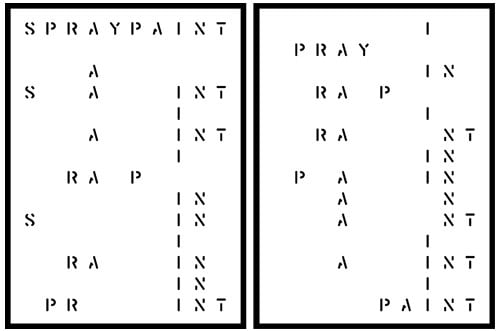
Giampietro has put out a call for someone to develop a Williams Word Generator. Drop him a line if you can help out…shouldn’t be too much different than the many “words within words” generators scattered around the web.
Austin Kleon makes Newspaper Blackout Poems by blacking out all but a few choice words of newspaper articles.
A Woman’s bust is the host of Romance, so Don’t deplore my fondness for It
The Virginia Quarterly Review analyzed their poetry submissions for use of poetic cliches and found that the cliches do get published more often than not. Also of note is that “darkness” is an undervalued poetic cliche…it was in only 4% of submitted poems but in 17% of published poems. Poets, “darkness” is your way into VQR.
I’ve gotten totally re-obsessed with Kathy Acker, the East Village writer who died in 1997. It started with this recording of Acker reading a poem [Warning: audio, 2 minutes, 28 seconds, and not really safe for work!] that was released in 1980 on the LP “Sugar, Alcohol & Meat” by Giorno Poetry Systems and recently digitized by UbuWeb. Her New York accent is one that has largely disappeared since; she sounds amazing. Then I found this, which is an incredibly long mp3, the first 3/4s of which is a Michael Brownstein reading. The end, though, is a monologue which then becomes a stageplay by Acker about a woman, her suicide, her grandmother, and her psychiatrist. It is absolutely not safe for work, what with its endless use of a certain word for ladyparts that goes over well in Scotland but not at all (yet!) in the U.S.
Winners of the Helvetica haiku contest I pointed to a couple of weeks ago. My favorite of all the ones listed: “i shot the serif / left him there full of leading / yearning for kerning”. Close second: “She misunderstood / When I said she was ‘Grotesque’ / Akzidenz happen”. I am a sucker for puns.

Socials & More