kottke.org posts about movies
In the same vein as the Zinn/Chomsky Lord of the Rings commentary is A People’s History of Tattooine, a Twitter conversation that Jacob Harris kicks off thusly:
What if Mos Eisley wasn’t really that wretched and it was just Obi Wan being racist again?
Some other highlights:
“more civilized time?” Check your privilege, Obi Wan
the Tusken People. Raiders presumes some malevolent intent
all I’m saying is that I don’t blame the Tusken People for steering clear of the racist, violent and armed old man
like anybody forgets what Luke and his friends did to native womp rat populations at Beggars Canyon Park
There are 46 reviews (and counting) of The Grand Budapest Hotel on TripAdvisor, which is ranked “#1 of 1 hotels in The Republic of Zubrowka”.
As an elderly women I was thoroughly delighted by the attention of the staff! Particularly the concierge, what a thoughtful generous man! Wish I could take him home to service me there! I also loved the food and the chocolate treats from mendls. Tip top!
See also Schrute Farms on TripAdvisor and TripAdvisor reviews for the Overlook Hotel. Oh and The Grand Budapest Hotel movie is now available for digital rental. (via @khoi)
This is an old piece from McSweeney’s, but it’s absolute gold and I can’t believe I’ve been missing it all these years. In it, Noam Chomsky and Howard Zinn record a DVD commentary for the first Lord of the Rings movie. So, so good.
Zinn: You’ve spoken to me before about Mordor’s lack of access to the mineral wealth that the Dwarves control.
Chomsky: If we’re going to get into the socio-economic reasons why certain structures develop in certain cultures… it’s mainly geographical. We have Orcs in Mordor — trapped, with no mineral resources — hemmed in by the Ash Mountains, where the “free peoples” of Middle Earth can put a city, like Osgiliath, and effectively keep the border closed.
Zinn: Don’t forget the Black Gate. The Black Gate, which, as Tolkien points out, was built by Gondor. And now we jump to the Orcs chopping down the trees in Isengard.
Chomsky: A terrible thing the Orcs do here, isn’t it? They destroy nature. But again, what have we seen, time and time again?
Zinn: The Orcs have no resources. They’re desperate.
Chomsky: Desperate people driven to do desperate things.
Zinn: Desperate to compete with the economic powerhouses of Rohan and Gondor.
Chomsky: Who really knows their motive? Maybe this is a means to an end. And while that might not be the best philosophy in the world, it makes the race of Man in no way superior. They’re going to great lengths to hold onto their power. Two cultures locked in conflict over power, with one culture clearly suffering a great deal. I think sharing power and resources would have been the wisest approach, but Rohan and Gondor have shown no interest in doing so. Sometimes, revolution must be —
Zinn: Mistakes are often —
Chomsky: Blood must be shed. I forget what Thomas Jefferson —
Here’s part two. And the same writers, Jeff Alexander and Tom Bissell, also did one for The Return of the King.
From CineFix, a collection of ten of the most iconic and memorable editing moments in cinematic history.
(via @brillhart)
Narrated by Malcolm McDowell and featuring interviews from many collaborators and colleagues, Lost Kubrick is a short documentary on the films that Stanley Kubrick never finished.
Through interviews and abundant archival materials, this documentary examines these “lost” films in depth to discover what drew Kubrick to these projects, the work he did to prepare them for production, and why they ultimately were abandoned. Some of the unfinished project discussed here are “Napoleon”, “The Aryan Papers” and also “A.I” (which we know finally made by Steven Spielberg).
In 1976, 20th Century Fox released a teaser trailer for a little film called Star Wars…aka “the story of a boy, a girl, and a universe”.
No James Earl Jones voiceover for Vader, no John Williams score (which wasn’t finished until just two months before the film premiered), but those visuals must have impressed.
Here’s the first teaser trailer for Empire Strikes Back, which features no film footage at all, just concept art drawn by Ralph McQuarrie:
And for the sake of completeness, the teaser trailer for Return of the Jedi, which appeared in theaters before Lucas changed the name from Revenge of the Jedi:
The staff and contributors of Dissolve recently listed the 50 greatest summer blockbusters ever. Here’s #50-31, #30-11, and the top 10.
Blockbusters have become such an integral part of the way we talk about films that it’s hard to believe they haven’t always been with us. But while there have always been big movies-lavish productions designed to draw crowds and command repeat business-the blockbuster as we know it has a definite start date: June 20, 1975. That’s when Jaws first hit screens in the middle of what was once, in the words of The Financial Times, a “low season” when the “only steady summer dollars came, in the U.S., from drive-in theaters.” It’s summer, after all; why go to the movies when you could be outside? Jaws changed that. Star Wars cemented that change. And now, the summer-movie season is dominated by the biggest films Hollywood has to offer.
Jaws is the no-surprise #1 but Who Framed Roger Rabbit at #8? Hmm, dunno about that. And leaving Star Wars just off the top 10 is a bold move. My personal top ten would also have included Ghostbusters — I remember vividly waiting in line in the sweltering heat outside the El Lago theater to see Ghostbusters and just being completely and utterly blown away by it — and Terminator 2. Oh and Batman. I think I saw that movie half-a-dozen times in the theater and it was just everywhere that summer…the logo, that song by Prince, everything. (via @khoi)
Life Itself, the documentary about Roger Ebert, is now out in theaters. But you can also watch it via various Video On Demand services, including Amazon and iTunes. Here’s the trailer to whet yer whistle:
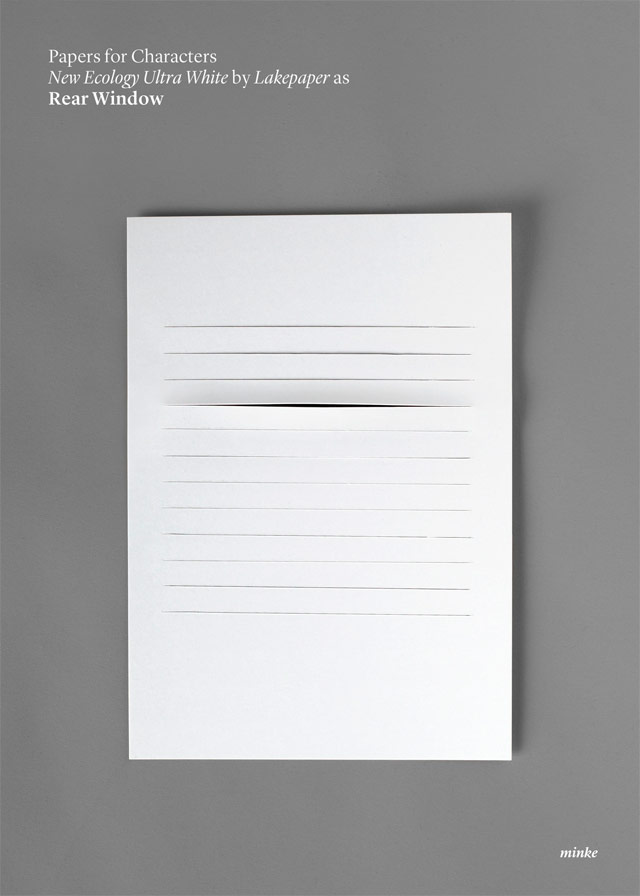
Spanish design firm Atipo made these nifty minimalist movie posters out of card stock. I really like the one for Rear Window:
Martin Scorsese uses silence very effectively in his films. Tony Zhou explains:
(via dot info)
If you took all the fight scenes from Quentin Tarantino’s Kill Bill movies and turned them into a Double Dragon-esque video game, this is what it would look like:
(via devour)
I missed this news a couple of months ago: Steven Spielberg is going to direct a movie version of Roald Dahl’s The BFG.
Renowned film director Steven Spielberg will direct the new adaptation with Melissa Mathison, who last worked with Spielberg on ET, writing the script. Frank Marshall will produce the film and Michael Siegel and John Madden are on board as executive producers.
I can’t find any direct evidence, but the way the news is being reported, this seems like it’ll be a live-action film and not a Tintin 3-D motion capture affair.
2014 is the first year without a Pixar film since 2005’s gap between The Incredibles and Cars. The company has two films planned for 2015 and one of them will hopefully do something about one of my long-standing pet peeves about their movies: the lack of strong women characters. Inside Out takes place inside the brain of a teenaged girl, with her emotions as the main characters.
The film’s real protagonist is Joy (voiced by an effervescent Amy Poehler), one of five emotions who steer Riley through life via a control center in her mind that’s akin to the bridge from the Starship Enterprise. Joy and her cohorts — including Fear (Bill Hader), Disgust (Mindy Kaling), Anger (Lewis Black), and Sadness (Phyllis Smith) — all work together to keep Riley emotionally balanced, and for the first 11 years of her life, the primary influencer is Joy, as evidenced by Riley’s sunny demeanor.
But as adolescence sets in, Joy finds her lead role usurped. Suddenly, Sadness wants to pipe in at inappropriate times — coaxing Riley to cry during her first day at a new school, for instance — and as the two emotions jostle for control, both of them fall into the deepest reaches of Riley’s mind and have to work their way back. Meanwhile, left to their own devices, Fear, Disgust, and Anger collude to transform Riley into a moody preteen.
Holy cow, that sounds great.
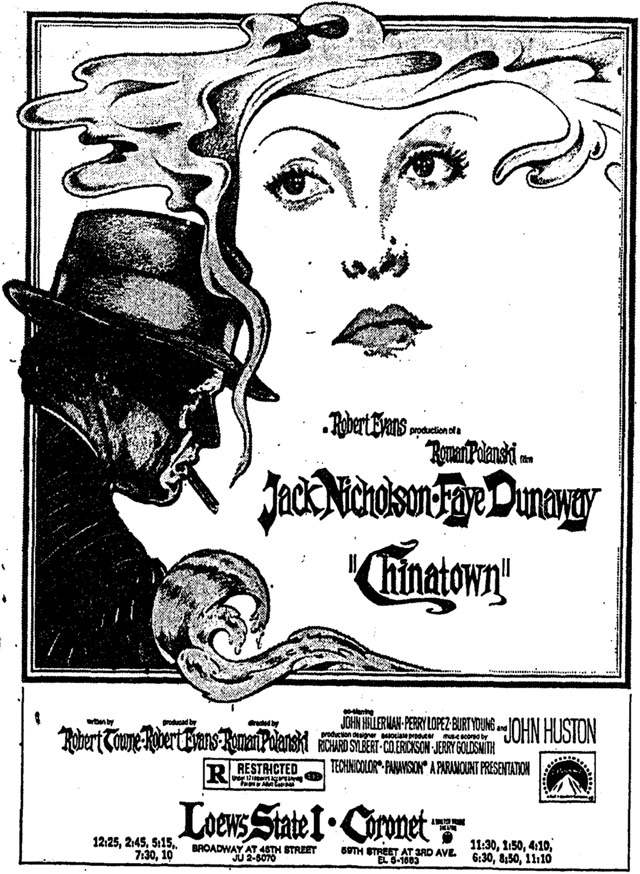
Yesterday, I did a round-up of movies, TV, and music available on this weekend in 1984. As a comparison, I thought looking at the same weekend from 1974 would be interesting. Tracking this information down was a little more difficult than with 1984, but I found most of what I needed in the June 23, 1974 edition of the NY Times.
Back in the 1970s (and probably particularly in NYC), movies stayed in theaters a lot longer than they do now. There was no home video market then…you either saw the movie in the theater or you missed it. This is a list of some of the movies available for viewing in theaters that weekend in NYC:
The Sting
The Exorcist
Parallax View
The Sugarland Express
The Conversation
Chinatown
Papillon
The Great Gatsby
The Sting, Papillon, and The Exorcist had been out since late 1973, The Great Gatsby since March, and The Sugarland Express (Spielberg’s directoral debut) and The Conversation since April. Only Parallax View and Chinatown had just opened. Interestingly, the year’s top-grossing film, Blazing Saddles, which opened in February, didn’t appear anywhere on the movie listing pages of the Times that week.
The top 10 on the Billboard chart for that week were:
Billy, Don’t Be A Hero - Bo Donaldson And The Heywoods
You Make Me Feel Brand New - The Stylistics
Sundown - Gordon Lightfoot
The Streak - Ray Stevens
Be Thankful For What You Got - William DeVaughn
Band On The Run - Paul McCartney & Wings
If You Love Me (let Me Know) - Olivia Newton-John
Dancing Machine - Jackson 5
Hollywood Swinging - Kool & The Gang
The Entertainer - Marvin Hamlisch/The Sting
And on TV that weekend, a number of classic shows, all reruns except for 60 Minutes:
Brady Bunch
Sanford and Son
Good Times
Upstairs, Downstairs
The Odd Couple
All in the Family
M*A*S*H
Mary Tyler Moore
60 Minutes
BTW, the entire copy of the Sunday Times was fascinating to page through. The ads for cigarettes, hand-held calculators, and color televisions, real estate listings, job openings, book listings, the NY Times Magazine, car ads, etc.
On this weekend 30 years ago, in the summer of 1984, you could stroll into a movie theater and choose between the following films:
Ghostbusters
Gremlins
Indiana Jones and the Temple of Doom
The Karate Kid
Star Trek III: The Search for Spock
Top Secret!
The Natural
Police Academy
Plus, Sixteen Candles and Footloose had just closed the weekend before. 1984 was generally a great year for movies. Musically, the following songs were in heavy rotation on the radio and on MTV that weekend:
The Reflex - Duran Duran
Time After Time - Cyndi Lauper
Let’s Hear It for the Boy - Deniece Williams
Dancing in the Dark - Bruce Springsteen
Self Control - Laura Branigan
The Heart of Rock & Roll - Huey Lewis
Jump - The Pointer Sisters
When Doves Cry - Prince
Eyes Without a Face - Billy Idol
Borderline - Madonna
On TV that weekend were mostly reruns and movies…networks only showed reruns in the summer back then. The shows airing included:
The Dukes of Hazzard
Fantasy Island
Webster
Dallas
Diff’rent Strokes
60 Minutes
The Tonight Show Starring Johnny Carson
Late Night with David Letterman
(via, no foolin’, the Stay Puft Marshmallow Man)
Newer posts
Older posts






Socials & More