kottke.org posts about movies
The entire run1 of James Bond films are available in a Blu-ray box set for $150. The DVD version is $100.
[1] Well, not the entire run. Not included are Never Say Never Again (an independently produced Bond film starring Sean Connery 12 years removed from his last Bond outing) and Casino Royale (a Bond satire starring David Niven, Woody Allen, and Peter Sellers). ↩
The trailer was supposed to go up later in the morning but here it is a little early.
If it gets pulled down, I’ll find another link.
Update: Apple has the trailer up now.
Archaeologist Marc Azéma thinks that Stone Age artists may have fashioned their cave paintings in such a way as to suggest movement, crude movies that came to life as the flickering light from a fire danced on the walls.
Not only that, Paleolithic artists may have also have invented the thaumatrope thousands of years before the Victorians in the 1800s.
Consisting of a card or disk with different designs on either side, the device demonstrates the persistence of vision: When the card or disk is twirled, the designs appear to blend into one.
Rivère discovered that Paleolithic artists used similar optical toys well in advance of their 19th-century descendants.
The artist examined Magdalenian bone discs — objects found in the Pyrenees, the north of Spain and the Dordogne, which measure about 1.5 inches in diameter.
Often pierced in their center, the discs have been generally interpreted as buttons or pendants.
“Given that some are decorated on both sides with animals shown in different positions, we realized that another type of use, relating to sequential animation, was possible,” the researchers said.
They mentioned one of the most convincing cases, a bone disc found in 1868 in the Dordogne. On one side, the disc features a standing doe or a chamois. On the other side, the animal is lying down.
Azéma and Rivère discovered if a string was threaded through the central hole and then stretched tight to make the disc rotate about its lateral axis, the result was a superimposition of the two pictures on the retina.
Incredible that moviemaking is tens of thousands of years old instead of just a couple hundred.
Flavorwire has a quick look at some noted directors (Kubrick, Wes Anderson, Fincher) and the typefaces that they often used. (via @curiousoctopus)
Jonny Greenwood’s soundtrack for P.T. Anderson’s new film, The Master, came out yesterday. It’s available on MP3 from Amazon ($11) and directly from Nonesuch in MP3 and other formats ($12+). Greenwood previously did the soundtrack for Anderson’s There Will Be Blood.
I can’t find any other information about this online or anywhere else, but tucked away in a fall arts preview in today’s NY Times is the juicy news that MoMA has picked a date for their screening of Christian Marclay’s 24-hour movie, The Clock. The show will open on Dec 21 and run through Jan 21. It sounds like the screening will happen in the contemporary galleries and won’t show continuously except on weekends and New Year’s Eve. Which is lame. Just keep the damn thing running the whole month…get Bloomberg to write a check or something.
Anyway, probably best to check this out on the early side during the holiday season because it’ll turn into a shitshow later on.
David Fincher has always started his movies right: with interesting opening title sequences.
The Art of the Title recently interviewed the director about his interest in title sequences.
The sequence for Se7en did very important non-narrative things; in the original script there was a title sequence that had Morgan Freeman buying a house out in the middle of nowhere and then travelling back on a train. He was making his way back to the unnamed city from the unnamed suburban sprawl, and that’s where the title was supposed to be — “insert title sequence here” — but we didn’t have the money to do that. We also lacked the feeling of John Doe, the villain, who just appeared 90 minutes into the movie. It was oddly problematic, you just needed a sense of what these guys were up against.
Kyle Cooper, the designer of the title sequence, came to me and said, “You know, you have these amazing books that you spent tens of thousands of dollars to make for the John Doe interior props. I’d like to see them featured.” And I said, “Well, that would be neat, but that’s kind of a 2D glimpse. Figure out a way for it to involve John Doe, to show that somewhere across town somebody is working on some really evil shit. I don’t want it to be just flipping through pages, as beautiful as they are.” So Kyle came up with a great storyboard, and then we got Angus Wall and Harris Savides — Harris to shoot it and Angus to cut it — and the rest, as they say, is internet history.
I don’t believe in decorative titles — neato for the sake of being neato. I want to make sure you’re going to get some bang for your buck. Titles should be engaging in a character way, it has to help set the scene, and you can do that elaborately or you can do it minimally.
(via devour)
Wes Anderson likes overhead shots, Quentin Tarantino prefers to peer up from below, Darren Aronofsky uses sharp sounds, and Stanley Kubrick often uses one-point perspective.
Aleksandar Hemon scored a rare chance to profile the publicity-averse Wachowskis as they prepare to unleash Cloud Atlas onto the world.
I first met the Wachowskis in December, 2009, when they were in the midst of their struggle to find financing for “Cloud Atlas.” Uncomfortable with being idle while they waited, they were also developing “Cobalt Neural 9,” a project that had grown out of their frustration with the Bush Presidency and the wars in Iraq and Afghanistan. Curious about how the early aughts would be perceived in the future, the Wachowskis imagined a documentary film made eight decades from now, looking back at the country’s plunge into imperial self-delusion. In order to write a script for “Cobalt Neural 9,” the Wachowskis were filming interviews with people, from Arianna Huffington to Cornel West, who they thought might be able to help them elucidate their concerns. I was invited to participate and was costumed to look as if I were speaking in 2090. Dressed like a Bosnian Isaac Hayes (with sparkling lights attached to my skull, a psychedelic shirt, and a New Age pendant), I ranted about the malignant idiocy of the Bush regime. Lana sat next to the camera, asking most of the questions, while Andy was somewhere beyond the lights, his voice occasionally booming from the void.
Usually, I experience an erosion of confidence around famous people-an inescapable conviction that they know more than I do, because the world is somehow more available to them. But I got along splendidly with the Wachowskis. Seemingly untouched by Hollywood, they did not project the jadedness that is a common symptom of stardom. Lana was one of the best-read people I’d ever met; Andy had a wry sense of humor; they were both devout Bulls fans. We also shared a militant belief in the art of narration and a passionate love for Chicago.
Eventually, I asked them to consider letting me write about the making of “Cloud Atlas.” They talked it over and decided to do it. By then, they’d sent the script to every major studio, after Warner Bros. had declined to exercise its option. Everyone passed. “Cloud Atlas” seemed too challenging, too complex. The Wachowskis reminded Warner Bros. that “The Matrix” had also been deemed too demanding, and that it had taken them nearly three years to get the green light on it. But the best the studio could do for “Cloud Atlas” was to keep open the possibility of buying the North American distribution rights, payment for which would cover a portion of the projected budget.
I read the book while on vacation and after rewatching the trailer, I am beyond excited for this movie. Still don’t understand how it’s not 14 hours long, but hey.
Back in July, we covered the Criterion Collection release of The Royal Tenenbaums. Recently, Criterion Collection posted a gallery of 9 books and magazines from the movie, which because of said gallery, I want to watch right now.
Everyone knows [X], what this post presupposes is maybe [Y].
See also The Royal Tenenbaum portraits. (thx, alex)
Steven Spielberg is re-releasing Raiders of the Lost Ark in IMAX theaters for a one week engagement in early September.
Mr. Spielberg, who with the sound designer Ben Burtt supervised the conversion of “Raiders of the Lost Ark” to Imax, said that no special effects or other visual elements of the film were changed. The audio, he said, had been enhanced for surround sound: “When the boulder is rolling, chasing Indy through the cave, you really feel the boulder in your stomach, the way you do when a marching band passes by, and you’re standing right next to it.”
All four Jones movies will be out on Blu-ray in mid-September. (via df)
Where have I seen this before, a massive long-lasting Arctic storm that looks a lot like a hurricane? Oh right, The Day After Tomorrow.
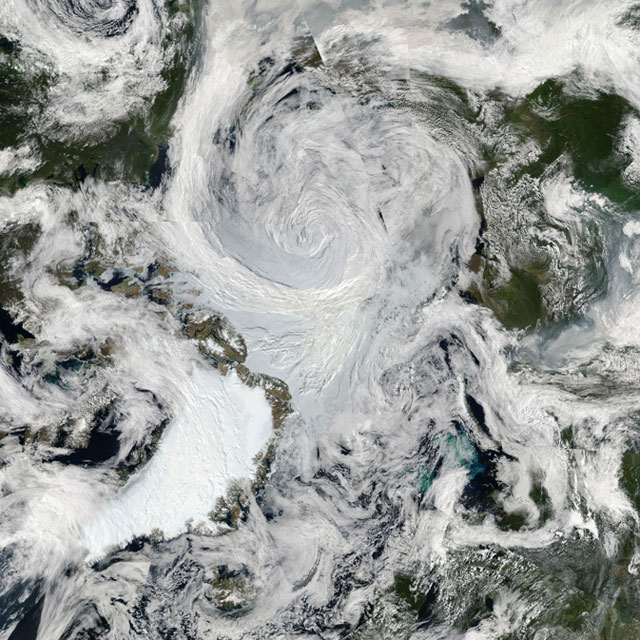
The storm had an unusually low central pressure area. Paul A. Newman, chief scientist for Atmospheric Sciences at NASA’s Goddard Space Flight Center in Greenbelt, Md., estimates that there have only been about eight storms of similar strength during the month of August in the last 34 years of satellite records. “It’s an uncommon event, especially because it’s occurring in the summer. Polar lows are more usual in the winter,” Newman said.
Arctic storms such as this one can have a large impact on the sea ice, causing it to melt rapidly through many mechanisms, such as tearing off large swaths of ice and pushing them to warmer sites, churning the ice and making it slushier, or lifting warmer waters from the depths of the Arctic Ocean.
I love The Day After Tomorrow. I know it’s a cheeseball disaster movie (which is pretty much why I love it) but it’s also looking more than a little prescient. Well, as prescient as a cheeseball disaster movie can be anyway. In the Washington Post the other day, prominent climatologist James Hansen wrote that human-driven climate change is responsible for an increase in extreme weather.
My projections about increasing global temperature have been proved true. But I failed to fully explore how quickly that average rise would drive an increase in extreme weather.
In a new analysis of the past six decades of global temperatures, which will be published Monday, my colleagues and I have revealed a stunning increase in the frequency of extremely hot summers, with deeply troubling ramifications for not only our future but also for our present.
This is not a climate model or a prediction but actual observations of weather events and temperatures that have happened. Our analysis shows that it is no longer enough to say that global warming will increase the likelihood of extreme weather and to repeat the caveat that no individual weather event can be directly linked to climate change. To the contrary, our analysis shows that, for the extreme hot weather of the recent past, there is virtually no explanation other than climate change.
In many ways, the phrase “global warming” is grossly misleading. “Oh,” we think, “it’s gonna be a couple degrees warmer in NYC in 20 years than it is now.” But the Earth’s climate is a chaotic non-linear system, which means that a sudden shift of a degree or two — and when you’re talking about something as big as the Earth, a degree over several decades is sudden — pushes things out of balance here and there in unpredictable ways. So it’s not just that it’s getting hotter, it’s that you’ve got droughts in places where you didn’t have them before, severe floods in other places, unusually hot summers, and even places that are cooler than normal, all of which disrupts the animal and plant life that won’t be able to acclimate to the new reality fast enough.
But pretty Arctic cyclone though, right?
Every decade since 1952, Sight & Sound has polled film professionals to determine the greatest films of all time. Citizen Kane is always the winner, except for the first year. This year, however, S&S expanded the number of contributors dramatically and included online critics as well resulting in Citizen Kane’s unseating. They’ve released the list of top 50 films now, and will release a top 100 in about a month.
About a year ago, the Sight & Sound team met to consider how we could best approach the poll this time. Given the dominance of electronic media, what became immediately apparent was that we would have to abandon the somewhat elitist exclusivity with which contributors to the poll had been chosen in the past and reach out to a much wider international group of commentators than before. We were also keen to include among them many critics who had established their careers online rather than purely in print.
To that end we approached more than 1,000 critics, programmers, academics, distributors, writers and other cinephiles, and received (in time for the deadline) precisely 846 top-ten lists that between them mention a total of 2,045 different films.
I (Aaron) have seen 4 of the movies in the top 50 because I am, apparently, a Luddite philistine. Topping the list this year is Vertigo.
After half a century of monopolising the top spot, Citizen Kane was beginning to look smugly inviolable. Call it Schadenfreude, but let’s rejoice that this now conventional and ritualised symbol of ‘the greatest’ has finally been taken down a peg. The accession of Vertigo is hardly in the nature of a coup d’etat. Tying for 11th place in 1972, Hitchcock’s masterpiece steadily inched up the poll over the next three decades, and by 2002 was clearly the heir apparent. Still, even ardent Wellesians should feel gratified at the modest revolution - if only for the proof that film canons (and the versions of history they legitimate) are not completely fossilised.
There’s also a directors’ list of top 10 films. (via @chrissandoval)
In 1979, singer Tom Waits appeared on The Don Lane Show in Australia. As you will soon be able to see (the action starts at 1:30), his appearance was likely the basis for Heath Ledger’s performance as The Joker in The Dark Knight.
Holy, uh, Batman, Batman!
Chris Marker, best known as a filmmaker and for his film La jetée, has died aged 91.
Marker’s creative use of sound, images and text in his poetic, political and philosophical documentaries made him one of the most inventive of film-makers. They looked forward to what is called “the new documentary”, but also looked back to the literary essay in the tradition of Michel de Montaigne. Marker’s interests lay in transitional societies - “life in the process of becoming history,” as he put it. How do various cultures perceive and sustain themselves and each other in the increasingly intermingled modern world?
La jetée is available in its 28-minute entirety on YouTube and is well worth watching.
Newer posts
Older posts



Socials & More