kottke.org posts about legal
Swift Justice is a short documentary that, perhaps for the first time, takes viewers inside a rural Afghan courtroom operated by the Taliban, whose arbiters decide cases using Sharia law. [Content warning: a man is visibly beaten in the courtroom to make him “speak the truth”.]
To Westerners, the term “Sharia law” may call to mind sword-wielding fanatics with Old Testament sensibilities. Traditionally, though, less than ten per cent of the Sharia—Arabic for “religious law”—relates to criminal injury like murder, rape, or theft. The rest concerns family and marital relations and prosaic matters of commercial transactions and ritual. Sharia courts have existed in Afghanistan for centuries, and during the U.S. occupation they formed one of three distinct legal systems. There were also the official courts of the U.S.-backed Afghan government that were notoriously corrupt and inefficient. Bribery was this system’s lubricant; murderers often walked free, while the innocent languished in prisons rife with torture and other abuses. And there was the tribal system, an informal and sometimes ad-hoc approach to dispute resolution based on rural Pashtun practices. Few rural Pashtuns miss the old Afghan government courts; instead, today the central tension is between tribal and religious law.
Disney dropped the trailer for The Mandalorian and Grogu today, a feature-length film that will debut in theaters in May 2026. As this Star Wars Explained breakdown, er, explains, that the trailer was going to come out earlier but:
Word on the street is that it was supposed to come out this past Friday, but Disney was and is in the middle of some hot water. Acting like cowards in the face of authoritarianism will do that, especially when one of the franchises you own {shows footage of Andor} is about the exact opposite.
Last week, Disney made the decision to pull Jimmy Kimmel Live from the schedule because of threats from the Trump regime, prompting protests. Kimmel returns to the air tomorrow night:
“Last Wednesday, we made the decision to suspend production on the show to avoid further inflaming a tense situation at an emotional moment for our country. It is a decision we made because we felt some of the comments were ill-timed and thus insensitive,” the company said in a statement. “We have spent the last days having thoughtful conversations with Jimmy, and after those conversations, we reached the decision to return the show on Tuesday.”

From Akela Lacy at The Intercept, Palestinian Student Leader Was Called In for Citizenship Interview — Then Arrested by ICE (archive):
Mohsen K. Mahdawi arrived at the U.S. Citizenship and Immigration Services office in Burlington, Vermont, on Monday. A Palestinian student at Columbia University, he hoped that, after 10 years in the U.S., he would pass the test to become a naturalized citizen.
Instead, agents from U.S. Immigration and Customs Enforcement arrested him and began the process to deport him to the occupied West Bank. Mahdawi, a leader of the campus protest movement against Israel’s war on Gaza, became yet another green card holder arrested and facing removal.
“Mohsen Mahdawi was unlawfully detained today for no reason other than his Palestinian identity,” Mahdawi’s attorney Luna Droubi said in a statement to The Intercept. “He came to this country hoping to be free to speak out about the atrocities he has witnessed, only to be punished for such speech.”
Windsor County state senator Rebecca White took a video of Mahdawi being escorted in handcuffs (also on Reddit & YouTube) from the U.S. Citizenship and Immigration Services in Colchester, VT by hooded and masked men to a group of unmarked vehicles.
(thx, caroline)
Heather Cox Richardson on where we are right now in terms of what type of government we currently have:
Here’s the thing: Once you give up the idea that we are all equal before the law and have the right to due process, you have given up the whole game. You have admitted the principle that some people have more rights than others. Once you have replaced the principle of equality before the law with the idea that some people have no rights, you have granted your approval to the idea of an authoritarian government. At that point, all you can do is to hope that the dictator and his henchmen overlook you.
They are 100% going to try to do this with citizens:
Make no mistake: as Supreme Court Justices Sonia Sotomayor, Elena Kagan, and Ketanji Brown Jackson recently warned, if the administration can take noncitizens off the streets, render them to prison in another country, and then claim it is helpless to correct the error either because the person is out of reach of U.S. jurisdiction, it could do the same thing to citizens.
Meanwhile, Trump’s approval rating is still well above 40% (and is even higher if you don’t factor in the economy/tariffs). 🤷♂️
There’s a letter at the end of this post that’s very much worth the read, but I have to explain some context first because otherwise it won’t make any sense. So:
The Trump regime has been targeting law firms “whose lawyers have provided legal work that Trump disagrees with” with executive orders that take away their security clearances and terminate their federal contracts. Yesterday, Trump rescinded his order against the firm of Paul, Weiss, Rifkind, Wharton & Garrison in exchange for a bribe in the form of the firm providing “$40m in free legal services to support his administration’s goals”. The settlement also includes an apparent agreement by Paul Weiss “to disavow the use of diversity, equity and inclusion considerations in its hiring and promotion decisions”.
Another of the law firms targeted by Trump is Perkins Coie, which has filed a lawsuit to fight the EO:
On March 11, 2025, we filed a legal action in response to a recent Executive Order that unlawfully targets Perkins Coie. The order violates core constitutional rights, including the rights to free speech and due process. At the heart of the order is an unlawful attack on the freedom of all Americans to select counsel of their choice without fear of retribution or punishment from the government. We were compelled to take this action to protect our firm and our clients.
In response to the Paul Weiss settlement news, Rachel Cohen, an associate at another law firm, Skadden Arps, sent a company-wide email to her colleagues last night with her “conditional” resignation notice, outlining her frustration with her firm’s unwillingness to support Perkins Coie’s lawsuit and related matters. She posted the letter to LinkedIn in image form — here’s the whole thing as text (boldface mine):
With gratitude and urgency.
Jeremy and colleagues,
Many deals I work on have concepts of conditional notice. This is mine.
Please consider this email my two week notice, revocable if the firm comes up with a satisfactory response to the current moment, which should include at minimum i) signing on to the firm amicus brief in support of Perkins Coie in its litigation fighting the Trump administration’s executive order against it, ii) committing to broad future representation, regardless of whether powerful people view it as adverse to them, iii) refusal to cooperate with the EEOC’s request for personal information of our colleagues clearly targeted at intimidating non-white employees, (iv) public refusal to fire or otherwise force out employees at the Trump administration’s directive or implied directive and (v) public commitment to maintenance of affinity groups and related initiatives.
This is not what I saw for my career or for my evening, but Paul Weiss’ decision to cave to the Trump administration on DEl, representation and staffing has forced my hand. We do not have time. It is now or it is never, and if it is never, I will not continue to work here.
When I went to law school and to Skadden, I did so in pursuit of agency. I was driven by a desire to be in rooms where decision-makers were, to get to play a role in things that mattered, because things felt so needlessly terrible. It never occurred to me that the people in those rooms might feel that they were powerless. I am forced to hope that our lack of response to the Trump administration’s attacks on our peers, both those at other large firms and the many people in this country with far fewer resources, is rooted in feelings of fear and powerlessness, as opposed to tacit agreement or desire to maximize profit. I still hope that is true. But it has not yet been borne out.
It feels mortifying to say “I suspect you know who I am,” but I suspect you know who I am. Over the last few weeks, I have devoted an inordinate amount of time trying to leverage various relationships and privileges to get our firm and broader industry to admit that we are in the throes of early-stage authoritarianism and that we are uniquely positioned to halt it. There is an open letter (now signed by over 600 other AmLaw 200 associates, many of them at this firm), mainstream media coverage and an oped explaining why I feel this way.
To anyone who feels sympathetic to the views I’ve espoused but wonders why I have taken the path I have: on Thursday, March 6, after the issuance of the Perkins Executive Order, I sent emails to multiple trusted partners in management asking to help with whatever response we coordinated.
One of them replied offering to talk and then failed to reply to my email asking for a time until a week later, significantly after I had begun speaking publicly. Know that I attended internal meetings about this topic, sent emails to decision makers, avoided commenting on the EEOC investigation publicly or airing any internal firm discourse publicly.
I did all of these things out of hope that we would do the right thing if given time and opportunity.
The firm has been given time and opportunity to do the right thing. Thus far, we have not. This is a moment that demands urgency. Whether we are failing to meet it because we are unprepared or because we don’t wish to is irrelevant to me — and to the world — where the outcome is the same. If we were going to resist, we would have done so already. If we were not going to respond to the EEOC (a refusal that would be fully legal), the firm would have already told us.
This is the first firmwide email that has been sent on this topic. What. Are. We. Doing.
Colleagues, if you question if it is as bad as you think it is, it is ten times worse. Whether what we measure is the cowardice in face of lost profits, or the proximity to authoritarianism, or the trauma inflicted on our colleagues who are nonwhite, or the disappointment that I feel in this moment, take what you suspect and multiply it by a factor of ten. Act accordingly.
I recognize not everyone is positioned as I am, and cannot act the same way. But do not recruit for this firm if they cannot protect their employees. Do not pretend that what is happening is normal or excusable. It isn’t.
To the many superiors, support staff and friends that I know I disappoint by making this announcement firmwide instead of talking to you first, I sincerely apologize. There are so many thank yous that I have for so many people at this firm. Please know that if you suspect that you have helped me or taught me or cared for me, that I agree and am eternally grateful. In the coming days, I will make every effort to reach out to you separately, but there is urgency here that makes it impossible to go to each of you first. I will do everything in my power to mitigate difficulties caused by my unexpected departure.
Like any self-important adolescent, I spent most of my high school history classes wondering what I would do in the moments before true horror or chaos or where my values were tested and demanded great sacrifice. I do not wonder anymore. I know who I am. I thought I knew who we all were.
Thank you for the opportunity. My personal email is cc’d. I wish each of you the best, and that you use the privileges you hold to work for the best for others.
Rachel
Cohen offered an update shortly after publishing her letter:
As an update, I no longer have access to my firm email, so I guess it’s just notice.
They owe me a payout for 24 accrued vacation days. Thank you and good night.
(via @annabower.bsky.social)

Yesterday was Public Domain Day and Duke University’s Center for the Study of the Public Domain has the scoop on what works entered the public domain in the US on January 1, 2025. They include:
- William Faulkner, The Sound and the Fury
- Ernest Hemingway, A Farewell to Arms
- Virginia Woolf, A Room of One’s Own
- Dashiell Hammett, The Maltese Falcon (as serialized in Black Mask magazine)
- Agatha Christie, Seven Dials Mystery
- Rainer Maria Rilke, Letters to a Young Poet (only the original German version, Briefe an einen jungen Dichter)
- A dozen more Mickey Mouse animations (including Mickey’s first talking appearance in The Karnival Kid)
- The Cocoanuts, directed by Robert Florey and Joseph Santley (the first Marx Brothers feature film)
- The Skeleton Dance, directed by Walt Disney and animated by Ub Iwerks (the first Silly Symphony short from Disney)
- Spite Marriage, directed by Edward Sedgwick and Buster Keaton (Keaton’s final silent feature)
- E. C. Segar, Popeye (in “Gobs of Work” from the Thimble Theatre comic strip)
- Hergé (Georges Remi), Tintin (in “Les Aventures de Tintin” from the magazine Le Petit Vingtième)
- Singin’ in the Rain, lyrics by Arthur Freed, music by Nacio Herb Brown
- Ain’t Misbehavin’, lyrics by Andy Paul Razaf, music by Thomas W. (“Fats”) Waller & Harry Brooks (from the musical Hot Chocolates)
- An American in Paris, George Gershwin
- Rhapsody in Blue, recorded by George Gershwin
The Internet Archive is hosting several of the newly sprung works, free for you to remix, reuse, misuse, and generally do whatever you would like with. Huzzah!
Oh, and here’s why the public domain matters:
The public domain is also a wellspring for creativity. You could think of it as the yin to copyright’s yang. Copyright law gives authors important rights that encourage creativity and distribution — this is a very good thing. But the United States Constitution requires that those rights last only for a “limited time,” so that when they expire, works go into the public domain, where future authors can legally build on the past — reimagining the books, making them into films, adapting the songs and movies. That’s a good thing too! It is part of copyright’s ecosystem. The point of copyright is to promote creativity, and the public domain plays a central role in doing so.
How does the public domain feed creativity? Here are just two examples from 2024. You may have enjoyed the film Wicked in 2024. Like many of its predecessors, it is based on L. Frank Baum’s The Wonderful Wizard of Oz books, and it offers origin stories for the Wicked Witch of the West and Glinda the Good. From the literary realm, Percival Everett’s 2024 novel James reimagines Mark Twain’s Adventures of Huckleberry Finn from the perspective of Jim, Huckleberry’s friend who is an escaped slave. The novel won the 2024 National Book Award and Kirkus Prize and was a finalist for the Booker Prize. As summed up by a New York Times review: “‘Huck Finn’ Is a Masterpiece. This Retelling Just Might Be, Too.” Mark Twain famously wanted copyright to last forever — if he had his wish, would his heirs have sued Everett? Thankfully, we did not have to find out, and Everett could publish James without such litigation.
A group of Costco shareholders, emboldened by the Supreme Court’s continued assault on the equal protection clause of the 14th Amendment, called on the company’s board to “conduct an evaluation and publish a report” on the risks involved in maintaining their DEI program, which these shareholders called “illegal discrimination” against employees who are “white, Asian, male or straight”. The board responded with a recommendation to vote against this proposal:
Our Board has considered this proposal and believes that our commitment to an enterprise rooted in respect and inclusion is appropriate and necessary. The report requested by this proposal would not provide meaningful additional information to our shareholders, and the Board thus unanimously recommends a vote AGAINST this proposal.
Our success at Costco Wholesale has been built on service to our critical stakeholders: employees, members, and suppliers. Our efforts around diversity, equity and inclusion follow our code of ethics:
For our employees, these efforts are built around inclusion – having all of our employees feel valued and respected. Our efforts at diversity, equity and inclusion remind and reinforce with everyone at our Company the importance of creating opportunities for all. We believe that these efforts enhance our capacity to attract and retain employees who will help our business succeed. This capacity is critical because we owe our success to our now over 300,000 employees around the globe.
But the board then went further, blaming these shareholders for wasting their time and resources:
The proponent professes concern about legal and financial risks to the Company and its shareholders associated with the diversity initiatives. The supporting statement demonstrates that it is the proponent and others that are responsible for inflicting burdens on companies with their challenges to longstanding diversity programs. The proponent’s broader agenda is not reducing risk for the Company but abolition of diversity initiatives.
This is the way. The whole shareholder proposal and the board’s response is worth reading. (via @heartwoodandsteel.bsky.social)
This short video takes us on a trip through the criminal justice system and highlights a “hidden form of punishment” directed toward incarcerated people: fees. At every turn, people who are sentenced to incarceration are subject to tens of thousands of dollars in fees: bail fees, public defender fees, filing fees, court costs, mandatory contributions to funds like the state police fund, room & board, phone calls, money transfer fees, medical co-pays, and fees for post-incarceration monitoring. This is on top of any penalties that are paid by offenders.
We’re not talking about fines, those monetary punishments that judges impose on offenders. And this isn’t about restitution, which is an additional sanction intended to reimburse victims. Fees are far more insidious, functioning like predatory taxes that raise revenue for the government. They can vary from state to state, municipality to municipality, institution to institution.
And they can have severe economic consequences, particularly for people who are already broke when they enter the system — that is, most people who run afoul of the law. The resulting debts can destroy people’s credit, prevent them from voting and interfere with their ability to find employment and housing.
And guess what? People in debt turn to crime to pay their bills. This is all just another way that America’s criminal justice system is punitive and not rehabilitative.
Well this is delightful: Vanity Fair set up Ayo Edebiri with a selection of personal beefs and several gavels (and maybe there’s a meat tenderizer in there, I don’t know), she listened to both sides of each argument, and then passed judgment. Listen until at least the second case before you pass judgment on watching the whole thing (verdict: you should)…it involves someone stealing a french fry from a room service tray.
I don’t know how to tell you this…but your father has murdered people before. There are bodies in the ground. ‘I don’t know what she’s so upset about. It’s a victimless crime. Nobody’s gonna miss that fry. Nobody’s gonna miss THAT KID!’
Vox recently invited two people with differing views on the decriminalization and commercialization of cannabis to have an on-camera debate. The topic is interesting and relevant, but I’m mostly highlighting this for the format. Instead of just doing a traditional debate, the producers and participants came up with a list of facts that both parties accepted as true to discuss and rebut:
We thought both of their perspectives were worth hearing but didn’t want to stage a traditional debate where viewers so often come away confused about what to believe. So we created a format that would help establish a shared foundation of facts while still communicating what each of these advocates believe is the most important information to know.
In this new take on a debate, we asked both participants to identify facts that their opponent would have to concede are true. They were given an opportunity to review their adversary’s facts in advance and in a video call agreed on a set of six. In the video, you’ll see those facts presented, with each participant given the opportunity to add a “footnote” to their opponent’s facts.
Producer Joss Fong said of this novel format:
We made something new: a debate format where you don’t have to trust either of the adversaries (or trust us!) to learn something new and valuable about a policy issue.
I think it worked really well — more facts, less arguing & peacocking. I’d definitely welcome a podcast with this debate format.
Speaking of the fundamentalist movement to repeal the 20th century, Jack Mirkinson isn’t writing for The Atlantic and therefore is free to not mince words:
[Alito] says that Roe should be scrapped because the right to an abortion is “not deeply rooted in the Nation’s history and traditions” — a byzantine litmus test that would wipe out just about every modern civil rights protection you can think of, given the nature of American history. He forthrightly casts aside the notion that the court should be cautious about overturning decades of precedent. He sends unmistakable signals that other civil rights opinions, especially ones protecting gay rights, are in the crosshairs.
The final opinion could differ, but what we have in front of us is an extremist, illegitimate opinion from an extremist, illegitimate court, one that sees women as serfs and breeders, that sees queer people as subhuman, that sees minorities of every kind as dirt under its collective shoe. It is happily dragging us into the dark ages. Alito and everyone who joins him are evil people. No hell is too hot for them.
(via waxy)
Adam Serwer writing in The Atlantic about the leaked Supreme Court opinion draft penned by conservative justice Samuel Alito that will, if it remains substantially unmodified, overturn Roe v Wade and other precedents that guarantee the right to an abortion in the United States.
“The majority can believe that it’s only eviscerating a right to abortion in this draft,” Stephen Vladeck, a law professor at the University of Texas at Austin, told me, “but the means by which it does so would open the door to similar attacks on other unenumerated rights, both directly, by attacking the underpinnings of those doctrines, and indirectly, by setting a precedent for such an attack.”
Aside from rights specifically mentioned in the text of the Constitution, Alito argues, only those rights “deeply rooted in the nation’s history in tradition” deserve its protections. This is as arbitrary as it is lawless. Alito is saying there is no freedom from state coercion that conservatives cannot strip away if conservatives find that freedom personally distasteful. The rights of heterosexual married couples to obtain contraception, or of LGBTQ people to be free from discrimination, are obvious targets. But other rights that Americans now take for granted could easily be excluded by this capricious reasoning.
“In a series of cases beginning in the early 1920s, the Court carved out a protected space for family, marriage, and children that the government is constrained from regulating,” Kimberly Wehle wrote last December. “A rollback of Roe could split this sphere open if the conservative theory that implied rights are constitutionally invalid takes hold, and states begin passing draconian laws that creep into other areas of intimate personal life.”
And:
On the grounds that it constitutes a form of religious discrimination, conservatives will be able to claim an exemption from any generally applicable rule they do not wish to follow, while imposing their own religious and ideological views on those who do not share them. Although the right-wing justices present this rule in the language of constitutionalism, they are simply imposing their ideological and cultural preferences on the rest of the country.
Abortion, same-sex marriage, birth control, rights for trans persons, other LGBTQ protections, other civil rights — it’s all on the table, they’re coming for all of it.
Update: See also This is just the beginning:
I ask you to re-read the above passage and substitute for the word “abortion” any other modern liberty not mentioned in the Constitution: the right to use contraception, same-sex marriage, the right of same-sex couples to adopt children, marriage between different “races,” the right of any consenting adults to engage in sex, the right of unmarried couples to live together, and the rights of LGBTQ people to be treated with equal dignity.
Each of the above rights — now widely accepted — was criminalized or prohibited in many U.S. states until the latter part of the 20th century. Under Justice Alito’s reasoning, because the Constitution “makes no reference to those rights” and they were “unknown” in American jurisprudence until recently, the Constitution affords them no protection. Alito does handsprings to claim the draft ruling does not reach other rights rooted in the same legal ground as Roe and Casey. But there is no difference under Alito’s reasoning between abortion and contraception, same sex marriage, same-sex adoption, and bans against “fornication,” “sodomy,” cohabitation, and “miscegenation.”
This is just the beginning.

For the curious and open-minded, many explanations of what “Black Lives Matter” means and what it doesn’t (e.g. White lives don’t matter) are readily available online. But in terms of pure clarity, it’s hard to beat what Whittier Law School professor Patricia Leary wrote in response to a letter sent to her by an anonymous group of students in 2016. This group of students was offended by Leary wearing a “Black Lives Matter” t-shirt on campus, writing in part:
We write this letter to you with concern about your inappropriate conduct at XXXXXXX Law School.
Specifically, you have presented yourself on campus, on at least one occasion, wearing a “Black Lives Matter” t-shirt. We believe this is an inappropriate and unnecessary statement that has no legitimate place within our institution of higher learning. The statement you represented and endorsed is also highly offensive and extremely inflammatory. We are here to learn the law. We do not spend three years of our lives and tens of thousands of dollars to be subjected to indoctrination or personal opinions of our professors.
XXXXXXX Law School has prided itself on the diverse demographics represented within the student body. Your actions however, clearly represent your View that some of those demographics matter more than others. That alienates and isolates all non-black groups.
As someone who is charged to teach criminal law, it should be abundantly clear to you and beyond any question that ALL lives matter, as it is expressed unequivocally in the law. Furthermore, the “Black Lives Matter” statement is racist and anti-law enforcement and has been known to incite violence in this country. As someone who is paid to teach the law, you should be ashamed of yourself.
If you’re going to argue with law professors, you should bring your A game, and Leary wastes no time in informing these students that they did not do so.
Premise: You are not paying for my opinion.
Critique: You are not paying me to pretend I don’t have one.
And on the meaning of “Black Lives Matter”:
Premise: There is an invisible “only” in front of the words “Black Lives Matter.”
Critique: There is a difference between focus and exclusion. If something matters, this does not imply that nothing else does. If I say “Law Students Matter” it does not imply that my colleagues, friends, and family do not. Here is something else that matters: context. The Black Lives Matter movement arose in a context of evidence that they don’t. When people are receiving messages from the culture in which they live that their lives are less important than other lives, it is a cruel distortion of reality to scold them for not being inclusive enough.
As applied specifically to the context in which I wore my Black Lives Matter shirt, I did this on a day in Criminal Procedure when we were explicitly discussing violence against the black community by police.
There are some implicit words that precede “Black Lives Matter,” and they go something like this:
“Because of the brutalizing and killing of black people at the hands of the police and the indifference of society in general and the criminal justice system in particular. It is important that we say that…”
This is, of course, far too long to fit on a shirt.
Black Lives Matter is about focus, not exclusion. As a general matter, seeing the world and the people in it in mutually exclusive, either/or terms impedes your own thought processes. If you wish to bear that intellectual consequence of a constricting ideology, that’s your decision. But this does not entitle you to project your either/or ideology onto people who do not share it.
The rest of her response is worth a read, particularly the part about the misconception that “what you think something means is the same as what it actually means”.
And then in part 2 of the letter, she rips the batteries right out of the anonymous students by critiquing how they wrote the letter.
Frame the issue precisely and then focus on it. Don’t overgeneralize. You begin by stating that the issue is my “inappropriate conduct,” which sounds very general. Then you narrow the issue to “specifically” one event that occurred on a particular day last semester. Your use of hyperbolic rhetoric throughout the memo suggests that you really are angry about more than just a T-shirt. If it really is about just the T-shirt, then by overgeneralizing from a specific occurrence, your message is swamped by exaggeration. If it really is about other “conduct” on my part, I can’t tell what that is. By the end of the memo you have lost focus completely, generalizing (in statements that are unexplained and inexplicable) about bar passage and about the faculty and administration of the entire law school.
Well, they did ask her to teach…
Confessions of a Former Bastard Cop is an essay allegedly written by a former police officer with ten years of experience in “a major metropolitan area in California with a predominantly poor, non-white population”. In it, he attempts to explain the system under which cops are trained and operate, “not to excuse their behavior, but to explain it and to indict the structures that perpetuate it.” At the very least, this essay corroborates what activists have been saying about the police for decades.
I could write an entire book of the awful things I’ve done, seen done, and heard others bragging about doing. But, to me, the bigger question is “How did it get this way?”. While I was a police officer in a city 30 miles from where I lived, many of my fellow officers were from the community and treated their neighbors just as badly as I did. While every cop’s individual biases come into play, it’s the profession itself that is toxic, and it starts from day 1 of training.
Every police academy is different but all of them share certain features: taught by old cops, run like a paramilitary bootcamp, strong emphasis on protecting yourself more than anyone else. The majority of my time in the academy was spent doing aggressive physical training and watching video after video after video of police officers being murdered on duty.
I want to highlight this: nearly everyone coming into law enforcement is bombarded with dash cam footage of police officers being ambushed and killed. Over and over and over. Colorless VHS mortality plays, cops screaming for help over their radios, their bodies going limp as a pair of tail lights speed away into a grainy black horizon. In my case, with commentary from an old racist cop who used to brag about assaulting Black Panthers.
And this, uh, training doesn’t prepare officers for what their actual job ends up being:
And consider this: my job as a police officer required me to be a marriage counselor, a mental health crisis professional, a conflict negotiator, a social worker, a child advocate, a traffic safety expert, a sexual assault specialist, and, every once in awhile, a public safety officer authorized to use force, all after only a 1000 hours of training at a police academy. Does the person we send to catch a robber also need to be the person we send to interview a rape victim or document a fender bender? Should one profession be expected to do all that important community care (with very little training) all at the same time?
To put this another way: I made double the salary most social workers made to do a fraction of what they could do to mitigate the causes of crimes and desperation. I can count very few times my monopoly on state violence actually made our citizens safer, and even then, it’s hard to say better-funded social safety nets and dozens of other community care specialists wouldn’t have prevented a problem before it started.
Armed, indoctrinated (and dare I say, traumatized) cops do not make you safer; community mutual aid networks who can unite other people with the resources they need to stay fed, clothed, and housed make you safer. I really want to hammer this home: every cop in your neighborhood is damaged by their training, emboldened by their immunity, and they have a gun and the ability to take your life with near-impunity. This does not make you safer, even if you’re white.
His conclusion: “consider abolishing the police” and “creating a society focused on reconciliation and restorative justice instead of punishment, pain, and suffering — a system that sees people in crisis as humans, not monsters”.
As someone who did it for nearly a decade, I need you to understand that by and large, police protection is marginal, incidental. It’s an illusion created by decades of copaganda designed to fool you into thinking these brave men and women are holding back the barbarians at the gates.
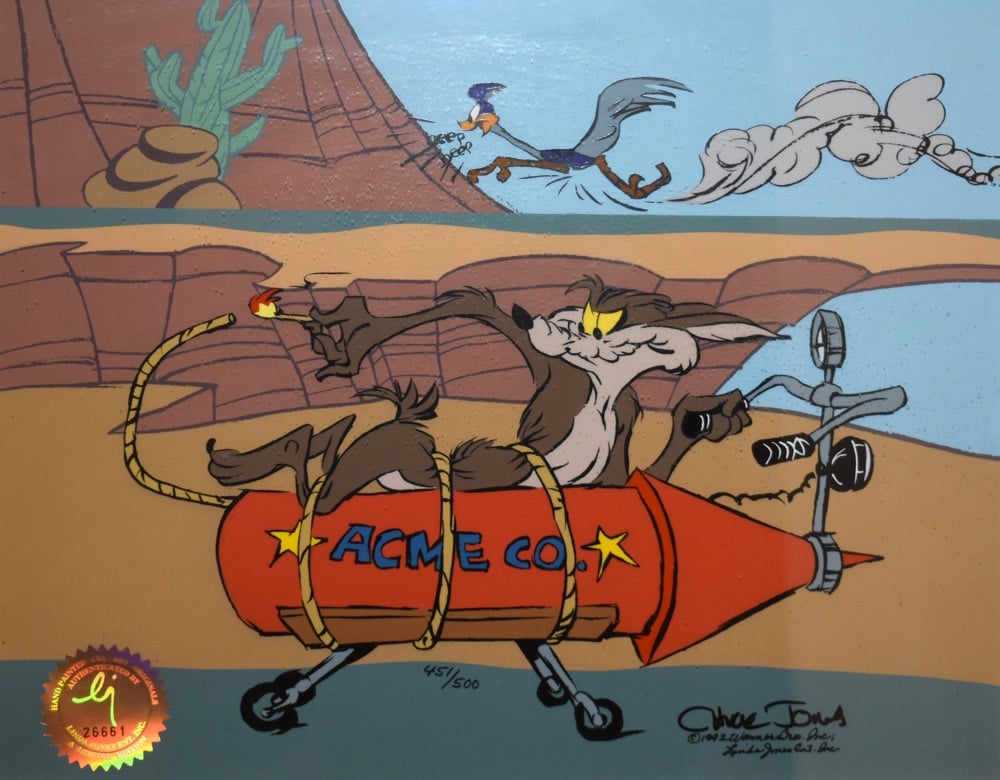
In a classic New Yorker article from 1990, Ian Frazier writes about an imagined lawsuit filed by Wile E. Coyote against the Acme Company in which he “seeks compensation for personal injuries, loss of business income, and mental suffering” due to the company’s defective products.
Mr. Coyote states that on December 13th he received of Defendant via parcel post one Acme Rocket Sled. The intention of Mr. Coyote was to use the Rocket Sled to aid him in pursuit of his prey. Upon receipt of the Rocket Sled Mr. Coyote removed it from its wooden shipping crate and, sighting his prey in the distance, activated the ignition. As Mr. Coyote gripped the handlebars, the Rocket Sled accelerated with such sudden and precipitate force as to stretch Mr. Coyote’s forelimbs to a length of fifty feet. Subsequently, the rest of Mr. Coyote’s body shot forward with a violent jolt, causing severe strain to his back and neck and placing him unexpectedly astride the Rocket Sled. Disappearing over the horizon at such speed as to leave a diminishing jet trail along its path, the Rocket Sled soon brought Mr. Coyote abreast of his prey. At that moment the animal he was pursuing veered sharply to the right. Mr. Coyote vigorously attempted to follow this maneuver but was unable to, due to poorly designed steering on the Rocket Sled and a faulty or nonexistent braking system. Shortly thereafter, the unchecked progress of the Rocket Sled brought it and Mr. Coyote into collision with the side of a mesa.
See also the rules followed by animator Chuck Jones and his team while making the Wile E. Coyote and Road Runner cartoons.
Older posts





Socials & More