kottke.org posts about language
Translating episodes of Seinfeld (and other sitcoms that rely on wordplay) is not an easy task. The Verge’s Jennifer Armstrong has a piece that focuses mostly on the struggle to translate Jerry, George, Elaine, and Kramer’s antics for a German audience.
Seinfeld’s Jewish references posed a unique challenge: as Sebastian explained, “The Germans have a certain you-know-what with the Jewish.” Her editor was worried about some of Seinfeld’s Jewish jokes. “We better not say it like that,” she remembered her editor saying, “because the Germans may be offended.” She added later, recalling the incident to me, “They should be offended, in my understanding. They did it!”
Sebastian appreciated Seinfeld’s direct approach to Jewish history. She wanted to use jokes in direct translation, but the editor wouldn’t let her. She lost several battles. It was a fine line: Der Suppen-Nazi? Sure. Subtle reference to an uncle who survived a concentration camp? Not so fast. An entire episode based on George being mistaken for a neo-Nazi was problematic. So were references to the TV miniseries Holocaust and the film Schindler’s List. Take Elaine’s voiceover narration in “The Subway” episode when her train gets stuck: “We are in a cage. … Oh, I can’t breathe, I feel faint. Take it easy, it’ll start moving soon. Think about the people in the concentration camps, what they went through.”
(via mr)
It is what it is. What’s done is done. My name is not my name. My name is my name.1 Derek Donahue found all of the tautologies from The Wire and collected them into one video:
These types of phrases characterize the immovable forces the characters feel govern their lives and actions: poverty, bureaucracy, addiction, institutional corruption, ethnicity, etc.
Oh my, I had forgotten about the Name of the Year site and how amazing it is. Each year, they collect the most unusual names in the world and pit them against each other in a March Madness-style bracket. Here are some of the names in the running for the 2015 Name of the Year:
Swindly Lint
Dr. Electron Kebebew
Flavious Coffee
Lancelot Supersad Jr.
Jazznique St. Junious
(A reminder…these are actual names of actual people. Somehow.)
Littice Bacon-Blood
Dr. Wallop Promthong
Infinite Grover
Genghis Muskox
Malvina Complainville
Beethoven Bong
Amanda Miranda Panda
Some Hall of Name inductees include Tokyo Sexwale, Nimrod Weiselfish, Doby Chrotchtangle, Tanqueray Beavers, and Vanilla Dong.

Ok, Pluto fans. They evicted Pluto from our solar system’s planetary pantheon, but a NASA mission launched in 2006 is nearing the dwarf planet with its cameras. We’ll soon have photos of Pluto that are much more high resolution than we currently have, which means scientists will need names for all the new geographic features. The Our Pluto site has been set up to help suggest and vote on names for these features. Naming themes include historic explorers, travelers to the underworld, and scientists and engineers. Go vote! (via slate)

James Joyce is the greatest writer the world has ever known. Arguably! He didn’t even bother confining himself to the known language. He created words of his own.
A few highlights from “17 Words Invented by James Joyce”:
Bababadalgharaghtakamminarronnkonnbronntonnerronntuonnthunnt-rovarrhounawnskawntoohoohoordenenthurnuk. This is Joyce’s most famous word creation. It’s from Finnegans Wake, and it’s supposed to sound like a thunderclap. Which it does. If you can figure out how to pronounce it.
Peloothered. This means you’re drunk. Someone calls you this in Ireland, and you know you’re blotto.
Smilesmirk. Girls on Instagram have basically perfected this one.
Update: Ryan Goodlett advises: “I’ve found after a handful of languages that Icelandic sounds the best.” Agreed! And Kevin Krebs suggests: “you’ll want to follow @FW_WOTD.” Michael Schwartz says: “You might want to try james Joyce or Kool Keith.” I got six out of ten. How embarrassing.

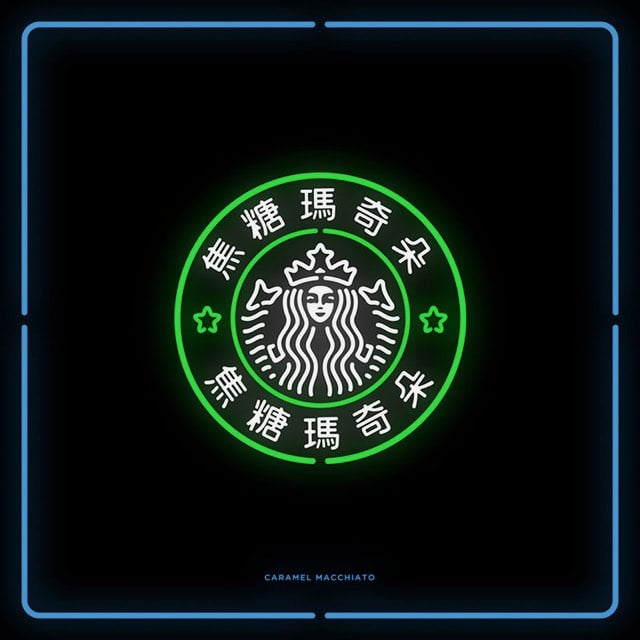

A project called Chinatown takes familiar logos like Pepsi, Starbucks, UPS, and Lego and translates them, imprecisely, into their Chinese equivalents.
It uses basic words for translation, such as “Caramel Macchiato” for “Starbucks” in order to maintain the visual continuity. By arranging the words this way, ‘Chinatown’ pushes viewers to ask themselves what it means to see, hear, and become fully aware. ‘Chinatown’ also demonstrates our strangeness to 1.35 billion people in the world, when you can’t read Chinese.
(via @pieratt)
One of the last interviews David Foster Wallace gave was with Bryan Garner, a lawyer and lexicographer who became friendly with Wallace due to their mutual love of language. That hour-long interview is reproduced in Quack This Way: David Foster Wallace & Bryan A. Garner Talk Language and Writing.
David Foster Wallace was at the center of late-20th-century American literature, Bryan A. Garner at that of legal scholarship and lexicography. It was language that drew them together. The wide-ranging interview reproduced here memorializes 67 minutes of their second and final evening together, in February 2006. It was DFW’s last long interview, and the only one devoted exclusively to language and writing.
It was Wallace’s piece featuring Garner in Harper’s, Tense Present, that cemented him as a favorite writer of mine, even before I tackled Infinite Jest. Wallace later expanded the essay to 62 pages in Consider the Lobster and Other Essays.
Thesis: the quality of every movie starring Samuel L. Jackson varies directly with the number of times he says “motherfucker.” I feel like somebody at 538 should get on this.
Whenever I think about how Sam Jackson says “motherfucker,” I can’t get this Supremes song out of my head.
Whenever you’re near, I hear a symphony
Play sweet and tenderly
Every time your lips meet mine, now, baby, baby, baby
You bring much joy within
Don’t let this feeling end
Let it go on and on and on, now, baby, baby, baby
Those tears that fill my eyes
I cry not for myself
But for those who’ve never felt the joy we felt (baby)
(via @igorbobic by way of @daveweigel)
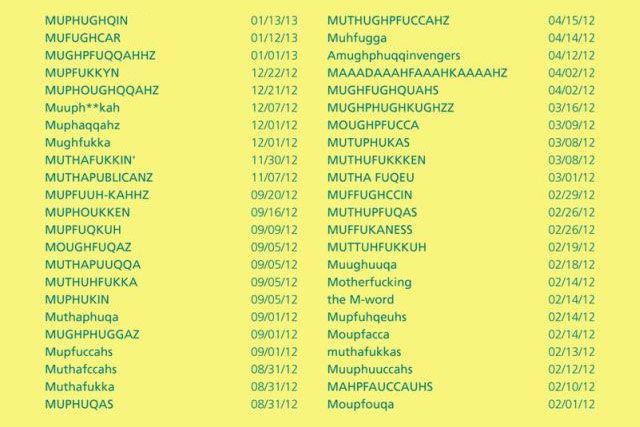
Update: In mid-2013, Filmdrunk calculated that since joining Twitter, Samuel L. Jackson has spelled “motherfucker” no fewer than 151 different ways.
Hi, everybody! Tim Carmody here, guest-hosting for Jason this week.
In the Marvel comic Hawkeye #15, published in February, the title character was brutally attacked and deafened by a supervillain real estate developer trying to push the hero’s neighbors out of their apartment building in Brooklyn’s Bed-Stuy. (It’s a very special comic book.) This week’s issue, #19, took months to finish but finally picks up that story line. It’s mostly told in a combination of silent panels, American Sign Language, and half-intelligible lip reading. It’s already being talked about as a shoo-in for this year’s Eisner award for best single issue.

There are precedents here. Last year’s mostly-silent Hawkeye #11 was told from the point of view of a dog (named Pizza Dog), using symbols and maps to tell a kind of detective story. (That issue also won writer Matt Fraction and artist David Aja the Eisner.)

There’s also a silent issue of Daredevil by Brian Michael Bendis and Alex Maleev where the blind superhero is temporarily deafened by an explosion. And there’s two gorgeous mini-arcs of Daredevil by writer/artist David Mack, featuring Maya Lopez as Echo, Daredevil’s deaf, super-powered love interest and counterpart.

Hawkeye’s also been temporarily deaf twice before: once in the limited series Hawkeye, back in the 1980s (his use of a hearing aid made him a minor hero to hearing-impaired readers) and (it’s revealed in this new issue) also as a child, as a result of an injury implied to be caused by his abusive father. This is how Clint and his brother Barney are shown to know American Sign Language.
I’ve been interested in ASL for a long time for personal reasons, but also as a kind of “writing,” in the family-resemblance sense of visible language, that functions like speech.
Comic books, at least in print, are a silent medium by necessity. But it’s still harder to render ASL in comics than ordinary oral/aural speech, because it’s a language of movement, and we don’t have the conventions of speech bubbles and the alphabet.
What we do have is a graphic tradition of maps, signs, atlases, manuals, and other forms of everyday iconography to draw on. And those are largely what Mack used in Daredevil, and what Aja uses in Hawkeye.
It’s a sign that we, all of us, read signs everywhere, and every kind of reading can be used and incorporated in every other kind. The best way to stay true to what’s essential in a medium is to do your best to explode your way out of it.
Hi, everybody! Tim Carmody here, guest-hosting for Jason this week.
You probably know that Donald Glover (actor on Community, writer on 30 Rock) also has a rap career under the stage name Childish Gambino. You may not know that the name “Childish Gambino” comes from a Wu-Tang Name Generator.
That’s half of the reason I’m here - I’m dead serious. Like I met RZA and he was like, “you’re a cool dude, man - and your name is perfect for you! It’s like that computer had a brain!” But yeah, I put my name in a Wu-Tang name generator and it spit out Childish Gambino, and for some reason I just thought that fit.
Now here’s where things get a little weird. There are multiple, competing Wu-Tang name generators. (Of course there are.) Most of them seem to work the same way — they run a script matching your name’s characters with a decent-sized database of Wu-sounding words, kind of like a hash. But little differences in the scripts or in the database give you different results.
For instance, at recordstore.com, the “Original Wu Name Generator” (tagline “WE CAN WU YOU!”) spits back “Erratic Assassin” (for “Timothy Carmody”), while “Tim Carmody” yields “Well-Liked Assman.” These names are both awesome.
But the “Wu-Tang Name Generator” at mess.be (“Become a real Wu warrior, entah ur full name ‘n smack da ol’ dirty button”), which proprietor Pieter Dom says was made in 2002, is totally different. There, “Timothy Carmody” and “Tim Carmody” return “Shriekin’ Wizard” and “Gentlemen Overlord,” respectively. Now, while these definitely sound like Wu names, they are definitely The W to the other site’s Enter the 36 Chambers.
Here’s the weird part: both of these Wu-Tang name generators return the same name for “Donald Glover.” It is, of course, “Childish Gambino.”
Is it just a quirk that whatever difference crept in affects most names, but not Donald Glover’s? Did one of the sites hard-code that result in, to boost its credibility with people who heard the Childish Gambino story? Or is Donald Glover somehow necessarily Childish Gambino, across all possible Wu-accessible worlds, in the same way that “Clifford Smith” is always and only “Method Man,” even when he pretends to be an actor?
I don’t think we can ever know. But just as Russell Jones was Ol’ Dirty Bastard, ODB, Dirt McGirt, Big Baby Jesus, and Ason Unique as well as Osirus, I am content to be known by many names under the Wu.
(Dedicated to “Sarkastik Beggar” and “Lesbian Pimp.” Via @hoverbird.)
Update: The TLDR podcast did a follow-up to this story: The Mystery of Childish Gambino.
Watch actress Siobhan Thompson do 17 different British and Irish accents:
Much better done and more entertaining than this tour of British accents I featured back in April. (via @Atul_Gawande)

In France, pie charts are called “le camembert” after the cheese. Or sometimes “un diagramme en fromage” (cheese diagram). In Brazil, they are pizza charts. (via numberphile & reddit)
The Guardian has an interview with Adam Parrish, creator of @everyword, an automated Twitter account that’s been listing a dictionary’s worth of English words in sequence since 2007. @everyword recently reached the Zs and will complete and close tomorrow, June 6.
Words aren’t just things that we write and use in our speech. They are also things we think about individually. Like sex, weed, swag - when they’re not in a sentence, we can also think about them individually. Everyword raises that question of thinking about a word just from that perspective, as a social object.
On the other hand, because @everyword is inside an individual person’s Twitter stream, the words take on the context of whatever else is in the stream at the time. There’s the possibility of weird serendipitous interactions between a word in your stream and some other tweets. The word “super” might be tweeted, and then you read a tweet about a school superintendent or Superman movie.
Any Twitter account that gets you thinking about both the Platonist and the Dadaist dimensions of language at the same time is my kind of fun. And that’s a sort of fun that I associate with the Golden Age of Twitter, given its commingling of high and low, news and musings, humans and bots. That too is coming to a close:
In its early days, because of ven-cap funding, Twitter wasn’t thinking about monetization. They were just really encouraging developers to work with it and do interesting things. There was no concept of ads or promoted tweets. Now things are different. They’ve changed the API and some of the things that were easy to do are now difficult.
The flipside is, more people use it. As an artist, it’s disappointing that the medium has been converted into this very commercial, focused platform, but on the other hand I get to have a huge audience for an experimental writing project. It’s a huge privilege and I definitely have Twitter to thank for that.
It’s all cause for low-grade melancholy and a touch of anxiety. As Suzanne Fischer wryly tweets: “If the dictionary is finite, what else might be ending?”
James Somers says that we’re probably using the wrong dictionary and that most modern dictionaries are “where all the words live and the writing’s no good”.
The New Oxford American dictionary, by the way, is not like singularly bad. Google’s dictionary, the modern Merriam-Webster, the dictionary at dictionary.com: they’re all like this. They’re all a chore to read. There’s no play, no delight in the language. The definitions are these desiccated little husks of technocratic meaningese, as if a word were no more than its coordinates in semantic space.
As a counterpoint, Somers offers John McPhee’s secret weapon, Webster’s Revised Unabridged Dictionary, the bulk of which was the work of one man and was last revised in 1913.
Take a simple word, like “flash.” In all the dictionaries I’ve ever known, I would have never looked up that word. I’d’ve had no reason to — I already knew what it meant. But go look up “flash” in Webster’s (the edition I’m using is the 1913). The first thing you’ll notice is that the example sentences don’t sound like they came out of a DMV training manual (“the lights started flashing”) — they come from Milton and Shakespeare and Tennyson (“A thought flashed through me, which I clothed in act”).
You’ll find a sense of the word that is somehow more evocative than any you’ve seen. “2. To convey as by a flash… as, to flash a message along the wires; to flash conviction on the mind.” In the juxtaposition of those two examples — a message transmitted by wires; a feeling that comes suddenly to mind — is a beautiful analogy, worth dwelling on, and savoring. Listen to that phrase: “to flash conviction on the mind.” This is in a dictionary, for God’s sake.
And, toward the bottom of the entry, as McPhee promised, is a usage note, explaining the fine differences in meaning between words in the penumbra of “flash”:
“… Flashing differs from exploding or disploding in not being accompanied with a loud report. To glisten, or glister, is to shine with a soft and fitful luster, as eyes suffused with tears, or flowers wet with dew.”
Did you see that last clause? “To shine with a soft and fitful luster, as eyes suffused with tears, or flowers wet with dew.” I’m not sure why you won’t find writing like that in dictionaries these days, but you won’t. Here is the modern equivalent of that sentence in the latest edition of the Merriam-Webster: “glisten applies to the soft sparkle from a wet or oily surface .”
Who decided that the American public couldn’t handle “a soft and fitful luster”? I can’t help but think something has been lost. “A soft sparkle from a wet or oily surface” doesn’t just sound worse, it actually describes the phenomenon with less precision. In particular it misses the shimmeriness, the micro movement and action, “the fitful luster,” of, for example, an eye full of tears — which is by the way far more intense and interesting an image than “a wet sidewalk.”
It’s as if someone decided that dictionaries these days had to sound like they were written by a Xerox machine, not a person, certainly not a person with a poet’s ear, a man capable of high and mighty English, who set out to write the secular American equivalent of the King James Bible and pulled it off.
Don’t miss the end of the piece, where Somers shows how to replace the tin-eared dictionaries on your Mac, iPhone, and Kindle with the Webster’s 1913. (via @satishev)
Update: In the same vein, Kevin Kelly recommends using The Synonym Finder as a thesaurus.
Just look up a word, any word, and it proceeds to overwhelm you with alternative choices (a total of 1.5 million synonyms are presented in 1,361 pages), including short phrases and only mildly related words. Rather than being a problem of imprecision, the Finder’s broad inclusiveness prods your imagination and prompts your recall.
While not quite exhaustive in scope, Laura Turner Garrison’s piece in Mental Floss about how Manhattan neighborhoods got their names is worthwhile reading.
In recent decades, businesses and real estate agents have tried in vain to clean up the lively reputation of this west side neighborhood by renaming it “Clinton.” Gentrification and expansion from the neighboring theater district have certainly helped the beautification cause. Nonetheless, the area spanning 34th Street to 59th Street and 8th Avenue (or 9th, depending on who you ask) to the Hudson River just can’t shake the nickname “Hell’s Kitchen.”
Not included in the piece is the East Village, which was part of the Lower East Side until the 1960s, when the neighborhood’s new residents (artists, hippies, Beatniks) and real estate brokers recast the area as the eastern outpost of Greenwich Village. (via digg)
Newer posts
Older posts





Socials & More