kottke.org posts about food
New Scientist reports that Czech beer tastes worse than it used to due to climate change.
Climatologist Martin Mozny of the Czech Hydrometeorological Institute and colleagues say that the quality of Saaz hops — the delicate variety used to make pilsner lager — has been decreasing in recent years. They say the culprit is climate change in the form of increased air temperature.
Winemaking regions are shifting due to climate change as well.
Nicola Twilley proposes a Climate Change Tasting Menu that highlights food and drink demonstrating the effects of human activities on climate.
The starter would feature new products that have only recently been cultivated locally, thanks to climate change — Devon olive oil perhaps, accompanied by a nice glass of Kent rosé. The main course might be controversial: test-tube grown imitation meats and vegetables that recreate the flavour and mouthfeel of species that are already lost or threatened with extinction by climate change.
PIG 05049 by Christien Meindertsma recently won the 2009 Index Award in the Play category. This book looks amazing.
05049 was an actual pig, raised and slaughtered on a commercial farm in the Netherlands. Rotterdam designer Christien Meindertsma was shocked to discover that she could document 185 products contributed to by the animal.
Meindertsma’s design includes the publication of her book, PIG 05049, which charts and pictures each of the products supported by the animal. The surprise is in the fact that elements of production contributed to by pig farming include not only predictable foodstuffs — pork chops and bacon — but far less expected non-food items: ammunition, train brakes, automobile paint, soap and washing powder, bone china, cigarettes.
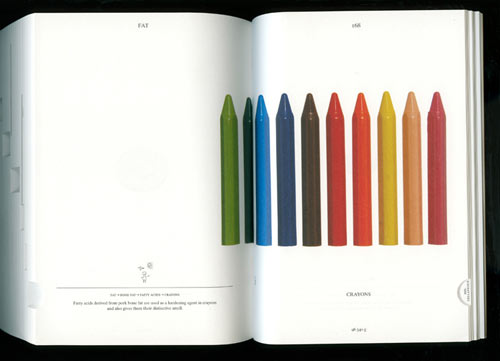
The caption on the page reads:
Fatty acids derived from pork bone fat are used as a hardening agent in crayons and also gives them their distinctive smell.
Crayons smell like pig bone fat. I don’t think I’ll use crayons ever again without thinking of that little factoid.
See also I, Pencil. Nobody knows how to make a pencil and nobody knows where all the parts of a pig go either. (via design observer)
Li-Sun Exotic Mushroom Farm grows their mushrooms in a disused railway tunnel just outside of Sydney, Australia; the varieties grown there have been bred specifically for growing in the tunnel…”they are species designed for architecture”.
He keeps his mushroom cultures in test-tubes filled with boiled potato and agar, and initially incubates the spawn on rye or wheat grains in clear plastic bags sealed with sponge anti-mould filters before transferring it to jars, black bin bags, or plastic-wrapped logs; (middle) Shimeji and (bottom) pink oyster mushrooms cropping on racks inside the tunnel. Dr. Arrold came up with the simple but clever idea of growing mushrooms in black bin bags with holes cut in them. Previously, mushrooms were typically grown inside clear plastic bags. The equal exposure to light meant that the mushrooms fruited all over, which made it harder to harvest without missing some
According to the nation’s largest food manufacturers, among the Smart Choices that shoppers can make at the supermarket are Fruit Loops, Fudgsicle bars, Cocoa Krispies, Frosted Flakes, Lucky Charms, I Can’t Believe It’s Not Butter, and Hellmann’s mayonnaise. Nutritionists are understandably upset.
“These are horrible choices,” said Walter C. Willett, chairman of the nutrition department of the Harvard School of Public Health. He said the criteria used by the Smart Choices Program were seriously flawed, allowing less healthy products, like sweet cereals and heavily salted packaged meals, to win its seal of approval. “It’s a blatant failure of this system and it makes it, I’m afraid, not credible,” Mr. Willett said.
Nutrition professor Marion Nestle added:
The object of this is to make highly processed foods appear as healthful as unprocessed foods, which they are not.
Is there a term for this…perhaps something akin to greenwashing? Faux-ganic?
In last Sunday’s episode of Mad Men, Grandpa Gene ate ice cream right out of the container and salted each spoonful before putting it in his mouth.

It was an odd sight…salt isn’t normally the first thing you think of as an ice cream topping. After the episode, Rex Sorgatz tweeted:
WHO THE FUCK SALTS THEIR ICE CREAM?
Salt has its own flavor when it’s concentrated (if you salt foods too much or eat some all by itself) but used judiciously, salt takes the natural flavor of food and enhances the intensity. To use another dairy product as an example, fresh mozzarella tastes pretty good on its own but throw a little salt on top and it’s mozzarella++. Salt makes ok food taste good and good food taste great. Along with butter, salt is the restaurant world’s secret weapon; chefs likely use way more salt than you do when you cook at home. It’s one of the reasons why restaurant food is so good.
But back to the ice cream. As food scientist Harold McGee writes, salt probably won’t make ice cream taste sweeter but will make it taste ice creamier, particularly if the ice cream is of low quality, as the store-bought variety might have been in 1963.
I’m not sure that salt makes sugar taste sweeter, but it fills out the flavor of foods, sweets included. It’s an important component of taste in our foods, so if it’s missing in a given dish, the dish will taste less complete or balanced. Salt also increase the volatility of some aromatic substances in food, and it enhances our perception of some aromas, so it can make the overall flavor of a food seem more intense.
So that’s why the fuck someone might want to salt their ice cream.
A Continuous Lean recommends Anthony Bourdain’s Disappearing Manhattan episode of No Reservations…with the pertinent YouTube embeds.
Fuck, it’s worth a watch even if you have seen it ten times. Eisenberg’s, Manganaro Foods, Keens, Le Veau d’Or, this show is like my NYC gastro-playbook. Watch it, love it, live it.
Grub Street has some textual CliffsNotes if you’re not into the video. If I had one of them life lists, sharing a meal with Bourdain would probably be on it.
In response to a hyperbolic statement from a friend about the goodness of New York City hot dogs, Matthew Diffee compiles an extensive list of stuff that’s better. A sampling:
Nice fluffy towels
Believing in yourself
Finding a lost twenty in your coat pocket
Prince Edward Island
Coming home after being away for a while
Submarines
Supermodels
A kiss in the rain
Adam Kuban interviewed my friend Mark about the pizza oven he built in his Brooklyn backyard.
It is actually pretty amazing how well the oven works. The first thing we made after pizza was a roasted chicken. I just can’t describe how amazing it was. Not to mention the pizzas. They cook in about 90 seconds, and when I pulled the first one out of the oven, and the backyard smelled like a pizzeria, we knew all the work was worth it.
Mark and I work in the same office and it’s nice to hear that his daily phone conversations about stucco, stucco suppliers, stucco styles, and stucco application techniques have resulted in success.
The Line Diet (good name!) is a web-based version of the Steve Ward Diet. There is also an (unrelated) iPhone app. From the site’s creator:
About 4 weeks ago, I stumbled across a story on Kottke’s Blog about the “Steve Ward Diet”. The idea seemed ingeniously simple to me… so I started my chart the same day. I’ve lost almost 8 pounds since then.
Update: There’s an Excel spreadsheet version as well.
The new restaurant hotness in NYC: A Taste of Pyongyang.
After a lengthy stare down, the maitre d’ shows you to your table. Once seated, you must adhere to two conditions: you will cook your own meal with your own ingredients, and no photography. If you refuse these terms, you will be warned that a crushing defeat will soon be brought down upon your soul. Don’t give in, though; stick to your guns (to coin a phrase), and ask calmly for a menu. But don’t press your luck by asking for water. This is very important.
The Cove has been getting great reviews: four stars from Ebert (who calls it “a certain Oscar nominee”) and a score of 82 on Metacritic. A quick synopsis from Wikipedia followed by the trailer:
The Cove is a 2009 documentary film documenting the annual killing of more than 2,500 dolphins in a cove at Taiji, Wakayama in Japan. The film was directed by former National Geographic photographer Louis Psihoyos, and was filmed secretly during 2007 using underwater microphones and high-definition cameras disguised as rocks.
Inspired by the Steve Ward Diet, an iPhone developer wrote Bang Bang Diet to help you “diet like a robot”. Again, here are the rules:
You plot your desired weight on a desired date towards the right side, making sure that you’ve left the correct number of lines in between (one per day). You draw a line from the current weight/date to the desired weight/date. Every morning you weigh yourself and plot the result. If the point is below the line, you eat whatever you want all day. If the point is above the line, you eat nothing but broccoli or some other low-calorie food.
The app takes care of the plot for you and tells you either to “Eat Normal” or “Eat Light” on any particular day. Only $1.99 at the App Store.
Update: The folks behind Bang Bang Diet have cleverly applied the same idea to budgeting with their Simple Budget app…the app tells you to “Spend” or “Don’t Spend” based on how much you’ve already spent for the day.
Under close scrutiny, hardly any of the things we refer to as fruits actually are.
Strawberries, you will be glad to know, are a ‘false fruit’. Which seems reasonable enough. But at this point a small doubt started to grow in my mind… what, actually, then, was a real fruit? Oranges? No, they’re a modified berry. Bananas? Leathery berry. Plums? Drupe — fleshy bit with one stone inside.
(via clusterflock)
Serious Eats made a short documentary (~9 min.) about the Union Square Greenmarket and one of the farmers who brings his goods to the market every week.
You know that image that’s been going around that shows several revisions to the Pepsi logo while the Coca-Cola logo is the same as it’s been since 1885? It tells a compelling story…Pepsi shifting its brand every few years in an attempt to catch up to steady market leader Coca-Cola. But of course it’s bullshit…Armin Vit constructs a more accurate brand timeline that shows many Coca-Cola logos over the years.
Newer posts
Older posts





Socials & More