kottke.org posts about food
The NY Times has named their replacement for outgoing restaurant critic Frank Bruni: current Times editor Sam Sifton. This is good news for me…I look a bit like Sifton; if I’m mistaken for him and incur favorable treatment at restaurants because of it, I won’t complain.
Update: Many many updates on Sifton and his appointment: from the Times itself on the transition, on restaurant critics and anonymity, and on Sifton’s preparation for the gig (more here); Ed Levine thinks Sifton is going to be good; and Eater has a dossier on Sifton.
Even though Michael Ruhlman had heard it all before, Food Inc. packed a powerful punch for him and his son.
Indeed his response will mirror that of most other people who see this movie. Upon leaving the theater, James said, “That was a really good movie, Dad. (pause) Kind of makes you want to be a vegetarian. (pause) Kind of makes you not want to eat.”
Here’s the trailer for Food, Inc.
In his latest long piece for the New York Times Magazine, Michael Pollan explores the reasons for the simultaneous decline of people cooking and the popularity of food shows.
Today the average American spends a mere 27 minutes a day on food preparation (another four minutes cleaning up); that’s less than half the time that we spent cooking and cleaning up when Julia arrived on our television screens. It’s also less than half the time it takes to watch a single episode of “Top Chef” or “Chopped” or “The Next Food Network Star.” What this suggests is that a great many Americans are spending considerably more time watching images of cooking on television than they are cooking themselves — an increasingly archaic activity they will tell you they no longer have the time for.
One of the things that food/cooking shows do — particularly the dump-and-stir programs like Rachael Ray — is to give the viewer the impression that by watching, they have cooked a meal. (Mirror neurons, anyone?) Perhaps that’s a small factor contributing to cooking’s decline in the American home.
An article in New Scientist discusses the current state of food allergy research.
Perhaps most striking are the regional differences. “Peach and melon allergy is particularly common in the Mediterranean - in Spain and Greece,” says Fern’andez Rivas. Reports from clinics suggest that Iceland is a hotspot for fish allergy and Switzerland has a higher rate of celeriac allergy than elsewhere.
These regional variations are likely to be due in part to differences in eating habits, causing people to be exposed to different allergens. But that alone cannot explain a pronounced north-south divide in the type of apple allergy people experience. In northern Europe, people react to the uncooked flesh of apples, whereas in the south it’s the skin that sets them off, whether it’s cooked or not. What could be the cause of this strange invisible dividing line that skims across south-west France, cuts through Italy close to Florence, and continues eastwards through the middle of the Black Sea?
Significantly, this line marks the southern limit of the birch tree, a plant whose pollen is one of the causes of hay fever in northern Europe.
Update: Are we being too tolerant of gluten-intolerance?
From an article by Philip Greenspun illustrating how the web allowed writers to find an audience for things that are too long for magazines yet too short for books, a simple and effective method for dieting developed by Steve Ward.
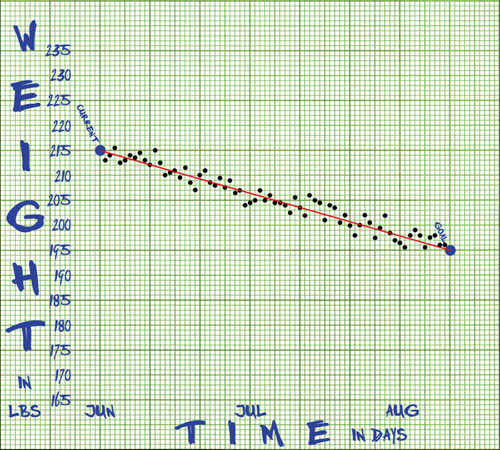
“All that you need for my diet is graph paper, a ruler, and a pencil,” Steve would explain. “The horizontal axis is time, one line per day. The vertical axis is weight in lbs. You plot your current weight on the left side of the paper. You plot your desired weight on a desired date towards the right side, making sure that you’ve left the correct number of lines in between (one per day). You draw a line from the current weight/date to the desired weight/date. Every morning you weigh yourself and plot the result. If the point is below the line, you eat whatever you want all day. If the point is above the line, you eat nothing but broccoli or some other low-calorie food.”
The resulting graph would look something like this:
Ben Leventhal on how to become a regular at a restaurant.
Restaurants may be the only place on earth where the last impression is the most important. Admit it: Your opinion can be swayed, or at least rescued, by excellent desserts. Similarly, it’s true for the house, and if you make a strong exit, they’ll remember you next time on the way in. So, in addition to the aforementioned good tip, this means a few things: When you sense the restaurant wants the table back, give it to them (once you’re a Regular, you’ll have the corner booth for as long as you need it). Thank your server by name if he or she is in earshot when you get up to leave.
As noted in the comments, it’s best not to try all of these at once, but this is pretty solid advice.
Simple video of a burger, fries, and a drink, right? Well, just watch until about 28 seconds in.
Food stylists, your days are numbered…some intern at Pixar is gunning for your job. (via red)
Fast food spokespersons as mob bosses.

Threadcakes is a contest that turns Threadless t-shirt designs into cakes. Ooh, do this one. (via waxy)
Update: Yes! (thx, andy)
Those spinning meat cylinders and the sandwiches that emerge from them…where did they come from? From something like this factory in Chicago.
The process starts with boxes of raw beef and lamb trimmings, and ends with what looks like oversized Popsicles the shade of a Band-Aid. In between, the meat is run through a four-ton grinder, where bread crumbs, water, oregano and other seasonings are added. A clumpy paste emerges and is squeezed into a machine that checks for metal and bone. (“You can never be too careful,” Mr. Tomaras said.) Hydraulic pressure — 60 pounds per square inch — is used to fuse the meat into cylinders, which are stacked on trays and then rolled into a flash freezer, where the temperature is 20 degrees below zero.
But forget how they’re made…how do you pronounce the damn word? The article gives what I would guess is the proper pronounciation of gyro: YEE-ro. I’ve ordered gyros using this pronounciation and have sometimes gotten confused looks in return. Alternate pronounciations that have worked in various situations include YUR-o, GEE-ro, JI-ro, and GUY-ro. The last pronounciation somehow seems the least correct to me but yields the best results. Somehow tzatziki is a lot easier.
Challenged to enjoy the food at The Cheesecake Factory, Michael Ruhlman finds some good dishes and a not so good overall impression.
The fact that any of the 146 [Cheesecake Factory restaurants] around the country can put out this astonishing variety of food is an impressive work of corporate organization and efficiency.
David Chang and Wylie Dufresne will be hosting a series of dinners at their restaurants featuring the talents of some of France’s up-and-coming chefs. It’s part of a number of events put on by Omnivore, a French restaurant guide.
There will also be one large meal, a free picnic in Central Park where eight chefs will each contribute a dish to what Luc Dubanchet, the founder of Omnivore, calls a “bento box performance.” Then there will be a series of demonstrations at the Alliance Francaise, master classes held by an impressive roster of French and American chefs (the final program is still being decided).
Love this: the chefs at Fancy Fast Food take fast food items and reformulate them into more delectable looking dishes. Here is just a portion of the directions for turning a White Castle meal into a tasty looking assortment of tapas.
Next, deconstruct everything and separate them into separate plates: french fries, onion rings, fried clams, beef patties, buns, cheese, bacon, and chicken. Using a paper towel, squeeze and dab each bun dry of its oil and ketchup. Then place all the buns on a baking sheet and bake them for ten minutes in a pre-heated oven at 400° F.
Meanwhile, using a food processor, blend the french fries into a pulp with a little water. Do the same with the beef (no water necessary) until it’s ground and moldable. Hand-roll the ground beef into meatballs, then pan-fry them until they start to brown.
(thx, paul)
Last night I found out about the most amazing load of crap I have ever heard of: breatharianism, a extreme diet whose most dedicated followers claim to subsist on air only. There are a number of variations on this basic theme but perhaps the most colorful breatharian is Wily Brooks. From Wikipedia:
Wiley Brooks is a purported breatharian, and founder of the “Breatharian Institute of America”. He was first introduced to the public in 1980, when he appeared on the TV show That’s Incredible!. Wiley has stopped teaching in recent years, so he can “devote 100% of his time on solving the problem as to why he needed to eat some type of food to keep his physical body alive and allow his light body to manifest completely.” Wiley Brooks believes that he has found “four major deterrents” which prevented him from living without food: “people pollution”, “food pollution”, “air pollution” and “electro pollution”. In 1983 he was allegedly observed leaving a Santa Cruz 7-Eleven with a Slurpee, hot dog and Twinkies.
He told Colors magazine in 2003 that he periodically breaks his fasting with a cheeseburger and a cola, explaining that when he’s surrounded by junk culture and junk food, consuming them adds balance. On his website, Brooks explains that his future followers must first prepare by combining the junk food diet with the meditative incantation of five magic “fifth-dimensional” words which appear on his website. In the “Question and Answer” section of his website, Brooks explains that the “Double Quarter-Pounder with Cheese” meal from McDonald’s possesses a special “base frequency” and that he thus recommends it as occasional food for beginning breatharians. He then goes on to reveal that the secret of Diet Coke is “liquid light”. Prospective disciples are asked after some time on this junk food/magic word preparation to revisit his website in order to test if they can feel the magic.
He further mentions that those interested can call him on his fifth-dimensional phone number in order to get the correct pronunciation of the five magic words. In case the line is busy, prospective recruits are asked to meditate on the five magic words for a few minutes, and then try calling again; he does not explain how anyone can meditate with words they cannot yet pronounce. Brooks’s “institute”, in the past, charged varying fees to prospective clients who wished to learn how to live without food, which ranged from US$15 million to $25 million. These charges have historically been presented as limited time offers exclusively for billionaires, New lower fees have been set to $10,000 with an initial deposit of $2,000.
He wants to consume only air but can’t stop eating McDonald’s hamburgers! Diet Coke is liquid light! My impulse is to say “you just can’t make this stuff up, folks” but that’s obviously not true. Kinda makes you want to start your own completely implausible religion, doesn’t it? (thx, andy)
Global Street Food is an exhibition the various contraptions people use to make and sell food on the street.

“Global Street Food” is dedicated to the fascination with improvised kitchens in public places. Urban fast food stations navigating the contrast between pragmatic dilettantism and complexity in the smallest of spaces. Mike Meiré will be presenting several objects and street kitchens from different parts of the world in the Buckmneister Fuller Dome. An exhibition depicting the sculptural quality of authentic objects and their cultural identity
(via today and tomorrow)
Newer posts
Older posts





Socials & More