


Mellwood Whisky
We just found this old bottle of Mellwood Whisky in Meg’s grandparents’ pantry. No date or anything on the label. Anyone know anything about it? I suspect it’s at least 50 years old…would it still be drinkable or would we go blind?

This site is made possible by member support. 💞
Big thanks to Arcustech for hosting the site and offering amazing tech support.
When you buy through links on kottke.org, I may earn an affiliate commission. Thanks for supporting the site!
kottke.org. home of fine hypertext products since 1998.
Beloved by 86.47% of the web.
We just found this old bottle of Mellwood Whisky in Meg’s grandparents’ pantry. No date or anything on the label. Anyone know anything about it? I suspect it’s at least 50 years old…would it still be drinkable or would we go blind?
Paul Greenberg explores the current state of fishing for bluefin tuna and it’s not looking good.
Tuna then are both a real thing and a metaphor. Literally they are one of the last big public supplies of wild fish left in the world. Metaphorically they are the terminus of an idea: that the ocean is an endless resource where new fish can always be found. In the years to come we can treat tuna as a mile marker to zoom past on our way toward annihilating the wild ocean or as a stop sign that compels us to turn back and radically reconsider.
Greenberg has written extensively on this and related topics in his forthcoming book, Four Fish. Humans have primarily selected four mammals (cows, pigs, sheep and goats) and four birds (chickens, turkeys, ducks and geese) to utilize for food, and are now in the process of choosing four fish (cod, salmon, tuna, and bass).
From a collection of old menus from Colorado, the 1892 menu from a Denver restaurant called The Boston Bakery and Lunch Room (For Ladies and Gents).
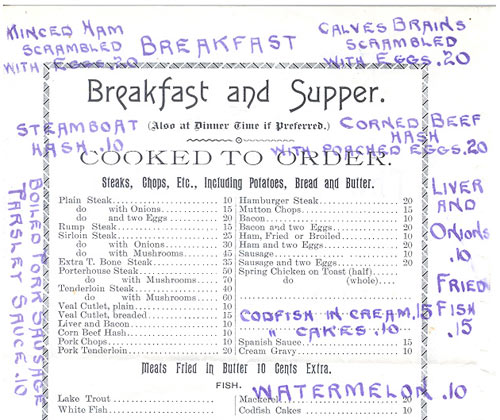
Porterhouse steak with mushrooms: 70 cents. This particular menu also contains a sort of customer bill of rights: an explanation of how waiters should treat customers and how the restaurant will catch you if you try to skip out on your check.
Now, we want your trade, and we do not care whether your check is 5¢ or $5; you will be rightly treated and correctly waited upon, or we will know the reason why, if you will only report any neglect to the head waiter or to us before leaving your seat.
The waiters are instructed to be civil and polite to every one, whether they are so to them or not, for even should the customer use bad manners, the waiter must not.
Have no conversation with the customer, except what is strictly necessary.
Give everyone a napkin who asks for it.
p>Give each one a glass of water as soon as seated.Be as quick and quiet as possible.
Place the orders down quietly; don’t slam them down.
Give each customer a check as son as you serve the order and see that it is kept in sight. Very few beats come in here, but experience has taught us that there are some. We will give any waiter $2.00 who will give us information that will enable us or the head waiter to detect any one in the act of Check Beating.
We want to call the customer’s attention to the fact that when we are looking at your checks and orders, it is as much to see that you are rightly served and not over-checked as that your not under-checked. Most would understand this but some might not.
See also the NYPL menu collection. (thx, micah)
Chinese masons used to make mortar using sticky rice. The practice originated at least 1500 years ago.
The secret ingredient that makes the mortar so strong and durable is amylopectin, a type of polysaccharide, or complex carbohydrate, found in rice and other starchy foods, the scientists determined. The mortar’s potency is so impressive that it can still be used today as a suitable restoration mortar for ancient masonry.
(via history blog)
A new Subway has recently opened in Manhattan…hanging on the outside of the 27th floor of the skeleton of 1 World Trade Center. The Subway will move upwards as the building is constructed and it is hoped that construction workers will dine there instead of heading off-site for long lunches via a slow hoist.
“I don’t think the veggies will be a big seller,” said Mr. Schragger, who owns four other Subways in Manhattan. “I imagine most of the guys will want protein. Philly Cheesesteaks and the Feast.”
Philly Cheesesteaks and the Feast would be a great name for a band.
I’ve only had a few of these…I am clearly not exercising my sandwich muscles enough these days. (Although the Brazilian sandwich at Project Sandwich has been treating me well lately.)
The manner in which tortillas and other bread are made in Mexico has had far-reaching societal effects.
Of course, there are trade-offs. Bimbo is not as good as a bolillo. A machine-made tortilla is not anything like a homemade tortilla — it’s not even in the same universe.
Mexican women that I have talked to are very explicit about this trade-off. They know it doesn’t taste as good; they don’t care. Because if they want to have time, if they want to work, if they want to send their kids to school, then taste is less important than having that bit of extra money, and moving into the middle class. They have very self-consciously made this decision. In the last ten years, the number of women working in Mexico has gone up from about thirty-three percent to nearly fifty percent. One reason for that-it’s not the only reason, but it is a very important reason-is that we’ve had a revolution in the processing of maize for tortillas.
This blog post and accompanying videos show you how to preheat your frying pan to the precise temperature at which your food won’t stick. It involves waiting until a small splash of water in the pan forms a single mercury-like ball that floats (literally!) around the pan. Too hot and the water will disperse into smaller balls; too cold and it’ll just boil off instantly.
The water “hovering” over the stainless steel pan like mercury happens due to the phenomenon known as the Leidenfrost effect. You can read more about it on wikipedia, but the basic idea is this: at a certain temperature known as the Leidenfrost point (roughly around 320F for water, but varying with surface and pressure), when the water droplet hits the hot pan, the bottom part of the water vaporizes immediately on contact. The resulting gas actually suspends the water above it and creates a pocket of water vapor that slows further heat transfer between the pan and the water. Thus it evaporates more slowly than it would at lower temperatures. At the proper temperature, a similar effect happens with the food you place in the pan, preventing the food from sticking.
This is possibly the best kitchen tip I’ve ever heard. (thx, jim)
My wife ate some pine nuts a few days ago and has had a weird metallic taste in her mouth ever since.
Monday for lunch I ate the leftovers, including a bunch of whole pine nuts that had fallen to the bottom of the dish. By Tuesday evening I had a weird taste in the back of my throat, so weird that when I when I woke up during the night, I couldn’t get back to sleep.
The taste was so bad that she doesn’t really feel like eating anything. That got me thinking: the pine nut diet. When you need to drop some pounds, eat a few of the offending pine nuts and boom!, eat as much as you want…as long as you can stand the taste.
P.S. Meg’s back to blogging over at Megnut.
It involves finagling some uncooked frozen fries from a local McDonald’s under the ruse of a scavenger hunt. Kenji Lopez-Alt explains.
I’ve been literally giddy with the quality of the fries that have been coming out of my kitchen for the last two days. My wife won’t hear the end of it. Even my puppy is wondering why his owner keeps exclaiming “Holy s**t that’s good!” every half hour from the kitchen. I’ve cooked over 43 batches of fries in the last three days, and I’m happy to report that I’ve finally found a way to consistently reach crisp, golden Nirvana.
Here’s the full recipe/instructions. BTW, Kenji’s series of posts on Serious Eats is one of the best things going on the web right now (you might remember his sous-vide in a beer cooler hack). Passionate down-to-earth writing about cooking and food backed by some serious skills and scientific knowledge…it’s really fun to read.
Don’t let the title of the article (“How to be a food snob”) throw you off; it offers solid advice for anyone who wants to enjoy eating more.
Keep a food diary not of what you eat but what you experience. She says, “There’s a pretty big difference between eating and tasting.”
What she means is considering and taking note of the entire experience of tasting: The way the food feels in your mouth, what your beer smells like cold and if it’s different when it’s lukewarm, what you notice with the first piping-hot bite of sauce compared with the last chilled streaks you scrape up before the server takes the plate. Do you feel one sensation more than others as you chew, a citrusy tingle at first, followed by rush of sweet?
(via @tcarmody)
A restaurant owner opines on the importance of the dining experience.
Mr. Marzovilla welcomes young children at his restaurant, even discounts their meals on Sunday evenings, and is not above serving a simple appetizer portion of pasta to please little ones. But he has strong opinions about food, and about the messages parents convey to their offspring through what they eat. Children’s menus aim too low, he argues — they’re a parenting crutch.
Changes in regulations governing school vending machines by states like New York and California are making healthy options more prominent. This is a good thing.
This spring the Alliance for a Healthier Generation reported an 88 percent decrease in beverage calories shipped to schools from the first half of 2004-05 to 2009-10, mostly due to calorie reformulations and reduced container sizes.
(via Carrie Becker)
Grant Achatz, Nick Kokonas, and his team are opening a restaurant called Next:
No reservations…you have to buy tickets, like for a play or a ballgame.
Your tickets will be fully inclusive of all charges, including service. Ticket price will depend on which seating you buy — Saturday at 8 PM will be more expensive than Wednesday at 9:30 PM. This will allow us to offer an amazing experience at a very reasonable price. We will also offer an annual subscription to all four menus at a discount with preferred seating.
The menu changes four times a year and each menu will be influenced by a particular place and time (Paris 1912, Hong Kong 2036). A Mad Men-era NYC menu please?
It’s no secret that I could watch food-sorting robots all day. This salami sorter is no exception:
The good stuff starts around 55 seconds.
Socials & More