From Alex Vitale, author of The End of Policing, a list of 10 Ways To Reduce Our Reliance On Policing And Make Our Communities Safer For Everyone, which includes proposals like having mental health and social workers to respond to crises, have crime labs operate independently of law enforcement, and replacing cops in schools with counselors & safety coaches.
For children growing up during the era of mass incarceration, seeing armed officers in their schools is commonplace. Federal grants have supported more and more cops in schools. Federal programs like the Community Oriented Policing Services (“COPS”) have provided millions of dollars to hire and train local police, including police in schools.
Police officers do not have specialized training in adolescent or childhood development. They are not mental health experts, social workers with licensed degrees, psychologists, or school counselors. They are not educators. To be clear, school resource officers are career law enforcement officers, with arresting authority, and a license to carry a weapon. Police officers patrol school hallways just like they do city streets. More than one and a half million students attend schools with an SRO, but no counselor.
There are better, safer, and cheaper alternatives. In 2016, Intermediate School District 287, a school west of the Twin Cities with a high concentration of students with special needs and mental health needs that can result in behavior issues, replaced their school resource officers with Student Safety Coaches. The Student Safety Coaches specialize in mental health, restorative justice, de-escalation, and building positive relationships with their students. Arrests decreased by 80 percent in the pilot school after implementation of the program.
The common, and commonsense, thread through all of these proposals is to replace armed, untrained responders who make difficult situations less safe with people & organizations that are specifically trained to help people in distress or crisis.
See also Police Abolition: The Growing Movement to Defund the Police.
In recent weeks as antiracism and anti-police violence protests continue around the country, the movement to defund and abolish policing in America has rapidly gained momentum. As Black communities have asserted for decades, people have begun to wonder in earnest what purpose police serve. They’re asking when there’s a problem in our communities, do we really need a person with a gun showing up to solve it? What would a system oriented around public safety look like if it was designed from scratch rather than just piling more responsibility onto and funding into increasingly militarized and unaccountable police departments?
There are a lot of resources out there about police abolition right now, so here are some that I’ve found helpful in understanding it.
Alex Vitale’s The End of Policing, which came out in 2017, is a well-reviewed critique of modern policing.
This book attempts to spark public discussion by revealing the tainted origins of modern policing as a tool of social control. It shows how the expansion of police authority is inconsistent with community empowerment, social justice — even public safety. Drawing on groundbreaking research from across the world, and covering virtually every area in the increasingly broad range of police work, Alex Vitale demonstrates how law enforcement has come to exacerbate the very problems it is supposed to solve.
In contrast, there are places where the robust implementation of policing alternatives—such as legalization, restorative justice, and harm reduction — has led to a decrease in crime, spending, and injustice. The best solution to bad policing may be an end to policing.
Verso, the book’s publisher, is offering the ebook version for free for a limited time. The Paris Review has an excerpt that addresses the difficulties with reforms (such as the #8cantwait initative):
This does not mean that no one should articulate or fight for reforms. However, those reforms must be part of a larger vision that questions the basic role of police in society and asks whether coercive government action will bring more justice or less. Too many of the reforms under discussion today fail to do that; many further empower the police and expand their role. Community policing, body cameras, and increased money for training reinforce a false sense of police legitimacy and expand the reach of the police into communities and private lives. More money, more technology, and more power and influence will not reduce the burden or increase the justness of policing. Ending the War on Drugs, abolishing school police, ending broken-windows policing, developing robust mental health care, and creating low-income housing systems will do much more to reduce abusive policing.
The Intercept interviewed Vitale in October 2017.
We should understand policing as the most coercive form of state power … and the reason is that policing has historically and inherently been at the root of reproducing fundamental inequalities of race, class, and immigration status. Trump, the police, ICE — this is just a continuation of a history of exclusion and repression going back to the exclusion of Chinese immigrants in the 19th century, Texas Rangers driving out Mexican landholders and indigenous populations to make room for white settlers, the transformation of slave patrols and urban slave management systems into what became Jim Crow policing in the South and ghetto policing in the North. Police have historical origins in relation to both the formation and disciplining of the industrial working class; early 19th century forms of policing in Europe and the United States shaped rural agricultural workers into urban industrial workers, and then suppressed their movements to form labor unions and win better living conditions.
The point of all this is to fundamentally question this liberal notion that police exist primarily as a tool for public safety and therefore, we should embrace their efforts uncritically, when in fact, there are lots of different ways to produce safety that don’t come with the baggage of colonialism, slavery, and the suppression of workers’ movements.
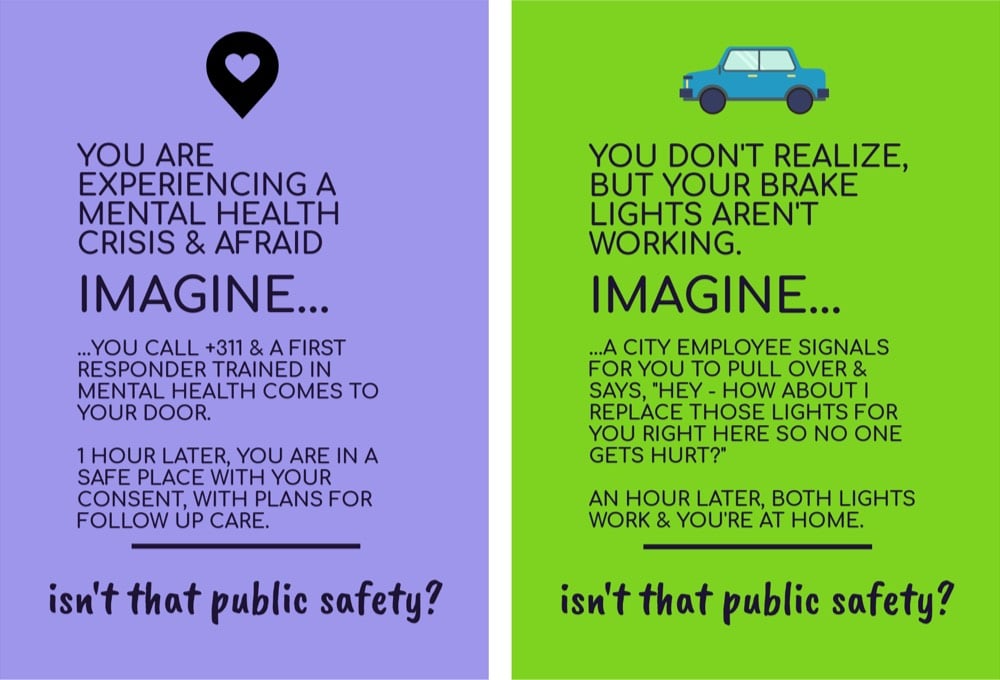
In 2018, Amber Hughson designed a series of flyers outlining some alternatives to policing. The “Isn’t this public safety?” question at the end of each flyer is really compelling.
Christy Lopez (co-director of Georgetown Law School’s Innovative Policing Program) writing in The Washington Post: Defund the police? Here’s what that really means.
To fix policing, we must first recognize how much we have come to over-rely on law enforcement. We turn to the police in situations where years of experience and common sense tell us that their involvement is unnecessary, and can make things worse. We ask police to take accident reports, respond to people who have overdosed and arrest, rather than cite, people who might have intentionally or not passed a counterfeit $20 bill. We call police to roust homeless people from corners and doorsteps, resolve verbal squabbles between family members and strangers alike, and arrest children for behavior that once would have been handled as a school disciplinary issue.
Police themselves often complain about having to “do too much,” including handling social problems for which they are ill-equipped. Some have been vocal about the need to decriminalize social problems and take police out of the equation. It is clear that we must reimagine the role they play in public safety.
MPD150, a grassroots organization working towards a police-free Minneapolis, has a bunch of resources on their website, including What are we talking about when we talk about “a police-free future?” and an 8-page FAQ zine for folks trying to get up to speed on police abolition.
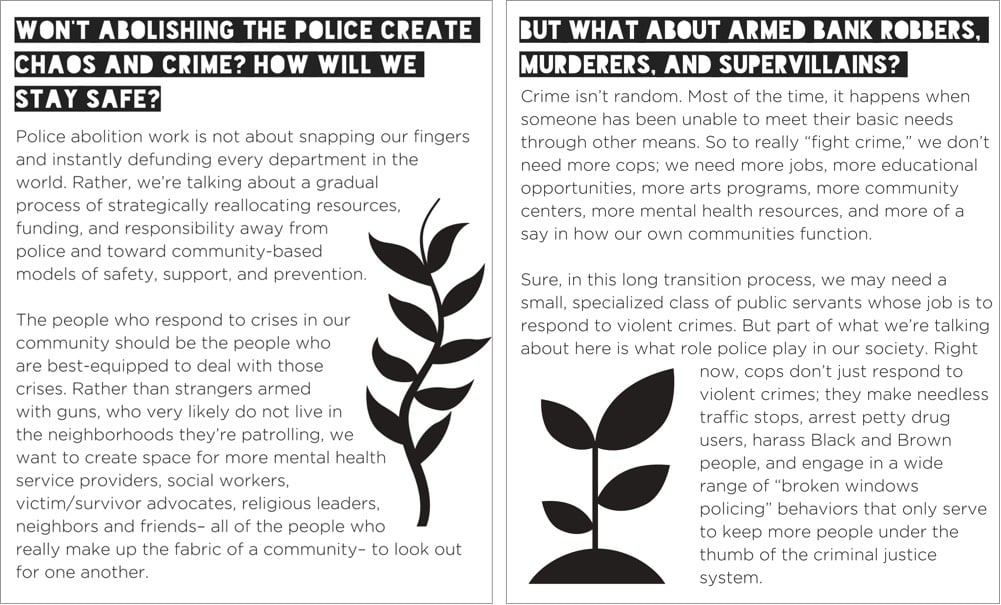
Many people already live in a world without police. If you grew up in a well-off, predominantly white suburb, how often did you interact with cops? Communities with lots of good jobs, strong schools, economies, and social safety nets are already, in some ways, living in a world without police.
Annie Lowrey makes a fiscal argument in Defund the Police.
A thin safety net, an expansive security state: This is the American way. At all levels of government, the country spends roughly double on police, prisons, and courts what it spends on food stamps, welfare, and income supplements. At the federal level, it spends twice as much on the Pentagon as on assistance programs, and eight times as much on defense as on education. The wars in Iraq and Afghanistan will ultimately cost something like $6 trillion and policing costs $100 billion a year. But proposals to end homelessness ($20 billion a year), create a universal prekindergarten program ($26 billion a year), reduce the racial wealth gap through baby bonds ($60 billion a year), and eliminate poverty among families with children ($70 billion a year) somehow never get financed. All told, taxpayers spend $31,286 a year on each incarcerated person, and $12,201 a year on every primary- and secondary-school student.
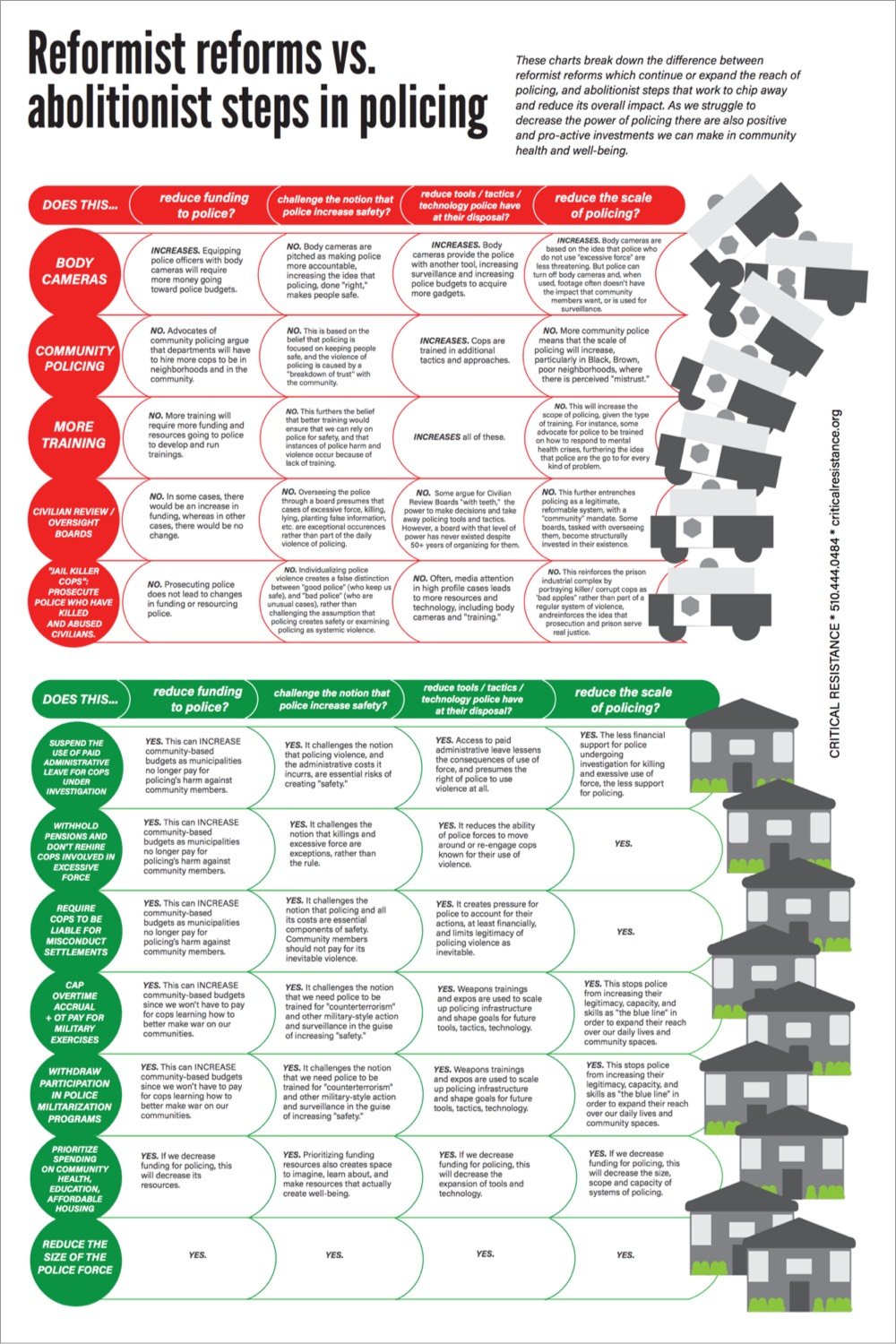
Critical Resistance has a police abolition resources page that many activists are recommending, including this toolkit and this chart comparing reforms vs abolition.
The Marshall Project is maintaining a collection of links about police abolition.
I liked the framing of this Twitter thread by Gabrielle Blair:
This is how I, a 45-year-old white woman and mother of 6, currently at her peak Karen power, went from assuming police work was a necessary part of functional communities, to becoming a passionate advocate for #abolishthepolice #defundthepolice, over the course of one week.
She continues:
“I suppose it is tempting, if the only tool you have is a hammer, to treat everything as if it were a nail.” Do you know that saying? Apply it to police. If you’re always prepared to easily inflict violence, then the chances of inflicting unwarranted violence go way up.
Cat in a tree? Got locked out of your car? Kids prank called 911? Found a brutally murdered body? When called, police will arrive at all four of these scenes equally armed to the teeth. Why would we ever be okay with that? It is INSANE.
Vox’s podcast Today, Explained did an episode on What “abolish the police” means. From the transcript:
SEAN: And for the people who are worried about how this you know, how this might affect the way our society functions, like, let’s just say, you know, it’s a Friday night, 4th of July or something like that, like like the Fourth of July. That’s coming up real soon. And, you know, you’re worried about drunk drivers on the road. Who’s getting your back on drunk drivers?
BRANDON: You’re going to be able to call the police. The police are still going to be out there enforcing traffic violations, maybe not with weapons, though, maybe they have some other tools to de-escalate situations.
SEAN: And what about, like, you’re scared that this jilted ex lover of yours is going to come after you and kill you? Same situation?
BRANDON: You know, we can continue to go through these hypotheticals. I want to be very clear here. Police don’t listen to black women as it exists today. Black women are often the victims of sexual assault, sexual violence, and they are not listened to. They’re not deemed credible by police officers. So we’ve got to ask yourself, is policing working? Maybe it’s working for certain communities, white communities in particular. Now, police are going to be there when you call and say, hey, look, there’s someone harassing me. They’re going to have the better trained police officer come and diffuse the situation if the perpetrator is still there.
I have not listened to this yet, but next up in my podcast queue is a two-episode series of Intercepted with host Chenjerai Kumanyika and long-time prison abolitionist Ruth Wilson Gilmore.
Journalist and lawyer Josie Duffy Rice:
many people in america already exist in a world where police and prisons do not exist. go to any middle to upper class suburb in america. cops arent wandering the streets. people aren’t being arrested. neighbors aren’t being sent to prison. and generally everyone is….fine.
many people say they cannot imagine this world. what most of them cannot imagine is someone not policing black brown and poor people. THAT is what is unimaginable to them. not the absence of law enforcement. if you are lucky, you already functionally live with that absence.
Garrett Felber details the history of the police and prison abolition movements that stretch back for decades: The Struggle to Abolish the Police Is Not New.
Although abolition was not a central demand of the midcentury civil rights movement — despite informing the activism of many of its key figures — it took hold in the 1970s. This revolutionary ethos — what Chicano poet Raul Salinas called the “prison rebellion years” — was linked to mass uprisings in the streets; the state repression, jailing, and murder of black and brown radicals; and opposition to the Vietnam War and imprisonment of conscientious objectors. Quaker Fay Honey Knopp’s pivotal 1976 Instead of Prisons: A Handbook for Prison Abolitionists, for example, had its genesis in her visits to conscientious objectors in prison during the Vietnam War and her participation in feminist, civil rights, gay rights, and prisoners’ rights struggles.
Update: Abolition activist Mariame Kaba writes in a NY Times opinion piece: Yes, We Mean Literally Abolish the Police.
Minneapolis had instituted many of these “best practices” but failed to remove Derek Chauvin from the force despite 17 misconduct complaints over nearly two decades, culminating in the entire world watching as he knelt on George Floyd’s neck for almost nine minutes.
Why on earth would we think the same reforms would work now? We need to change our demands. The surest way of reducing police violence is to reduce the power of the police, by cutting budgets and the number of officers.
But don’t get me wrong. We are not abandoning our communities to violence. We don’t want to just close police departments. We want to make them obsolete.
We should redirect the billions that now go to police departments toward providing health care, housing, education and good jobs. If we did this, there would be less need for the police in the first place.
Confessions of a Former Bastard Cop is an essay allegedly written by a former police officer with ten years of experience in “a major metropolitan area in California with a predominantly poor, non-white population”. In it, he attempts to explain the system under which cops are trained and operate, “not to excuse their behavior, but to explain it and to indict the structures that perpetuate it.” At the very least, this essay corroborates what activists have been saying about the police for decades.
I could write an entire book of the awful things I’ve done, seen done, and heard others bragging about doing. But, to me, the bigger question is “How did it get this way?”. While I was a police officer in a city 30 miles from where I lived, many of my fellow officers were from the community and treated their neighbors just as badly as I did. While every cop’s individual biases come into play, it’s the profession itself that is toxic, and it starts from day 1 of training.
Every police academy is different but all of them share certain features: taught by old cops, run like a paramilitary bootcamp, strong emphasis on protecting yourself more than anyone else. The majority of my time in the academy was spent doing aggressive physical training and watching video after video after video of police officers being murdered on duty.
I want to highlight this: nearly everyone coming into law enforcement is bombarded with dash cam footage of police officers being ambushed and killed. Over and over and over. Colorless VHS mortality plays, cops screaming for help over their radios, their bodies going limp as a pair of tail lights speed away into a grainy black horizon. In my case, with commentary from an old racist cop who used to brag about assaulting Black Panthers.
And this, uh, training doesn’t prepare officers for what their actual job ends up being:
And consider this: my job as a police officer required me to be a marriage counselor, a mental health crisis professional, a conflict negotiator, a social worker, a child advocate, a traffic safety expert, a sexual assault specialist, and, every once in awhile, a public safety officer authorized to use force, all after only a 1000 hours of training at a police academy. Does the person we send to catch a robber also need to be the person we send to interview a rape victim or document a fender bender? Should one profession be expected to do all that important community care (with very little training) all at the same time?
To put this another way: I made double the salary most social workers made to do a fraction of what they could do to mitigate the causes of crimes and desperation. I can count very few times my monopoly on state violence actually made our citizens safer, and even then, it’s hard to say better-funded social safety nets and dozens of other community care specialists wouldn’t have prevented a problem before it started.
Armed, indoctrinated (and dare I say, traumatized) cops do not make you safer; community mutual aid networks who can unite other people with the resources they need to stay fed, clothed, and housed make you safer. I really want to hammer this home: every cop in your neighborhood is damaged by their training, emboldened by their immunity, and they have a gun and the ability to take your life with near-impunity. This does not make you safer, even if you’re white.
His conclusion: “consider abolishing the police” and “creating a society focused on reconciliation and restorative justice instead of punishment, pain, and suffering — a system that sees people in crisis as humans, not monsters”.
As someone who did it for nearly a decade, I need you to understand that by and large, police protection is marginal, incidental. It’s an illusion created by decades of copaganda designed to fool you into thinking these brave men and women are holding back the barbarians at the gates.
In 1971, Richard Nixon kicked off America’s “war on drugs”, focusing not on the societal problems that lead to drug abuse but on categorizing drug users as criminals.
In Nixon’s eyes, drug use was rampant in 1971 not because of grand social pressures that society had a duty to correct, but because drug users were law-breaking hedonists who deserved only discipline and punishment.
Over the next several decades, the US government (and particularly Ronald Reagan) took Nixon’s lead and imprisoned millions of people for drug offenses, including a disproportionate number of Black men. Michelle Alexander wrote about this in her 2010 book The New Jim Crow. From the about page:
Alexander shows that, by targeting black men through the War on Drugs and decimating communities of color, the U.S. criminal justice system functions as a contemporary system of racial control, even as it formally adheres to the principle of colorblindness.
In 1994, former Nixon aide and Watergate co-conspirator John Ehrlichman proudly told writer Dan Baum that racial control and discrimination was in fact the purpose of the war on drugs.
At the time, I was writing a book about the politics of drug prohibition. I started to ask Ehrlichman a series of earnest, wonky questions that he impatiently waved away. “You want to know what this was really all about?” he asked with the bluntness of a man who, after public disgrace and a stretch in federal prison, had little left to protect. “The Nixon campaign in 1968, and the Nixon White House after that, had two enemies: the antiwar left and black people. You understand what I’m saying? We knew we couldn’t make it illegal to be either against the war or black, but by getting the public to associate the hippies with marijuana and blacks with heroin, and then criminalizing both heavily, we could disrupt those communities. We could arrest their leaders, raid their homes, break up their meetings, and vilify them night after night on the evening news. Did we know we were lying about the drugs? Of course we did.”
An astonishing thing to admit but hardly a rare tactic for the cynical Republican Party. See also how they decided to champion abortion as an issue to attract the support of white evangelical Christians and shifted from indifference to scientific denialism on climate change in order to oppose the Obama administration and advance the interests of wealthy donors.
Thanks to Ibram X. Kendi’s How to Be an Antiracist for reminding me of Ehrlichman’s admission.
BuzzFeed’s Melissa Segura writes that the political ideologies of police unions moved further to the right in response to calls for reform from the Obama administration and groups like Black Lives Matter, resulting in increasing violence and a lack of accountability & consequences for police.
Like in Minneapolis, police unions across the country have bucked reforms meant to promote transparency and racial equity in law enforcement. Many of these unions have pushed collective bargaining agreements that make it all but impossible for departments to punish, much less fire, officers. These agreements defang civilian review boards and police internal affairs departments, and they even prevent police chiefs from providing meaningful oversight, according to community activists and civil rights lawyers. Meanwhile, the unions have set up legal slush funds to defend officers sued for misconduct.
I mean, this stuff is just cartoonishly maddening:
More than a year before a Minneapolis police officer, Derek Chauvin, pinned George Floyd to the ground in a knee chokehold, Mayor Jacob Frey banned “warrior” training for the city’s police force.
Private trainers across the country host seminars, frequently at taxpayer expense, teaching “killology” and pushing the notion that if officers aren’t willing to “snuff out a life” then they should “consider another line of work.” Frey explained that this type of training — which has accompanied the increasing militarization of the police over the last few decades — undermined the community-based policing he wanted the city to adopt after a string of high-profile killings in the region.
But then the police union stepped in.
The Police Officers Federation of Minneapolis worked out a deal with a company to offer warrior training. For free. For as long as Frey was mayor.
See also James Surowiecki’s 2016 New Yorker piece, Why Are Police Unions Blocking Reform?
For the past fifty years, police unions have done their best to block policing reforms of all kinds. In the seventies, they opposed officers’ having to wear name tags. More recently, they’ve opposed the use of body cameras and have protested proposals to document racial profiling and to track excessive-force complaints. They have lobbied to keep disciplinary histories sealed. If a doctor commits malpractice, it’s a matter of public record, but, in much of the country, a police officer’s use of excessive force is not. Across the nation, unions have led the battle to limit the power of civilian-review boards, generally by arguing that civilians are in no position to judge the split-second decisions that police officers make. Earlier this year, Newark created a civilian-review board that was acclaimed as a model of oversight. The city’s police union immediately announced that it would sue to shut it down.
(via @torrHL)
Update: I forgot to include this thread from Minneapolis City Council member Steve Fletcher about how difficult it has been to enact policing reforms in the city.
I want to be clear: I am about as pro-union as a person can be. The Police Federation should not be thought of as a union. They do not affiliate with the AFL-CIO. They don’t walk picket lines in solidarity. How do I know? Because I do and I’ve never seen them on a line. Not once.
Instead, they distort hard-earned labor laws to defend indefensible behaviors. The City recently lost an arbitration after Chief Arradondo fired a cop for beating someone while in handcuffs. Kroll, on behalf of rank and file MPD, pressed the case and won that officer’s job back.
And then he calls the police department a “protection racket”:
Politicians who cross the MPD find slowdowns in their wards. After the first time I cut money from the proposed police budget, I had an uptick in calls taking forever to get a response, and MPD officers telling business owners to call their councilman about why it took so long.
We pay dearly for public safety: $195 million a year plus extensive, expensive legal settlements. That should buy us more than a protection racket that’ll take it out on our constituents if we try to create accountability.
(via @alopexfoxy)
Nick Baumann on the militarization of the American police:
“You create this world where you’re not just militarizing the police — you equip the police like soldiers, you train the police like soldiers. Why are you surprised when they act like soldiers?” Rizer, a former police officer and soldier, said. “The mission of the police is to protect and serve. But the premise of the soldier is to engage the enemy in close combat and destroy them. When you blur those lines together with statements like that … It’s an absolute breakdown of civil society.”
American police officers generally believe that carrying military equipment and wearing military gear makes them feel like they can do more, and that it makes them scarier, Rizer’s research has found. Officers even acknowledge that acting and dressing like soldiers could change how the public feels about them. But “they don’t care,” he said.
In 2015, after the militarized police response to the protests in Ferguson, Mo., President Obama restricted the sales of military equipment by the Pentagon to police departments.
Mr. Obama ordered a review of the Pentagon program in late 2014 after the police responded to protests with armored vehicles, snipers and riot gear. The images of police officers with military gear squaring off against protesters around the country angered community activists who said law enforcement agencies were reacting disproportionately.
In addition to the prohibitions on certain military surplus gear, he added restrictions on transferring some weapons and devices, including explosives, battering rams, riot helmets and shields.
The Pentagon said 126 tracked armored vehicles, 138 grenade launchers and 1,623 bayonets had been returned since Mr. Obama prohibited their transfer.
In 2017, Donald Trump fully restored the practice of transferring military goods to police, grenade launchers and all.
Update: Would just like to note that the 1033 Program was signed into law by Bill Clinton, has historically enjoyed bipartisan support, and was greatly expanded under Obama.
A recent study show that, under the Pentagon’s 1033 program, enacted in 1997, the value of military weapons, gear and equipment transferred to local cops did not exceed $34 million annually until 2010, the second year of the Obama administration, when it nearly tripled to more than $91 million. By 2014, the year that Michael Brown was shot down — and when the full Congress, including 32 members of the Congressional Black Caucus, rejected a bill that would have shut down the 1033 program — Obama was sending three quarters of a billion dollars, more than $787 million a year, in battlefield weaponry to local police departments. In other words, President Obama oversaw a 24-fold (2,400%) increase in the militarization of local police between 2008 and 2014. Even with the scale-back announced in 2015, Obama still managed to transfer a $459 million arsenal to the cops — 14 times as much weapons of terror and death than President Bush gifted to the local police at his high point year of 2008.
(thx, chuck)
Hi. I wanted to take today to compile a sampling of what Black people (along with a few immigrant and other PoC voices) are saying about the recent murders by police of Breonna Taylor and George Floyd, the murder of Ahmaud Arbery, the threatening of Christian Cooper with police violence by a White woman, the protests in Minneapolis & other places, and the unequal impact of the pandemic on communities of color, as well as what Black voices have said in the past about similar incidents & situations. This is not an exhaustive list of reaction & commentary — it’s just a sample. I’m not going to add anything to these voices, but I will share a few resources at the end of the post.
Please put your urge to judge on the shelf for a minute and just listen to your fellow human beings in all of their raw, righteous, and furious anger. I am trying to listen. Is America finally ready to listen? Are you ready?
Keeanga-Yamahtta Taylor, Of Course There Are Protests. The State Is Failing Black People.
This simultaneous collapse of politics and governance has forced people to take to the streets — to the detriment of their health and the health of others — to demand the most basic necessities of life, including the right to be free of police harassment or murder.
What are the alternatives to protest when the state cannot perform its basic tasks and when lawless police officers rarely get even a slap on the wrist for crimes that would result in years of prison for regular citizens? If you cannot attain justice by engaging the system, then you must seek other means of changing it. That’s not a wish; it’s a premonition.
Keeanga-Yamahtta Taylor again reacting to “American billionaires got $434 billion richer during the pandemic”:
This looting by billionaires is what sets fires and burns down stores. You do not get one without the other.
Jillian Sloane:
I wish America loved black people the way they love black culture.
Martin Luther King, Jr., The Other America (via Paul Octavious):
I think America must see that riots do not develop out of thin air. Certain conditions continue to exist in our society which must be condemned as vigorously as we condemn riots. But in the final analysis, a riot is the language of the unheard. And what is it that America has failed to hear? It has failed to hear that the plight of the Negro poor has worsened over the last few years. It has failed to hear that the promises of freedom and justice have not been met. And it has failed to hear that large segments of white society are more concerned about tranquility and the status quo than about justice, equality, and humanity. And so in a real sense our nation’s summers of riots are caused by our nation’s winters of delay. And as long as America postpones justice, we stand in the position of having these recurrences of violence and riots over and over again. Social justice and progress are the absolute guarantors of riot prevention.
Bakari Sellers (click through to watch the video):
It’s just so much pain. You get so tired. We have black children. I have a 15-year-old daughter. What do I tell her? I’m raising a son. I have no idea what to tell him. It’s just, it’s hard being black in this country when your life is not valued.
Black parents talk to their children about how to deal with the police:
Ruhel Islam, a Bangladeshi immigrant and owner of Gandhi Mahal Restaurant, which burned in Minneapolis:
Let my building burn, Justice needs to be served, put those officers in jail.
DiDi Delgado:
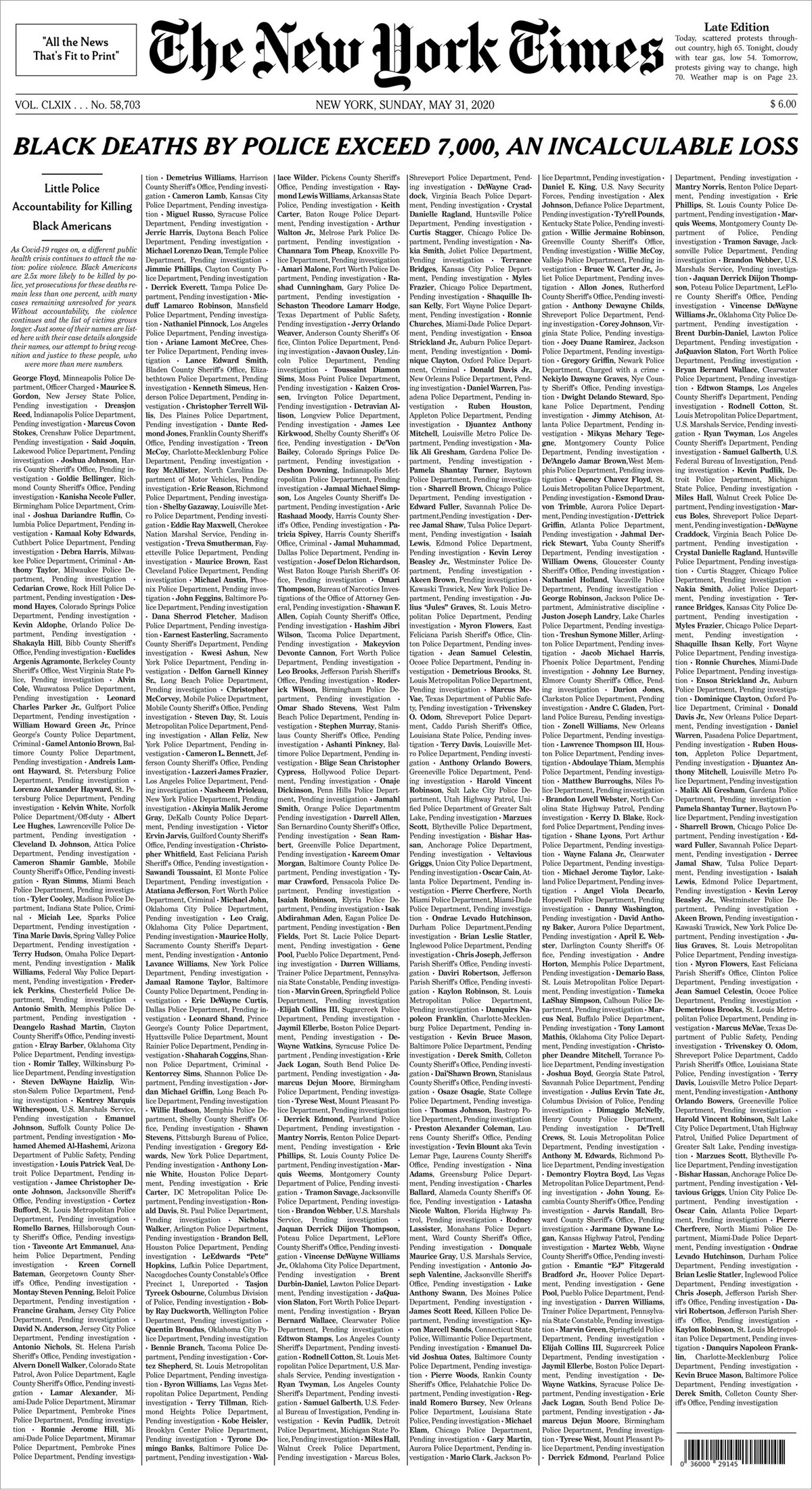
In the time between Eric Garner’s “I can’t breathe” and George Floyd’s “I can’t breathe” police in the United States killed at least (AT LEAST) 5,947 people. #WeCantBreathe
Ella Baker:
Until the killing of black men, black mothers’ sons, becomes as important to the rest of the country as the killing of a white mother’s son, we who believe in freedom cannot rest.
Peter Daou:
America, where it’s okay to kneel on a black man’s neck and murder him, but it’s “unpatriotic” to kneel in protest of that murder.
#BlackLivesMatter #TakeAKnee
Luvvie Ajay, About the Weary Weaponizing of White Women Tears:
White people will never have to deal with the fact that their skin is considered a weapon but they use their skins as ammunition by using all the privileges that come with it to terrorize the world. White women use their tears as pity me bombs all the time and it often instigates Black people being punished.
Ajay again:
I’ve traveled all over the world. And have never felt as unsafe as I do at home, in the United States.
Never.
@jxparisxo:
Can we stop calling it “police brutality” it’s murder, M-U-R-D-E-R
Nikole Hannah-Jones, Yes, Black America Fears the Police. Here’s Why.:
For those of you reading this who may not be black, or perhaps Latino, this is my chance to tell you that a substantial portion of your fellow citizens in the United States of America have little expectation of being treated fairly by the law or receiving justice. It’s possible this will come as a surprise to you. But to a very real extent, you have grown up in a different country than I have.
As Khalil Gibran Muhammad, author of The Condemnation of Blackness, puts it, “White people, by and large, do not know what it is like to be occupied by a police force. They don’t understand it because it is not the type of policing they experience. Because they are treated like individuals, they believe that if ‘I am not breaking the law, I will never be abused.’”
We are not criminals because we are black. Nor are we somehow the only people in America who don’t want to live in safe neighborhoods. Yet many of us cannot fundamentally trust the people who are charged with keeping us and our communities safe.
Jemele Hill:
Trump to the white people with AR-15s throwing a temper tantrum over a haircut — “Liberate”
Trump to those protesting the lack of justice in Minneapolis — “THUGS”
A whole, racist clown.
Tarana Burke:
A few years ago me and dude are out and come back to his car to find it vandalized. He parked by a driveway and partially blocked it and we concluded that the owners had vandalized the car. I get pissed and go knock on the door. They don’t answer so I’m yelling!
He’s telling me to calm down and forget it but I’m pissed! A few minutes later cop car rolls by and they stop and get out. I start to tell them what happened and they walk up on him and immediately start questioning him. I interrupt and say “excuse me HIS car was vandalized!”
The cops tell me to ‘be quiet’ and just as I’m about to turn all the way up on them he turns to me and says “Baby, please…” firmly. Then he calmly answers the cops questions even though they are rude and invasive. They take his license and keep asking ridiculous questions…
“What are you all doing here?”
“Did you get into an altercation earlier tonight?”
“If I knock on these people’s door what are they going to say?”
I was fuming. Now I’m nervous.
Damon Young, Thoughts on Forgiving Amy Cooper (aka ‘Darth Karen’), Who Got Fired, Banned From Central Park, and Lost Her Dog:
LOLOLOLOLOLOLOLOLOLOL…
Ibram X. Kendi (via Nicole Parker):
The greatest white privilege is life itself. People of color are being deprived of life.
Dr. Kendi again:
They say they can’t be racist because they are northerners. They say they can’t be racist because they are progressives. They say they can’t be racist because they are Democrats.
Why are they saying they can’t be racist? Because they are racist.
Dr. Kendi for a third time (he wrote a whole book about moments like these):
It feels like Black people were running for their lives from racist terror only to run into the murderous face of COVID-19, only to start running for their lives from COVID-19 only to run into the murderous face of racist terror.
Maurice Moe Mitchell:
If you have trouble imagining the concept of “police abolition,” look no further than the many live experiments being played out in upper middle class white suburbs across the country where people carry on their lives with little to no interaction with law enforcement.
Ernest Owens, I Have Not Missed the Amy Coopers of the World:
I’m doing better these days because staying home alone and practicing social distancing has meant I’m avoiding many of the racist encounters that used to plague my daily life.
The video that circulated this weekend of a white woman calling the police with a false report about threats by a black man who simply asked her to leash her dog in Central Park illustrates exactly why I’m so happy to be spending more time inside.
Blair Imani:
Murder is worse than property destruction. Every single time. Don’t let capitalism fool you.
Ruby Hamad, A White Damsel Leveraged Racial Power and Failed:
The damsel-in-distress archetype probably conjures up images of delicate maidens and chivalrous gentlemen. That is precisely what it is designed to do — for white people. To people of color, and especially African-Americans who have borne the brunt of her power in the United States, the image is very different. The damsel in distress is an illusion of innocence that deflects and denies the racial crimes of white society.
J. Drew Lanham, Birding While Black:
Up until now the going has been fun and easy, more leisurely than almost any “work” anyone could imagine. But here I am, on stop number thirty-two of the Laurel Falls Breeding Bird Survey (BBS) route: a large black man in one of the whitest places in the state, sitting on the side of the road with binoculars pointed toward a house with the Confederate flag proudly displayed. Rumbling trucks passing by, a honking horn or two, and curious double takes are infrequent but still distract me from the task at hand. Maybe there’s some special posthumous award given for dying in the line of duty on a BBS route-perhaps a roadside plaque honoring my bird-censusing skills.
Tyler Merritt, Before You Call the Cops:
Alexandria Ocasio-Cortez:
I’ll just say it: a lot of politicians are scared of the political power of the police, and that’s why changes to hold them accountable for flagrant killings don’t happen. That in itself is a scary problem.
We shouldn’t be intimidated out of holding people accountable for murder.
Ernest Owens:
BEFORE Y’ALL KEEP GOING: Christian Cooper could have had tattoos on his face, hated birds, been smoking a blunt and listening to Future, and #CentralParkAmy WOULD HAVE STILL BEEN AS GUILTY AND RACIST AND WRONG AF FOR TERRORIZING HIM.
Enough with the respectability politics.
Alicia Crosby:
I really can’t shake how profoundly evil it is to tear gas folks protesting the suffocation of a man by the police during a pandemic driven by a respiratory disease.
Shenequa Golding, Maintaining Professionalism In The Age of Black Death Is….A Lot:
Your black employees are exhausted.
Your black employees are scared.
Your black employees are crying in between meetings.
Your black employees have mentally checked out.
Your black employees are putting on a performance.
Charles Blow, How White Women Use Themselves as Instruments of Terror:
At a time of so much death and suffering in this country and around the world from the Covid-19 pandemic, it can be easy, I suppose, to take any incidents that don’t result in death as minor occurrences.
But they aren’t. The continued public assault on black people, particularly black men, by the white public and by the police predates the pandemic and will outlast it. This racial street theater against black people is an endemic, primal feature of the Republic.
Specifically, I am enraged by white women weaponizing racial anxiety, using their white femininity to activate systems of white terror against black men. This has long been a power white women realized they had and that they exerted.
Michael Harriot (from this thread):
There has NEVER been a successful protest movement in modern history that succeeded without violence.
Not Christianity. Not democracy. Not civil rights.
The choice is, which side is going to do the donate their blood?
We’re damn near out of blood to give.
So, if you want to change the system, history has repeatedly told us how to do it.
Burn.
That.
Shit.
Down.
And amen, motherfuckers.
James Baldwin (see also How to Cool It and, like, everything else Baldwin has ever written or said):
The reason that black people are in the streets has to do with the lives they’re forced to lead in this country. And they’re forced to lead these lives by the indifference and the apathy and a certain kind of ignorance — a very willful ignorance — on the part of their co-citizens.
Several people on social media have pointed to this list of 75 Things White People Can Do for Racial Justice, including several organizations you can donate to. Ibram X. Kendi compiled an antiracist reading list. I am not any sort of expert, but I personally have found much understanding in listening to the Seeing White podcast, reading Isabel Wilkerson’s The Warmth of Other Suns, and watching Eyes on the Prize, I Am Not Your Negro, & OJ: Made in America among other things. Thanks to everyone listed here for sharing their words and works with us.
This is a few years old, but is it ever clever: some thieves in Brazil put an entire fake ATM interface (screen, card reader, keypad) over the real ATM to skim card numbers and PINs.
Krebs on Security wrote up a report on the scheme:
Interestingly, much like grammatical and spelling errors that often give away phishing emails and Web sites, the thieves who assembled the video for the screen for the fake ATM used in the April robbery appear have made a grammatical goof in spelling “país,” the Portuguese word for “country”; apparently, they left off the acute accent.
Most skimming attacks (including the two mentioned here) take place over the weekend hours. Skimmer scammers like to place their devices at a time when they know the bank will be closed for an extended period, and when foot traffic to the machine will be at its highest.
This is like when the T-1000 in Termintor 2 can impersonate any person that it touches, except with cash machines. (I would read a book entirely composed of clever thieves’ inventions and techniques. I assume this already exists?)
Spurred by The Irishman’s take on the matter, Errol Morris, the progenitor of our current obsession with true crime, tackles an enduring mystery: Who Really Killed Jimmy Hoffa?
There is a weird discrepancy about whether the meeting was set for 2:00 or 2:30, but the uncertainty simply contributes to the argument that something strange was going on: Hoffa’s friends and family were incredulous that he would wait any amount of time; he was known to be extremely punctual and intolerant of those who weren’t. What compelled Hoffa to continue to pace around the sweltering asphalt outside the Machus Red Fox? Was he hoping to get high-level Mafia approval of his attempts to regain control of the Teamsters?
What happens next is a matter of conjecture, of inference — a collision between unimpeachable data such as phone calls, the unreliability of witness testimony, and fish-delivery times. We do know several things for certain: there’s a real world out there, a real asphalt parking lot, a real phone booth, and a real Machus Red Fox (now called Andiamo). And Jimmy Hoffa was there, left, and never came back.
If you know Morris, you know he loves ambiguity, so there’s not a 100% ironclad answer to the question posed by the article’s title, but Morris does have a guess in the closing paragraphs.





Socials & More