kottke.org posts about cars
I really enjoyed this piece by John Siracusa about why Apple should continue to make a high-end personal computer (like the Mac Pro) even though it’s not a big seller or hugely profitable. Basically, the Mac Pro is Apple’s halo car:
In the automobile industry, there’s what’s known as a “halo car.” Though you may not know the term, you surely know a few examples. The Corvette is GM’s halo car. Chrysler has the Viper.
The vast, vast majority of people who buy a Chrysler car get something other than a Viper. The same goes for GM buyers and the Corvette. These cars are expensive to develop and maintain. Due to the low sales volumes, most halo cars do not make money for car makers. When Chrysler was recovering from bankruptcy in 2010, it considered selling the Viper product line.
But car companies continue to make halo cars in part because they are great cars, or at least have the potential to be great cars, and when a car company stops caring about making great cars, they lose their identity and credibility…with consumers, with employees, with investors, and with competitors. Halo cars are the difference between being a car company and being a company that sells cars.
Normally I’m not a big fan of advice like “do what big car companies do”, but what Siracusa’s piece demontrates is one of the things that’s problematic about data: there are important things about business and success that you can’t measure. And I would go so far as to say that these unmeasurables are the most important things, the stuff that makes or breaks a business or product or, hell, even a relationship, stuff that you just can’t measure quantitatively, no matter how Big your Data is. (via df)
Motor Trend chose the Tesla Model S as its 2013 Car of the Year, the first time their top prize has gone to an electric car.
The 2013 Motor Trend Car of the Year is one of the quickest American four-doors ever built. It drives like a sports car, eager and agile and instantly responsive. But it’s also as smoothly effortless as a Rolls-Royce, can carry almost as much stuff as a Chevy Equinox, and is more efficient than a Toyota Prius. Oh, and it’ll sashay up to the valet at a luxury hotel like a supermodel working a Paris catwalk. By any measure, the Tesla Model S is a truly remarkable automobile, perhaps the most accomplished all-new luxury car since the original Lexus LS 400. That’s why it’s our 2013 Car of the Year.
The magazine went on to say that “the Tesla Model S is simply a damned good car you happen to plug in to refuel”. This is how environmentally friendly products win, by being better than the less green products they replace.
Brad Templeton imagines how the design of cars and other transportation systems might change with widespread use of driverless cars. I especially like the robocar used as a mobile office or a place to get a good night’s sleep as you travel from one place to the other.
The in-car environment will become more of a work and entertainment space than just a travel space. Passengers will expect things like a screen, a keyboard, and a desk. Passengers may wish to face one another (though not all are comfortable riding backwards.)
Quiet will be a very important consideration, though passengers will be allowed to wear headphones if desired, unlike drivers today.
The smooth ride (especially on the highway) of a robocar may generate demand for cars for night-travel, while the passengers sleep. Such vehicles might aim to make a trip last 8 hours rather than make the fastest possible trip, and as such would be much more energy efficient for such trips.
(This also requires a very low crash rate, as seat belts don’t work as well on flat beds.)
My guess is that the first big market for driverless cars will not be the US but somewhere smaller, more urban, and more used to experimentation with alternate modes of transportation. (via the atlantic)
Speaking of what fast looks like, here’s a pair of synced videos that show just how fast F1 cars are. On the left are drivers participating in a track day, that is, normal folks who want to drive their cars fast on a real race course. A couple of them look like actual GT cars and are moving pretty quick. On the right, you’ve got F1 cars on the same track. It’s not even close:
Here’s an overlaid version and you can also see how much faster F1 cars are than just 25 years ago…the 2011 F1 car beats the 1986 F1 car by an amazing 22 seconds over a total time of a minute and a half. (via @coreyh)
Update: In a speed test, an F1 car starts 40 seconds after a Mercedes sports car and 25 seconds after a V8 Supercar (essentially an Australian NASCAR) and still catches them by the end of the first lap.
Driverless cars is the type of innovation that may have unanticipated consequences. Sure, you can read Twitter while you’re being spirited around by your robotic car, but driverless cars may also end private car ownership. And what will intersections look like when used exclusively by driverless cars? Perhaps a little like this:
“There would be an intersection manager,” Stone says, “an autonomous agent directing traffic at a much finer-grain scale than just a red light for one direction and a green light for another direction.”
Because of this, we won’t need traffic lights at all (or stop signs, for that matter). Traffic will constantly flow, and at a rate that would probably unnerve the average human driver.
I wonder how people will abuse or have fun with driverless cars. Driver- and passenger-less car joyrides? Will they be hackable and if so, dangerous?
In a short essay about The Unintended Effects of Driverless Cars (like the kind being tested by Google), Koushik Dutta guesses at what they might mean for the future of transportation.
Currently, a car spends 96% of its time idle. Compare that with planes which spend almost their entire lifetime in operation/airborne. Idle planes aren’t making money, and they need to recoup their hefty $120M price tag. There is an unforgiving economic incentive to make sure it is always in use.
The proliferation of driverless cars will have a similar effect. Cars will spend less time idle: why would a household buy 2 (or even 3) cars, when they only need 1? Ride to work, then send the car home to your spouse. Need to go grocery shopping, but your kid also needs a ride to a soccer game? No problem, a driverless car can handle that.
Most people don’t need cars most of the time but pay for the convenience of having one nearby when they do. Schedule-able on-demand driverless cars could eliminate that need, with the added bonus of expanding effortlessly to fit current capacity (e.g. imagine a family of four needing to go in four different directions at four different times…just schedule four Hertz Driverless pickups from your phone). Of course, people said similarish things about the Segway…
I posted about Chris Burden’s Metropolis II a few months ago. The artist is almost set to deliver the piece to Los Angeles County Museum of Art and there’s a proper preview for it:
My favorite line of the interview with Burden that runs over the video:
The idea that a car runs free, those days are about to close.
(via sippey)
For a piece called Metropolis II, artist Chris Burden is building a huge track and put 1200 Hot Wheels cars on it…the noise is deafening when they’re all circulating.
It includes 1,200 custom-designed cars and 18 lanes; 13 toy trains and tracks; and, dotting the landscape, buildings made of wood block, tiles, Legos and Lincoln Logs. The crew is still at work on the installation. In “Metropolis II,” by his calculation, “every hour 100,000 cars circulate through the city,” Mr. Burden said. “It has an audio quality to it. When you have 1,200 cars circulating it mimics a real freeway. It’s quite intense.”
(thx, aaron)
This is Ken Block practicing a sport called gymkhana, which is sort of the Mario Kart version of rodeo barrel racing.
The build-up is way too long…the good stuff starts at about 1:10 and the crazy-ass shit starts at 3:00. The move right at three minutes in is just absolutely fantastic as is the 360 sliding thing he does through a building. (via clusterflock)

Isn’t that the cutest little thing? The City Car was a concept car with an electric engine designed by Fiat in 1972. I say build the sucker…what a beautiful machine. They could call it the Fiat Squee!!
Here’s the first part in a series of five videos from the 1960s that show how Porsches are made:
A Continuous Lean has the other four parts.
The Trabant 601, 1963:

Wikipedia notes of the Trabant:
For advocates of capitalism it is often cited as an example of the disadvantages of centralized planning as even refueling the car required lifting the hood, filling the tank with gasoline (only 24 litres), then adding two-stroke oil and shaking it back and forth to mix.
Pollution, poor construction, and lack of availability were also issues with the East German auto.
Trabant nT concept car, 2009:

Here’s the official site; plus more photos. BBC News has an overview of the project:
A German consortium is developing a slick, updated version of the Trabant, communist East Germany’s famously unreliable mass-produced car. The new model is electric with solar panels on the roof — in stark contrast to the fume-belching original.
Looks very cool.
Rich Cohen has a really fantastic article about the American history of the automobile and car salesman in the September issue of The Believer.
The history of America is the history of the automobile industry: it starts in fields and garages and ends in boardrooms and dumps; it starts with daredevils and tinkerers and ends with bureaucrats and congressmen; it starts with a sense of here-goes-let’s-hope-it-works and ends with help-help-help. We tend to think of it as an American history that opens, as if summoned by the nature of the age, early in the last century, when the big mills and factories were already spewing smoke above Flint and Detroit, but we tend to be wrong. The history of the car is far older and stranger than you might suppose. Its early life is like the knock-around life one of the stars of the ’80s lived in the ’70s, Stallone before Rocky, say, picking up odd jobs, working the grift, and, of course, porn. The first automobile turned up outside Paris in 1789, when Detroit was an open field. (The hot rod belonged to the Grand Armee before it belonged to Neal and Jack.) It was another of the great innovations that seemed to appear in that age of revolution.
Cohen references one of my favorite pieces from a few years ago, Confessions of a Car Salesman, in which a journalist goes undercover for three months at a pair of Southern California car dealerships. Required reading before purchasing a car.
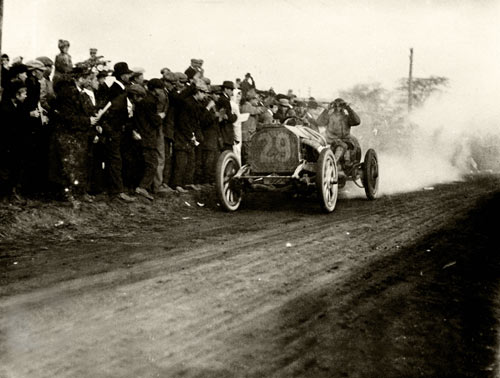
Cohen’s article also reminded me just how many of the American cars on the road today owe their names to the people who actually started these companies and built these cars back in the early days. Ransom Olds, Louis Chevrolet, Walter Chrysler, Horace and John Dodge, Henry Ford, David Buick…some of these read like a joke from The Simpsons. Here’s Louis Chevrolet racing a Buick in 1910:
Looking overseas, there’s Karl Benz, Michio Suzuki (who didn’t actually start out building cars), Wilhelm Maybach, Ferdinand Porsche, and many others. In an interesting reversal of that trend, Daimler Motoren Gesellschaft (which eventually became part of Daimler-Benz) built a custom sports car for Emil Jellinek, who named it Mercedes after his daughter. Jellinek was so fond of the car that he legally changed his last name to Jellinek-Mercedes and thereafter went by E.J. Mercédès.
People like to go fast and film themselves doing so. Modern technology offers a variety of ways to both go faster than ever before and record that speed for posterity. But for something to look fast on video, there needs to be a frame of reference for the viewer — something to hurtle past or whoosh by — and maybe even a hint of danger. Here are a selection of videos of people doing just that: traveling at high speeds in cars, on train tracks, through the air, and down mountains in close proximity to traffic, large rocks, and thin atmospheres. Most of these videos are filmed from a first-person perspective so that when you watch them, you can imagine that you’re the one zooming along.
In 1976, Claude Lelouch mounted a camera on the front of his Mercedes-Benz 450SEL 6.9 and drove through the streets of Paris — running red lights, jumping curbs and possibly reaching speeds upwards of 120 mph — before reaching his date near the Sacré Coeur. The result is the film C’était un rendez-vous, 8 uncut minutes of insane urban driving.
Base jumpers equipped with wingsuits can glide very fast very close to the ground. Perhaps the most insane videos on the page…they’re not doing 1200 mph or anything, but they are awfully close to the ground with few safety options if they slip up.
The lads at Top Gear took the Bugatti Veyron to its top speed of 253 mph on a test track. The test driver seems to have had what I would term a religious experience at the top speed.
Two gents in powder-blue suits speed down a California hill on skateboards. Holy crap!
240 mph on a Suzuki Hayabusa motorcycle. Oh, and he does a wheelie from 70 to 140 mph. (Note: Wikipedia says the bike has an “electronically restricted” top speed of 188 mph. Either the owner a) removed the restriction, or b) tweaked the speedometer to display higher than normal speeds.)
In 1960, Joseph Kittinger reached a speed of 714 mph after jumping from a helium balloon at an altitude of 102,800 feet.
A French TGV train reaches a top speed of 357 mph in a 2007 test.
A camera mounted on the external tank records the launch of the Space Shuttle Atlantis in May 2009. There’s not a lot to whoosh past here, but at an eventual 18,000 mph, the pace at which the Shuttle leaves the Earth behind is astounding.
While skydiving, both of Michael Holmes’ chutes failed as his helmet camera recorded his crash landing into some thick bushes. (He lived.)
Footage of Alex Roy and David Maher on the road as they sped across the entire United States in just over 32 hours, an unofficial world record. There is a book and a blog of the experience.
Passenger seat and road-side views of a Lamborghini Murcielago doing 219 mph on the 202 freeway in Mesa, Arizona.
Newer posts
Older posts





Socials & More