


Flying car sculptures
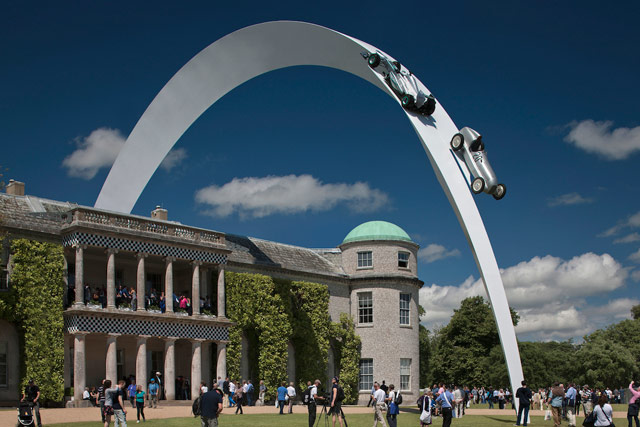
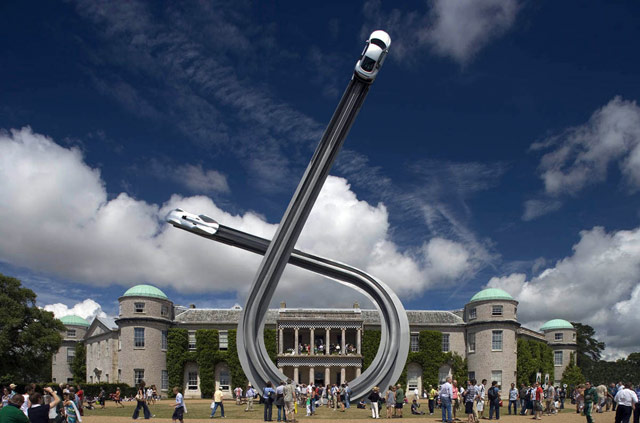
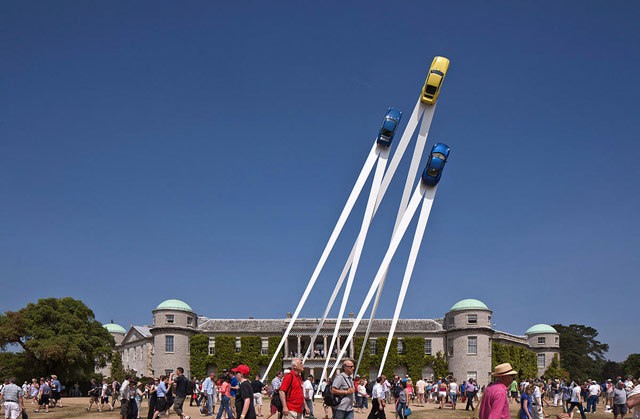
These sculptures by Gerry Judah for the Goodwood Festival of Speed are amazing. Here’s how they made the Mercedes arch for this year’s festival. (via ministry of type)

This site is made possible by member support. 💞
Big thanks to Arcustech for hosting the site and offering amazing tech support.
When you buy through links on kottke.org, I may earn an affiliate commission. Thanks for supporting the site!
kottke.org. home of fine hypertext products since 1998.
Beloved by 86.47% of the web.
These sculptures by Gerry Judah for the Goodwood Festival of Speed are amazing. Here’s how they made the Mercedes arch for this year’s festival. (via ministry of type)
Dang, Tesla just announced they’re letting anyone use their patented technology. CEO Elon Musk:
Yesterday, there was a wall of Tesla patents in the lobby of our Palo Alto headquarters. That is no longer the case. They have been removed, in the spirit of the open source movement, for the advancement of electric vehicle technology.
Tesla Motors was created to accelerate the advent of sustainable transport. If we clear a path to the creation of compelling electric vehicles, but then lay intellectual property landmines behind us to inhibit others, we are acting in a manner contrary to that goal. Tesla will not initiate patent lawsuits against anyone who, in good faith, wants to use our technology.
Damn good move for a damn good reason. It’s impressive to watch this company in action.
Update: I read that last line quoted above again and perhaps “abandoned” is too strong a word. Glenn Fleishman notes on Twitter:
They did not abandon their patents. They aren’t apparently even licensing them. They are stating they won’t sue except defensively. The devil is in the details. Twitter released a complete framework of their policy when they announced the same thing.
Hopefully Musk and co. will clarify what they mean by “in good faith”.
Michael Paul Smith takes photographs of classic cars that evoke feelings of nostalgia for America in the 30s, 40s, 50s, and 60s. Take a look, these are about as Pleasantville as you can get:


But as you’ll discover browsing through Smith’s collection, the cars he photographs are scale models. Here’s the set-up for that second shot:

And here’s further evidence of Smith’s trickery:

No Photoshop here…all effects are done in-camera. As Smith notes, “It is the oldest trick in the special effects book: lining up a model with an appropriate background, then photographing it.” (via @osteslag)
Watch Ferrari’s F1 pit crew do a pit stop in a bit over two seconds:
I wish this were in slow motion because I’ve watched this three times now and I still cannot understand how it’s done. My favorite part is how calm they all are about it. Here’s a longer video that shows the process over and over from several points of view, including from a GoPro mounted on the chest of the wheelgun man:
Watch for the guy on the front jack pirouetting out of the way. I would love to read a long piece on how F1 pit crews train and practice. There are tantalizing bits in shorter articles, like this one from Autosport.com:
With three people per wheel, two jack operators, and a handful of mechanics fulfilling other functions, each pit crew comprises nearly 20 people.
Each is trained for a specific role and teams take their preparation as seriously as drivers’, managing crewmen’s fitness and diet.
They are drilled incessantly at both the factory and during race weekends, with hundreds of pitstop practices until the process is instinctive.
Although problems such as faulty guns are rehearsed, everyone focuses on their own job — in a two-second pitstop, there is no time to see what everyone else is doing. By the time an error has been alerted, the car has often already pulled away, as was the case at the Nurburgring.
And this one from the AP:
Teams now spend huge sums to design their own equipment and improve the fitness of their teams who also work as mechanics. McLaren is working with the English Institute of Sport to hone their 24-member team’s technique while Williams has partnered with Olympic champion Michael Johnson’s Performance Center to work on everything from diet to eye-hand coordination to core strength.
Training has also been ramped up. Most teams have rigs to practice on in the factory and pit stops are practiced as many as 70 times over a typical race weekend. Each stop is timed and videotaped for later review.
“When you had to go from 3.5 seconds down to a lower number, then you really need to be very specific and accurate on how you train because everything needs to be very synchronized to achieve that level of fast time and consistency,” said Williams’ chief race engineer Xevi Pujolar, whose team had its fastest pit stop this season in Spain after making changes to its crew but still is almost a second behind the top teams.
“There still a lot of room for improvement and we are working hard to catch up to these guys that do close to two seconds,” Pujolar said. “If you look at video of pit crew and how they move during pit stop, everything is so well coordinated. To achieve this level of coordination on every pits stop requires a lot of training.”
As well as this series about pit stops by Williams on YouTube. (via digg)
This collection of before-and-after photos of NYC’s streets shows how much the Bloomberg administration and former Transportation Commissioner Janette Sadik-Khan transformed the city’s streets.

Constructing our cities around cars is one of the biggest mistakes of the 20th century and we’re still paying for it. As Kaj Pindal cleverly depicted in his 1966 Oscar-nominated short film What On Earth!, it often seems like cars and not people are the Earth’s dominant life form.
(via @anildash)
Burkhard Bilger got inside the secretive Google X lab and reports back on the search giant’s effort to build a self-driving car.
The Google car has now driven more than half a million miles without causing an accident-about twice as far as the average American driver goes before crashing. Of course, the computer has always had a human driver to take over in tight spots. Left to its own devices, Thrun says, it could go only about fifty thousand miles on freeways without a major mistake. Google calls this the dog-food stage: not quite fit for human consumption. “The risk is too high,” Thrun says. “You would never accept it.” The car has trouble in the rain, for instance, when its lasers bounce off shiny surfaces. (The first drops call forth a small icon of a cloud onscreen and a voice warning that auto-drive will soon disengage.) It can’t tell wet concrete from dry or fresh asphalt from firm. It can’t hear a traffic cop’s whistle or follow hand signals.
And yet, for each of its failings, the car has a corresponding strength. It never gets drowsy or distracted, never wonders who has the right-of-way. It knows every turn, tree, and streetlight ahead in precise, three-dimensional detail. Dolgov was riding through a wooded area one night when the car suddenly slowed to a crawl. “I was thinking, What the hell? It must be a bug,” he told me. “Then we noticed the deer walking along the shoulder.” The car, unlike its riders, could see in the dark. Within a year, Thrun added, it should be safe for a hundred thousand miles.
America’s legal system will make it difficult for self-driving cars to be accepted here…while not a legal kerfuffle yet, see Tesla’s current difficulties w/r/t fire risk in electric cars for a taste of what’s to come with self-driving cars. Europe is more likely…someplace like Holland or Denmark. They take their public and personal transportation seriously over there.
Leave it to Werner Herzog to take the driver safety video to new heights. From One Second To The Next is a 35-minute documentary film by Herzog on the dangers of texting while driving.
Powerful stuff. Don’t text while you’re driving, okay? (via @brillhart)
The CarsAndFilms Etsy shop sells posters featuring famous cars from films.
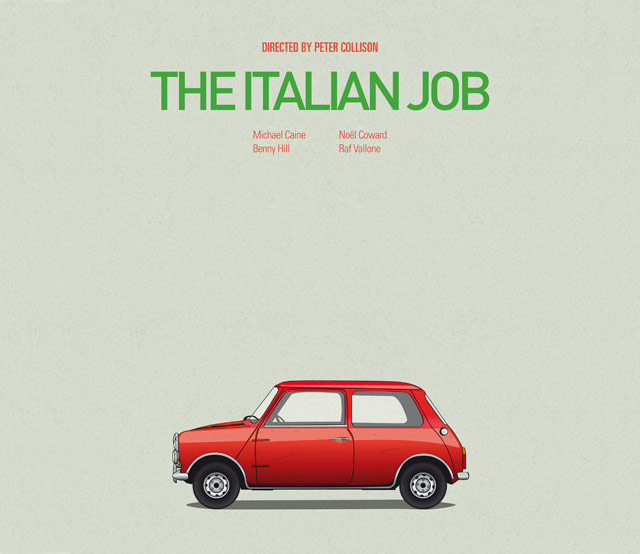
(via cup of jo)
Changing a tire on a car while driving on two wheels is apparently a bit of a thing in Saudi Arabia. Here are a couple of examples:
If you want to try this at home (don’t), here’s how you get a car up on two wheels (don’t).
A nice video from Wired that shows how Tesla’s sedan is made.
Tesla got the factory for a song from Toyota in 2010, spent about a year or so setting up tooling and started producing the Model S sedan in mid-2012. The automaker brings in raw materials by the truckload, including the massive rolls of aluminum that are bent, pressed, and formed to create the car. Those lightweight components are assembled by swarm of red robots in an intricate ballet that is mesmerizing to behold.
(via ★interesting)
People love Jerry Seinfeld so much that we will watch him driving cars and drinking coffee with other comedians. Wait, that actually sounds fantastic!
All the season one episodes are available on YouTube, featuring Ricky Gervais, Alec Baldwin, Michael Richards, and Larry David. (via devour)
Indonesian artist Ichwan Noor made this amazing thing, a 1953 Volkswagen Beetle formed into a sphere:

Cars were moving too fast through an intersection in the town of Poynton in England, so they took out the stoplights & walk signals and replaced the intersection with an unusual double roundel design. The result is a mixed-use space with slower moving car traffic and safer pedestrian traffic.
(via digg)
I’ve posted this before, but it’s so good, here it is again: a super-simple explanation of why differential gears are necessary in cars and how they work.
(via @stevenstrogatz)
Alfred Anaya was really good at putting secret compartments into cars and he thought he was in the clear if he didn’t know what his customers were putting in these compartments. He was wrong.
Alfred Anaya took pride in his generous service guarantee. Though his stereo installation business, Valley Custom Audio Fanatics, was just a one-man operation based out of his San Fernando, California, home, he offered all of his clients a lifetime warranty: If there was ever any problem with his handiwork, he would fix it for the cost of parts alone-no questions asked.
Anaya’s customers typically took advantage of this deal when their fiendishly loud subwoofers blew out or their fiberglass speaker boxes developed hairline cracks. But in late January 2009, a man whom Anaya knew only as Esteban called for help with a more exotic product: a hidden compartment that Anaya had installed in his Ford F-150 pickup truck. Over the years, these secret stash spots-or traps, as they’re known in automotive slang-have become a popular luxury item among the wealthy and shady alike. This particular compartment was located behind the truck’s backseat, which Anaya had rigged with a set of hydraulic cylinders linked to the vehicle’s electrical system. The only way to make the seat slide forward and reveal its secret was by pressing and holding four switches simultaneously: two for the power door locks and two for the windows.
Esteban said the seat was no longer responding to the switch combination and that no amount of jiggling could make it budge. He pleaded with Anaya to take a look.
Anaya was unsettled by this request, for he had suspicions about the nature of Esteban’s work. There is nothing intrinsically illegal about building traps, which are commonly used to hide everything from pricey jewelry to legal handguns. But the activity runs afoul of California law if an installer knows for certain that his compartment will be used to transport drugs. The maximum penalty is three years in prison. Anaya thus thought it wise to deviate from his standard no-questions-asked policy before agreeing to honor his warranty. “There’s nothing in there I shouldn’t know about, is there?” he asked. Esteban assured him that he needn’t worry.
Read all the way to the end for author Brendan Koerner’s conclusions about our government’s position of the moral neutrality of technology.
Socials & More