Now, I’d like you to imagine you’re chatting with your conversation partner. But instead of speaking and hearing the words alone, each syllable they utter has a note, sometimes more than one. They speak in tunes and I can sing back their melody. Once I know them a little bit, I can play along to their words as they speak them, accompanying them on the piano as if they’re singing an operatic recitative. They drop a glass on the floor, it plays a particular melody as it hits the tiles. I’ll play that melody back — on a piano, on anything. I can accompany that melody with harmony, chords — or perhaps compose a variation on that melody - develop it into a stupendous symphony filled with strings, or play it back in the style of Chopin, Debussy or Bob Marley. That car horn beeps an F major chord, this kettle’s in A flat, some bedside lights get thrown out because they are out of tune with other appliances. I can play along to every song on the radio whether or not I’ve heard it before, the chord progressions as open to me as if I had the sheet music in front of me. I can play other songs with the same chords and fit them with the song being played. Those bath taps squeak in E, this person sneezes in E flat. That printer’s in D mostly. The microwave is in the same key as the washing machine.
I have a friend with perfect pitch and one of the first times we hung out together, the horn on a tugboat sounded and she said, “C sharp”. I looked puzzled so she explained, and then I peppered her with questions about all the other sounds around us. It was like watching a superhero do their thing.
LJ said she had been a “weird prodigy kid.” For her, perfect pitch had been a nightmare. The whole world seemed out of tune. But then teachers introduced her to Indian ragas, Gamelan music and compositions with quarter tones, unfamiliar modes and atonal structures. As her musical horizons expanded, her anxiety dissipated. (She remains exceedingly sensitive to pitch, though. Her refrigerator, for example, hums in A flat. Working from home, I hear my fridge running 12 hours a day. Blindfolded, I’m not sure I could pick the thing out of a lineup of three other refrigerators.)
This is neat: Peter Mayhew as Chewbacca speaking English to Harrison Ford’s Han Solo in a scene from Empire Strikes Back:
Mayhew’s dialogue provided context for Ford to play off of. Chewbacca’s more familiar voice was dubbed over the on-set dialogue in post production — listen to Star Wars sound designer Ben Burtt describe how he created Chewie’s voice in this video at ~26:18. Mayhew passed away last week at the age of 74.
Centuries of Sound is a podcast that creates mixtapes by year. So far, that’s pretty standard. The main difference is that CoS’s mixtapes begin in 1853.
That’s as early as we’ve been able to recover recorded audio, mostly from technology that did not work particularly well at the time. The technology of the 1850s recorded sound, but couldn’t reliably reproduce it.
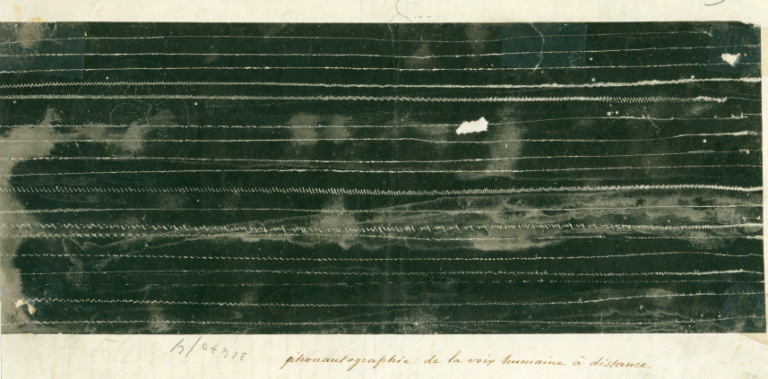
The real start date for us is nearly a quarter of a century [before Thomas Edison], in the studio of French printer and bookseller Édouard-Léon Scott de Martinville. The year was 1853 or 1854, and he was working on engravings for a physiology textbook, in particular a diagram of the internal workings of the human ear. What if, he thought, we could photograph sounds in the way we do images? (photography was a quarter-century old at this point) He began to sketch a device, a way of mimicking the inner workings of the human ear in order to make lines on a piece of paper.
I cover a plate of glass with an exceedingly thin stratum of lampblack. Above I fix an acoustic trumpet with a membrane the diameter of a five franc coin at its small end—the physiological tympanum (eardrum). At its center I affix a stylus—a boar’s bristle a centimeter or more in length, fine but suitably rigid. I carefully adjust the trumpet so the stylus barely grazes the lampblack. Then, as the glass plate slides horizontally in a well formed groove at a speed of one meter per second, one speaks in the vicinity of the trumpet’s opening, causing the membranes to vibrate and the stylus to trace figures.
Firstsounds.org did the most work in deciphering these early paper recordings, and that story is well told by the radio show Studio 360.
It even has a perfect name, what these people do: archeophony.
Here, then, is Centuries of Sound’s mix of all the recorded audio up to 1860 that they’ve been able to recreate from those early, not-at-the-time-reproducible pre-Edison audio signal recordings.
I wish I had known about this when I was still writing my dissertation (which was, in part, on paper and multimedia in the 1900s). It would have made many things much easier.
Ben Burtt was the sound designer for the original Star Wars trilogy and was responsible for coming up with many of the movies’ iconic sounds, including the lightsaber and Darth Vader’s breathing.1 In this video, Burtt talks at length about how two dozens sounds from Star Wars were developed.
The base sound for the blaster shots came from a piece of metal hitting the guy-wire of a radio tower — I have always loved the noise that high-tension cables make. And I never noticed that Vader’s use of the force was accompanied by a rumbling sound. Anyway, this is a 45-minute masterclass in scrappy sound design.
Burtt was the sound designer for the Indiana Jones trilogy, E.T. (he got the voice from an old woman he met who smoked Kool cigarettes), and did the voice for Wall-E. He’s also a big reason why you hear the Wilhelm scream in lots of movies.↩
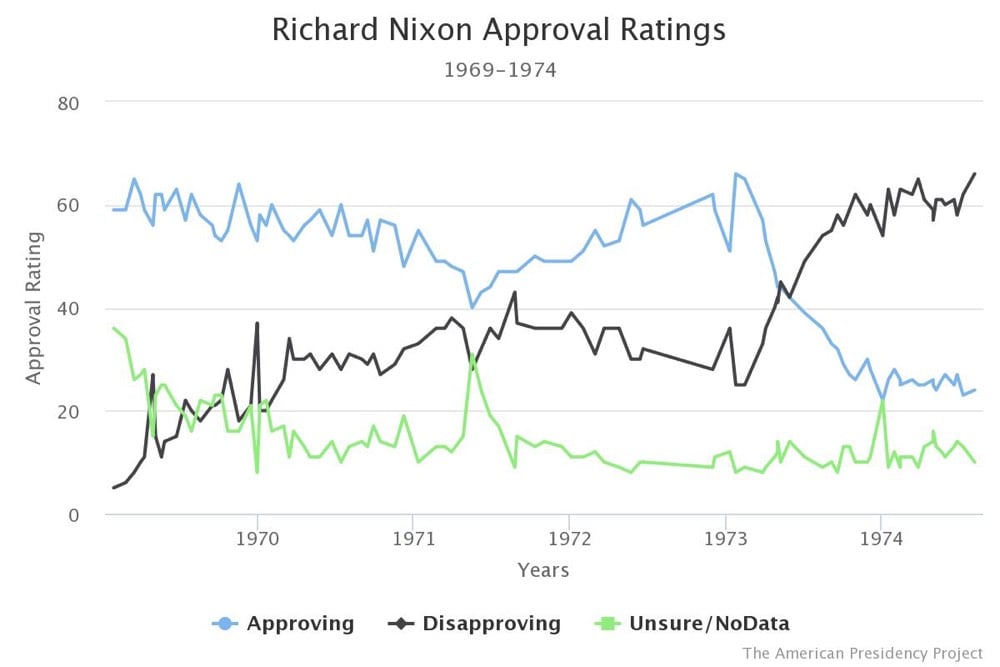
The sound effects mostly represent actions the protagonist Link takes like the “sword slash”, things that happen to him like a grunt when he gets hurt, or the status of the game like the low health alarm that beeps when Link has only half a “heart container” left and can only take one or two more hits before he dies and the game is over. The goal of this project is to create a piece of audio that sounds like a typical playthrough of the game and also accurately tells the story of Nixon’s fall as represented by the data.
What a cool example of using the familiar to explain or illustrate the unfamiliar. If you’ve ever played Zelda, you can clearly hear Nixon doing more and more poorly as the track goes on — he’s taking damage, the dungeon boss sound chimes in right around when Watergate is ramping up, and he’s gaining fewer hearts. It’s like he’s a novice player armed only with the wooden sword trying to defeat the level 3 dungeon without a potion…the end comes pretty quickly.
I am only a casual Beastie Boys fan, but I’ve been hearing nothing but really good things about their goofball memoir, Beastie Boys Book.
With a style as distinctive and eclectic as a Beastie Boys album, Beastie Boys Book upends the typical music memoir. Alongside the band narrative you will find rare photos, original illustrations, a cookbook by chef Roy Choi, a graphic novel, a map of Beastie Boys’ New York, mixtape playlists, pieces by guest contributors, and many more surprises.
The boys also went all-out on the audiobook edition, a 13-hour version of the book that’s as much a mixtape as an audiobook from an all-star cast of more than three dozen readers, including Beasties Mike D and Ad-Rock as well as Steve Buscemi, Elvis Costello, Chuck D, Snoop Dogg, Will Ferrell, Kim Gordon, LL Cool J, Spike Jonze, Pat Kiernan, Talib Kweli, Bette Midler, Nas, Rosie Perez, Amy Poehler, and many more.
There are a pair of excerpts on Soundcloud, the first from the book’s introduction by Ad-Rock and the second from Mike D:
Swiss artist Zimoun makes large-scale sound sculptures out of simple materials like cardboard boxes, wires, washers, tiny motors, and sticks of wood. Here are a few of his works (sound on, obviously):
I would love to see one of these installations in person sometime.
NASA’s InSight mission recently landed on Mars and like other missions before it, the lander is a equipped with a camera and has sent back some pictures of the red planet. But InSight is also carrying a couple of instruments that made it possible to record something no human has ever experienced: what Mars sounds like:
Two very sensitive sensors on the spacecraft detected these wind vibrations: an air pressure sensor inside the lander and a seismometer sitting on the lander’s deck, awaiting deployment by InSight’s robotic arm. The two instruments recorded the wind noise in different ways. The air pressure sensor, part of the Auxiliary Payload Sensor Subsystem (APSS), which will collect meteorological data, recorded these air vibrations directly. The seismometer recorded lander vibrations caused by the wind moving over the spacecraft’s solar panels, which are each 7 feet (2.2 meters) in diameter and stick out from the sides of the lander like a giant pair of ears.
The sounds are best heard with a good pair of headphones.
Smart speaker news briefings didn’t get much love from users in this research. Here are some of the complaints Newman heard:
— Overlong updates — the typical duration is around five minutes, but many wanted something much shorter.
— They are not updated often enough. News and sports bulletins are sometimes hours or days out of date.
— Some bulletins still use synthesized voices (text to speech), which many find hard to listen to.
— Some updates have low production values or poor audio quality.
— Where bulletins from different providers run together, there is often duplication of stories.
— Some updates have intrusive jingles or adverts.
— There is no opportunity to skip or select stories.
Based on my experience with these devices and general trends in news and media consumption, I have a few predictions as to how this will change in the near future:
Audio news updates will get shorter and more specialized. The New York Times using The Daily as a “flash briefing” is really the ne plus ultra of cramming content not designed for smart speakers into the space. I had to pull them as a news source because of it.
Audio news updates will move from pull to push. Unless you put it on “do not disturb,” you’ll hear a news update just after it’s posted, rather than having to ask for it.
Conserve the Sound is a project aimed at the preservation of sounds from old technologies.
»Conserve the sound« is an online museum for vanishing and endangered sounds. The sound of a dial telephone, a walkman, a analog typewriter, a pay phone, a 56k modem, a nuclear power plant or even a cell phone keypad are partially already gone or are about to disappear from our daily life.
Accompanying the archive people are interviewed and give an insight in to the world of disappearing sounds.
If you grew up in the 80s, you might remember Bronson Pinchot as Balki Bartokomous in Perfect Strangers or Serge in Beverly Hills Cop. But Pinchot has built a second career as an award-winning audiobook narrator. I recently listened to him read A Man on the Moon and while the story of the Apollo program is engrossing all by itself, his narration is fantastic. This interview of Pinchot by Jeff VanderMeer (author of the Southern Reach trilogy) is really interesting, particularly the bits about how he approaches his work.
Q: Do you have a philosophy of how to create the perfect audiobook experience?
A: I do, though, like all philosophical resolutions, I only intermittently achieve it. The essential task facing the narrator is to identify or invent a vivid personal definition of what “narrating” ought to be. I am uncomfortable with the chilliness of the word narration. It sounds very much outside the action - the voice on a National Geographic educational film intoning, “These giraffes are just learning how to mate”; or my mother, upon Audrey Hepburn’s entrance in My Fair Lady, informing the room: “She used to have such big doe eyes; what happened to her eyes?”
Simply “reading a book” aloud in an airless audio booth is the kind of mental and physical punishment only ever glimpsed in the lower section of Michelangelo’s Last Judgment. I decided early on that I should not “read” the book but “be” the book, the way I imagine Homer, in performance, “was” the Odyssey. We know he wasn’t “reading” it. In any case, if an audiobook listener doesn’t have the time to curl up with the actual physical text, he or she still yearns for, and deserves, the experience of being carried away by the author’s vision.
What’s the best conference talk/public speech you’ve seen? Topic can be anything. Just the most engaging talk you’ve been present for?
And bonus points: Is there any one particular speaker who’s so good you make an effort to see?
I’ve been to a lot of conferences and seen some very engaging speakers, but the one that sticks out most in my mind is Eloma Simpson Barnes’ performance of a Martin Luther King Jr. speech at PopTech in 2004 (audio-only here).
And so this afternoon, I have a dream. (Go ahead) It is a dream deeply rooted in the American dream.
I have a dream that one day, right down in Georgia and Mississippi and Alabama, the sons of former slaves and the sons of former slave owners will be able to live together as brothers.
I have a dream this afternoon (I have a dream) that one day, [Applause] one day little white children and little Negro children will be able to join hands as brothers and sisters.
In the Drum Major Instinct sermon given two months to the day before his assassination, King told the congregation what he wanted to be said about him at his funeral:
I’d like somebody to mention that day that Martin Luther King, Jr., tried to give his life serving others.
I’d like for somebody to say that day that Martin Luther King, Jr., tried to love somebody.
I want you to say that day that I tried to be right on the war question.
I want you to be able to say that day that I did try to feed the hungry.
And I want you to be able to say that day that I did try in my life to clothe those who were naked.
I want you to say on that day that I did try in my life to visit those who were in prison.
I want you to say that I tried to love and serve humanity.
Some of the power of Barnes’ performance is lost in the video, particularly when audio from King’s actual speeches are availableonline, but sitting in the audience listening to her thundering away in that familiar cadence was thrilling. I can’t imagine how it must have felt to experience the real thing.
Using a JavaScript machine learning package called TensorFlow.js, Abhishek Singh built a program that learned how to translate sign language into verbal speech that an Amazon Alexa can understand. “If voice is the future of computing,” he signs, “what about those who cannot [hear and speak]?”
The McGurk effect pairs different mouth movements with speech, and you tend to hear different things with different mouth movements.
In this video, you hear the word for whatever object is on the screen (bill, mayo, pail) even though the audio doesn’t change:
And in this one, whichever word you focus on, “green needle” or “brainstorm”, that’s what you hear:
What all of these effects demonstrate is that there are (at least) two parts to hearing something. First, there’s the mechanical process of waves moving through the air into the ear canal, which triggers a physical chain reaction involving the ear drum, three tiny bones, and cochlear fluids. But then the brain has to interpret the signal coming from the ear and, as the examples above show, it has a lot of power in determining what is heard.
My kids and I listen to music in the car quite often (here’s our playlist, suggestions welcome) and when Daft Punk’s Get Lucky comes on, my son swears up and down that he hears the mondegreen “up all Mexican lucky” instead of “up all night to get lucky”. If I concentrate really hard, I can hear “Mexican lucky” but mostly my brain knows what the “right” lyric is…as does his brain, but it’s far more convinced of his version.
Update: On the topic of misheard lyrics to Get Lucky, there is this bit of amazingness:
Note: If you are a member and tried to log in, it didn't work, and now you're stuck in a neverending login loop of death, try disabling any ad blockers or extensions. Or try logging out and then back in. Still having trouble? Email me!







Socials & More