kottke.org posts about TV
In partnership with Fred Rogers Productions and The Fred Rogers Center, Google is honoring Mister Rogers today with a stop motion animated short as part of their Google Doodle program.
On this date, September 21, 1967, 51 years ago, Fred Rogers walked into the television studio at WQED in Pittsburgh to tape the very first episode of Mister Rogers’ Neighborhood, which would premiere nationally on PBS in February 1968. He became known as Mister Rogers, nationally beloved, sweater wearing, “television neighbor,” whose groundbreaking children’s series inspired and educated generations of young viewers with warmth, sensitivity, and honesty.
What’s interesting is that on his show (unlike his stop motion counterpart in the short), Rogers deliberately didn’t show himself travelling to the Neighborhood of Make-Believe because he didn’t want his young viewers to confuse reality and fantasy. He wanted kids to know he and the people he visited with were in the real world, dealing with real situations.
P.S. And a further interesting tech note: this is the first YouTube video I’ve seen where the number of views isn’t displayed. I’m assuming that’s a Google-only God Mode feature?
What’s My Name? is an upcoming HBO documentary about Muhammad Ali. This is a teaser trailer so there’s not much to go on but LeBron James and Maverick Carter are executive producing and the director is Antoine Fuqua, who directed Training Day in 2001. What’s My Name? will air in two parts in early 2019.
A huge cache of rare Hollywood memorabilia is up for sale at a London auction on September 20. The catalog includes over 600 items from movies like Back to the Future, Blade Runner, Batman, Blues Brothers, Die Hard, Goonies, Harry Potter, Indiana Jones, James Bond, Lord of the Rings, Star Trek, Star Wars, Superman, Terminator, Willy Wonka and the Chocolate Factory, and X-Men.
Among the most valuable and unique items are the iconic Indiana Jones hat worn by Harrison Ford in Raiders of the Lost Ark (estimate £200,000-£300,000):

They’re also selling Indy’s bullwhip from Temple of Doom (estimate £50,000-£70,000).
The most expensive item is Han Solo’s jacket from Empire Strikes Back (£500,000-£1,000,000):

Pairs nicely with this stormtrooper helmet from the first film (estimate £40,000-£60,000):

Marty McFly’s hoverboard from Back to the Future II (estimate £30,000-£50,000):

They’re also offering the DeLorean’s OUTATIME license plate from the first film (estimate £10,000-£15,000):

A Wonka Bar from Willy Wonka and the Chocolate Factory (estimate £8,000-£10,000), a rare item because most props from the film were “destroyed at its Bavarian film studio to allow production to wrap quickly, making way for the immediate filming of Cabaret”:

Captain Picard’s uniform from the first two seasons of Star Trek: The Next Generation (£10,000-£15,000):

And a bunch of other stuff, including John McClane’s radio from Die Hard, Edward Scissorhands’ costume, Mikey’s doubloon from The Goonies, a T-800 exoskeleton from Terminator 2, Tom Hanks’ helmet from Saving Private Ryan, a THX 138 license plate from American Graffiti, and a full-size drivable replica of the DeLorean from Back to the Future.
If you want to bid on any of this stuff, either in person, via the phone, or online, check out the info page on how to register.
To mark the 25th anniversary of its airing, the very first episode of Late Night With Conan O’Brien has been made available online in its entirety. His guests that evening were John Goodman, Drew Barrymore, and Tony Randall.
O’Brien says this initial video will be joined by a “complete online archive of Conan’s 25 years in late night” in January 2019. (via anil dash)
I’ve been keeping track of every media thing I “consume”, so here are quick reviews of some things I’ve read, seen, heard, and experienced in the last month or so. This installment has a few things on it from a trip to NYC and is also very movie-heavy. In addition to the stuff below, I also finished Sharp Objects (HBO series, not the book) and Star Trek: Voyager, both of which I reviewed last time. I’m almost done with Origin Story…might do a whole separate post on that one. Up next in the book department: Now My Heart Is Full, The Good Neighbor, or Fantasyland.
Mission: Impossible - Fallout. I’m not a particular fan of the series, but this was so fun that maybe I should be? Love the practical effects. (B+)
Bundyville. This podcast came highly recommended by a reader but as soon as Cliven Bundy opened his mouth to speak I realized I did not want to spend a single second of my life in this asshole’s ville or town or mind or anything. Maybe this makes me intolerant or incurious? Not sure I particularly care…there are worthier things I can choose spend my time on. (-)
Radiohead at TD Garden, 7/29/2018. I somehow won the Ticketmaster lottery and got floor tickets, so we were about 35 feet from the stage. Cool to see my favorite band that close. (A)

French Pastels: Treasures from the Vault, MFA Boston. I don’t have much experience with viewing pastels but these seemed simultaneously alive and dreamy. (A-)
Kitchen Confidential by Anthony Bourdain. One of our culture’s recent great storytellers. It’s dated (and cringeworthy) in places, but that Bourdain voice and perspective is right there on the page, almost fully formed. In the chapter about Tokyo, you also get to witness the prototype for Bourdain’s third and, arguably, greatest career as a culinary and cultural observer of far-flung places. Pro tip: get the audiobook read by the man himself. (A)
My new electric toothbrush. Why didn’t anyone tell me about this sooner? My teeth feel (and probably are) so much cleaner now! (A-)
Holedown. I’ve spent too many hours playing this. It sucks I hate it it’s so good and I can’t stopppppppp. (A-/D+)
David Wojnarowicz exhibition at the Whitney. A strong show about an artist I didn’t know a lot about going in. (B+)
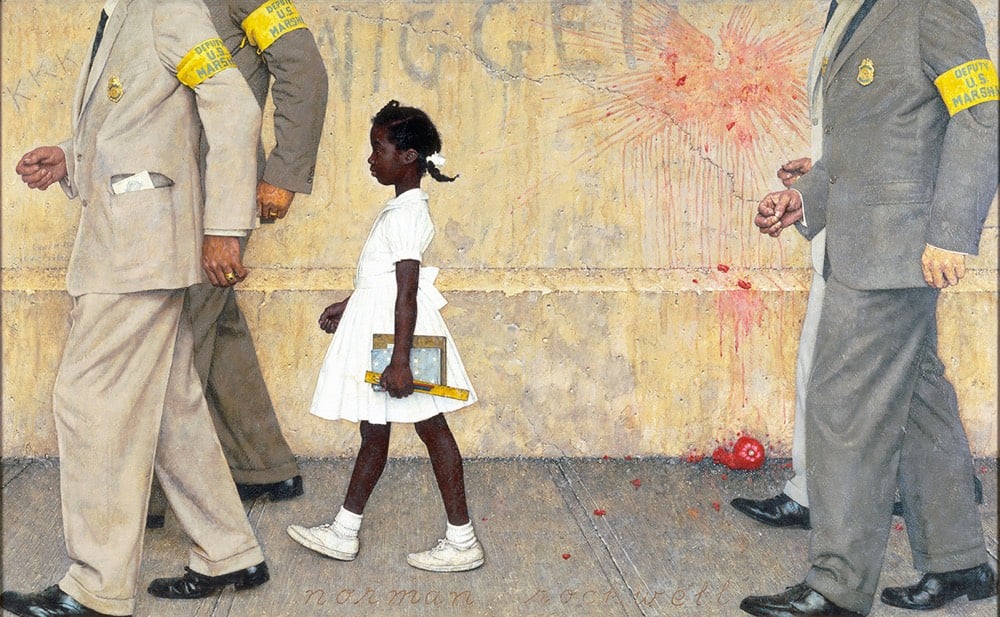
Celebrating Bill Cunningham exhibition at the New-York Historical Society. The exhibition was in a small room and featured very few photographs, so I was a little disappointed. But I did get to see the Norman Rockwell/FDR exhibition, including this arresting painting. (B)
Through a Different Lens: Stanley Kubrick Photographs at the Museum of the City of New York. Even though I have the book, the original photos were worth seeing in person. (B+)
Eighth Grade. The feelings generated by watching this film — dread, crushing anxiety — closely approximated how I felt attending 8th grade. Well played. (B+)
Sorry to Bother You. If you haven’t seen this, don’t watch or read anything about it before you do. Just watch it. (A-)
Arbitrary Stupid Goal by Tamara Shopsin. This had me thinking about all sorts of different things. Recommended. (A)
Succession. This wasn’t quite as good as everyone said it was, but I still enjoyed it. My tolerance for watching rich, powerful, white assholes, however entertaining, is waning though… (B)
The Handmaid’s Tale by Margaret Atwood. Unsurprisingly more spare than the TV series but still powerful and unsparing. (A-)
The Dark Knight. If not the best superhero movie ever, it’s close. (A-)
Crazy Rich Asians. A romantic comedy with a strong dramatic element rooted in family & cultural dynamics, women who are strong & interesting & feminine in different ways, and a wondrous setting. Also, put Awkwafina in every movie from now on. (A-)
Won’t You Be My Neighbor?. Fred Rogers was a relentless person, a fantastic example of a different kind of unyielding masculinity. I sobbed like a baby for the last 20 minutes of this. (A)
BlacKkKlansman. Messy. I didn’t really know what to feel about it when it ended…other than shellshocked. Was that the point? (B+)
Tycho’s 2018 Burning Man Sunrise DJ set. Always an end-of-the-summer treat. (A)
Bill & Ted’s Excellent Adventure. I watched this movie at least 100 times in high school. Despite not having seen it in probably 20 years, I still knew every single line of dialogue — inflections, timing, the whole thing. (A+)
Foggy hikes. (A+)
American Animals. This is like Ocean’s 11 directed by Errol Morris. Stealing things is more difficult than it seems in the movies. (B+)
Past installments of my media diet are available here.
This is a pitch-perfect mashup by Funny Or Die of Amazon’s new series Tom Clancy’s Jack Ryan (starring John Krasinski) and The Office (also starring John Krasinski).
P.S. I know Funny Or Die called this “Tom Clancy’s Jim Ryan”, but they should have called it “Tom Clancy’s Jim Halpert”. Hardass name + goofy creampuff name = Comedy 101, folks. (via anil dash)
I loved Elena Ferrante’s Neapolitan novels so much that that I almost couldn’t bring myself to watch the trailer for HBO’s upcoming miniseries adaptation of the first book. But I did and I’m…cautiously optimistic? Eight episodes, premieres in November. Oh god, I hope this is good.
P.S. Seriously, this series is probably my favorite read from the last five years. Phenomenal. (via @rkgnystrom)

Welp, I want to unsee that. 3D rendering courtesy of Miguel Vasquez, who did the same thing for SpongeBob awhile back.

(via @roeeb)
As a fundraiser for the Leukemia & Lymphoma Society, Micah Sherman and Mark Stetson produced a web series called The Bob Ross Challenge in which 13 comedians attempt to paint along with Bob Ross as he does his thing with the trees and little fluffy clouds. Here’s the first episode, featuring Aparna Nancherla:
I feel like she does a lot better than I would have! The episodes are each less than 2 minutes long…you can burn through the whole season in about 20 minutes. Or if you want to try the challenge yourself, you can watch every episode of The Joy of Painting on YouTube. (via open culture)
In 1998, author and media critic Neil Postman gave a talk he called Five Things We Need to Know About Technological Change. Here are the five ideas Postman shared that day, which are all still highly relevant today:
1. All technological change is a trade-off. For every advantage a new technology offers, there is always a corresponding disadvantage.
2. The advantages and disadvantages of new technologies are never distributed evenly among the population. This means that every new technology benefits some and harms others.
3. Embedded in every technology there is a powerful idea, sometimes two or three powerful ideas. Every technology has a philosophy which is given expression in how the technology makes people use their minds, in what it makes us do with our bodies, in how it codifies the world, in which of our senses it amplifies, in which of our emotional and intellectual tendencies it disregards.
4. Technological change is not additive; it is ecological. The consequences of technological change are always vast, often unpredictable and largely irreversible.
5. Media tend to become mythic. Cars, planes, TV, movies, newspapers — they have achieved mythic status because they are perceived as gifts of nature, not as artifacts produced in a specific political and historical context.
His first idea about technology is perhaps the most apropos to the current moment:
The first idea is that all technological change is a trade-off. I like to call it a Faustian bargain. Technology giveth and technology taketh away. This means that for every advantage a new technology offers, there is always a corresponding disadvantage. The disadvantage may exceed in importance the advantage, or the advantage may well be worth the cost. Now, this may seem to be a rather obvious idea, but you would be surprised at how many people believe that new technologies are unmixed blessings. You need only think of the enthusiasms with which most people approach their understanding of computers. Ask anyone who knows something about computers to talk about them, and you will find that they will, unabashedly and relentlessly, extol the wonders of computers. You will also find that in most cases they will completely neglect to mention any of the liabilities of computers. This is a dangerous imbalance, since the greater the wonders of a technology, the greater will be its negative consequences.
Think of the automobile, which for all of its obvious advantages, has poisoned our air, choked our cities, and degraded the beauty of our natural landscape. Or you might reflect on the paradox of medical technology which brings wondrous cures but is, at the same time, a demonstrable cause of certain diseases and disabilities, and has played a significant role in reducing the diagnostic skills of physicians. It is also well to recall that for all of the intellectual and social benefits provided by the printing press, its costs were equally monumental. The printing press gave the Western world prose, but it made poetry into an exotic and elitist form of communication. It gave us inductive science, but it reduced religious sensibility to a form of fanciful superstition. Printing gave us the modern conception of nationhood, but in so doing turned patriotism into a sordid if not lethal emotion. We might even say that the printing of the Bible in vernacular languages introduced the impression that God was an Englishman or a German or a Frenchman — that is to say, printing reduced God to the dimensions of a local potentate.
Perhaps the best way I can express this idea is to say that the question, “What will a new technology do?” is no more important than the question, “What will a new technology undo?” Indeed, the latter question is more important, precisely because it is asked so infrequently. One might say, then, that a sophisticated perspective on technological change includes one’s being skeptical of Utopian and Messianic visions drawn by those who have no sense of history or of the precarious balances on which culture depends. In fact, if it were up to me, I would forbid anyone from talking about the new information technologies unless the person can demonstrate that he or she knows something about the social and psychic effects of the alphabet, the mechanical clock, the printing press, and telegraphy. In other words, knows something about the costs of great technologies.
Idea Number One, then, is that culture always pays a price for technology.
It is nearly impossible to read these paragraphs and not think about how social media (and the internet more generally) has shaped our culture in both good and bad ways…and those who still believe that services like Facebook or Twitter are “unmixed blessings”. The rest of the talk is equally thought-provoking and enlightening.
P.S. Postman made these remarks about 2 weeks after I started publishing kottke.org 20 years ago. At that time, very few people I knew or interacted with online saw anything but the positive aspects of the internet and personal publishing online. Should we have seen the weaponization of the internet coming? Perhaps. But then again, not a lot of people who enjoyed the simple pleasures of Howdy Doody, I Love Lucy, and Lassie could have anticipated the government-shaping toxicity of Fox News and cable news in general.
I have mixed feelings about The Ringer’s enormous ranking of the 100 best TV shows of the century (so far), but I’ve enjoyed some of the accompanying material. In particular, I like Alison Herman’s essay on the rise, fall, and metastasis of TV recap culture in the late 90s and early 2000s. Regardless of whether you believe the premise that time was a golden age of television, it was almost certainly the golden age of TV recaps.
Part of the reason now-classic episodes like Mad Men’s “The Suitcase,” Breaking Bad’s “Ozymandias,” or The Sopranos’ finale are remembered as such is because recappers were there to register their amazement and enumerate the reasons why those hours had the power to shock and surprise. “Sopranos and Mad Men are two of the best shows to write recaps of, because they’re so dense and laden with meaning and subtext and symbolism,” [Alan] Sepinwall explains. “You get to really dive in deep with, Well, what does all that mean? What was the show trying to say?” This would prove a common theme of the rise of recapping: More was being written about TV because, in many critics’ minds, there was more to write about. As for viewers, they got the message that neither TV criticism nor TV itself was a one-way street. Television didn’t have to be talked about as an investment to be made or checked in on, but as it was actually experienced: as a regular, consistent part of our lives.
Herman’s genealogy hits some of the usual suspects (Television Without Pity, The Onion’s AV Club, Gossip Girl) while also giving time to some lesser-traveled corners of the recaposphere, like Mad Style, the Mad Men fashion recap series that helped spawn similar specialist takes on other costume-heavy shows.
But the arc in general is pretty familiar: a few pioneers (both TV shows and the people who recap them) help establish the parameters of style, before a glut of content and commentary made the form less coherent and universal. Streaming and social led to a deemphasis of the episode as a unit and the recapper as an authority. Production, distribution, and reception all fundamentally changed. (So did the blogosphere and the broader cultural media universe, which maybe gets shortchanged some in Herman’s account.)
And maybe the Recap Age was all a little too ponderous and self-serious, especially when it came to “jokes.” Some of it doesn’t age well. But it’s a time when a lot of exciting things were happening, not least on the television set, and it’s one I still miss.
I’ve been keeping track of every media thing I “consume”,1 so here are quick reviews of some things I’ve read, seen, heard, and experienced in the past two months or so. My summer has been a little slow, media-wise…the World Cup, my roadtrip, and time spent enjoying the outdoors have conspired to limit my reading and watching time. This is not a bad thing. I’m still working my way through The Odyssey w/ the kids (now on hold b/c they’re at camp) and David Christian’s Origin Story. I wanted to get way more reading done this summer than I have…maybe I can pick up the pace in August. (Ignore the letter grades. Or don’t!)
Solo: A Star Wars Story. The movie was fine, but I liked the branding for it more. I would watch an Enfys Nest movie though. (B)
The Dave Chang Show w/ Helen Rosner. Chang is an engaging interviewer, and Rosner is a great guest. (B+)
RBG. What an extraordinary person. (B+)
American Innovations. Engaging and informative podcast hosted by Steven Johnson. (B)
Ocean’s 8. Pretty good but would have benefitted from a slightly more clever plot and direction by Soderbergh. (B+)
ye. As I’ve heard from more than one person: I hate that I like this album. (B+)
Skin in the Game: Hidden Asymmetries in Daily Life by Nassim Nicholas Taleb. This book contains a valuable central message and several fascinating insights but the constant ad hominems, irrelevant tangents, stereotyping, and general antagonistic tone of the writing makes for tough reading. I wish Taleb were a more generous writer. (B)
Incredibles 2. A solid sequel. Kids gave it two thumbs up. (A-)
Everything is Love. Ok, “The Carters”, but they smartly made this a Beyoncé album feat. Jay-Z. This has been on heavy rotation in my car. (A-)
The Disaster Artist. Gave up on this about 30 minutes in…zero interest. (-)
Justice League. Not as terrible as I was led to believe. But maybe DC can trade Wonder Woman to Marvel? (C+)
Caliphate. Finished this…what a great and important series. I know a lot of people think Serial is the podcast gold standard, but this was better and more significant. (A)
Seabiscuit. This one always gets me right in the feels. (B+)
Scorpion. Kanye’s latest album is 23 minutes long while Drake went for a full 90 minutes. I know there’s some controversy about it, but it was genuinely great hearing new music from Michael Jackson. (B)
The Handmaid’s Tale. The remainder of the second season was brutal. (A-)
A Man on the Moon: The Voyages of the Apollo Astronauts by Andrew Chaikin. An epic story of adventure and discovery, expertly told. (A)
Sharp Objects. This one is a slow burn, but I will watch Amy Adams in anything…she is mesmerizing. (B+)
Star Trek: Voyager. Still making progress on this…I’m about 70% of the way through. It’s better in the middle seasons than a lot of people give it credit for. (B)
Solo roadtrips. The world is a fascinating place…get out and explore it if you can. (A+)
Pacific Rim Uprising. They could have done more with this, but they didn’t. They really didn’t. (C+)
The 2018 FIFA World Cup. I missed most of the knockout stage because I was traveling, but I still loved every minute of this World Cup. (A-)
Jaws. My first time seeing it. (Yes, yes, I know.) Amazing to see so many of Spielberg’s filmmaking techniques on display so early in his career. (A-)
Westworld. This show asks, over and over again, “Is any of this real?” The result is a complete inability on my part to suspend my disbelief…I’m always very aware that what I’m watching is fake. (C-)
Hot Fuzz. Will watch this anytime. (A-)
Past installments of my media diet are available here.
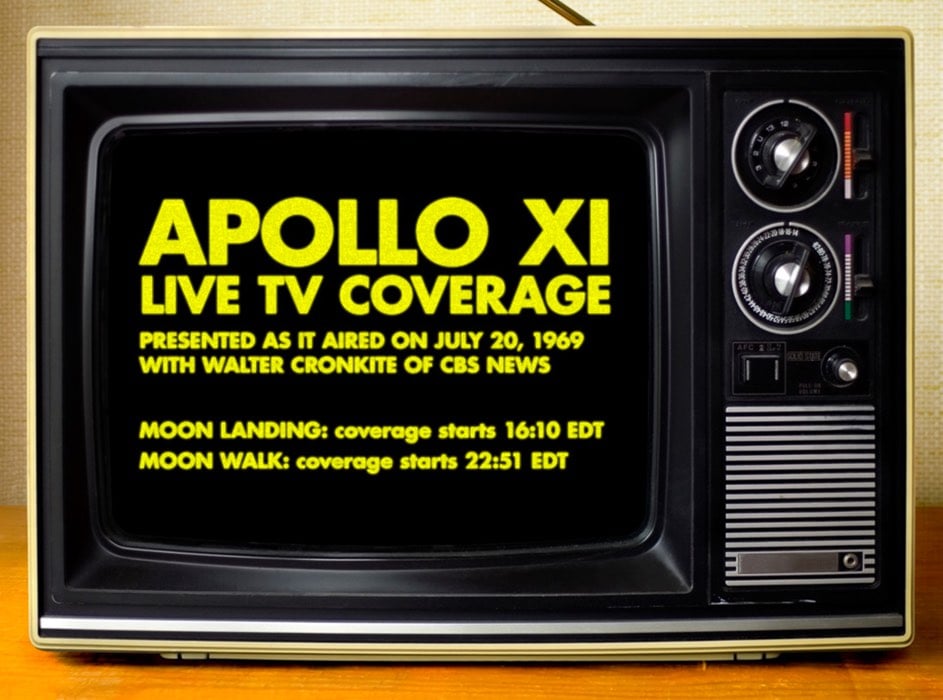
In May 1961, President John F. Kennedy stood before Congress and said:
I believe that this nation should commit itself to achieving the goal, before this decade is out, of landing a man on the moon and returning him safely to the earth.
A little more than 8 years later, it was done. On July 20, 1969, 49 years ago today, Neil Armstrong and Buzz Aldrin landed on the Moon, took a walk, and returned safely to Earth a few days later. And the whole thing was broadcast live on television screens around the world.
For the 40th anniversary of the landing in 2009, I put together a page where you can watch the original CBS News coverage of Walter Cronkite reporting on the Moon landing and the first Moon walk, synced to the present-day time. Just open this page in your browser and the coverage will start playing at the proper time. Here’s the schedule (all times EDT):
4:10:30 pm: Moon landing broadcast starts
4:17:40 pm: Lunar module lands on the Moon
4:20:15 pm: Break in coverage
10:51:27 pm: Moon walk broadcast starts
10:56:15 pm: First step on Moon
11:51:30 pm: Nixon speaks to the Eagle crew
12:00:30 am: Broadcast end (on July 21)
You can add these yearly recurring events to your calendar: Moon landing & Moon walk.
Here’s what I wrote when I launched the project, which is one of my favorite things I’ve ever done online:
If you’ve never seen this coverage, I urge you to watch at least the landing segment (~10 min.) and the first 10-20 minutes of the Moon walk. I hope that with the old time TV display and poor YouTube quality, you get a small sense of how someone 40 years ago might have experienced it. I’ve watched the whole thing a couple of times while putting this together and I’m struck by two things: 1) how it’s almost more amazing that hundreds of millions of people watched the first Moon walk *live* on TV than it is that they got to the Moon in the first place, and 2) that pretty much the sole purpose of the Apollo 11 Moon walk was to photograph it and broadcast it live back to Earth.
I’ve been listening to the audiobook of Andrew Chaikin’s account of the Apollo program, A Man on the Moon, and the chapter about Apollo 11’s Moon landing was riveting.1 I’ve watched the TV footage & listened to the recordings dozens of times and I was still on the edge of my seat, sweating the landing alongside Armstrong and Aldrin. And sweating they were…at least Armstrong was. Take a look at his heart rate during the landing; it peaked at 150 beats per minute at landing (note: the “1000 ft altitude” is mislabeled, it should be “100 ft”):
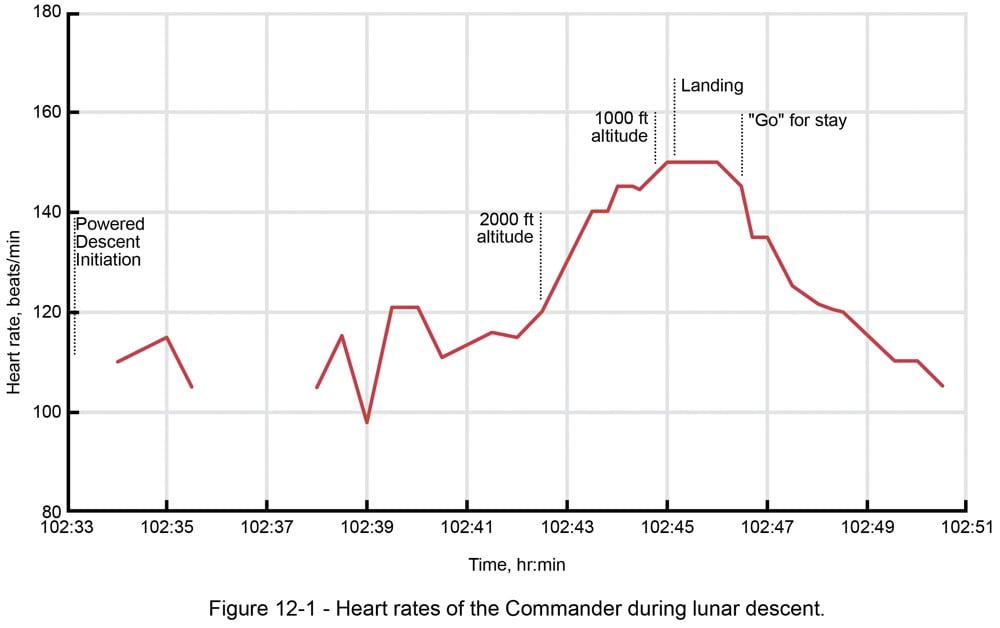
For reference, Armstrong’s resting heart rate was around 60 bpm. There are a couple of other interesting things about this chart. The first is the two minutes of missing data starting around 102:36. They were supposed to be 10 minutes from landing on the Moon and instead their link to Mission Control in Houston kept cutting out. Then there were the intermittent 1201 and 1202 program alarms, which neither the LM crew nor Houston had encountered in any of the training simulations. At the sign of the first alarm at 102:38:26, Armstrong’s heart rate actually appears to drop. And then, as the alarms continue throughout the sequence along with Houston’s assurances that the alarm is nothing to worry about, Armstrong’s heart rate stays steady.
Right around the 2000 feet mark, Armstrong realizes that he needs to maneuver around a crater and some rocks on the surface to reach a flat landing spot and his heart rate steadily rises until it plateaus at the landing. At the time, he thought he’d landed with less than 30 seconds of fuel remaining. That Neil Armstrong was able to keep his cool with unknown alarms going off while avoiding craters and boulders with very little fuel remaining and his heart rate spiking while skimming over the surface OF THE FREAKING MOON doing something no one had ever done before is one of the most totally cold-blooded & badass things anyone has ever done. Damn, I get goosebumps just reading about it!
Update: The landing broadcast just aired and I wanted to explain a little about what you saw (you can relive it here).
The shots of the Moon you see during the landing broadcast are animations…there is obviously no camera on the Moon watching the LM descend to the surface. There was a camera recording the landing from the LM but that footage was not released until later. This is in contrast to the footage you’ll see later on the Moon walk broadcast…that footage was piped in live to TV screens all over the world as it happened.
The radio voices you hear are mostly Mission Control in Houston (specifically Apollo astronaut Charlie Duke, who acted as the spacecraft communicator for this mission) and Buzz Aldrin, whose job during the landing was to keep an eye on the LM’s altitude and speed — you can hear him calling it out, “3 1/2 down, 220 feet, 13 forward.” Armstrong doesn’t say a whole lot…he’s busy flying and furiously searching for a suitable landing site. But it’s Armstrong that says after they land, “Houston, Tranquility Base here. The Eagle has landed.”. Note the change in call sign from “Eagle” to “Tranquility Base”. :)
Two things to listen for on the broadcast: the 1201/1202 program alarms I mentioned above and two quick callouts by Charlie Duke about the remaining fuel towards the end: “60 seconds” and “30 seconds”. Armstrong is taking all this information in through his earpiece — the 1202s, the altitude and speed from Aldrin, and the remaining fuel — and using it to figure out where to land.
The CBS animation shows the fake LM landing on the fake Moon before the actual landing — when Buzz says “contact light” and then “engine stop”. The animation was based on the scheduled landing time and evidently couldn’t be adjusted. The scheduled time was overshot because of the crater and boulders situation mentioned above.
Cronkite was joined on the program by former astronaut Wally Schirra. When Armstrong signaled they’d landed, Schirra can be seen dabbing his eyes and Cronkite looks a little misty as well as he rubs his hands together.
Brian Stelter is known for media scoops, but sometimes, he can bring the insight too. On CNN and in his nightly newsletter, he briefly outlines what I think anyone has to agree is an unusual symbiosis of the Presidency and a single news outlet, Fox News. (Trump hiring Fox News’s Bill Shine to run his communications shop is just one symptom of the bigger entanglement.)
— No president has ever endorsed a network to this degree before: Promoting it, telling people when and where to tune in, while trashing all of its rivals…
— And no network has ever propped up a president quite like this before…
— The back-scratching benefits both sides. Trump benefits from the friendly segments and softball Q’s. Fox benefits from Trump’s preferential treatment and constant promos…
— The beating heart of this relationship is Sean Hannity, who reportedly golfed with Trump on Sunday. Hannity is an adviser, a booster, an attack dog, a friend. No TV host has ever had this kind of alliance with a US president…
— And no president has never treated a TV channel like it’s an intelligence agency the way Trump treats Fox…
My point: This is new. And weird. And we shouldn’t get used to it. There’s been almost a merger between a culture war TV station and a culture war president. In the essay, I asked, rhetorically, “What would Trump do without Fox?”
Is this the weirdest thing about the Trump presidency, or the most dangerous? Probably not. But it’s one of the legs that props up all the other legs. And it’s definitely weird, and I’d argue, dangerous.
The Iceland men’s soccer team is nearly impossible not to root for in this World Cup. They are the smallest nation by population ever to qualify for a World Cup. Their coach is a dentist and still maintains his hometown dental practice. The Skol chant done by the team’s fans is a great addition to the collection of international soccer chants & songs. All great underdog stuff.
Adding to that, their goalkeeper Hannes Thor Halldórsson is a former film director who, until four years ago, pursued soccer as a second job. In anticipation for the World Cup, Halldórsson stepped back into his old job to direct a commercial for Coca-Cola featuring the Icelandic men’s national team and the Skol chant.
Pretty good for a keeper. Is this the best commercial ever made by someone who has also kept clean sheets against both Lionel Messi and Cristiano Ronaldo?
Newer posts
Older posts




Socials & More