kottke.org posts about Olympic Games
Alan Taylor has shared a bunch of photos of the just-concluded Winter Olympics “featuring infrared imaging, vintage cameras, optical filters, digital composites, unusual angles, unexpected subjects, and more”. Two of my favorites:
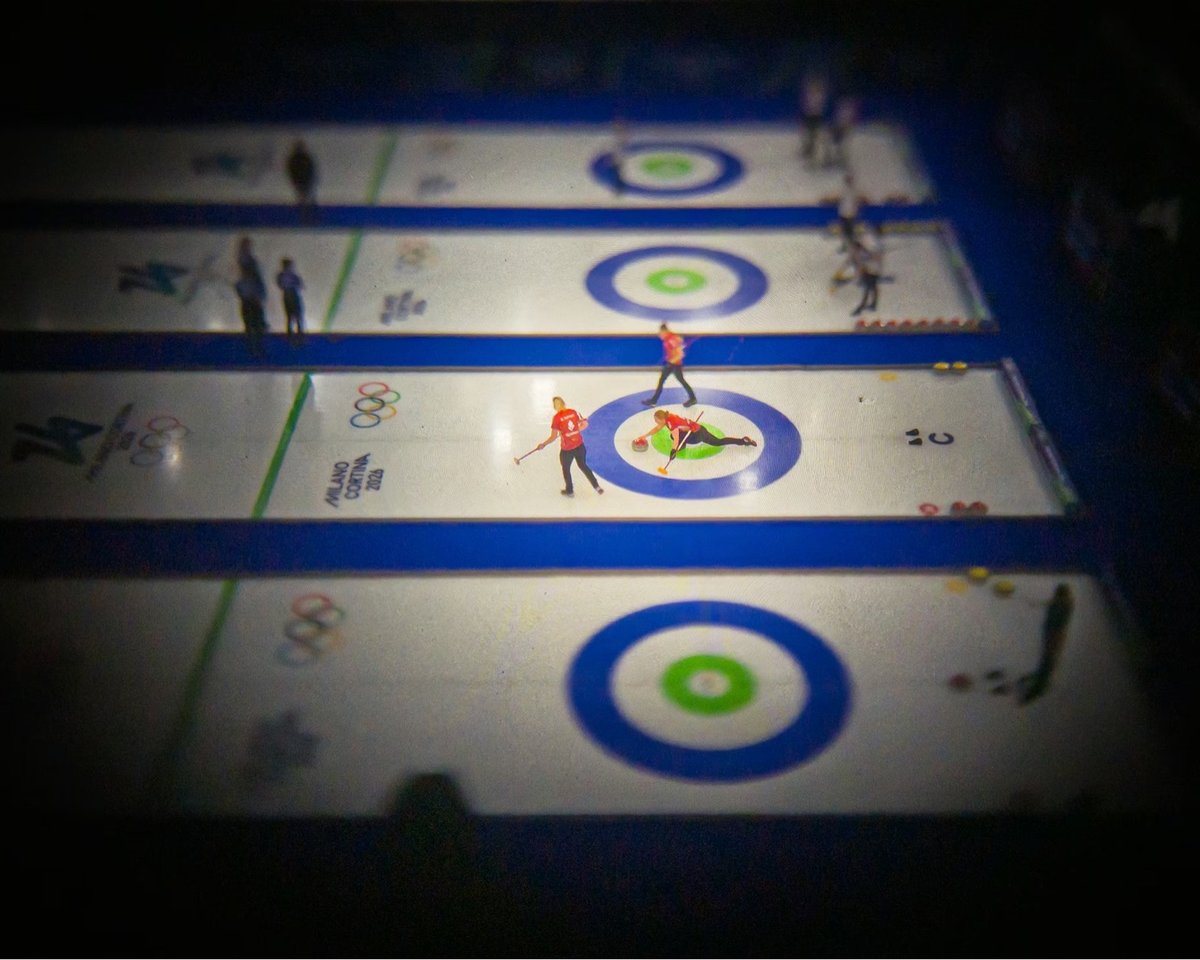
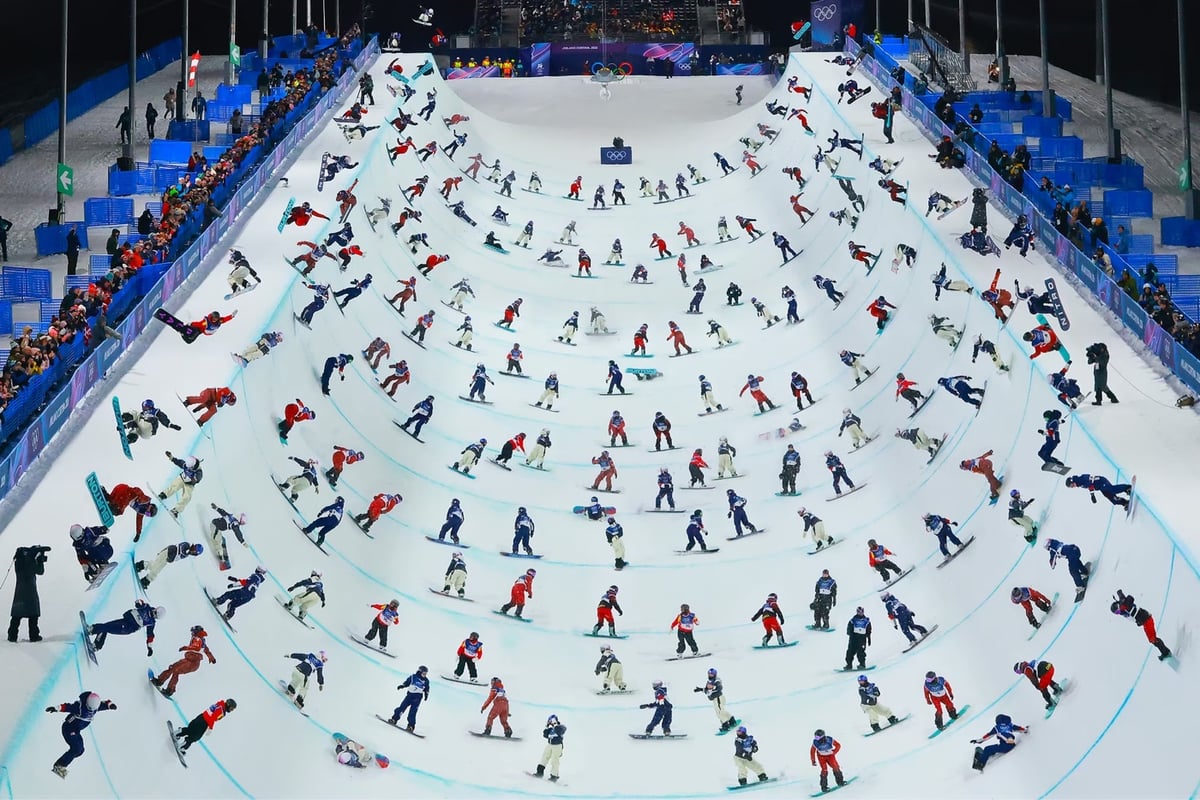
The first photo is of a curling match taken by Ryan Pierse with a vintage camera. Taylor:
Images in this series were captured using vintage Graflex cameras, paying tribute to the type of camera that would have been used 70 years ago when Cortina previously hosted the games in 1956. In a modern twist, these cameras have been adapted to record images on smartphones, enabling live transmission of the content captured.
The second is a composite image of the women’s snowboard halfpipe final by Hector Vivas, a technique popularized in recent years by Pelle Cass.
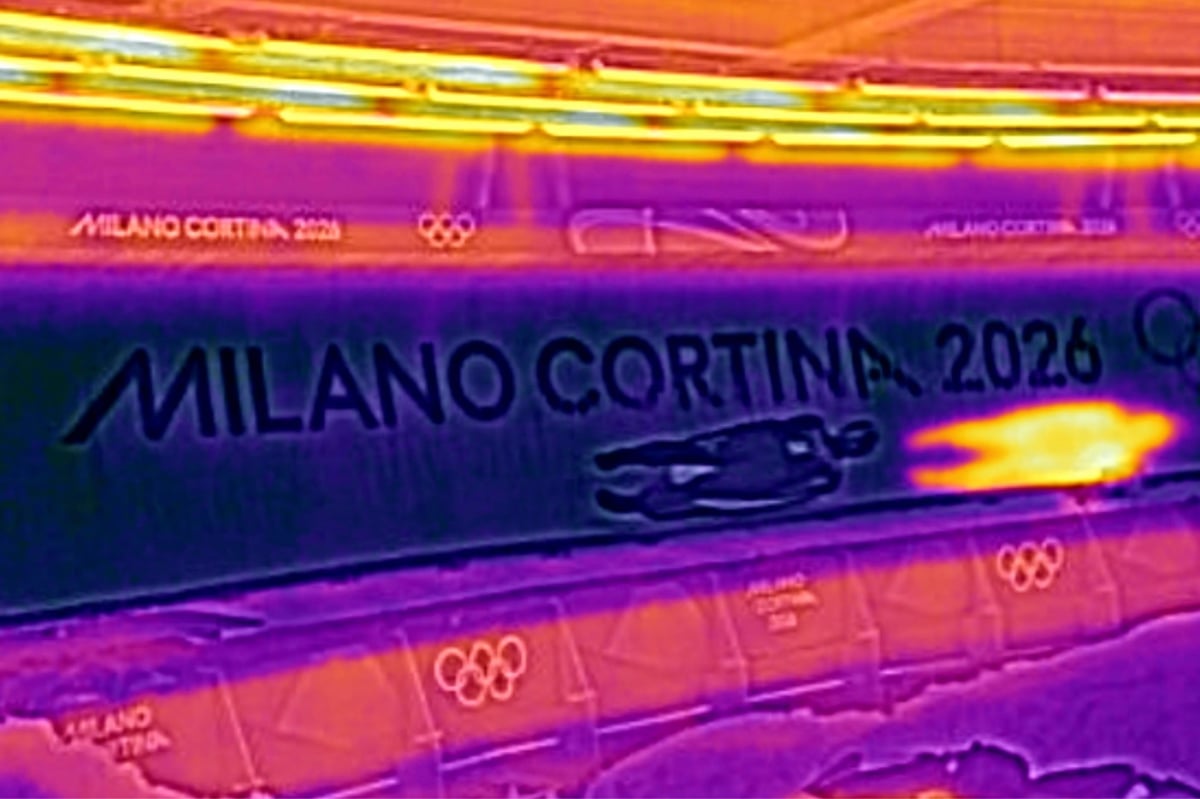
See also photos of the Winter Olympics using thermal imaging cameras.
The Track is a documentary film about a group of athletes training in post-war Bosnia to make the Olympics in luge.
The Track is a coming-of-age journey of three friends chasing their improbable Olympic dreams in post-war Bosnia. Training on a crumbling track left behind from the 1984 Sarajevo Winter Olympics, the boys are guided by their devoted coach Senad, whose fight to rebuild the neglected track mirrors his determination to create a future for his athletes in a country facing one of the highest youth unemployment rates in Europe.
Filmed over five transformative years, The Track captures an intimate and deeply human coming-of-age story set against the backdrop of a nation still recovering from the scars of war, political corruption, and rising nationalism. As the boys balance Olympic ambition with the pull of street life, heartbreak, and survival, their paths begin to diverge, revealing the stark realities young people face in modern Bosnia.
You can check the website for online and IRL showings; it’s on Amazon Prime in the US.

I watched the men’s Olympic mountain biking race last week and something one of the announcers said caught my attention. She was describing the electronic shifters the cyclists use and then said that many of the competitors were also using an AI-controlled suspension system that automagically adjusted the level of suspension according to the terrain and rider preference.
I’d never heard of this before, so I poked around a little and found some reviews of the Specialized S-Works Epic 8, a bike that comes with an adaptive suspension system called Flight Attendant (and retails for $14,500). From a review in Mountain Bike Rider:
The S-Works is the first production bike to debut with the latest version of RockShox’s Flight Attendant Ai suspension. This uses sensors in the SID Ultimate fork, SIDLuxe Ultimate shock, Quarq XX SL power crank, XX SL rear mech and XX shifters to build a comprehensive ride ‘picture’. It then automatically switch the fork and shock between open, pedal and lock modes depending on incoming impacts, bike orientation, pre-emptive shift signals and rider referencing ‘effort states’.
And from Flow Mountain Bike:
Flight Attendant is comprised of two primary components: a fork module and a rear shock module. The fork module sits atop a special Charger damper that comes inside a Pike, Lyrik or Zeb, while the shock module is built into the piggyback reservoir of a Flight Attendant-specific Super Deluxe Ultimate shock. These two modules communicate wirelessly, and decide whether the suspension should be in one of three predetermined compression settings: Open, Pedal or Lock.
The system makes these decisions based on input provided by an array of sensors. Inside the fork and shock modules you’ll find an accelerometer and an inclinometer, which allows the bike to detect both bump forces and pitch. There’s also a sensor within the crank spindle to detect if you’re pedalling or coasting.
With this combination of sensors, Flight Attendant builds a picture of the terrain and the rider’s pedalling input. Based on that picture, it automatically adjusts the suspension to the ideal setting. Put simply, it’s designed to firm up the suspension to improve pedal efficiency on the climbs and along smoother terrain, while allowing the suspension to open up for the descents and on rougher trails. And all without your hands ever having to leave the grips.
And does it work? Again from Mountain Bike Rider:
In fact I’d actually say RockShox’s claimed 1.8% faster over a 90 minute event is an underestimation for most riders. Even XC GOAT Nino Schurter found the Flight Attendant changed modes over four times more often (1,325 switches rather than 300) than he normally would with a manual lockout. That experiment also ended in the first of several World Cup wins for SID Flight Attendant prototypes in 2023 including some by Victor Koretsky on a modified version of the previous Epic Evo.
A lot of that is MTB jargon but I hope you get the jist. What I couldn’t find is any evidence that Flight Attendant or any of the similar systems are actually using AI or machine learning to assist with these adjustments. I did find this article on Pinkbike about Shimano’s plans for a suspension system that a rider can train.
Automatic control of suspension itself is nothing new. Fox Live Valve, RockShox Flight Attendant and more recently, SR Suntour’s TACT suspension products have been automatically adjusting suspension damping, with varying levels of success, for a good number of years now. However, the programming behind the function of these products is relatively fixed. There is no scope for the rider to give the system feedback on its performance. It can’t “learn” what the rider’s preferences are.
It could be that the Olympic riders are using pre-market prototypes that use machine learning to adapt to individual rider preferences, but I don’t know. I’d love to hear from folks out there if you know any more details!
I haven’t watched too much of the Olympics this summer so maybe the announcers explain this every single time they show a medals ceremony, but in case you didn’t know, the long, thin boxes given to the medalists along with their medals contain the official poster of the Games (and a plushie).
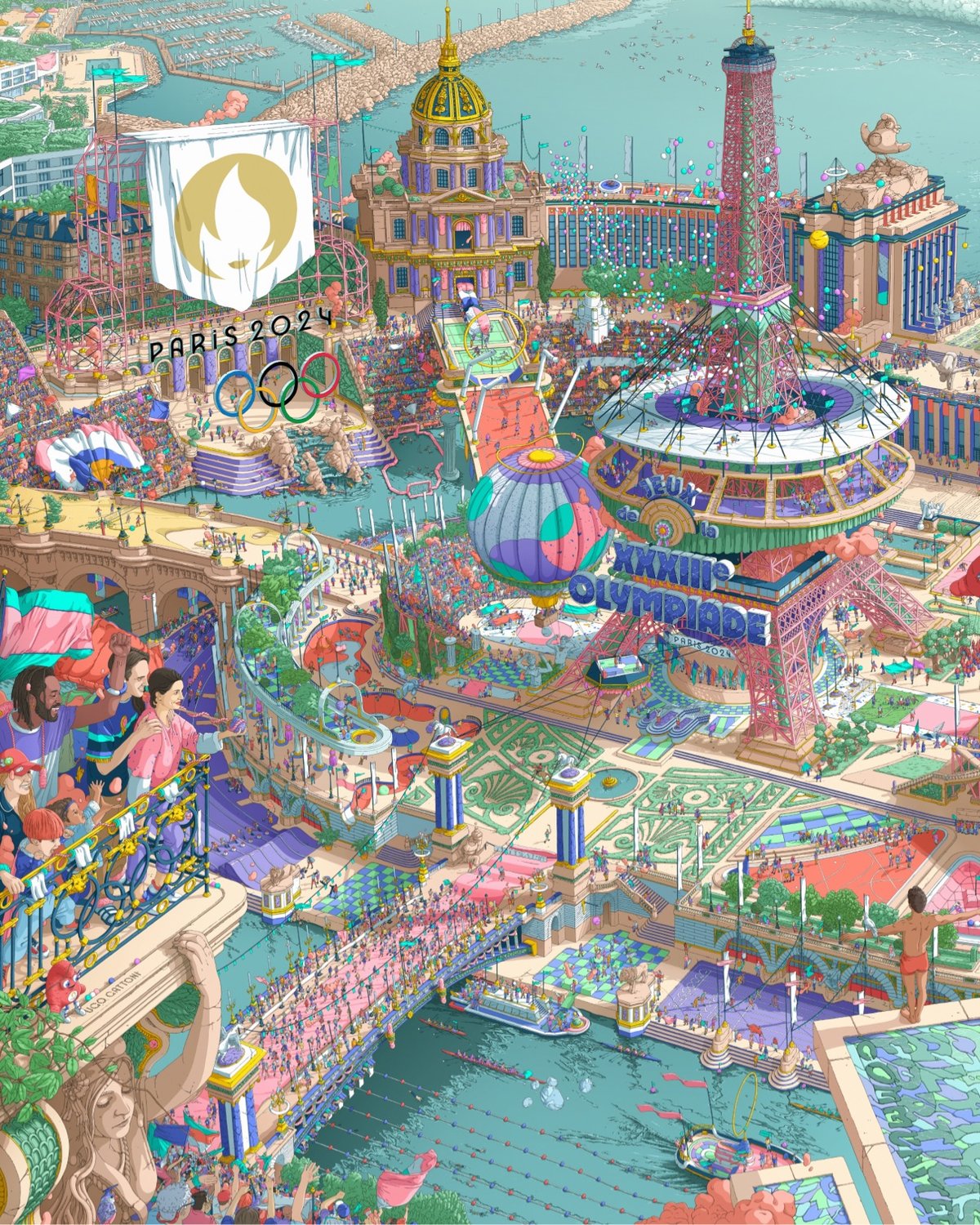
The poster was created by illustrator Ugo Gattoni and is a sort of Where’s Waldo / Busy Busy Town representation of the Games and its venues.
The designer had total creative freedom. While working to a brief and respecting the look of the Games, he still managed to maintain his own playful and joyful style.
This is why eight mascots are hidden within the posters. In fact, whatever age you are, there is something within the artwork that you will be able to enjoy.
The biggest images of the poster I can find are here if you want to zoom in to see the details. There are also zoomed-in images and videos on Gattoni’s Instagram.
The Olympic poster is the twin of the poster for the Paralympic Games, also created by Gattoni:

Together, they create one unified view of the 2024 Summer Games.
If you’d like to buy your own version of the poster, check out the official Olympics store.
Over the last century, athletic performances have dramatically improved because of better training, improved nutrition, a bigger pool of people to draw from, technology, increased financial support, and the human desire to build on each others’ successes. It’s actually shocking how much better athletics have gotten, as you can see from these “then & now” videos from the Summer Olympics. Here’s the men’s pole vault from 1912 and then 2020:
The women’s javelin in 1932 (Babe Didrikson!) vs. 2020:
And perhaps the most stark difference: the women’s 10-meter platform diving in 1912 and 2020; it’s like watching two completely different sports:
Ok, maybe gymnastics too:
You can see the entire playlist of then & now videos on the Olympics YouTube channel. (via open culture)
The 2020 Summer Olympics are over, but it’s never too late to find inspiration in the athletes who competed. For the New Yorker, Nathan Fitch made a short film about professional skateboarder Lizzie Armanto, who was then preparing to represent Finland in the first ever skateboarding competition at the Olympics.
“There [are] no masters,” Armanto says. “And even the people that we call masters — they haven’t done every trick. No one can do everything on a skateboard at all times without failing. Everyone falls, and everyone will have something that they can work on.”
Armanto didn’t medal at these Games — she broke several bones and underwent surgery after a skating accident in late 2020 and was perhaps still recovering from that. But she represented Finland and her sport in fine style; she helped design the uniforms she wore:
Those distinctive squiggles were actually an homage to Finland, the country Armanto was competing for. Specifically, she was inspired by architect and designer Alvar Aalto. “In 1939, he designed a kidney-shaped swimming pool which became synonymous with pool skateboarding much later in the ’70s,” Armanto says. “The various patterns on the jumpsuits are modeled after empty swimming pools around the world.”
(thx, pete)
Yesterday, world champion gymnast Simone Biles removed herself from the women’s team final at the Olympics after not doing one of the planned two-and-a-half twists on her vault and stumbling on the landing. Biles said after the final:
I just felt like it would be a little bit better to take a back seat, work on my mindfulness. I didn’t want to risk the team a medal for, kind of, my screw ups, because they’ve worked way too hard for that.
On Twitter, former gymnast and diver Catherine Burns explained that Biles was likely experiencing a case of “the dreaded twisties”.
When you’re flipping or twisting (or both!) it is very disorienting to the human brain. When training new flips and twists, you need external cues to learn how it feels to complete the trick correctly. (In diving, a coach yells “OUT” and you kick your body straight and pray).
Once you’ve practiced a trick enough, you develop the neural pathways that create kinesthesia which leads to muscle memory. Your brain remembers how your body feels doing the trick and you gain air awareness.
It’s like driving a car, she explains. At first everything you do is unnatural and requires deep concentration to learn but once you’ve got it down, you can do it instinctively, without thinking or even paying that much attention. Then sometimes, in stressful situations, you start thinking too much about how to do the familiar thing and you lose it completely:
Suddenly, in the middle of driving on the freeway, right as you need to complete a tricky merge, you have totally lost your muscle memory of how to drive a car. You have to focus on making you foot press the pedal at the right angle, turn the steering wheel just so, shift gears..
It’s terrifying. You’re moving way too fast, you’re totally lost, you’re trying to THINK but you know you don’t usually have to think to do these maneuvers, you just feel them and do them.
The twisties are like this, and often happen under pressure. You’re working so hard to get it right that you stop trusting your muscle memory. You’re getting lost in the air, second guessing your instincts, overthinking every movement.
And when you’re driving a car or performing a high-intensity sport like gymnastics, second guessing and overthinking can cause serious injury.
I used to write a lot about this kind of thing in this loosely connected series of posts on relaxed concentration. This phenomenon goes by many names — performance anxiety, stage fright, choking, the yips, cueitis (in snooker), and target panic (for archers) — and the world-class are not immune. Daniel Day-Lewis had stage fright so bad he quit the stage decades ago — an affliction he shared with Laurence Olivier, Barbra Streisand, and Mikhail Baryshnikov. If you’ve read anything at all about this stuff, Biles’ case of the twisties doesn’t seem so unusual or mysterious — it’s just one of those things that makes her, and the rest of us, human.
Update: I’d missed this yesterday: Biles herself told reporters about the twisties.
They saw it a little bit in practice… having a little bit of the twisties.
Which is something she’s struggled with before:
The twisties are an issue Biles has faced before, including in the lead up to the 2016 Olympic Games in Rio and prior to the 2019 season.
“2019, at the beginning of the year, I forgot how to twist and flip. It was great,” Biles told Olympics.com in January 2020.
You’ve probably seen the photograph: Tommie Smith and John Carlos each raising a black-gloved fist during the playing of the US nation anthem during the medals ceremony at the 1968 Summer Olympic Games in Mexico City. But as this video explains, their protest was a part of a larger effort to use the Olympics to highlight racial inequality in American sports and society.
After watching the video, you might be interested in reading about the aftermath of the protest. Smith and Carlos were both suspended from the US team and expelled from the Games. They were both subject to abuse from the American press and received death threats. Australian Peter Norman, who had come in second and supported the protest, was ostracized in his own country. But when Norman died in 2006, both Smith and Carlos were pallbearers at this funeral.
Wow, check out the official posters for the Tokyo 2020 Olympic and Paralympic Games.
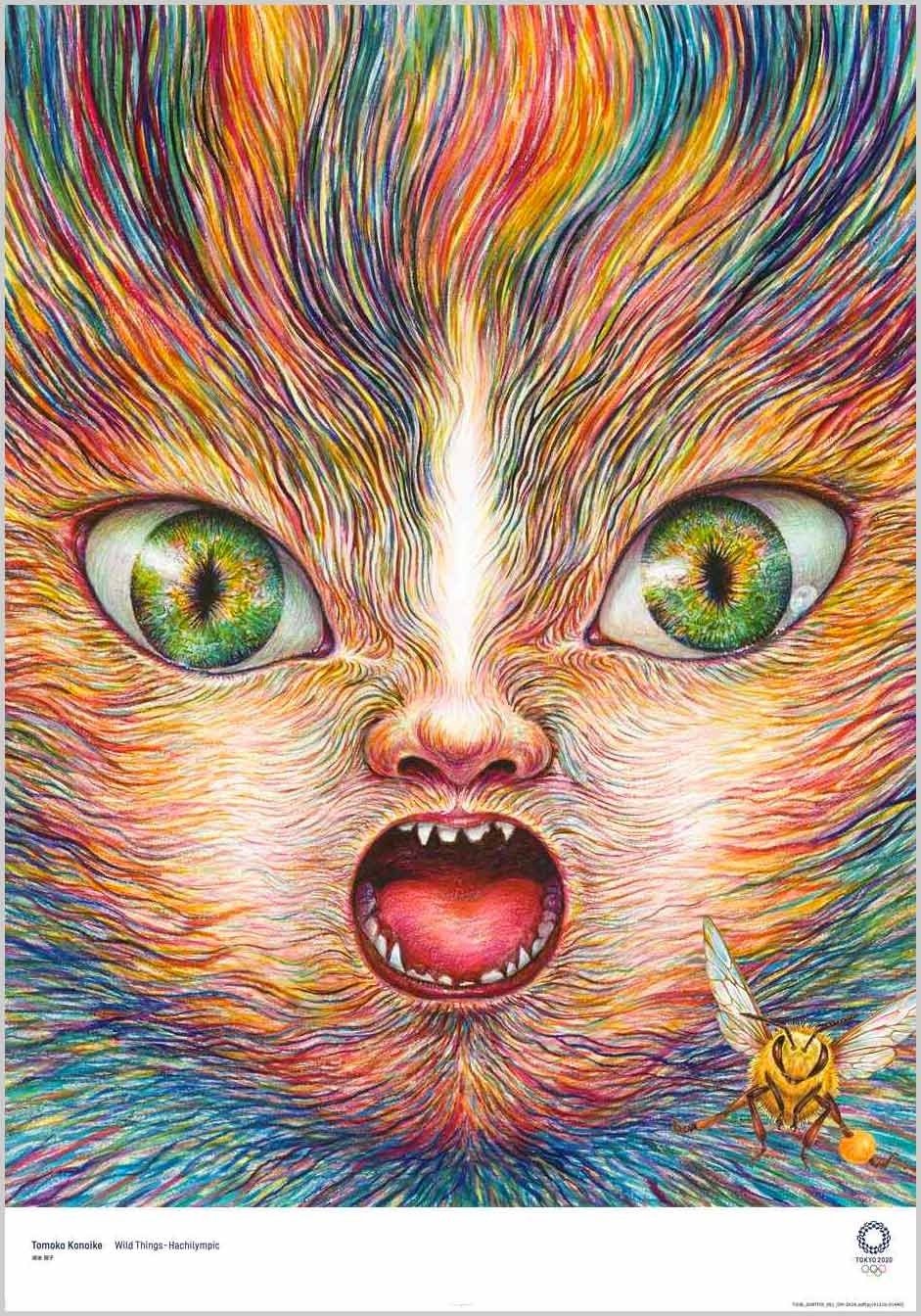
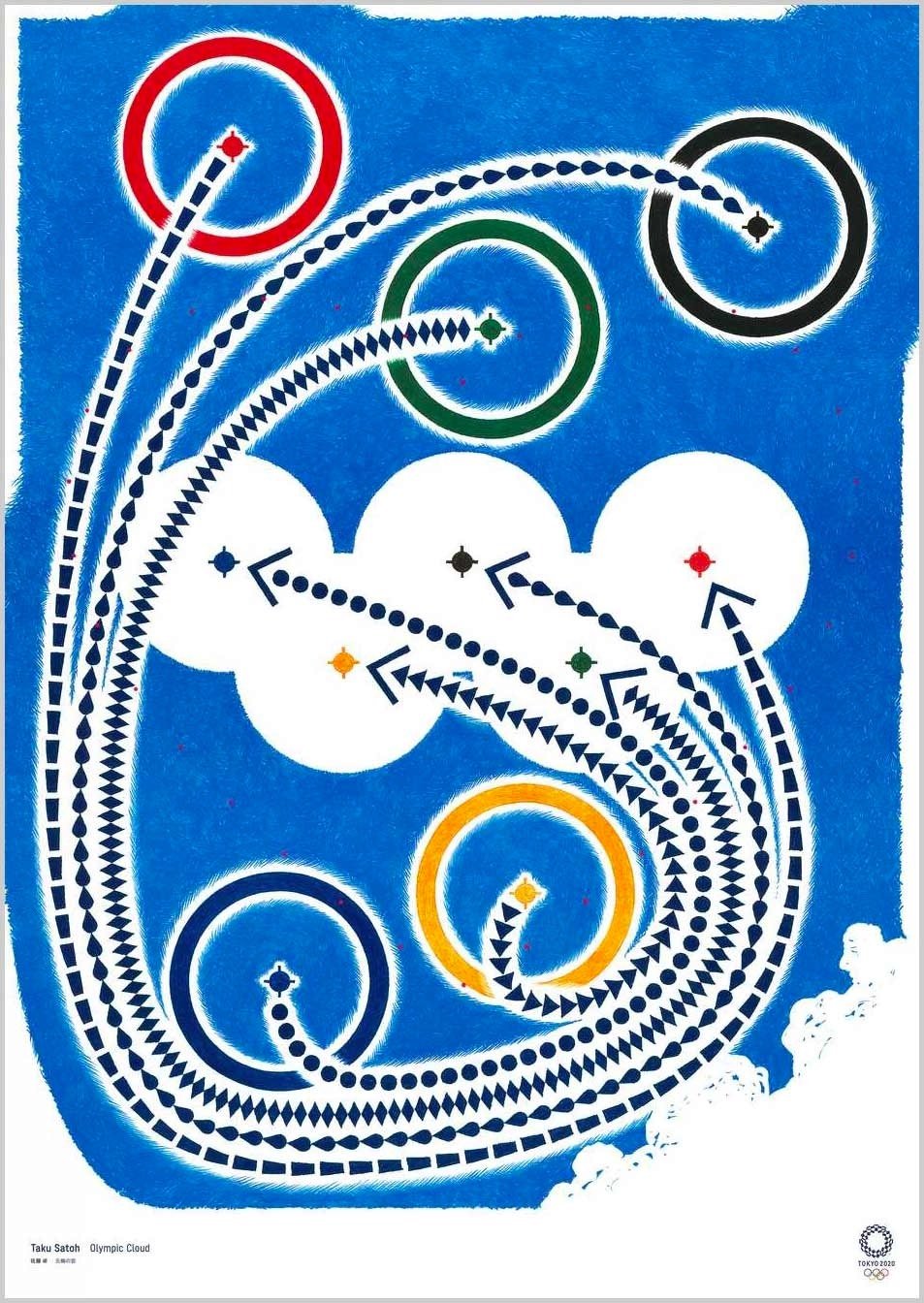

What an amazing array of styles and disciplines — there’s manga, shodo (calligraphy), Cubism, photography, surrealism, and ukiyo-e. That stunning poster at the top is from Tomoko Konoike — fantastic. As you can see, posters from past Olympics have tended towards the literal, with more straightforward depictions of sports, the rings, stadiums, etc. Kudos to the organizers of the Tokyo Games for casting their net a little wider. Love it. (via sidebar)
On Oct 21, the emblem for the 2024 Summer Olympics and Paralympics was unveiled in Paris, site of the Games. It features a round symbol that represents a gold medal, the Olympic flame, and Marianne, the “national personification of the French Republic since the French Revolution”.
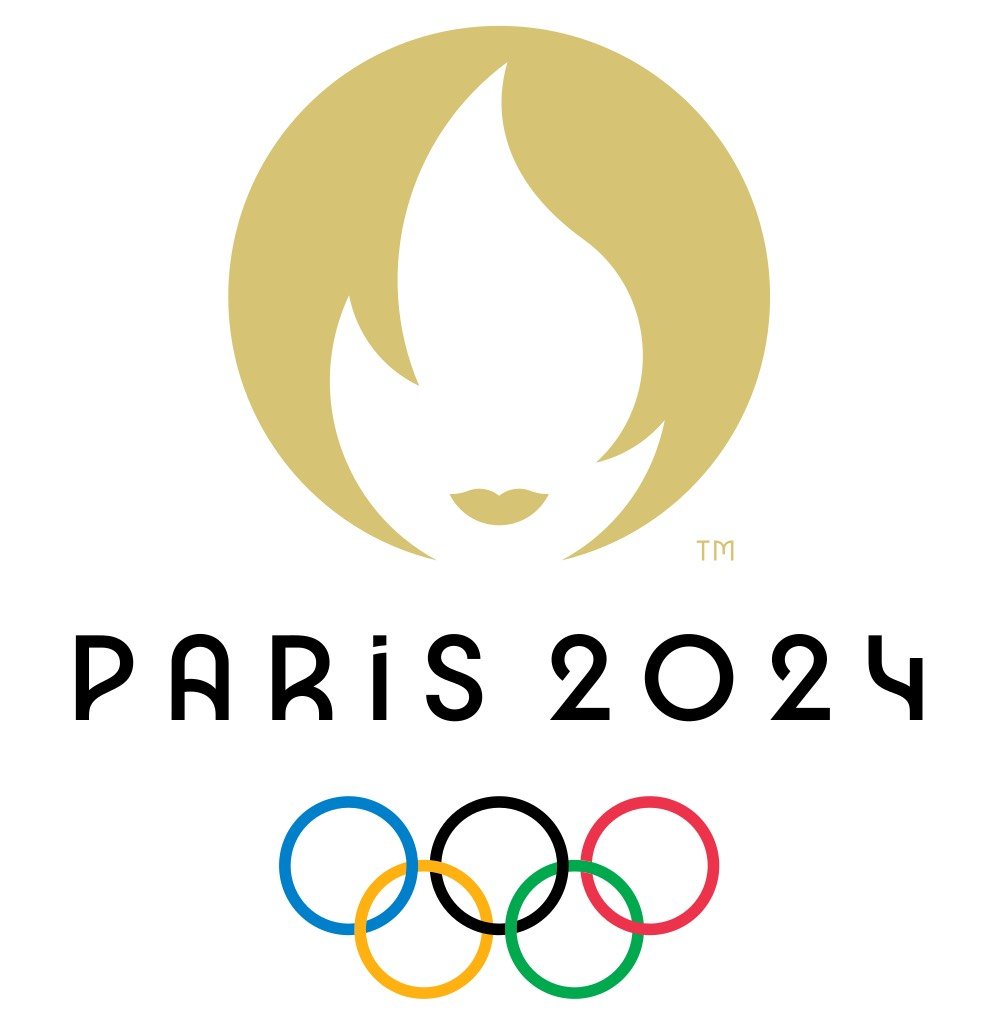
The emblem’s Marianne is quite chic, so Parisian freelance journalist Megan Clement concocted a vignette of that young woman’s life. It begins like so:
The French Olympic logo tumbles out of bed on a Parisian morning. She tousles her messy bob, dons breton stripes and ballet flats and whisks down the stairs from her fifth-floor apartment to grab a baguette before enigmatically texting two men who are pursuing her romantically.
The French Olympic logo has an expresso and a cigarette for lunch.
(via @legalnomads)
For the 1972 Summer Olympics in Munich, a team led by Otl Aicher designed the iconic identity for the event. The guidelines for the visual design were laid out in a manual produced in 1969, which contained the design systems governing how everything from signage and merchandise to tickets and even landscaping were to be produced.
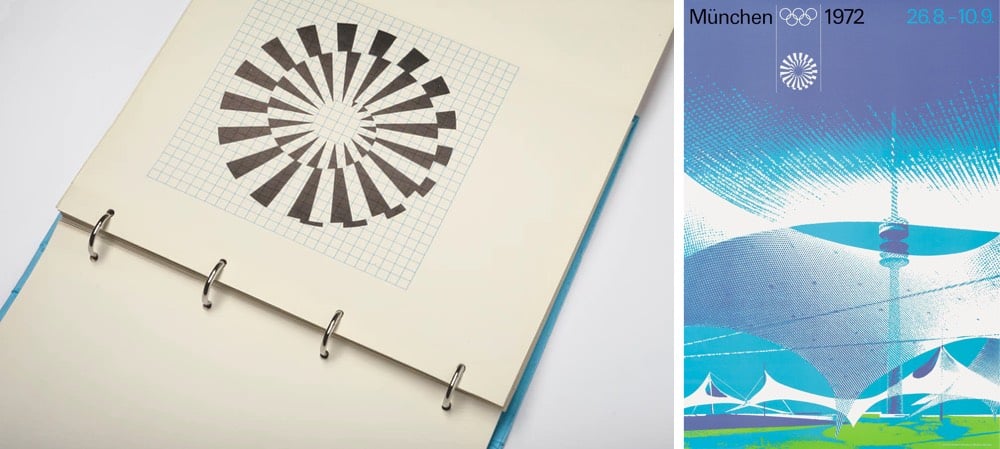
Now, a lovingly produced reprint of that manual is available for purchase on Kickstarter.
The visual modules — the typeface, the colors, the grid systems and the application methods — were the basis of all printed matter, merchandising products, signage, wayfinding systems, urban planning and landscaping.
“The freedom of play” was about ensuring “maximum variation” via “strict discipline and adherence to rules”, explained Otl Aicher in 1975.
(via steven heller)
One of my favorite moments from the 2018 Winter Olympics was the US team of Jessie Diggins and Kikkan Randall winning the women’s cross-country team sprint. In this episode of How the Race Was Won, Cosmo Catalano deftly breaks down how the pair did it, from start to finish (along with a little social commentary about how shitty parental leave policy is in the US). As Matt Haughey said, “This is a better explanation of the women’s sprint cross-country ski race than any Olympics TV coverage anywhere.”
I’ve watched the end of the race about 20 times and that shot (at 4:07 in the video) of how hard Diggins charges coming off that final corner gets me every fucking time. She just wanted it more. Maximum effort. So hardcore.
The folks at Botnik used their Predictive Writer app to write an article about the 5 Most Memorable Moments of Pyeongchang 2018.
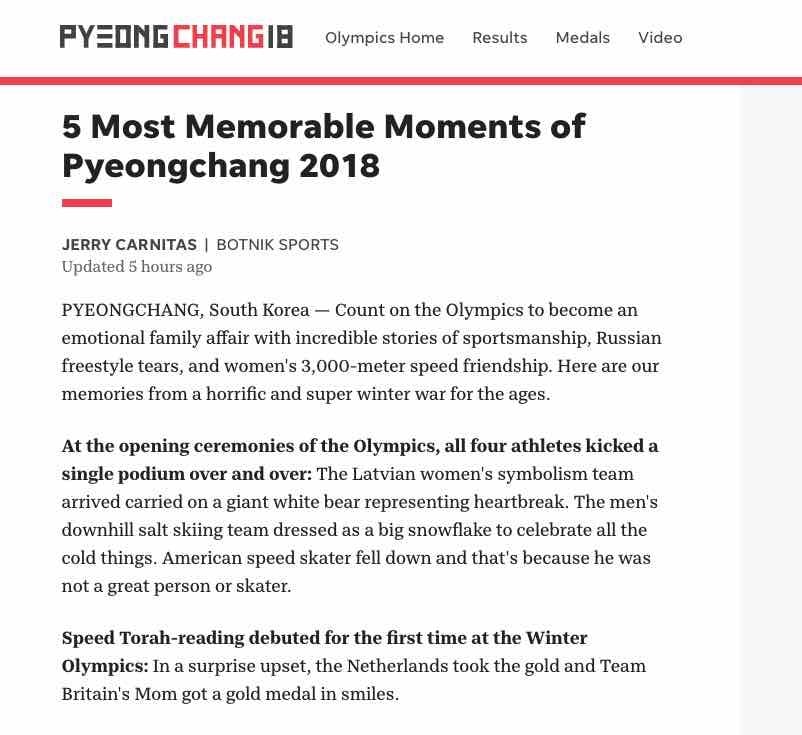
People couldn’t stop talking about all the flawless jewels scattered on the ground: Whose jewels were they? Did they want them back? Why did the sound of Bob Costas turn them to ashes?
The world watched in shock as a nation called the Horror Zone swept every single event: It was tense as they too advantage of sports to win medals. The world squandered the chance to capture the unstoppable Ice Elvis who stole all the wine from the Olympic village. The result was a reminder that nothing is ever guaranteed in winter.
The Predictive Writer is a word processor that offers word suggestions based on any text you give it. You can try it out yourself to write Radiohead lyrics, Seinfeld dialogue, John Keats poetry, or upload your own text. (via imperica)
This is a fascinating thread by Milena Popova about the differing performances of male and female athletes at the Winter Olympics. As they point out, humans are sexually dimorphic but the story doesn’t end there. Bodies are also socially constructed.
Physiology is a thing, but physiology is shaped and mediated by our social context.
Look back at those pictures of “women”. Those petite, delicate bodies, those faces we process as “beautiful”. Those are the qualities that globally dominant Western cultures associate with “femininity”.
And sport is one of the institutions that fiercely guards and reproduces dominant ideas about gender, masculinity and femininity. This plays out differently in different sports.
Generally, men and women compete separately. And for the purposes of sport “men” and “women” are defined as people whose bodies were assigned male or female at birth and whose gender matches that assignment.
The obvious example here is South African runner Caster Semenya. But Popova continues with a more subtle (and admittedly speculative) situation:
Now, what really gets me is snowboarding. Because on the face of it that’s not a sport that’s judged on the same gendered criteria of artistry and aesthetics as figure skating or gymnastics.
You’d think under all the skiing gear, helmets, scarves and goggles, it would be quite hard to perform femininity.
And still, as my friend whom I made watch slope style and half pipe for the first time in her life last night pointed out, the body types of the men and women riders are really rather different. You can tell even under all the gear.
And that translates to performance. Women get an amplitude of about 3m above the half pipe, men about 4-5m. The best women do 1080s (three revolutions), the best men 1440s (four revolutions).
…
But much like any other subculture snowboarding reproduces hierarchical structures. Moves are named after people, some people find it easier to access than others (hint: it’s a massively expensive sport), some people set trends.
One of the structures it reproduces is a gendered hierarchy. It’s a very masculine culture. Women find it harder to access the sport, find it harder to be taken seriously as athletes in their own right rather than “just hangers-on”.
And I have the sneaky suspicion that because the people with the most subcultural capital tend to be men and they decide whom they will admit and accept to the community, there are certain looks and body types of women who find it less hard (not easy!) to gain access.
And those happen to be the body types that may find it harder to do 1440s and to get 5m amplitude above the half pipe.
Another example from figure skating is Surya Bonaly, a French figure skater who landed a backflip on one skate in a performance at the 1998 Olympics. While backflips weren’t banned because of Bonaly’s relative ease in performing them (as claimed here), her athletic style was outside the norm in women’s figure skating, in which traditional femininity is baked right into the rules & judging. This was also a factor in Tonya Harding’s career (as depicted in I, Tonya).
Anyway, super interesting to think about.


These composite photos from the NY Times of athletes competing at the Olympics are fantastic. See also the same treatment for Simone Biles and Usain Bolt. (via @feltron, who wrote the book on this stuff)
Older posts





Socials & More