kottke.org posts about NYC
Alexander Chen made a version of the NYC subway map that plays music as the trains intersect routes.
At www.mta.me, Conductor turns the New York subway system into an interactive string instrument. Using the MTA’s actual subway schedule, the piece begins in realtime by spawning trains which departed in the last minute, then continues accelerating through a 24 hour loop. The visuals are based on Massimo Vignelli’s 1972 diagram.
Check out the full version; there are more details here. See also Isle of Tune. (via about 20 people on Twitter just now)
This illustrated map of Central Park individually depicts, labels, and categories by species every single significant tree in the park. All 19,630 of them.
Central Park Entire, The Definitive Illustrated Map is the most detailed map of any urban park in the world. I spent over two years creating it, walking more than 500 miles as I documented over 170 different kinds of trees and shrubs. Central Park contains over 58 miles of paved paths and many more miles of obscure woodland trails. I hiked along every one of them multiple times in order to identify and pinpoint each major tree. There are 19,630 trees drawn and placed in position on this map. There are no filler trees, no fluff. Every tree symbol represents a real tree in the Park, and you can identify its genus or species with the accompanying tree legend.
If you’ve got a subscription to the New Yorker, you can read about the map in this week’s issue. (thx, @bamstutz)
Looks like Bill Cunningham New York will be showing around the US starting with New York on March 16th. (Film Forum!) And hark, a trailer.
If you don’t take money, they can’t tell you what to do. That’s the key to the whole thing.
The Brooklyn Historical Society recently restored a 1770 map of New York City, one of a handful of “Ratzer maps” that have survived to the present day.
A British Army officer in America, Lieutenant Ratzer was a surveyor and draftsman, and his map was immediately praised as a step forward from those of his predecessors. For his trouble, his name was misspelled on initial versions of his maps, called the “Ratzen plan.”
The map included a detailed rendering of the island’s slips and shores and streets in Lower Manhattan, the familiar mixing with the long gone. Pearl, Broad, Grand and Prince lay beside Fair and Crown and the “Fresh Water” pond.
“Manhattan, at least the part shown here, was mapped as precisely as any spot on the Earth at the time,” said Robert T. Augustyn, co-author of “Manhattan in Maps: 1527-1995”. “There was no more beautiful or revealing a map of New York City ever done.”
The side-by-side comparison of the restored map with the pre-restored map is worth a look. And compare with the Viele map of Manhattan made in 1865.
Chef John Fraser’s new NYC restaurant will be designed to be open for only nine months…until the building it’s in is demolished. Some other unusual things about the restaurant: diners set their own tables, chairs are from eBay, and it’s funded in part via Kickstarter.
With little more than two weeks before the planned opening, he was still formulating the initial menu and pricing. For one appetizer he envisioned a Gruyere, leek and potato veloute; for another, Arctic char in aspic. For entrees he was mulling a pork cheek, a veal shank, Dover sole for two. These would probably be served as part of a three-course prix fixe for $58, he said.
Nothing too unconventional there. But beyond the plate, he said, anything goes. Although he’ll take reservations, he’s bypassing the Web service Open Table (too cumbersome). And he’s curious about having a marching band stomp through some night. Obligatory resourcefulness has given way to revolutionary thoughts.
Bruce McCall imagines the Manhattan street with no room for cars…but there’s a baby stroller lane, a Segway/skateboarding lane, and a runner/jogger lane. (via @bldgblog)
The Museum of the City of New York has put a sizable chunk of their photography collection up on their web site. The interface is a little hinky, but it’s worth wading through. This is 220 Spring St from 1932, from right near Sixth Avenue:
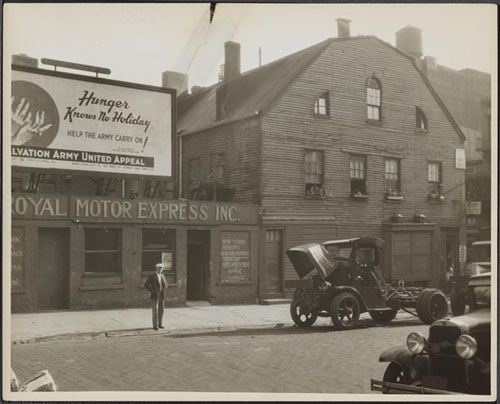
Photo credit: 220 Spring Street by Charles Von Urban. From the Collections of the Museum of the City of New York. (thx, @bamstutz)
McDonald’s in the Czech Republic has introduced a line of NYC-themed hamburgers, including the Wall Street Beef and SoHo Grande:
Grilled beef, spicy salami pepperoni, cheese, crisp, with cheese sauce and salsa mexico-tion in the bun, cheese.
Mmmm?
Michael Sorkin’s Twenty Minutes in Manhattan is an account of the author’s daily walk to work from his Greenwich Village home to a Tribeca studio. From reaktionbooks:
Over the course of more than fifteen years, architect and critic Michael Sorkin has taken an almost daily twenty-minute walk from his apartment near Washington Square in New York’s Greenwich Village to his architecture studio further downtown in Tribeca. This walk has afforded abundant opportunities for Sorkin to reflect on the ongoing transformation of the neighbourhoods through which he passes. Inspired by events both mundane and monumental, Twenty Minutes in Manhattan unearths a network of relationships between the physical and the social city.
Here’s a chapter listing:
The Stairs
The Stoop
The Block
Washington Square
LaGuardia Place
Soho
Canal Street
Tribeca
145 Hudson Street
Alternative Routes
Espri d’Escalier
Robert Campbell, the architecture critic for the Boston Globe, says of the book:
Not since the great Jane Jacobs has there been a book this good about the day-to-day life of New York. Sorkin writes like an American Montaigne, riffing freely off his personal experience (sometimes happy, sometimes frustrating) to arrive at general insights about New York and about cities everywhere.
Sounds great!
From the New Yorker a week or two ago, John Cassidy has an article about the social value of what Wall Street and investment banking. It’s not a pretty picture.
Lord Adair Turner, the chairman of Britain’s top financial watchdog, the Financial Services Authority, has described much of what happens on Wall Street and in other financial centers as “socially useless activity” — a comment that suggests it could be eliminated without doing any damage to the economy. In a recent article titled “What Do Banks Do?,” which appeared in a collection of essays devoted to the future of finance, Turner pointed out that although certain financial activities were genuinely valuable, others generated revenues and profits without delivering anything of real worth — payments that economists refer to as rents. “It is possible for financial activity to extract rents from the real economy rather than to deliver economic value,” Turner wrote. “Financial innovation…may in some ways and under some circumstances foster economic value creation, but that needs to be illustrated at the level of specific effects: it cannot be asserted a priori.”
Turner’s viewpoint caused consternation in the City of London, the world’s largest financial market. A clear implication of his argument is that many people in the City and on Wall Street are the financial equivalent of slumlords or toll collectors in pin-striped suits. If they retired to their beach houses en masse, the rest of the economy would be fine, or perhaps even healthier.
I particularly enjoyed the characterization of banking as a utility:
Most people on Wall Street, not surprisingly, believe that they earn their keep, but at least one influential financier vehemently disagrees: Paul Woolley, a seventy-one-year-old Englishman who has set up an institute at the London School of Economics called the Woolley Centre for the Study of Capital Market Dysfunctionality. “Why on earth should finance be the biggest and most highly paid industry when it’s just a utility, like sewage or gas?” Woolley said to me when I met with him in London. “It is like a cancer that is growing to infinite size, until it takes over the entire body.”
p.s. Thanks to Typekit, the New Yorker’s web site now uses the same familiar typefaces that you find in the magazine. Looks great.
Over at Edible Geography, Nicola Twilley has a fascinating interview with Alan Stillman, the founder of TGI Friday’s and Smith & Wollensky. Stillman started Friday’s because, essentially, he was interested in meeting girls.
I wanted T.G.I. Friday’s to feel like a neighbourhood, corner bar, where you could get a good hamburger, good french fries, and feel comfortable. At the time, it was a sophisticated hamburger and french fry place — apparently, I invented the idea of serving burgers on a toasted English muffin — but the principle involved was to make people feel that they were going to someone’s apartment for a cocktail party.
The food eventually played a larger role than I imagined it would, because a lot of the girls didn’t have enough money to stretch from one paycheque to the other, so I became the purveyor of free hamburgers at the end of the month.
I don’t think there was anything else like it at the time. Before T.G.I. Friday’s, four single twenty-five year-old girls were not going out on Friday nights, in public and with each other, to have a good time. They went to people’s apartments for cocktail parties or they might go to a real restaurant for a date or for somebody’s birthday, but they weren’t going out with each other to a bar for a casual dinner and drinks because there was no such place for them to go.
A profile of the woman who does the announcements — the ones you can actually understand — for the NYC subway. Since becoming “the voice”, she hasn’t actually ridden the subway.
On the telephone, her voice does not have quite as much oomph as it does on the subway. “My husband says he doesn’t hear the nice voice as often as he’d like,” she said.
But the nice voice cannot be disobeyed. Before 9/11, when they lived in Louisville, Ky., he drove to the airport to pick up her. He was early. He parked right in front of the terminal. He could hear her on the public-address system, saying no one was supposed to park there.
A traffic officer came along and said he had to follow the voice’s orders.
Her husband said, “I don’t listen to that voice at home; I’m not going to listen to it here.”
If you crossed The Sartorialist with The Selby and put the whole thing on a bike, you’d get Downtown From Behind, a collection of photographs of creative people biking the streets of downtown Manhattan, shot from behind.

Steven Johnson on what NYC and other cites are learning from services like 311.
But the service also helps city leaders detect patterns that might otherwise have escaped notice. After the first survey of 311 complaints ranked excessive noise as the number one source of irritation among residents, the Bloomberg administration instituted a series of noise-abatement programs, going after the offenders whom callers complained about most often (that means you, Mister Softee). Similarly, clusters of public-drinking complaints in certain neighborhoods have led to crackdowns on illegal social clubs. Some of the discoveries have been subtle but brilliant. For example, officials now know that the first warm day of spring will bring a surge in use of the city’s chlorofluorocarbon recycling programs. The connection is logical once you think about it: The hot weather inspires people to upgrade their air conditioners, and they don’t want to just leave the old, Freon-filled units out on the street.
The 311 system has proved useful not just at detecting reliable patterns but also at providing insights when the normal patterns are disrupted. Clusters of calls about food-borne illness or sanitary problems from the same restaurant now trigger a rapid response from the city’s health department.
Not discussed in the article is an assertion by my pal David that exclusive access to 311 data gives incumbent politicians — like, say, Michael Bloomberg — a distinct advantage when it comes to getting reelected. For instance, when campaigning on a neighborhood level, the incumbent can look at the 311 data for each neighborhood and tailor their message appropriately, e.g. promising to help combat noise in a neighborhood with lots of noise complaints or fix the streets in a neighborhood with lots of calls about potholes.
Newer posts
Older posts





Socials & More