


Travel deals for New Yorkers
Jauntsetter does a useful weekly roundup of travels deals specifically for New Yorkers. This week’s selection includes cheap fares to Cancun and Europe.

This site is made possible by member support. 💞
Big thanks to Arcustech for hosting the site and offering amazing tech support.
When you buy through links on kottke.org, I may earn an affiliate commission. Thanks for supporting the site!
kottke.org. home of fine hypertext products since 1998.
Beloved by 86.47% of the web.
Jauntsetter does a useful weekly roundup of travels deals specifically for New Yorkers. This week’s selection includes cheap fares to Cancun and Europe.
The Danziger Projects gallery in New York is running an exhibition called Can & Did, a collection of art, graphics, and photography from the Obama campaign. The opening party is on Inauguration night (Jan 20) and it runs through the end of February. All details in the press release.
A fifteen-year old foodie used some of the money from his summer job to go dine solo at Per Se. In an attempt to secure the hard-to-get reservation, he asked to be excused from his classroom and dialed the reservations line while hiding in the bathroom.
It was September 29th; exactly two months from the Saturday of Thanksgiving break and one of the few times I would be able to make the trek up to New York to dine at Per Se. I would have to call to make the reservation at Per Se at exactly 10 A.M today if I had any hope of getting that Saturday reservation. The only problem? I had school.
I sat patiently in my 9:30 - 10:25 science class as the clock neared 10. Very strategically, at exactly 9:57, I innocently asked to use the bathroom. I walked, no sprinted to the bathroom down the hall. I scrolled down my contact list until I reached Per Se, then dialed, and waited…
A beautiful heart-shaped map of the NYC subway system is among the several such maps done by a pair of Korean graphic designers calling themselves Zero Per Zero.
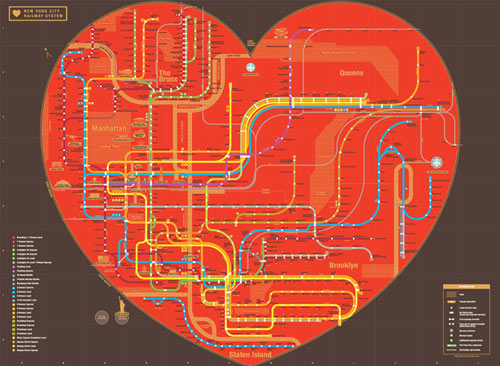
A portable map version is available for sale, but the shipping cost from Korea to the US is a bit steep.
A.A. Gill goes on a Sex and the City tour and loves to hate it.
You remember the episode where Carrie spills the cappuccino because she’s looking after the dog and has lost the manuscript with a description of oral sex with the Russian and then oh my God she bumps into Big who she hasn’t seen since that time with the martini olives and the hemorrhoids? Well, if you look to the right, that’s the cafe, and it’s like oh my God bad hair dog blow job cappuccino hell. You remember that of course.
Oh, just one more excerpt:
I suppose a vibrator might be an impulse buy, and buying yourself one in front of 50 strangers with whom you then have to share a bus journey might be considered the height of liberated insouciance. But buying a sex aid because some actress has faked an orgasm on TV with it is evidence that there’s more wrong with your social life than can be fixed by a dildo.
Included in the NYPL’s recent addition to the Flickr Commons project is Changing New York, a selection of photos taken of NYC in the 1930s by Berenice Abbott as part of a government program for unemployed artists. Here are the Starrett-Lehigh Building and looking north from Washington Square…so open! And the buildings are so low too. The Cyanotypes of British Algae set is worth a look as well.
Here’s a video from 1905 of a NYC subway car going from 14th Street to 42nd Street. It’s funny to see all the men in suits and hats running for the train…it takes some of the formality out what seems from photographs to be a more dignified time. Also, anyone know what line/train this is?
Update: The inbox consensus seems clustered around the opinion that this train is running on the contemporary 4/5/6 line. Here’s a 1904 map which shows the then-IRT line in question (in red). At 42nd St, the line runs crosstown to Times Square and then up the 1/2/3. (thx jason et al.)
Locations of interest in New New York (with photos), the setting for the events of Futurama in the year 3000. Includes Citihall, Taco Bellevue Hospital, Little Bitaly, the Metropolitan House of Opera, Original Cosmic Ray’s Pizza, and Commander Riker’s Island Jail. (thx, anthony)
Eat me daily rounds up a recent AIGA event about food. The most interesting tidbit came from Matteo Bologna’s speech. Bologna designs restaurants, most notably for Keith McNally (Pastis, Balthazar, Morandi, Schillers, etc.).
Really fascinating was what he and McNally did for Pastis — it doesn’t actually have a visual brand. McNally wanted the restaurant to look like it had been in the neighborhood for years, so Bologna constructed this narrative of a family that had maintained the restaurant for a century, and each generation some element gets updated or redesigned, but without going for consistency or even style. The result is completely different-looking signage, awnings, menus, wine lists, checks… everything uses a different palette, type set, but its essential Frenchiness ties everything together. It’s an anti-brand.
The name of the restaurant is thus a play on pastiche in addition to being named after the French aperitif. (via eater)
More on the Saigon Grill saga: the owners were arrested yesterday on over 400 counts of “violating minimum-wage laws, falsifying business records and defrauding the state’s unemployment insurance system”.
“Like so many restaurants across New York City, Saigon Grill was run on the backs of its workers,” Mr. Cuomo said in a statement. “These workers allowed the business to thrive, and in exchange they were allegedly cheated out of wages, fined for ridiculous reasons” and, he said, “pulled into a painstaking ploy to cover it all up.”
(thx, nick)
Richard Howe takes photographs of Manhattan street corners. From March to November 2006, Howe took a photo of every single street corner in Manhattan, around 11,000 in all.
I photographed each corner just as I found it, almost always as seen from its diagonally opposite corner. Some of the photographs have no people and no traffic, others are completely dominated by people or even, in some instances, by traffic; the majority are somewhere in between. Most of the photographs simply show what people were doing on the corner when I got there: crossing the street or waiting to cross it, shopping, hanging out, riding a bicycle, and so on — in short, doing what people do at almost any street corner anywhere in Manhattan.
The ridiculously giant Carnegie Deli pastrami sandwich (retail: $14.95) contains enough meat to make at least 5 normal-sized sandwiches.
Update: There’s a Flickr group called Campaign for a Sensible Sandwich. (thx, dunstan)
From an article about a collection of businesses located near Riker’s Island, this tidbit: the inmates refer to the prison-issued orange sneakers as Air Giulianis. Also:
The food truck man, Mr. Samolis, said he often gives free food to inmates who are released from Rikers with no money.
“They get released at 6 in the morning with nothing but a $2 MetroCard the jail gives them,” he said. “So I’ll give them a coffee and an egg sandwich, on credit. I know they’re never going to pay it back, but I feel bad for them.”
(thx, jake)
When I profiled the Metropolitan Life Tower (and an unusual postscript) a couple of months ago, I mentioned that Daniel Libeskind was working on an addition to the building that would dwarf the iconic clock tower. New York magazine has a rendering of what the building might look like, taken from the architect’s new book.
Initial designs show a glass-curtained tube with cutaways spiraling up and around the facade to reveal segments of terraced verdure, like cultivated patches on the side of a steep alpine slope. “We didn’t just fill up the tower,” the architect says. “We’ve taken space away [from the apartments] to create the gardens,” which are actually balconies tucked within the envelope. “It’s as if nature has come back into the city,” he says.
Update: More photos and details here.
The Bank of Oklahoma Building in Tulsa, Oklahoma is (nearly) a half-scale version of the World Trade Center towers. The building was designed by the WTC architect and completed just three years after the Twin Towers.
For the BOk building, Yamasaki reprised the scheme of a Twin Tower at almost exactly half the scale: 52 stories and 667 feet tall, to the Twin Towers’ 110 floors (1,362 and 1,368 feet). It has 31 steel perimeter columns per side, to the Twin Towers’ 59, producing the same eye-boggling vertical lines on each face. (As Jean Baudrillard noted of the more famous pair, well before its destruction, it is “blind,” with no side presenting a facade.) The BOk, too, has a bilevel lobby, whose height is matched by arched windows. But the arches are big and round, like a child’s plain wooden building blocks, rather than the Venetian Gothic ogees that, in the World Trade Center, flowed directly into the perimeter columns.
According to Bender’s Game (good title!), a direct-to-DVD Futurama movie, the Planet Express HQ is located in Hell’s Kitchen right on the Hudson.
Interview with David Graves, NYC beekeeper.
For Berkshire bees, quitting time is about 5 pm. New York City bees, they work harder and longer. And as you can see, we’re here before 7 am, and these bees are already starting to work, whereas the country bees won’t be opening the doors till about 9 am. And these city bees will still be hard at work at 7 tonight! Maybe it’s because it’s warmer here or maybe it’s the city lights. Whatever it is, they definitely work longer hours.
Graves is one of a number of New York City beekeepers who defy the city health code and risk the $2000 fine levied upon its violation.
But in New York, bees are reprobate and illegal. They appear in the City Health Code’s Section 161.01, along with an enormous list of animals “naturally inclined to do harm or capable of inflicting harm,” lumped in with the truly ferocious/impractical-polar bear, cougar, alligator, whale-and a menagerie of the truly obscure. Actively encouraged by almost every other self-respecting cultural capital, the common honey bee, according to Health Department logic, must be banished along with binturongs, sea kraits, coatimundis, numbats and zorilles.
Graves has been at this awhile…a NY Times article called him the “Johnny Appleseed of New York beedom” in 1999.
All right, but why beekeeping? “After you do it, everything else in life is calm,” said Mr. Solomon, the investment banker. “Let me tell you, 40,000 bees will teach you the power of concentration and patience.”
Graves’ “Rooftop Magic” Honey is available for purchase online. Some say that eating local honey helps with seasonal allergies but evidence is scarce. Oh and you can order your own package of bees here…three pounds of Buckfast with a queen is just $130. (via clusterflock)
The (Mostly) True Story of Helvetica and the New York City Subway details the use of type in signage, maps, and manuals for the NYC subway. A must-read for type and subway fans.
As if this plethora of signs were not enough, the subway system also had a bewildering variety of other porcelain enamel and hand-painted signs. The porcelain enamel signs, either hung from the ceiling or posted on the walls, were directional as well as informational. The directional signs included those on the outside of the station entrances as well as those intended for the corridors and platforms underground. Many of the informational signs warned against criminal, dangerous or unhealthy behavior: no peddling wares, no leaning over the tracks, no crossing the tracks, no smoking, no spitting. The directional and informational ones were made by Nelke Veribrite Signs and the Baltimore Enamel Company, while the behavioral ones were the product of the Manhattan Dial Company. Most were lettered in some form of sans serif capitals-regular, condensed, square-countered, chamfered, outlined-though some were in bracketed or slab serif roman capitals. They were usually white letters on a colored background (often dark green for the IND and dark blue for the IRT and BMT), yet many were also black on a white background. There was no house style.
What is to modern eyes a beautiful disorder of tiled text and hand-painted enamel became an embarrassing shambles in the 70s and 80s. It was only in late 1989 that Helvetica became the official typeface for New York City subway system signage…about 20 years too late to prevent the current signage from looking dated.
Hey, the USS Intrepid, an aircraft carrier and museum, is back in her old spot on the west side of Manhattan. The Intrepid somewhat famously didn’t want to leave her berth in 2006 for refurbishment in New Jersey.
The NY Times has photographer David Dunlap running around NYC taking updated versions of the photos he took of the city for Paul Goldberger’s 1978 guidebook to Manhattan, The City Observed: New York. Recent Now/Then comparisons include Grand Central Terminal, the corner of 59th St and 5th Ave (where the Apple Store is), and, perhaps the most striking pair of photos, the Hudson River shoreline.
Filed under things I really don’t understand: Silver Towers/University Village, part of a residential superblock complex in Greenwich Village and designed by I.M. Pei, has been granted landmark status by New York City Landmarks Preservation Commission. Said the Greenwich Village Society for Historic Preservation, who battled to preserve the buildings:
Silver Towers is the first post-war urban renewal superblock development in New York City to be landmarked. While such urban renewal projects rarely receive high marks for design, Silver Towers is considered a watershed moment for one of the late 20th century’s most respected and influential architects. The design won awards from the American Institute of Architects and the City Club, was dubbed “one of ten buildings that climax an era” by Fortune Magazine, and was cited as a basis for which Pei received the 1983 Pritzker Prize — the most prestigious award for architects — for his body of work up to that time. Landmarking Silver Towers not only helps preserve an eminently livable place and honors a great work of architecture, but it also acknowledges the importance of our city’s past efforts to create affordable housing and public art.
These may or may not be great buildings, but that whole complex is just this big sucky void between the Village and Soho that no one can get rid of now. Blech.
A lovely photo set of New York City from the 1930s. My favorites are the crowded beach scene at Coney Island, Margaret Bourke-White’s shot of hats in the Garment District, and a shot of “the Lung Block” on the Lower East Side. In due time, that then-notorious but now-beautiful block was razed to make way for one of Manhattan’s first large apartment complexes, Knickerbocker Village which at various times housed several members of the Bonnano crime family and Julius & Ethel Rosenberg. (thx, mark)
For his Fabric of Brooklyn project, Tom Mason took photos of scenes in Brooklyn and combined them to depict super-bustling neighborhoods. Reminded me of this wonderful composite image of a busy airport by Ho-Yeol Ryu.
Alternate Manhattan maps, #510 in an infinite series: map of where the Marvel comic book characters hang out in the city.
Update: And of course, fans have made even better, more detailed maps. (thx, sam)
Dark Days is a documentary released in 2000 about a group of homeless people living in an abandoned Manhattan railway tunnel.
When he relocated from London to Manhattan, Marc Singer was struck by the number of homeless people he had seen throughout the city. Singer had befriended a good number of New York’s homeless and later, after hearing of people living underground in abandoned tunnel systems, he met and became close to a group of people living in The Freedom Tunnel community stretching north from Penn Station past Harlem. After living with them for a number of months, he decided to create a documentary in order to help them financially. The film’s crew consisted of the subjects themselves, who rigged up makeshift lighting and steadicam dollies, and learned to use a 16mm camera with black & white Kodak film. Singer himself had never been a filmmaker before, and saw the production of Dark Days as a means of gaining better accommodation for the residents of the tunnel.
The entire film is available for viewing at Google Video. (via waxy)
Thanks to artist Carsten Holler, you can spend a night in the Guggenheim Museum in Manhattan.
Revolving Hotel Room is an art installation comprising three outfitted, superimposed turning glass discs mounted onto a fourth disc that all turn harmoniously at a very slow speed. During the day the hotel room will be on view as part of the Guggenheim’s theanyspacewhatever exhibition, which runs from October 24, 2008-January 7, 2009. At night, the art installation becomes an operative hotel room outfitted with luxury amenities.
The view from the rotating bed.
Holler was previously responsible for the seriously fun-looking slides in the Tate Modern’s Turbine Hall a couple of years back.
Shorpy has posted a photo of the Metropolitan Life Tower taken in 1909, the year the building was completed. I recently wrote posts about the building and about an odd death that occurred there. (thx, finn)
A collection of photos of signs located in NYC from 14th St to 42nd St in Manhattan. Many of the photos were taken in the 80s and 90s and the signs they depict are already gone. The photos are extensively annotated…this is a real history lesson.
A federal judge has awarded $4.6 million in back pay and damages to 36 delivery workers at two Saigon Grill restaurants in Manhattan, finding blatant and systematic violations of minimum-wage and overtime laws.
We live right around the corner from one of the SGs and have avoided eating there despite the decent and close Vietnamese food. The fired workers were out in front of the place protesting for months and months…it’s great to see hard work pay off like that, particularly when the protestors probably couldn’t actually afford to be out there.
Socials & More