kottke.org posts about Carl Sagan
Raffi Khatchadourian’s long piece on the construction of the International Thermonuclear Experimental Reactor (ITER) is at once fascinating (for science reasons) and depressing (for political/bureaucratic reasons). Fusion reactors hold incredible promise:
But if it is truly possible to bottle up a star, and to do so economically, the technology could solve the world’s energy problems for the next thirty million years, and help save the planet from environmental catastrophe. Hydrogen, a primordial element, is the most abundant atom in the universe, a potential fuel that poses little risk of scarcity. Eventually, physicists hope, commercial reactors modelled on iter will be built, too-generating terawatts of power with no carbon, virtually no pollution, and scant radioactive waste. The reactor would run on no more than seawater and lithium. It would never melt down. It would realize a yearning, as old as the story of Prometheus, to bring the light of the heavens to Earth, and bend it to humanity’s will. iter, in Latin, means “the way.”
But ITER is a collaborative effort between 35 different countries, which means the project is political, slow, and expensive.
For the machine’s creators, this process-sparking and controlling a self-sustaining synthetic star-will be the culmination of decades of preparation, billions of dollars’ worth of investment, and immeasurable ingenuity, misdirection, recalibration, infighting, heartache, and ridicule. Few engineering feats can compare, in scale, in technical complexity, in ambition or hubris. Even the iter organization, a makeshift scientific United Nations, assembled eight years ago to construct the machine, is unprecedented. Thirty-five countries, representing more than half the world’s population, are invested in the project, which is so complex to finance that it requires its own currency: the iter Unit of Account.
No one knows iter’s true cost, which may be incalculable, but estimates have been rising steadily, and a conservative figure rests at twenty billion dollars — a sum that makes iter the most expensive scientific instrument on Earth.
I wonder what the project would look like if, say, Google or Apple were to take the reins instead. In that context, it’s only $20 billion to build a tiny Sun on the Earth. Facebook just paid $19 billion for WhatsApp, Apple has a whopping $158.8 billion in cash, and Google & Microsoft both have more than $50 billion in cash. Google in particular, which is making a self-driving car and has been buying up robots by the company-full recently, might want their own tiny star.
But back to reality, the circumstances of ITER’s international construction consortium reminded me of the building of The Machine in Carl Sagan’s Contact. In the book, the countries of the world work together to make a machine of unknown function from plans beamed to them from an alien intelligence, which results in the development of several new lucrative life-enhancing technologies and generally unites humanity. In Sagan’s view, that’s the power of science. Hopefully the ITER can work through its difficulties to achieve something similar.
In 1976, legendary cosmologist and astronomer Carl Sagan tried to recruit a 17-year-old Neil deGrasse Tyson to Cornell University. In April of that year, Tyson wrote Sagan a letter informing him of his intention to enroll at Harvard instead:
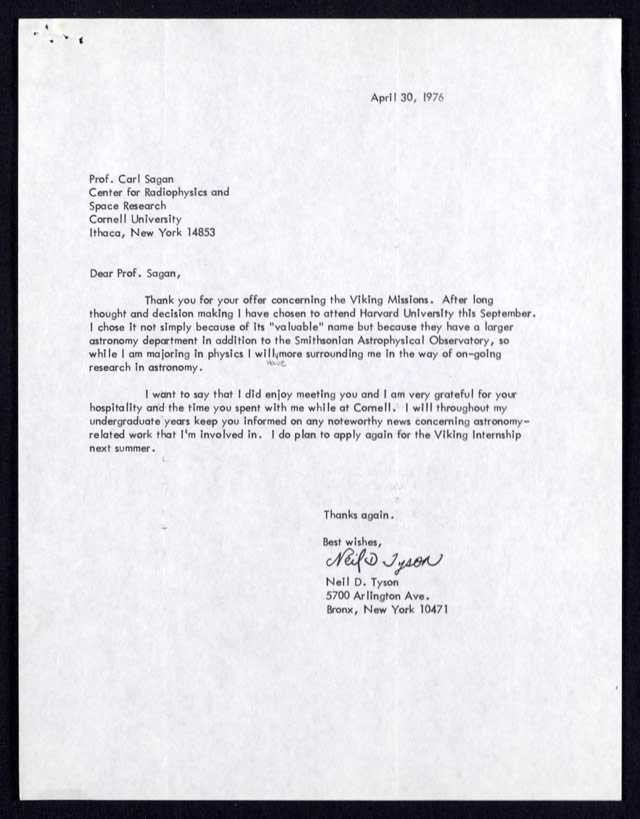
The Viking Missions referred to in the letter were the two probes sent to Mars in the mid-1970s.
Tyson occupies a role in today’s society similar to Sagan’s in the 1980s as an unofficial public spokesman of the wonderous world of science. Tyson is even hosting an updated version of Sagan’s seminal Cosmos series for Fox, which debuts on March 9th. Here’s a trailer:
Letter courtesy of The Seth Macfarlane Collection of the Carl Sagan and Ann Druyan Archive at the Library of Congress, which is chock full of great Sagan stuff. And yeah, that’s Seth Macfarlane, creator of Family Guy and much-maligned host of the Oscars. Macfarlane was a big fan of the original Cosmos series and was instrumental in getting the new series made. (via @john_overholt)
Been waiting for this one for awhile: a three-minute trailer for Cosmos: A Spacetime Odyssey, a sequel to Carl Sagan’s Cosmos.
The show will be hosted by Neil deGrasse Tyson and is being produced by Seth MacFarlane (Family Guy) and Sagan’s widow Ann Druyan. If MacFarlane’s involvement raises some eyebrows, it shouldn’t: he came up with the idea of rebooting the series and is apparently a big space nerd and fan of the original series. (via devour)
From a collection of his papers recently acquired by The Library of Congress, a 1954 reading list from physicist Carl Sagan. Huxley, Plato, Shakespeare, and the Bible are all on there among many others. If I understand mathematics properly, and I think I do, using the associative property, if you read all these books, you will become as smart and cool as Carl Sagan was. Or is it the transitive property?
This is a bit of a head-scratcher…the guy behind the Family Guy (Seth MacFarlane) is teaming up with Carl Sagan’s widow and Neil DeGrasse Tyson to do a sequel to the landmark science series, Cosmos. The series will air in primetime on Fox.
The producers of the show say the new series will tell “the story of how human beings began to comprehend the laws of nature and find our place in space and time.” They go on to boast: “It will take viewers to other worlds and travel across the universe for a vision of the cosmos on the grandest scale. The most profound scientific concepts will be presented with stunning clarity, uniting skepticism and wonder, and weaving rigorous science with the emotional and spiritual into a transcendent experience.”
I’ll be tuning in but will be pleasantly surprised if it does well in the ratings or is any good.
Nerd Boyfriend, a site that details the sartorial choices of desirable nerds, shows us where to buy the outfit Carl Sagan wore in Cosmos.
If you want to make an apple pie from scratch, first you must invent the universe.
That’s Carl Sagan in Cosmos. Here’s the recipe for Carl’s apple pie.
Maybe you’re tired of un-pop-music-like things being run through Auto-Tune, but I’m not quite there yet. This Auto-Tuned Carl Sagan mix is very nearly sublime.
The entire Cosmos series is available for free on Hulu, in 480p no less (US only). From the Wikipedia:
[Cosmos] covered a wide range of scientific subjects including the origin of life and a perspective of our place in the universe. The series was first broadcast by the Public Broadcasting Service in 1980, and was the most widely watched series in the history of American public television until 1990’s The Civil War. It is still the most widely watched PBS series in the world. It won an Emmy and a Peabody Award and has since been broadcast in more than 60 countries and seen by over 600 million people, according to the Science Channel.
(thx, sam)
A map of the Milky Way done in the style of the London tube map.
I was re-reading Carl Sagan’s novel Contact recently, essentially a series of arguments about SETI wrapped into a story, and he alludes to some sort of cosmic Grand Central Station. That, coupled with my longtime interest in transit maps, got me thinking about all of this.
At the very moment that humans discovered the scale of the universe and found that their most unconstrained fancies were in fact dwarfed by the true dimensions of even the Milky Way Galaxy, they took steps that ensured that their descendants would be unable to see the stars at all. For a million years humans had grown up with a personal daily knowledge of the vault of heaven. In the last few thousand years they began building and emigrating to the cities. In the last few decades, a major fraction of the human population had abandoned a rustic way of life. As technology developed and the cities were polluted, the nights became starless. New generations grew to maturity wholly ignorant of the sky that had transfixed their ancestors and had stimulated the modern age of science and technology. Without even noticing, just as astronomy entered a golden age most people cut themselves off from the sky, a cosmic isolationism that only ended with the dawn of space exploration.
That’s Carl Sagan in Contact from 1985. The effects of light pollution were documented in the New Yorker last August.
Scientists who have tried drugs have included Carl Sagan, Richard Feynman, and Stephen Jay Gould. Like Sigmund Freud, fictional detective Sherlock Holmes was a fan of cocaine. (via cyc-c)
The New Yorker recently ran a feature on how a couple of mathematicians helped The Met photograph a part of The Hunt of the Unicorn tapestries. That same week, they ran from their extensive archives a 1992 profile of the same mathematicians, brothers David and Gregory Chudnovsky. The Chudnovskys were then engaged in calculating as many digits of pi as they could using a homemade supercomputer housed in their Manhattan apartment. There’s some speculation that director Darren Aronfsky based his 1998 film, Pi, on the Chudnovskys and after reading the above article, there’s little doubt that’s exactly what he did:
They wonder whether the digits contain a hidden rule, an as yet unseen architecture, close to the mind of God. A subtle and fantastic order may appear in the digits of pi way out there somewhere; no one knows. No one has ever proved, for example, that pi does not turn into nothing but nines and zeros, spattered to infinity in some peculiar arrangement. If we were to explore the digits of pi far enough, they might resolve into a breathtaking numerical pattern, as knotty as “The Book of Kells,” and it might mean something. It might be a small but interesting message from God, hidden in the crypt of the circle, awaiting notice by a mathematician.
The Chudnovsky article also reminds me of Contact by Carl Sagan in which pi is prominently featured as well.
According to Wolfram Research’s Mathworld, the current world record for the calculation of digits in pi is 1241100000000 digits, held by Japanese computer scientists Kanada, Ushio and Kuroda. Kanada is named in the article as the Chudnovskys main competitor at the time.
(Oh, and as for patterns hidden in pi, we’ve already found one. It’s called the circle. Just because humans discovered circles first and pi later shouldn’t mean that the latter is derived from the former.)
Newer posts




Socials & More