



Phil Plait: What Happens to a Werewolf on the Moon? “The transformation wouldn’t last a mere terrestrial night but an entire lunar day, which is two weeks in duration. The carnage would be literally unearthly.”

Advertise here with Carbon Ads
This site is made possible by member support. 💞
Big thanks to Arcustech for hosting the site and offering amazing tech support.
When you buy through links on kottke.org, I may earn an affiliate commission. Thanks for supporting the site!
kottke.org. home of fine hypertext products since 1998.
Beloved by 86.47% of the web.
Entries for October 2023
Stop, Before You Close This Tab (or Any Others)… “Think of your browser like an ongoing autobiography. Why would you ever delete it?”
The History of the Electric Guitar Solo
YouTube channel Polyphonic (whose videos I’ve featured before) has taken on an ambitious project: tracing the history of the electric guitar solo from its origins in blues and country music in the American South all the way up to the present day. The series is called Axe To Grind and the first three episodes are available on YouTube (the first two are embedded above). People are sharing their favorite early electric guitar players in the comments of the first video.
The series is also available on the subscription-only Nebula — episodes appear there first and the music excerpts are longer because Nebula doesn’t trample all over creators’ fair use rights like YT does. (via open culture)
Look, I’m tired of all things Trump too, but for some reason, but this improv of Lord of the Rings’ Sauron as Trump by Brennan Mulligan had me rolling on the floor. The cadence is perfect.
Fungi: Web of Life
Fungi: Web of Life is an upcoming IMAX documentary on mushrooms & their fungi brethren narrated by Björk and presented by Merlin Sheldrake.
Join acclaimed British biologist, Dr. Merlin Sheldrake, on a quest to find an incredibly precious blue mushroom, against the backdrop of Tasmania’s ancient Tarkine rainforest. Merlin will show us some the grandest and strangest organisms ever discovered, showcased through jaw-dropping time-lapse cinematography, in a landscape largely unchanged from the time of the dinosaurs. Fungi have important lessons to teach humanity about survival through cooperation. Indeed, these incredible lifeforms may hold the key to solving some of humanity’s most urgent problems. With millions more species to discover, our journey into the secret world of fungi has only just begun.
Sheldrake is the author of Entangled Life: How Fungi Make Our Worlds, Change Our Minds & Shape Our Futures.
In 1952, a group of three ‘stars’ vanished — astronomers still can’t find them. A photographic plate taken at 8:52 pm shows a cluster of three bright stars. In a plate at 9:45 pm, they’re gone.
The Main Problem With Pedestrian Deaths Isn’t the Pedestrians. “Our transportation infrastructure exists to tell drivers that they have pride of place on our roads and streets and that their convenience is more important than any other consideration.”
Trailer for Stamped From the Beginning
Based on the bestselling book Stamped from the Beginning: The Definitive History of Racist Ideas in America by Ibram X. Kendi (also available as a graphic novel), this documentary explores the mythology of American racism and how it still shapes the world today. The director is Oscar-winner Roger Ross Williams and in preparing for the film, he decided that only Black women would appear in it:
“When we started looking at historians and scholars, we came up with a long list. I noticed the pattern that most of the people doing the work around racism in America were Black women,” Williams told Netflix. “I asked them in pre-interviews, ‘Why do you do this work?’ And many of them said the same thing — that they had no choice. This was their experience and their life. And if they’re going to dedicate their life to something, it’s going to be about changing and understanding racism in America because they can’t escape racism in America. I said to everyone, ‘We’re going to have only Black women in this film.’ It was an important statement to make.
Stamped From the Beginning comes out on Netflix on November 20.
Artisans Cooperative is a member-owned marketplace for handmade goods. Looks like they are trying to be what Etsy was back in the day.
Lionel Messi has won his eighth Ballon d’Or award, given annually to the best football player in the world. Hard to imagine anyone beating that record.
The World’s Most Popular Painter Sent His Followers After Me Because He Didn’t Like a Review of His Work. Here’s What I Learned. This was really interesting re: “parasocial aesthetics”.
Time Lapse Video of a Massive Lego Build of The Great Wave off Kanagawa
Lego master Jumpei Mitsui spent over 400 hours building a 3D version of Hokusai’s Great Wave off Kanagawa out of 50,000 Lego bricks — you can watch a time lapse of the construction in the video above. The build was included at an exhibition of Hokusai’s work at the MFA in Boston:
In order to create Hokusai’s Wave in three dimensions, he made a detailed study of rogue waves and their characteristics. He also drew on childhood memories of waves near his family home at Akashi on the Inland Sea.
The video slows down to realtime in spots, so you can see how fast he’s actually building (quite fast). And you can also see the level of trial and error involved as he builds and then un-builds the waves until he’s happy with them. (via the kid should see this)
Is This the End of David Chang’s Momofuku Empire as We Know It? Some of my favorite meals have been at Momofuku joints, but I gotta say, “perhaps Momofuku will give us the next Tim Cook” is a pretty sick burn.
Boston Dynamics turned its robot dog into a talking tour guide with ChatGPT. “The ‘fancy butler’ is not the only persona Spot assumes […it] also takes on the personality of a 1920s archaeologist, a teenager, and a Shakespearean time traveler.”
Nile Rodgers & CHIC’s Tiny Desk Concert
Oh, this is a good one: disco, funk, and hip-hop pioneers Nile Rodgers & CHIC play some of the most rousing and joyful music ever witnessed on the Tiny Desk Concert stage / corner of the NPR office. Here’s what they played:
“Le Freak”
“I’m Coming Out”
“We Are Family”
“Get Lucky”
“Good Times”
“Let’s Dance”
Name a better six-song set. I’ll wait. (Ok, maaaaybe this one.)
See also Nile Rodgers Tells the Story of the Iconic Riff on Bowie’s Let’s Dance.
The surprising scientific weirdness of glass. “Glass is so much weirder than a very slow-moving liquid. […] The simplest explanation for how glass forms is that it’s a liquid that cools too quickly for those crystals to form.”
An Inspiring Message From General George Washington About Our Nation’s Destiny
In this SNL sketch featuring host Nate Bargatze as George Washington, the commander of the Continental Army gives a rousing speech to a group of his soldiers about…measurement systems. So good.
Also good from the same episode: a soul food cooking competition:
As Tressie McMillan Cottom says: “Every time he says ‘I’m sorry’, it gets funnier.”
I came up with a tiny snippet of code that will annotate gift links (no paywall!) from NY Times, Washington Post, and the Atlantic using pure CSS. You can see it in action here.
How Much Blood Is Your Fun Worth? “Mothers must ask their sons for pictures of open [classroom] windows because Americans own AR-15s, and they own them because they are fun.”
The Loneliest Road in Every State in America. Only about 200 vehicles travel on the 414-mile stretch of state route 11 in Alaska each day.
The Best of Japan’s Mundane Halloween Costumes for 2023
There are only a couple of things I like about Halloween: 1. Heidi Klum’s costumes (last year she dressed up as a worm), and 2. the relatively recent Japanese tradition of mundane Halloween costumes. From Spoon & Tamago and Nick Kapur (here too), here are a few of my favorite mundane costumes:

“Factory worker who wore a helmet all day”

“Person who was about to be late for work, but then their train got delayed and now they are taking their time since they got a proof-of-delay ticket from the station”
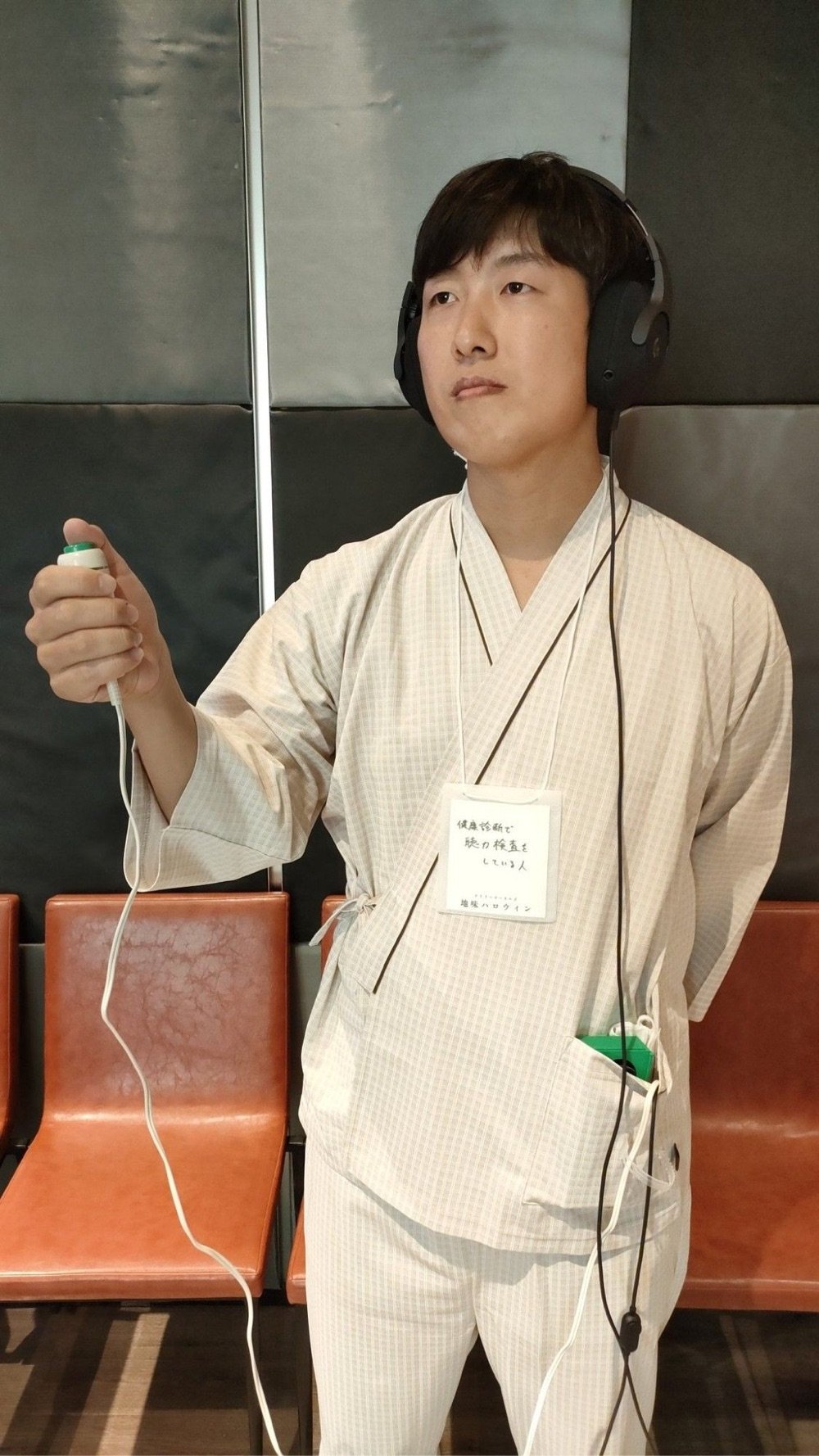
“Person taking a hearing test at the doctor’s office”
See also 2021’s best costumes, including “guy who leans in as his Mario Kart character turns a curve”.
I just found out that the original version of Tetris for the Game Boy is available on the Switch, so guess what I’m doing for the rest of the week?
I am…intrigued by this Bluetooth remote control that you can use to remotely scroll through TikTok or the Kindle app (and presumably less cool things like websites?) on your phone.
Feist and Hundreds of Choir Members Sing ‘Nothing Compares 2 U’ in Tribute to Sinéad O’Connor
Just hit play on this one and watch it. Absolutely magical…it sent shivers down my spine. The organization that arranged this is called Choir! Choir! Choir! and they also did a version of this in Dublin with 1000 people singing in tribute:
I’ve previously featured the group singing David Bowie’s Heroes with David Byrne, who said this of the experience:
What happens when one sings together with a lot of other people?
A couple of things I immediately noticed. There is a transcendent feeling in being subsumed and surrendering to a group. This applies to sports, military drills, dancing… and group singing. One becomes a part of something larger than oneself, and something in our makeup rewards us when that happens. We cling to our individuality, but we experience true ecstasy when we give it up.
(via open culture)
I enjoyed reading Ted Gioia’s list of 12 problems that he’s devoted his life to answering. Many of them go to the heart of how to lead a life of creativity and compassion, things which are often at odds in our culture.
From the looks of the teaser trailer, Poor Things is gonna be another Yorgos Lanthimos banger (The Lobster, The Favourite).
LIGO Has Surpassed The Quantum Limit. The gravitational wave detector’s sensitivity was bumping up against quantum uncertainties but they figured out a way around it called frequency-dependent squeezing.
Declassified Cold War satellite images reveal 100s of unknown Roman forts in Syria & Iraq. “The new discoveries instead point to the frontier being more fluid and a vibrant place of cross-border trade, rather than of constant violent conflict.”
Does Your Brain Picture Things?
A few weeks ago, I shared the following image on Instagram:

It’s a scale for measuring how people visualize objects in their heads. I’m between 4 & 5, which means I have a condition called aphantasia. Marco Giancotti recently wrote about this for Nautilus; he underwent an MRI scan to test what was going on in his head:
A few seconds pass, then a synthetic female voice speaks into my ears over the electronic clamor: “top hat.” I close my eyes and I imagine a top hat. A few seconds later a beep tells me I should rate the quality of my mental picture, which I do with a controller in my hand. The voice speaks again: “fire extinguisher,” and I repeat the routine. Next is “butterfly,” then “camel,” then “snowmobile,” and so on, for about 10 minutes, while the system monitors the activation of my brain synapses.
For most people, this should be a rather simple exercise, perhaps even satisfying. For me, it’s a considerable strain, because I don’t “see” any of those things. For each and every one of the prompts, I rate my mental image “0” on a 0 to 5 scale, because as soon as I close my eyes, what I see are not everyday objects, animals, and vehicles, but the dark underside of my eyelids. I can’t willingly form the faintest of images in my mind. And, although it isn’t the subject of the current experiment, I also can’t conjure sounds, smells, or any other kind of sensory stimulation inside my head. I have what is called “aphantasia,” the absence of voluntary imagination of the senses. I know what a top hat is. I can describe its main characteristics. I can even draw an above-average impression of one on a piece of paper for you. But I can’t visualize it mentally. What’s wrong with me?
And here’s a good video explanation of it too, from an artist who has aphantasia:
Like a lot of people, I wasn’t even aware that I visualized things differently than others — I assumed that everyone saw extremely ghostly images of objects in their mind’s eye, more like the ideas of things than the things themselves. It wasn’t until I was talking to my daughter a few years ago about how the characters in a movie looked nothing like the ones she’d pictured in her head from reading the books that I realized that she’s got a vibrant, full-color movie going on in her head when she reads and I was like EXCUSE ME?
Aphantasia is sometimes described as a deficiency or even a disability, but I don’t think of it that way at all. I believe my brain works pretty well, thank you very much, even though I can’t close my eyes and see the faces of my kids. And it’s not as straightforward as the simple scale above, at least in my case.
I can’t picture what a room would look like with a different sofa or rug (I just have to buy it and cross my fingers that it looks good when it arrives) or what a sweater would look like on me without actually trying it on (making online clothes shopping difficult). But I also have a weirdly visual memory. In college, I would remember things for tests and papers based where they were written in my notebook (lower right-hand corner of the left-hand page) or appeared in the textbook (on the right-hand page, under the blue illustration). I can’t see it in my brain, but I can see the idea of it and remember what was written there. (I told my daughter this and she said she can do this too, but for her, she pictures herself sitting at her desk in biology class with her notes open in front of her and she can then recall what was written in certain places. It is fascinating to talk about this stuff with her!)
Anyway, on Insta I asked people where they are on the apple scale and the responses were super interesting, so I’m opening up the comments on this one so we can chat about it.
So, You’ve Decided to Start Listening to Radiohead in Your Mid-Thirties. “Welcome, abandon all hope, smile, and settle into the uneasy feeling of being stuck somewhere between melancholy and smug satisfaction.”
I love these little ceramic ghosts. “High-fired ceramics has the ability to outlive us all. If you treat them respectfully, they will haunt you forever.”
Love this: a museum of internet artifacts, including the first email, Line Rider, an early Netflix website, Space Jam, and the first mp3. Some them are interactive — try signing on to AOL.
“From bacteria to blue whales, the number of cells in living things exceeds the estimated number of sand grains on Earth by a factor of a trillion. […] And the number of cells that have ever lived is 10 orders of magnitude larger still.”
How many animals have ever existed on Earth? The estimated number is ludicrously big, orders of magnitude more than a trillion. Mostly insects.
The United States of Guns
Like many of you, I read the news of a single person killing at least 18 people in Lewiston, Maine yesterday, which comes on the heels of many, many other mass shootings over the past four years. While these are outrageous and horrifying events, they aren’t surprising or shocking in any way in a country where more than 33,000 people die from gun violence each year.
America is a stuck in a Groundhog Day loop of gun violence. We’ll keep waking up, stuck in the same reality of oppression, carnage, and ruined lives until we can figure out how to effect meaningful change. I’ve collected some articles here about America’s dysfunctional relationship with guns, most of which I’ve shared before. Change is possible — there are good reasons to control the ownership of guns and control has a high likelihood of success — but how will our country find the political will to make it happen?
An armed society is not a free society:
Arendt offers two points that are salient to our thinking about guns: for one, they insert a hierarchy of some kind, but fundamental nonetheless, and thereby undermine equality. But furthermore, guns pose a monumental challenge to freedom, and particular, the liberty that is the hallmark of any democracy worthy of the name — that is, freedom of speech. Guns do communicate, after all, but in a way that is contrary to free speech aspirations: for, guns chasten speech.
This becomes clear if only you pry a little more deeply into the N.R.A.’s logic behind an armed society. An armed society is polite, by their thinking, precisely because guns would compel everyone to tamp down eccentric behavior, and refrain from actions that might seem threatening. The suggestion is that guns liberally interspersed throughout society would cause us all to walk gingerly — not make any sudden, unexpected moves — and watch what we say, how we act, whom we might offend.
We’re sacrificing America’s children to “our great god Gun”:
Read again those lines, with recent images seared into our brains — “besmeared with blood” and “parents’ tears.” They give the real meaning of what happened at Sandy Hook Elementary School Friday morning. That horror cannot be blamed just on one unhinged person. It was the sacrifice we as a culture made, and continually make, to our demonic god. We guarantee that crazed man after crazed man will have a flood of killing power readily supplied him. We have to make that offering, out of devotion to our Moloch, our god. The gun is our Moloch. We sacrifice children to him daily — sometimes, as at Sandy Hook, by directly throwing them into the fire-hose of bullets from our protected private killing machines, sometimes by blighting our children’s lives by the death of a parent, a schoolmate, a teacher, a protector. Sometimes this is done by mass killings (eight this year), sometimes by private offerings to the god (thousands this year).
The gun is not a mere tool, a bit of technology, a political issue, a point of debate. It is an object of reverence. Devotion to it precludes interruption with the sacrifices it entails. Like most gods, it does what it will, and cannot be questioned. Its acolytes think it is capable only of good things. It guarantees life and safety and freedom. It even guarantees law. Law grows from it. Then how can law question it?
Roger Ebert on the media’s coverage of mass shootings:
Let me tell you a story. The day after Columbine, I was interviewed for the Tom Brokaw news program. The reporter had been assigned a theory and was seeking sound bites to support it. “Wouldn’t you say,” she asked, “that killings like this are influenced by violent movies?” No, I said, I wouldn’t say that. “But what about ‘Basketball Diaries’?” she asked. “Doesn’t that have a scene of a boy walking into a school with a machine gun?” The obscure 1995 Leonardo Di Caprio movie did indeed have a brief fantasy scene of that nature, I said, but the movie failed at the box office (it grossed only $2.5 million), and it’s unlikely the Columbine killers saw it.
The reporter looked disappointed, so I offered her my theory. “Events like this,” I said, “if they are influenced by anything, are influenced by news programs like your own. When an unbalanced kid walks into a school and starts shooting, it becomes a major media event. Cable news drops ordinary programming and goes around the clock with it. The story is assigned a logo and a theme song; these two kids were packaged as the Trench Coat Mafia. The message is clear to other disturbed kids around the country: If I shoot up my school, I can be famous. The TV will talk about nothing else but me. Experts will try to figure out what I was thinking. The kids and teachers at school will see they shouldn’t have messed with me. I’ll go out in a blaze of glory.”
In short, I said, events like Columbine are influenced far less by violent movies than by CNN, the NBC Nightly News and all the other news media, who glorify the killers in the guise of “explaining” them. I commended the policy at the Sun-Times, where our editor said the paper would no longer feature school killings on Page 1. The reporter thanked me and turned off the camera. Of course the interview was never used. They found plenty of talking heads to condemn violent movies, and everybody was happy.
Jill Lepore on the United States of Guns:
There are nearly three hundred million privately owned firearms in the United States: a hundred and six million handguns, a hundred and five million rifles, and eighty-three million shotguns. That works out to about one gun for every American. The gun that T. J. Lane brought to Chardon High School belonged to his uncle, who had bought it in 2010, at a gun shop. Both of Lane’s parents had been arrested on charges of domestic violence over the years. Lane found the gun in his grandfather’s barn.
The United States is the country with the highest rate of civilian gun ownership in the world. (The second highest is Yemen, where the rate is nevertheless only half that of the U.S.) No civilian population is more powerfully armed. Most Americans do not, however, own guns, because three-quarters of people with guns own two or more. According to the General Social Survey, conducted by the National Policy Opinion Center at the University of Chicago, the prevalence of gun ownership has declined steadily in the past few decades. In 1973, there were guns in roughly one in two households in the United States; in 2010, one in three. In 1980, nearly one in three Americans owned a gun; in 2010, that figure had dropped to one in five.
A Land Without Guns: How Japan Has Virtually Eliminated Shooting Deaths:
The only guns that Japanese citizens can legally buy and use are shotguns and air rifles, and it’s not easy to do. The process is detailed in David Kopel’s landmark study on Japanese gun control, published in the 1993 Asia Pacific Law Review, still cited as current. (Kopel, no left-wing loony, is a member of the National Rifle Association and once wrote in National Review that looser gun control laws could have stopped Adolf Hitler.)
To get a gun in Japan, first, you have to attend an all-day class and pass a written test, which are held only once per month. You also must take and pass a shooting range class. Then, head over to a hospital for a mental test and drug test (Japan is unusual in that potential gun owners must affirmatively prove their mental fitness), which you’ll file with the police. Finally, pass a rigorous background check for any criminal record or association with criminal or extremist groups, and you will be the proud new owner of your shotgun or air rifle. Just don’t forget to provide police with documentation on the specific location of the gun in your home, as well as the ammo, both of which must be locked and stored separately. And remember to have the police inspect the gun once per year and to re-take the class and exam every three years.
Australia’s gun laws stopped mass shootings and reduced homicides, study finds:
From 1979 to 1996, the average annual rate of total non-firearm suicide and homicide deaths was rising at 2.1% per year. Since then, the average annual rate of total non-firearm suicide and homicide deaths has been declining by 1.4%, with the researchers concluding there was no evidence of murderers moving to other methods, and that the same was true for suicide.
The average decline in total firearm deaths accelerated significantly, from a 3% decline annually before the reforms to a 5% decline afterwards, the study found.
In the 18 years to 1996, Australia experienced 13 fatal mass shootings in which 104 victims were killed and at least another 52 were wounded. There have been no fatal mass shootings since that time, with the study defining a mass shooting as having at least five victims.
From The Onion, ‘No Way To Prevent This,’ Says Only Nation Where This Regularly Happens:
At press time, residents of the only economically advanced nation in the world where roughly two mass shootings have occurred every month for the past eight years were referring to themselves and their situation as “helpless.”
But America is not Australia or Japan. Dan Hodges said on Twitter a few years ago:
In retrospect Sandy Hook marked the end of the US gun control debate. Once America decided killing children was bearable, it was over.
This can’t be the last word on guns in America. We have to do better than this for our children and everyone else whose lives are torn apart by guns. But right now, we are failing them miserably, and Hodges’ words ring with the awful truth that all those lives and our diminished freedom & equality are somehow worth it to the United States as a society.
How to Officiate a Wedding. “I think of it as a storytelling event. You’re really just telling the love story of two people, and guests should sort of nod along but also discover things they didn’t know about the couple.”
The World’s Writing Systems



A simple and beautiful listing of the World’s Writing Systems. You can sort by time (proto-cuneiform to Toto), region, name (Adlam to Zou), and whether the scripts are living or historical.
The owner of Tokyo’s Bar Martha: “I have never run a bar that has considered what the customer wants. People often say that the customer is always right, but I’m not confident that’s true.”
They Cracked the Code to a Locked USB Drive Worth $235 Million in Bitcoin. Then It Got Weird. The owner of the USB drive doesn’t actually want them to unlock it.
Barbis! MIT students surprised the school’s president by placing a life-sized Barbie-themed TARDIS in her office. Barbis? Barbis. Barbis!
YouTube recommended this video of people jumping from 100+ foot cliffs in an abandoned quarry in Vermont. I have no desire to ever do this, but it would be fun to go and watch.
The World Solved Acid Rain. We Can Also Solve Climate Change. “Climate agreements and targets take time to evolve. Negotiations are long. The ozone hole and acid rain were not fixed with the first international agreements on the table.”
Lego’s New Dune Set With a Loooooong Baron Harkonnen Minifig


Lego is coming out with a huge new set that’s based on Denis Villeneuve’s two-installment adaptation of Dune (or, as it’s know around these parts, DUNC). OMG, the Baron Harkonnen minifig!! It reminds me of something…ah yes:

Longbaron is looooooooong.
Anyway, it’s coming out in February and the main build is a 1369-piece model of the Atreides Royal Ornithopter with “fold-out, flappable wings, deployable landing gear and an opening cockpit”. Baron Harkooooooooooooonnen. I can’t stop! I, uh, may have pre-ordered this the second I saw it. (via polygon)
Update: Absolutely perfect:
(via @justgregb)
Hundreds of Gorgeous Vintage Watercolors of Mushrooms











From 1913 to 1944, amateur mycologist Hans Walty created hundreds of fantastic watercolor illustrations of mushrooms, which are available to peruse in very high-resolution at Wikimedia Commons. There’s not a great deal of information about Walty or his drawings online,1 but I did find this piece from the Swiss National Library.
His images depict the colours and shapes of the mushrooms’ fruiting bodies and sometimes also include drawings of microscopic views. The fungi are usually depicted from the side and often from the top and bottom as well. Walty also frequently documented the characteristics of the stems, spores and undersides of the caps. The hobby mycologist also produced an explanatory book to accompany his illustrations that contains descriptions of the mushrooms, with each specimen being assigned a family and genus. His illustrations often contain notes about the time and date the mushroom was found and whether it was edible, inedible or poisonous.
Walty’s illustrations were published in multiple editions of a Swiss mushroom guide from the 40s through the 70s. According to the German version of Wikipedia (translated): “For decades, 500 of his illustrations on mushrooms were considered a standard work on mushroom identification, especially in Switzerland.”
Again, you can browse through hundreds of Walty’s mushroom illustrations at Wikimedia Commons. (thx, christoph)
Not in English at least; Walty was born in Italy and lived in Germany and Switzerland for much of his life. A biography is available on the German version of Wikipedia. ↩
Out next week, a memoir by Olympic champion Caster Semenya: The Race to Be Myself. “This book is a searing testimony for anyone who has been forced to stop doing what they love.”
Papercraft Four-Color Houses

Papercraft artist Charles Young has been sourcing color combinations from this book and using them to construct extremely tidy and precise little buildings.
Starting in May 2020 I used Sanzo Wada’s Dictionary of Colour Combinations as inspiration for a new project introducing colour to my paper work for the first time. The book is made up of two, three and four colour combinations drawn from Japanese design and publishing in the early 20th century.
Check this out to get a sense of the scale — they’re really tiny. You can see many more of these on Instagram. It is actually hard to believe these are made out of paper and not computer generated. (via present & correct)
Craig Mod is walking 143km (89 miles) across the full length of the metropolis of Tokyo over the course of a week and is running a pop-up newsletter that he’ll send out along the way (and then will cease to exist — the newsletter, not Craig or Tokyo).
The 10-Millionth Visitor to the Rijksmuseum Spends the Night Sleeping Under Rembrandt
This story is a few years old but it charmed me too much this morning to let it slide. In 2017, four years after its grand reopening, Amsterdam’s Rijksmuseum welcomed its 10-millionth visitor, a man named Stefan Kasper. His lucky timing resulted in getting to spend the night in the museum, where he dined and slept underneath Rembrandt’s the Night Watch.
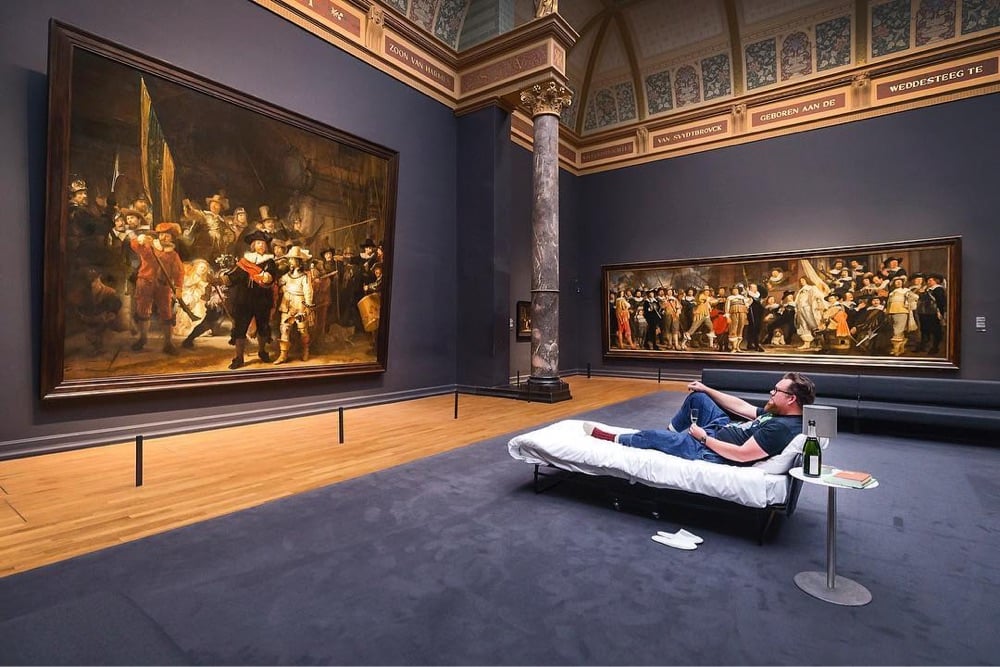
Here’s a short video of Kasper’s time in the museum:
I still can’t believe it. I discovered characters that I have never seen before. They came to life in front of me. It’s an experience that is forever etched in my memory.
Not the same, but I got to go to a press preview when the MoMA reopened a few years ago after renovations and it was quite an experience to wander those familiar galleries pretty much by myself. I stood in front of Starry Night and One: Number 31, 1950 for a really long time that morning.
Been hearing good things about this in my feeds: More Is More: Get Loose in the Kitchen by Molly Baz. The cookbook “encourages more risk-taking, better intuition, fewer exact measurements, and a ‘don’t stop ‘til it tastes delicious’ mentality”.
Socials & More