
Naomi Osaka has withdrawn from the French Open. This sucks – she was very clear about her mental health needs and WTA officials fined her and basically said “fuck you”. Do they care about the wellbeing of their players or no?

Advertise here with Carbon Ads
This site is made possible by member support. 💞
Big thanks to Arcustech for hosting the site and offering amazing tech support.
When you buy through links on kottke.org, I may earn an affiliate commission. Thanks for supporting the site!
kottke.org. home of fine hypertext products since 1998.
Beloved by 86.47% of the web.
Entries for May 2021
Sky Pool. Yikes!
Was the Microwave Invented to Thaw Out Frozen Hamsters?
We all know that the microwave oven was invented by Raytheon’s Percy Spencer in 1945. What this video presupposes is, maybe it was invented to thaw out frozen hamsters? And somehow James Lovelock, who formulated the Gaia hypothesis, is involved? (via @fourfoldway)
For £50, you get 15 minutes to fill your car up with as many mannequin body parts as you can carry. “Under no circumstances whatsoever will you be able to fill your car boot with hands. Please don’t ask.”
A visually impaired person shares how she uses her iPhone. I hadn’t seen the Braille keyboard option in action before – amazing!
Some literary collective nouns. My favorite by far is “a gruop of proofreaders”.
Political scientist David Faris on the dangers of the Republican revolt against American democracy. “My current level of concern is exploring countries to move to after 2024.”
The Honest Broker Plays the Long Game
Ted Gioia’s newsletter is called Culture Notes of an Honest Broker and in this recent issue, he shares the surprisingly cloak and dagger story of how he came to think of himself as an “Honest Broker”.
“Who, exactly, is this Honest Broker?”
“There’s at least one in every city. But don’t expect their business cards to say ‘Honest Broker’ - that’s just what I call them. But that’s exactly what they are. Sometimes they don’t even have an official position. But they are the key to everything.”
He proceeded to explain how Honest Brokers play a hidden but vital role in communities without a history of legal protections and stable institutions. Their influence and power is built solely on a reputation for straight talk and trustworthy dealings. “They are true brokers, intermediaries between others. They aren’t going to participate in your deal, no matter what it is. They are go-betweens, really. But do not underestimate the power of this kind of brokerage. Whatever you need — a loan, a building permit, political influence, a place to land a private jet, whatever — they will introduce you to the right people and steer you away from the sharks.
Reading Gioia’s essay, I realized that with my work here on kottke.org, I’ve been unknowingly trying to be that Honest Broker for you folks. I don’t always live up to that ideal, but I work pretty hard so that everything I write and link to here is stuff that I genuinely enjoy and find interesting and believe that you will as well.
Do not underestimate the power of this kind of brokerage…the Honest Broker plays the long-term game, mate. Over time, that scrupulous fidelity and reputation for trustworthy advice beats out all other strategies. The Honest Broker is irreplaceable, and all the more so when other guides have become unreliable.
All it takes is 23 years of consistent effort…and presto! :)
Inside Citizen’s Dangerous Effort to Cash In On Vigilantism. This is just evil, deeply immoral stuff that is making society more dangerous to live in.
Cate Blanchett in The Four Temperaments
I didn’t wake up this morning knowing I needed to hear Cate Blanchett saying “I love you” over and over again while looking right at me, but now that it’s happened I could not have imagined it going any other way. (She also says “I don’t love you” several times but we’re going to ignore that.)
Bent Reality


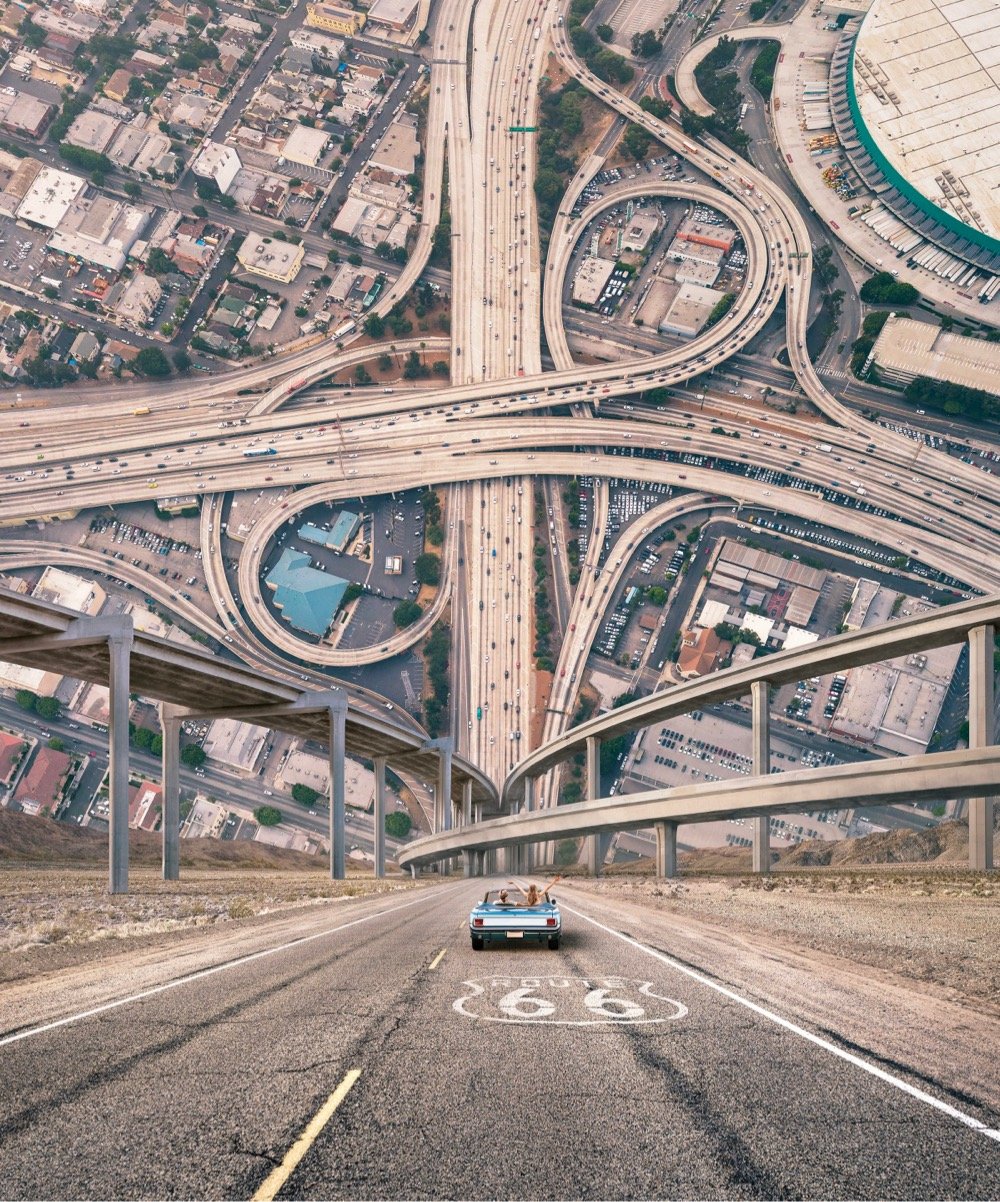
These surrealistic images were created by Cream Electric Art for a United Airlines ad campaign. Here’s a quick behind-the-scenes on how the Route 66 image was constructed. Prior art: Berg’s Here & There map of Manhattan, Inception, and these curved cityscape panoramas. (via moss & fog)
Interesting fact about the 1918 pandemic: “Doctors then hadn’t even figured out that influenza was caused by a virus.” That discovery didn’t happen until the 1930s.
An Engineer Explains All the Different Kinds of Rollercoasters
In this video, rollercoaster engineer Korey Kiepert talks about all the different types of rollercoasters that you’ll see at an amusement park, including wooden, terrain, launched, hyper, out-and-back, and wild mouse coasters.
So, when we design a roller coaster, we’re trying to take something that’s very much driven by the same codes that would be used to design a building. And we’re working with those to create something that gives you the illusion that it’s daring and adventurous but, at the same time, it’s all very controlled.
See also Every Bridge For Every Situation, Explained by an Engineer. (via the kid should see this)
Eric Carle, Author of The Very Hungry Caterpillar, Has Passed On
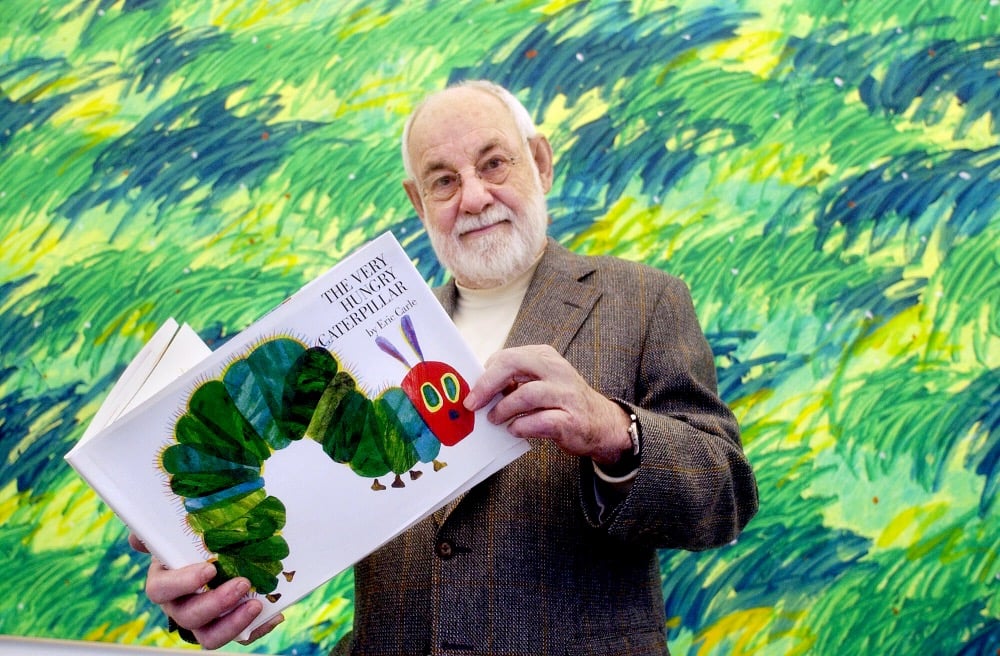
Beloved children’s book author Eric Carle died this past weekend at the age of 91 and this is one of the best openings to an obituary I can recall reading:
When a fictional caterpillar chomps through one apple, two pears, three plums, four strawberries, five oranges, one piece of chocolate cake, one ice cream cone, one pickle, one slice of Swiss cheese, one slice of salami, one lollipop, one piece of cherry pie, one sausage, one cupcake and one slice of watermelon, it might get a stomach ache.
But it might also become the star of one of the best-selling children’s books of all time.
Eric Carle, the artist and author who created that creature in his book “The Very Hungry Caterpillar,” a tale that has charmed generations of children and parents alike, died on Sunday at his summer studio in Northampton, Mass. He was 91.
I’ve written about Carle and his most famous creation, The Very Hungry Caterpillar, a couple of times here — I can still remember the first time my son read (or, more likely, recited from memory) the list of everything the caterpillar ate on Saturday, including all of his adorable pronunciations.
The Very Hungry Caterpillar was certainly one of my favorite books as a kid — along with Cloudy With a Chance of Meatballs, Richard Scarry’s Busy, Busy Town & Cars and Trucks and Things That Go, and the Frog & Toad books — and it was one of the first books we read to our kids. I remember very clearly loving the partial pages and the holes. Holes! In a book! Right in the middle of the page! It felt transgressive. Like, what else is possible in this world if you can do such a thing?
You can see Carle at work in his workshop from an episode of Mister Rogers’ Neighborhood in 1998. I particularly appreciated this short exchange:
Rogers: In this, there’s just no mistakes, is there?
Carle: No, you can’t make mistakes really.
How Does America’s Response to Climate Change Look From Abroad?
For this video, the NY Times talked to several people from around the world (Britain, Zimbabwe, Norway, India, etc.) about what they think about how the United States is approaching climate change and other environmental challenges. Spoiler alert: there is a lot of incredulity about how shitty America is doing in this area. And that matters because what happens here affects everyone around the world.
See also What Does U.S. Health Care Look Like Abroad? and What Do U.S. Elections Look Like Abroad?
“If Democracy Is Dying, Why Are Democrats So Complacent?”
For The Atlantic, Luke Savage writes that Democrats have to put their money where their mouth is when it comes to protecting American democracy.
If you’ve followed recent Democratic messaging, you’ll have heard that American democracy is under serious attack by the Republican Party, representing an existential threat to the country. If you’ve followed Democratic lawmaking, you’d be forgiven for thinking that the threat is actually a rather piddling one. The disconnect, in this case, isn’t attributable to Democratic embellishment, but to inexcusable complacency.
Without meaningfully reforming the rules of the Senate, the Biden administration & Congressional Democratic leadership basically gets to pass one substantial bill per year (through budget reconciliation). That’s it. If Democrats lose the House in 2022, which seems likely or even certain without the passage of a federal voting rights bill, then it’s only one or two bills. And then maybe Democrats don’t see the White House, a Senate majority, and a House majority for a generation and we’ll all have to ask ourselves whether we actually like living in a de facto nationalistic one-party state.
“Immunity to the coronavirus lasts at least a year, possibly a lifetime, improving over time especially after vaccination, according to two new studies.” What amazing news this would be if these studies prove true.
Facebook is not listening to your offline conversations with friends, but here’s how it knows to show you ads about those convos. “If my phone is regularly in the same GPS location as another phone, they take note of that.”
Leslie Odom Jr. Teaches You Philly Slang
Singer and actor Leslie Odom Jr., who grew up in Philadelphia and who you may know from Hamilton and who is wearing an amazing purple sweater in this video, breaks down some Philly slang for us, including jawn, Mummers, MAC machine, old head, water ice, and outta pocket.
What If We Just Stopped Calling the Cops? “For decades, the solution to Black Americans’ distrust of cops has often been to not call them. Now white people are catching on too.”
Hisako Koyama, the Woman Who Stared at the Sun
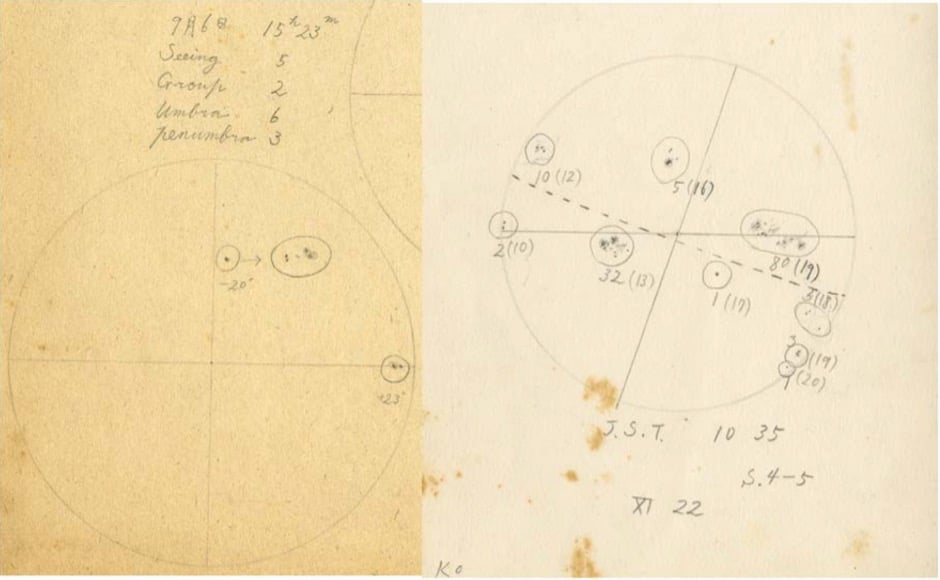
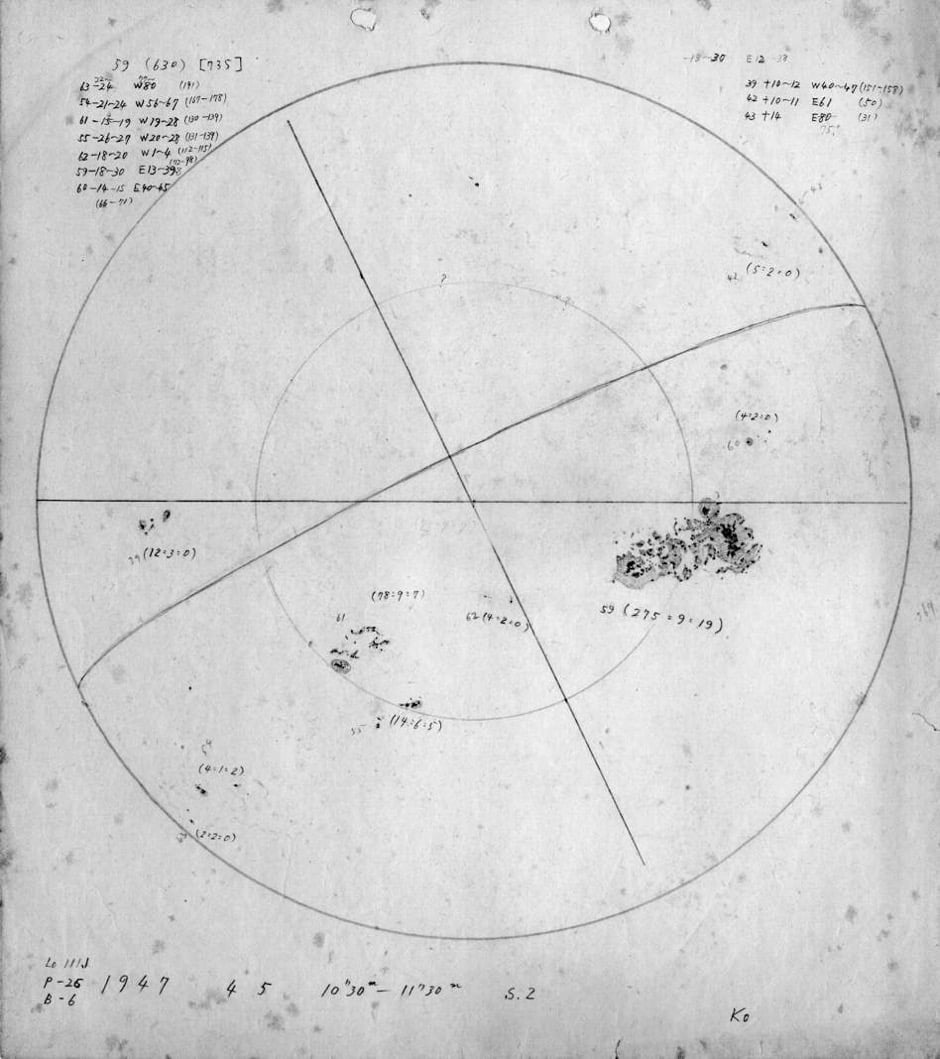
In the history of science, there are women who have made significant contributions to their field but haven’t gotten the recognition that their male peers have. The field of astronomy & astrophysics in particular has had many female pioneers — Vera Rubin, Cecilia Payne-Gaposchkin, Annie Jump Cannon, Nancy Grace Roman, Maria Mitchell, Jocelyn Bell Burnell, Henrietta Swan Leavitt, Caroline Herschel, Williamina Fleming, and many others. Add to that list Hisako Koyama, a Japanese astronomer whose detailed sketches of the Sun over a 40-year period laid the foundation for a 400-year timeline of sunspot activity, which has aided researchers in studying solar cycles and magnetic fields.
Ms. Koyama was a most unusual woman of her time. As a scientist, she bridged the amateur and professional world. She preferred “doing” activities: observing, data recording, interacting with the public, and writing. No doubt many Japanese citizens benefited from personal interaction with her. The space and geophysics community continues to benefit from her regular and precise observations of the Sun. Although we know very little of her young personal life other than she was relatively well educated and had a father who supported her desire to view the skies by providing a telescope, we can see from snippets in Japanese amateur astronomy articles that she had a passion for observing, as revealed in her 1981 article: “I simply can’t stop observing when thinking that one can never know when the nature will show us something unusual.”
Here are a few of her sunspot sketches, the top two done using her home telescope and the bottom one using the much larger telescope at the National Museum of Nature and Science (that shows the largest sunspot of the 20th century):
(via the kid should see this)
George Floyd Is Dead Because America Is a Racist Country. “For 46 years, he had managed to survive the pillaging of his family’s wealth. He outlasted a racist education system. He withstood the prejudice of the criminal justice system.”
This Chemistry Nobel Prize winner was very vocal about Covid-19 – and very wrong, even dangerously wrong. And he wasn’t the only one. How should society & the scientific community react to this sort of thing?
1000 Musicians Play Rock Songs From Nirvana, Queen, etc.
Before I clicked play on the video embedded above of 1000 musicians playing Learn to Fly by the Foo Fighters, I assumed it was going to be kind of a mess, a muddled wall of sound. Instead, I was surprised to hear something almost magical, a rock anthem played with the fullness of a orchestra or chorus, the band and the crowd merged into a single, gorgeously layered entity. I was moved by it, almost immediately. All those drummers pounding away on their drum kits in unison! You can check out this playlist for more 1000 musician versions of rock songs, including Seven Nation Army (White Stripes), We Will Rock You (Queen), and Smells Like Teen Spirit (Nirvana):
I also have to say that these videos hit me harder now, 15 months into a global pandemic that kept my family and I separated from all but a narrow slice of the world, than they would have before, especially now that things are starting to loosen up a bit and I am able to safely socialize with other vaccinated folks in person. Seeing thousands of people collectively engaged something so joyful is both a reminder of what we lost during the pandemic and what we stand to gain if we can manage to contain the virus worldwide. I think this is the reason why this video of a flash mob performing Ode to Joy went viral early on in the pandemic. All the feels. (another great find via openculture)
Your Wild and Precious Life
How do you know what to do with your life? The introduction to this new and uncharacteristically existential Kurzgesagt video is some real truth:
Wrapping your mind around your life is pretty hard, because you are up to your neck in it. It’s like trying to understand the ocean while learning how to swim. On most days you are busy just keeping your head above water. So it is not easy to figure out what to do with your life and how to spend your time. There are a million distractions. Your family, friends and romantic partners, boring work, and exciting projects. Video games to play and books to read. And then there is your couch that somebody needs to lie on. It’s easy to get lost.
Thinking about this stuff can be kind of a downer, as the writer of this video admits in a comment:
It’s so easy to get lost in your daily life: there are so many “urgent” and “annoying” things that you forget that actually every day is special, sort of. And even more so the days we have with friends and family. I know watching a video like this can hit pretty hard. But at least for me, the message it tries to convey does make me actually change my behavior. Reprioritize things. You know. Hope it had a similar effect for some of you.
See also Your Life in Weeks by Tim Urban.
The housing market in the US right now is bonkers. “There are now more Realtors than listings.”
We Know What You Did During Lockdown
After watching this short film on how much data private companies are able to gather about you (data that we willingly give them in some cases), you might be forgiven for thinking that, never mind some far flung future, we are living in a full-on dystopia right now. The set design, the acting, the positioning of the tables, the see-through table tops, the laptop vs. notebook…this was really well done. When the interrogator got up from his desk, I viscerally felt the invasion of privacy.
The World’s Greatest Card Trick Can’t Be Taught
World-renowned magician David Berglas, now 94 years old, does a card trick that’s so effortlessly simple and dazzling that no one has figured it out and Berglas himself says it cannot be taught.
The trick is a version of a classic plot of magic, called Any Card at Any Number. These tricks are called ACAAN in the business.
ACAAN has been around since the 1700s, and every iteration unfolds in roughly the same way: A spectator is asked to name any card in a deck — let’s say the nine of clubs. Another is asked to name any number between one and 52 — let’s say 31.
The cards are dealt face up, one by one. The 31st card revealed is, of course, the nine of clubs. Cue the gasps.
There are hundreds of ACAAN variations, and you’d be hard pressed to find a professional card magician without at least one in his or her repertoire. (A Buddha-like maestro in Spain, Dani DaOrtiz, knows about 60.) There are ACAANs in which the card-choosing spectator writes down the named card in secrecy; ACAANs in which the spectator shuffles the deck; ACAANs in which every other card turns out to be blank.
For all their differences, every ACAAN has one feature in common: At some point, the magician touches the cards. The touch might be imperceptible, it might appear entirely innocent. But the cards are always touched.
With one exception: David Berglas’s ACAAN. He would place the cards on a table and he didn’t handle them again until after the revelation and during the applause. There was no sleight of hand, no hint of shenanigans. It was both effortless and boggling.
Of course, his unwillingness to reveal how the trick works or even that he is unable to show someone else how to do it could be part of the trick. But in recent years, Berglas has pulled back the curtain on most of his other tricks, like the time he made a grand piano vanish into thin air, explained by Berglas himself in a YouTube video:
But not this card trick, as the author of the Times’ piece discovers. A delightful read.
Update: Part of the reason I love publishing posts like this (about magic and unknowable tricks) is that I know I’m gonna get some great feedback. In 2011, Richard Kaufman wrote a book called The Berglas Effects with the participation of Berglas himself in which his version of ACAAN is explained at length. Here’s Kaufman himself remarking on the Times story:
The writer is under the odd impression that “The Berglas Effect” has never been explained and is not explained in my book. There are 75 pages devoted to it.
So…huh. I wonder what the book says about the trick? (thx, bill)
For those who are not vaccinated, Covid-19 case/hosp./death levels are still relatively high in many parts of the US. Something to keep in mind that the state and national averages we’re seeing don’t reflect.
The Great Wave Off Kanagawa by Hokusai, Explained
Great Art Explained is a super YouTube series that I am somehow just now learning about that, uh, explains great art. Host James Payne has done about a dozen videos on pieces like Artemisia Gentileschi’s Judith Beheading Holofernes, Warhol’s Marilyn Diptych, and Untitled (Skull) by Jean-Michel Basquiat. His latest is about The Great Wave Off Kanagawa by Katsushika Hokusai.
In 1639 Japan closed its borders and cut itself off from the outside world. Foreigners were expelled, Western culture was forbidden, and Entering or leaving Japan was punishable by Death. It would remain that way for over 200 years.
It was under these circumstances that a quintessentially Japanese art developed. Art for the people that was consumed on an unprecedented scale.
Really interesting stuff. Subscribed.
See also several different versions of The Great Wave print and The Art of Traditional Japanese Printmaking. (via open culture)
Trillions and Trillions and Trillions of Stars

This is a photo of a tiny tiny snippet of the universe, taken by the Hubble Space Telescope. Every object you see in the photo is a staggeringly massive galaxy that contains hundreds of billions of stars along with all sort of other things.
Our own galaxy, the Milky Way, is well over one hundred thousand light years across. We only see a pitiful portion of it. Although it contains several hundred billion stars in its expanse, we can only see a fraction of a fraction of them.
And even that doesn’t fully capture the essence of a galaxy, which also has planets, gas, dust, dark matter, and more. Galaxies are colossal objects, their true nature only becoming apparent to us a century ago.
I know I’ve posted photos like this before, but every time I see something like this, my mind boggles anew at the sheer scale and magnitude of it all and I just have to share it.
P.S. And Earth contains the only sentient life in the entire universe? Lol.
When a Raindrop Falls in the US, Where Does It End Up?
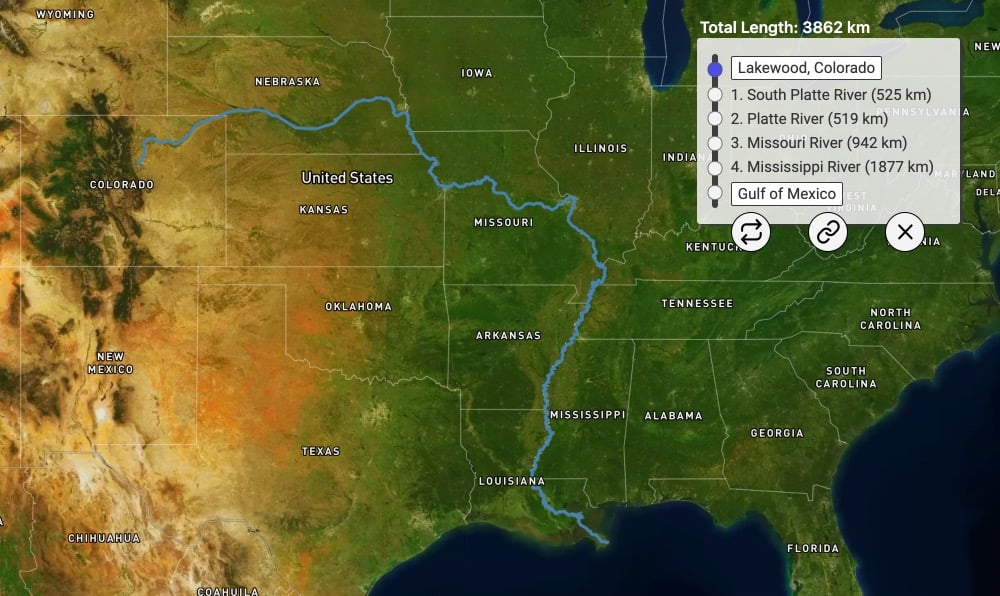
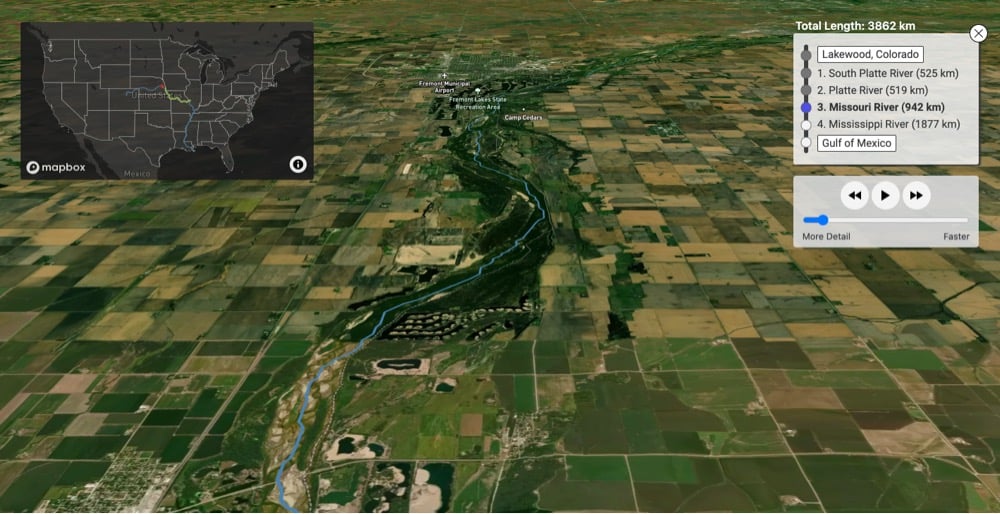
Using data from the United States Geological Survey, River Runner visualizes the path taken by a raindrop from its landing spot to its eventual endpoint. Just click on any spot in the US and it maps out the path the drop would take, complete with a satellite fly-through of the route. I spent many happy minutes playing with this, although the endpoint of “Canada” for a raindrop that lands in my Vermont yard was somewhat unsatisfying.
See also The Marvelous Mississippi River Meander Maps and a map of all of the rivers in the US. (via waxy)
A Map of the Internet 2021
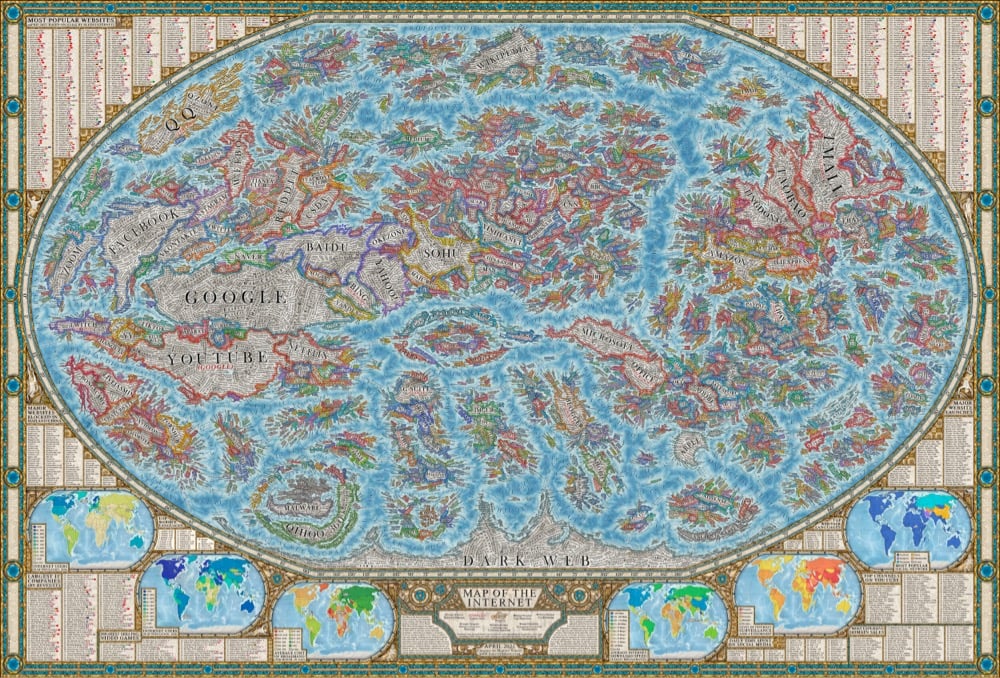
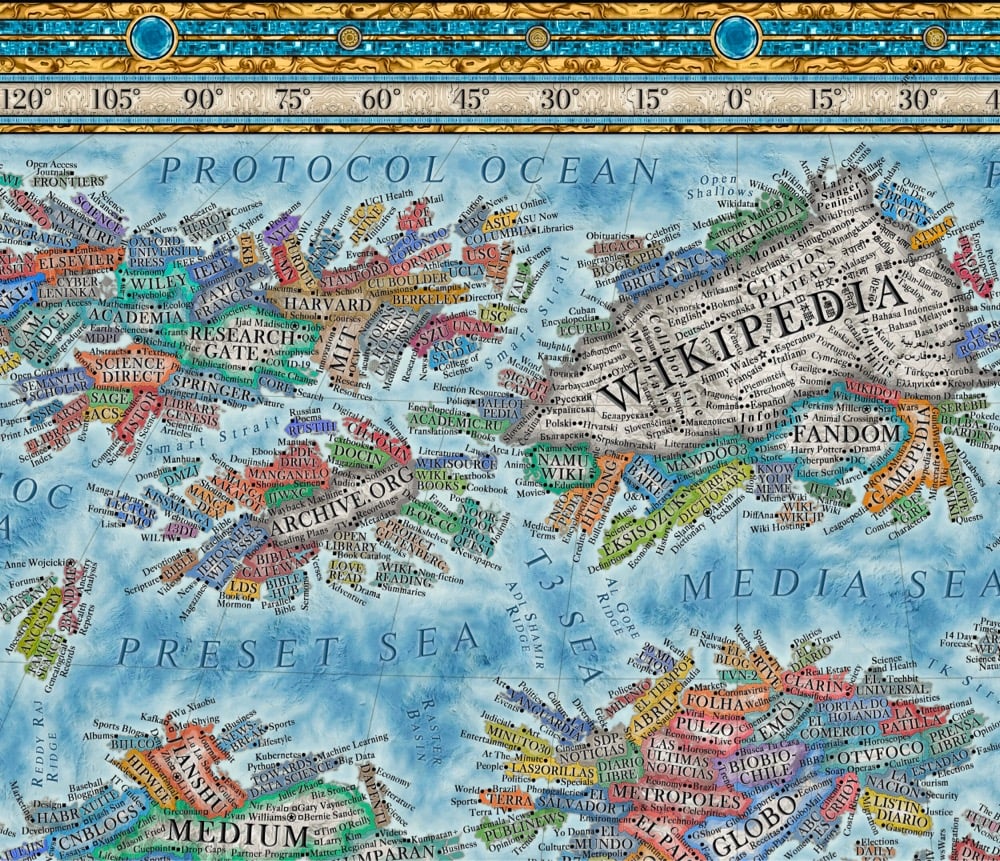
Translating sites, search engines, social networks, browsers, ISPs, and other internet entities into geographic features, Martin Vargic has created a map of the internet circa 2021.
It includes several thousand of some of the most popular websites, represented as distinct “countries”, which are grouped together with others of similar type or category, forming dozens of distinct clusters, regions and continents that stretch throughout the map, such as “news sites”, “search engines”, “social networks”, “e-commerce”, “adult entertainment”, “file sharing”, “software companies” and so much more. In the center of it all can be found ISPs and web browsers, which form the core and backbone of the internet as we know it, while the far south is the domain of the mysterious “dark web”.
See also an actual map of the known internet from May 1973.
An update on the support for Black Lives Matter in the US. “Republicans and white people have actually become less supportive of Black Lives Matter than they were before the death of George Floyd.”
Socials & More