



A map of the least-traveled routes in each US state (along with 10 of the most scenic routes)

Advertise here with Carbon Ads
This site is made possible by member support. 💞
Big thanks to Arcustech for hosting the site and offering amazing tech support.
When you buy through links on kottke.org, I may earn an affiliate commission. Thanks for supporting the site!
kottke.org. home of fine hypertext products since 1998.
Beloved by 86.47% of the web.
Entries for March 2018
Rams, a documentary about legendary designer Dieter Rams
Dieter Rams is one of the world’s most influential designers. Rams acolyte and Apple design chief Jony Ive has said of him:
Dieter Rams’ ability to bring form to a product so that it clearly, concisely and immediately communicates its meaning is remarkable… He remains utterly alone in producing a body of work so consistently beautiful, so right, and so accessible.
Gary Hustwit, director of Helvetica and Objectified, is making a documentary about Rams called Rams. Here are three short clips from the film:
Rams will include in-depth conversations with Dieter, and dive deep into his philosophy, his process, and his inspirations. But one of the most interesting parts of Dieter’s story is that he now looks back on his career with some regret. “If I had to do it over again, I would not want to be a designer,” he’s said. “There are too many unnecessary products in this world.” Dieter has long been an advocate for the ideas of environmental consciousness and long-lasting products. He’s dismayed by today’s unsustainable world of over-consumption, where “design” has been reduced to a meaningless marketing buzzword.
The movie will have original music by Brian Eno and will be released sometime later this year.
Update: Wallpaper has a trailer for the film, which looks minimalistic af.
Hear Beowulf & Sir Gawain and the Green Knight read in the original Old and Middle English
In this short video, MIT literature professor Arthur Bahr reads brief selections from Beowulf and Sir Gawain and the Green Knight in their original languages, respectively Old English and Middle English. You’ll notice that they sound almost completely like foreign languages. From Open Culture:
After the Viking and Norman invasions, Old English became “the third language in its own country,” notes Luke Mastin at his History of English site. More spoken than written, it “effectively sank to the level of a patois or creole,” with several distinct regional variants. English seemed at one time “in dire peril” of dying out but “showed its resilience once again, and, two hundred years after the Norman Conquest, it was English not French that emerged as the language of England,” though it remained a diffuse collection of dialects.
The entire page on Middle English at the History of English site — “how English went from an obscure German dialect to a global language” — is worth a read.
See also Shakespeare in its original pronunciation.
Meet Doris Jones, a 90-year-old armchair space archaeologist
I don’t know who my old favorite archaeologist was, but my new favorite archaeologist is Doris Jones. Jones is 90 years old and is one of the top volunteer space archaeologists on GlobalXplorer, a site that crowdsources the process of locating potential archaeological sites on satellite imagery. People like Jones look at satellite images for telltale signs of past human activity and promising locations are then passed on to field archaeologists working in the area.
From 2007: “Will MySpace ever lose its monopoly?” The piece mentions two possible competitors, neither of them Facebook or Twitter.
Remember that sculpture of Cristiano Ronaldo that didn’t look very much like him? The amateur sculptor who made it gave it another try…
An AI paints nightmarishly surreal nude paintings

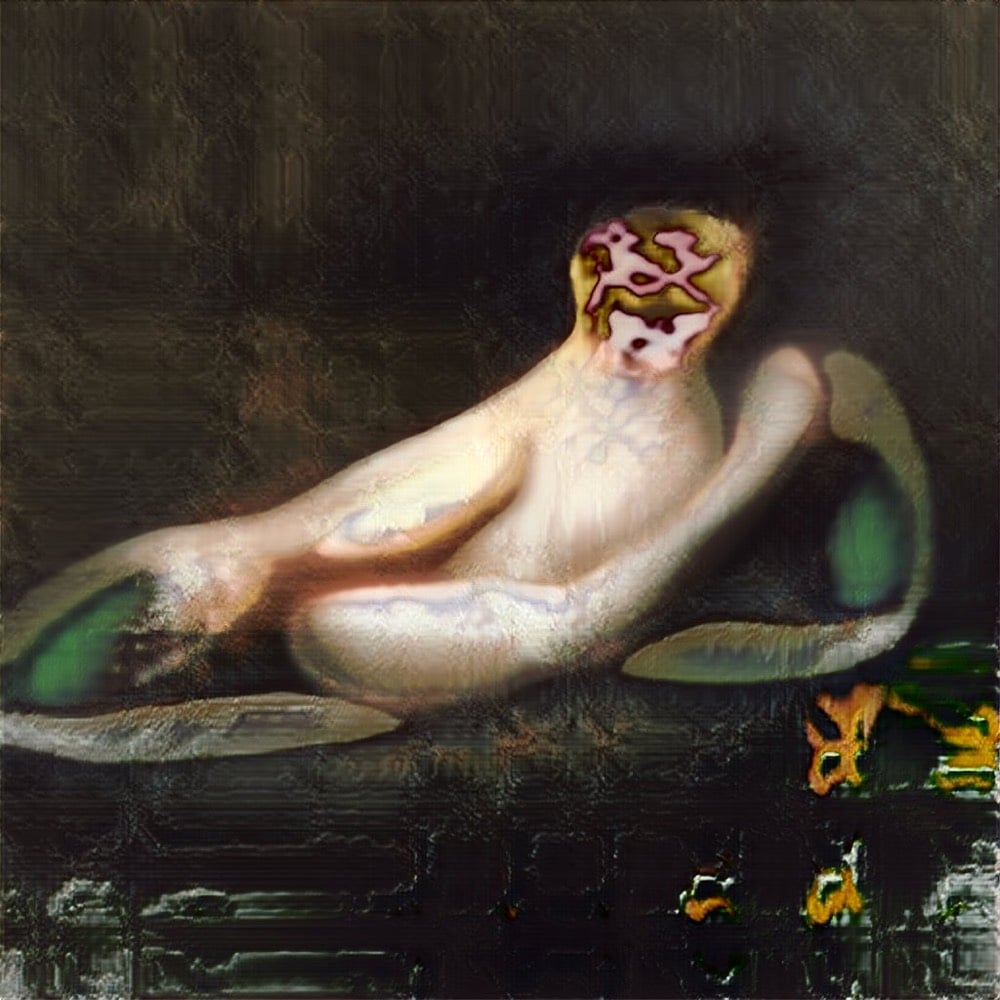
Titian on shrooms? Francis Bacon turned up to 11? Picasso++? Dali, um, well, Dali would probably come up with something like this tbh. Robbie Barrat is a machine learning researcher at Stanford who’s using an AI program to generate nude portraits (more, more, and more).
Usually the machine just paints people as blobs of flesh with tendrils and limbs randomly growing out — I think it’s really surreal. I wonder if that’s how machines see us…
(via boing boing)
Janus words: “words that are their own opposites”. Examples are cleave, clip, and fast, as in “the car is fast” and “the rope held fast”.
Tyler Cowen’s great wide-ranging conversation with Martina Navratilova. “You were a contender, and then you became completely dominant, say, by 1981. How did you do that?”
Fooling online users with dark patterns
From Evan Puschak, a quick video on dark patterns, UI design that tricks users into doing things they might not want to do. For instance, as he shows in the video, the hoops you need to jump through to delete your Amazon account are astounding; it’s buried levels deep in a place no one would ever think to look. This dark pattern is called a roach motel — users check in but they don’t check out. I wonder how much this single pattern has added to Jeff Bezos’ personal net worth?
The world’s smallest sushi is made from a single grain of rice

At Sushiya no Nohachi in Tokyo, you can eat sushi that is made using a single grain of rice. The tiny sushi came about when a customer challenged the owner’s son to make the smallest possible sushi.
The most difficult tiny sushi are the ones with nori seaweed — those are the sea urchin and egg. For sea urchin, he has to put a small piece of nori around a grain of rice horizontally. For egg, he has to wrap the nori around the egg and grain of rice. It’s pretty impressive to witness.
You can see the small sushi being made in this video:
That said, when we asked how often they need to make a plate of small sushi, we were surprised.
“Just a few times a week and at most five times in a day.” Though when customers from overseas order, they tend to be extra enthusiastic about the tiny sushi.
He told us that one woman from Europe burst into tears and cried for an hour and a half after seeing the cute, little sushi.
(thx, jason)
Fake laughs! The invention of the laugh track.
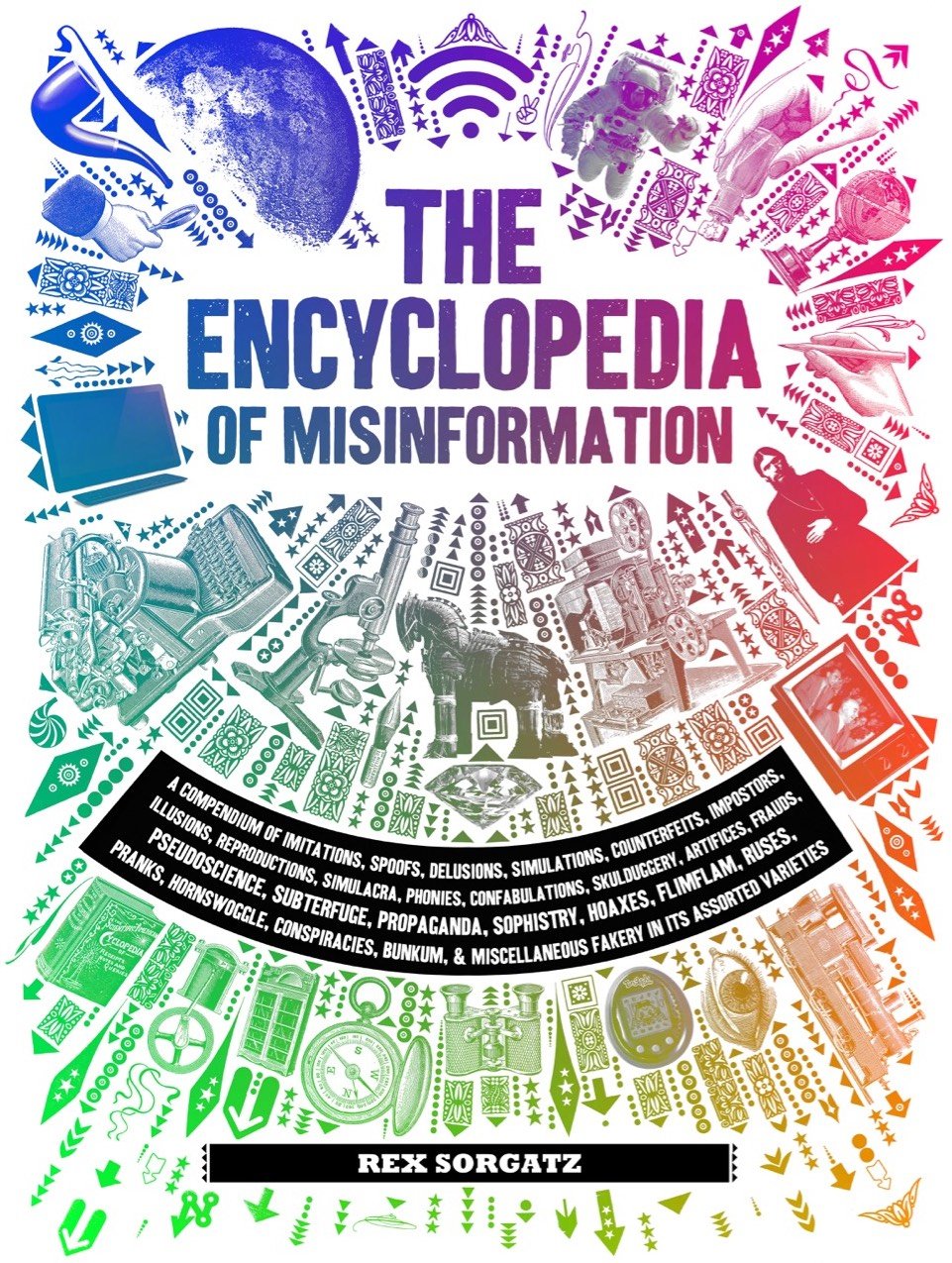
On Tuesday, my friend Rex Sorgatz came out with the very timely book, The Encyclopedia of Misinformation, the full subtitle of which is “A Compendium of Imitations, Spoofs, Delusions, Simulations, Counterfeits, Impostors, Illusions, Confabulations, Skullduggery, Frauds, Pseudoscience, Propaganda, Hoaxes, Flimflam, Pranks, Hornswoggle, Conspiracies & Miscellaneous Fakery”. Today I’m happy to present an excerpt about the genesis and use of the laugh track on television. [The video insert on how the laff box worked is mine.] -jason
No technique in television production has been more maligned than the laugh track, yet it somehow perseveres through decades of ridicule.
It all started innocently, as a quick hack to solve a technical problem. Charley Douglass, a sound engineer at CBS in the early ’50s, was annoyed at studio audiences who inconveniently laughed at the wrong moments. Sometimes they chuckled too long at unfunny bits; other times, they refused to bellow with sufficient gusto. To evenly redistribute the laughter, Douglass invented a contraption that looked like a steampunk organ collided with a cyberpunk adding machine, connected on the back end to magnetic tapes with recorded laughter. By pressing buttons on the laff box (that’s actually what he called it), an orchestrator could punch up guffaws, chortles, and giggles on demand. The magical machine also acted as a sort of demographic keyboard, with inputs for specific genders, ages, and ethnicities, plus a foot pedal that controlled the duration of each laugh. One keystroke might simulate frothy housewife giggle; another, guy who missed joke but laughs anyway. Keys could be combined into melodic chords of laughter, bringing down the house in a crescendo of hilarity.
The gizmo was a success, smoothing out the aural wrinkles in programs like The Abbott and Costello Show and I Love Lucy. It was a necessary evil of this nascent era, when television was rapidly changing from live broadcast to taped recordings. Audiences were still growing accustomed to the big square tube in their living rooms, and the laugh track helped ease the transition by simulating an intimate theater experience at home. You knew when to laugh because they told you when to laugh.
Naturally, this quaint bag of laughs was quickly abused. Sitcoms in the ’60s and ’70s took the laff box and cranked it to eleven. Realizing canned chuckles freed them from the burden of a live audience, shows like Gilligan’s Island and The Brady Bunch ratcheted the laugh track to egregious levels. No show could escape the canned laughter craze — beloved programs like The Muppet Show and M*A*S*H used laugh tracking, even during outdoor scenes, when a studio audience was improbable. When animated shows like The Flintstones and The Jetsons added tracks of artificial mirth, the entire illusion of a captive studio audience was finally shattered.
Show creators hated the laugh track, spurring a constant feud with network executives who believed audiences enjoyed the audio cues. To adjudicate the conflict, CBS held a controlled experiment in 1965 with its brand-new show Hogan’s Heroes. The network tested two versions of the World War II comedy — one with canned laughter, one without. The test audiences overwhelmingly preferred the laugh-tracked show. Since then, nearly all CBS comedies have contained audience laughter.
Fake laughter was far from universal though. Many beloved shows, including The Mary Tyler Moore Show, Friends, Cheers, and Seinfeld, used studio audiences for most of their laughter, only adding dashes of the canned stuff through sweetening (that’s the term of art).1
But laughter of all kinds — live or tracked — was becoming the joke of the sitcom industry, as a morose aura started to envelop the merriment. An oft-told anecdote asserted that due to track age, the laff box contained the chortles of dead people. The canard seems to have originated with Jim Carrey as Andy Kaufman in Man on the Moon (1999), who ad libbed this bit of dialogue about sitcoms like Taxi:
It’s just stupid jokes and canned laughter! And you don’t know why it’s there, but it’s there! And it’s dead people laughing, did you know that? Those people are dead!1
It might have been true in the ’70s, but the claim is likely not accurate today, as audio engineers are known to assiduously update their libraries with new snorts and snickers.
Regardless, the stench of dead laughter was in the air. Starting in the early aughts, shows began to jettison the laugh track, as most celebrated comedies of the era — The Office, Arrested Development, Curb Your Enthusiasm, Orange Is the New Black, 30 Rock, Community, Louie, Modern Family — abandoned the cheesy blandishment. Some programs maintain laugh tracks today (especially those on CBS), and they do tend to get good ratings. In fact, one can almost divide sitcoms into two categories — “critically acclaimed” versus “high ratings” — on whether they use a laugh track. As a generalization, shows that cozen a laugh from the viewer perform better in the ratings but seldom win Emmys.
Although widely derided, the laugh track served its purpose. Television began as a medium for viewing live events with an audience (essentially theater-at-a-distance), and it took decades for television to evolve into its own medium. The laff box allowed producers to literally play the audience, like an organ. Perhaps it was synthetic, but the technical innovation put the audience into the tube, creating a more communal experience in our homes. Today, that role — incorporating a disembodied audience — is played by social media. LOL.
If you’re interested in reading about more simulations, skullduggery, and flimflam, The Encyclopedia Of Misinformation is now available on Amazon.
Sweetening is demonstrated with dismay in Annie Hall when Woody Allen witnesses laugh tracks being added to a live broadcast in a Los Angeles television studio. The term is also invoked in other commercial arts. When Kiss’s Alive! was released in 1975, it claimed to be a live album but many tracks were clearly sweetened, as they say, with studio overdubs to sharpen the sound.↩
Another oft-cited (but inaccurate) source for this old saw is Chuck Palahniuk’s 2002 novel Lullaby: “Most of the laugh tracks on television were recorded in the early 1950s. These days, most of the people you hear laughing are dead.”↩
Advice for visiting Paris
Tyler Cowen has some advice for those looking to visit Paris.
My overall take is this: Paris today is fairly sterile in terms of overall creativity, or for that matter business dynamism. But Parisians have perfected the art of taste along a number of notable dimensions, like nowhere else in the world. If your trip allows you to free ride upon those efforts in a meaningful way, it will go very well.
I am not with him about skipping the Jardin du Luxembourg (it’s one of my favorite places in Paris) and I would urge you to skip not only the Mona Lisa but the entire Louvre (go to d’Orsay instead). But eating cheese (and bread!), developing a “mini-Paris residential life”, going to the top of the Eiffel Tower, seeing the cathedrals, walking everywhere,1 and skipping the expensive restaurants is all solid advice. Further Paris notes from my trip last October here.
I just looked at my Pedometer++ data from my October trip to Paris and during a 7-day period, I averaged 8.5 miles of walking per day.↩
Bill Ewasko disappeared in Joshua Tree National Park eight years ago. He’s still missing and an unofficial search goes on. “People should not be able to disappear, not in this day and age.”
How to Make 29 Different Shapes of Pasta by Hand
Somehow, I happily watched all 26 minutes of this video on how to make 29 different pasta shapes by hand. Pasta architecture is fascinating!
Semolina pasta is a southern Italy specialty. From that dough, Luca makes cavatelli, malloreddus, lorighittas, cencioni, capunti, strascinati, culurgionis, and sagne incannulate. From the egg dough, D’Onofrio makes fusilli al ferretto, tagliatelle, tortellini, farfalle, garganelli, anolini, cappelletti, tagliolini, agnolotti, sacchetti. From the spinach dough, Luca makes foglie d’ulivo, trofie, fagiolini, and pappardelle. From the cuttlefish squid ink pasta dough, D’Onofrio makes orecchiette, strichetti, fettuccine, and corzetti.
(via the kid should see this)
The Preciousness of Time, a tribute to Stephen Hawking
John Boswell, aka melodysheep, created this tribute video for Stephen Hawking using the late physicist’s words drawn from a variety of different speeches and interviews. It begins:
I am very aware of the preciousness of time. I was given two to three years to live. I faced a life unable to properly communicate. Fortunately my mind was unaffected. While all around me people have passed the day deep in conversation, I have often been transported afar, lost inside my own thoughts, trying to fathom how the universe works.
The 13 most Wes Anderson things about Wes Anderson movies
When you’re watching a Wes Anderson movie, you are never not aware that you’re watching a Wes Anderson movie. In this video, ScreenPrism examines the 13 aspects common to most of the director’s films. There’s the art-directed microworlds (the sub in The Life Aquatic, the house on Archer Avenue in Tenenbaums), the distinctive camera language (wide-angle shots, symmetry), the extensive use of musical deep cuts from the 60s and 70s (These Days by Nico in Tenenbaums), performances within the films (the plays in Rushmore, Tenenbaums, and Moonrise Kingdom), the exacting & deadpan dialogue, and children who act like adults and adults who act like children (which Anderson got from Charles Schulz).
If you remember the honest trailer for every Wes Anderson movie from last week, this is the nicer version of that.
Whatever You Do, Don’t.

Scarfolk is a dystopian satire site about an English town that’s stuck in a 1970s time loop.
Scarfolk is a town in North West England that did not progress beyond 1979. Instead, the entire decade of the 1970s loops ad infinitum. Here in Scarfolk, pagan rituals blend seamlessly with science; hauntology is a compulsory subject at school, and everyone must be in bed by 8pm because they are perpetually running a slight fever. “Visit Scarfolk today. Our number one priority is keeping rabies at bay.” For more information please reread.
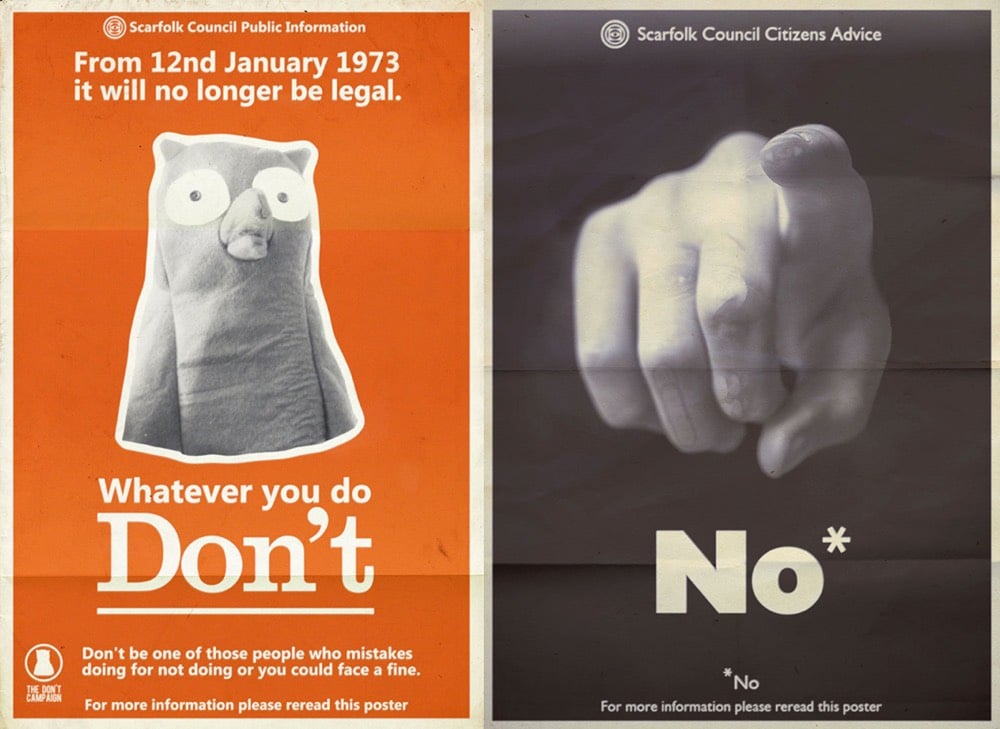

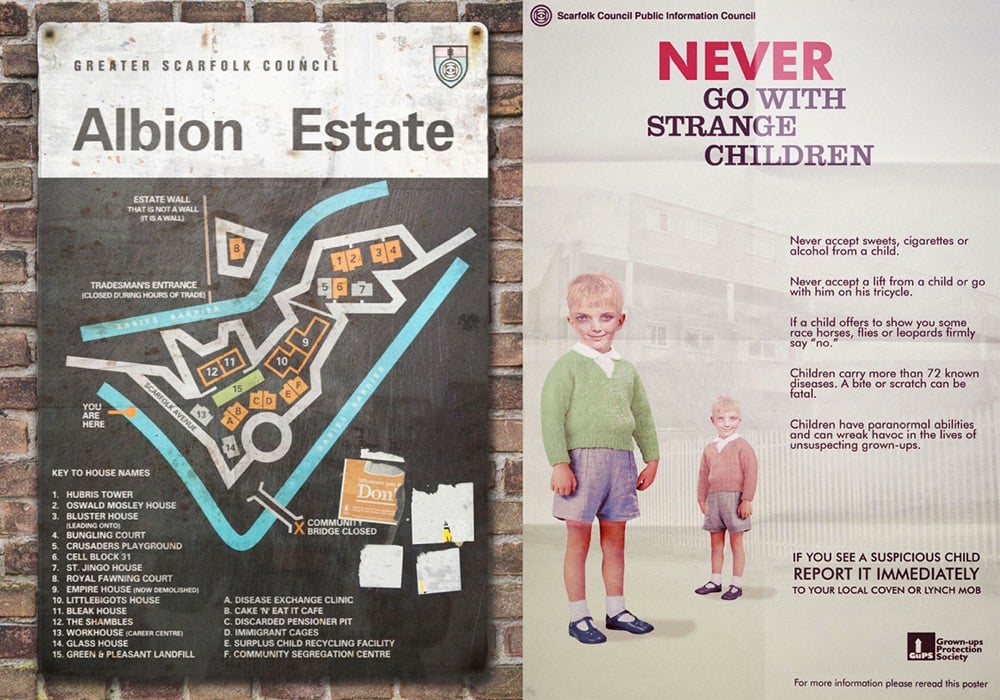
The slogans and advertisements the site produces are fantastic. It’s Nice That has a good overview of the some of the best pieces.
Spotify playlist of rap songs featuring technology. There are songs called “Microsoft Word”, “Lyft (Fuck a Uber)”, and “Twitter Song”.
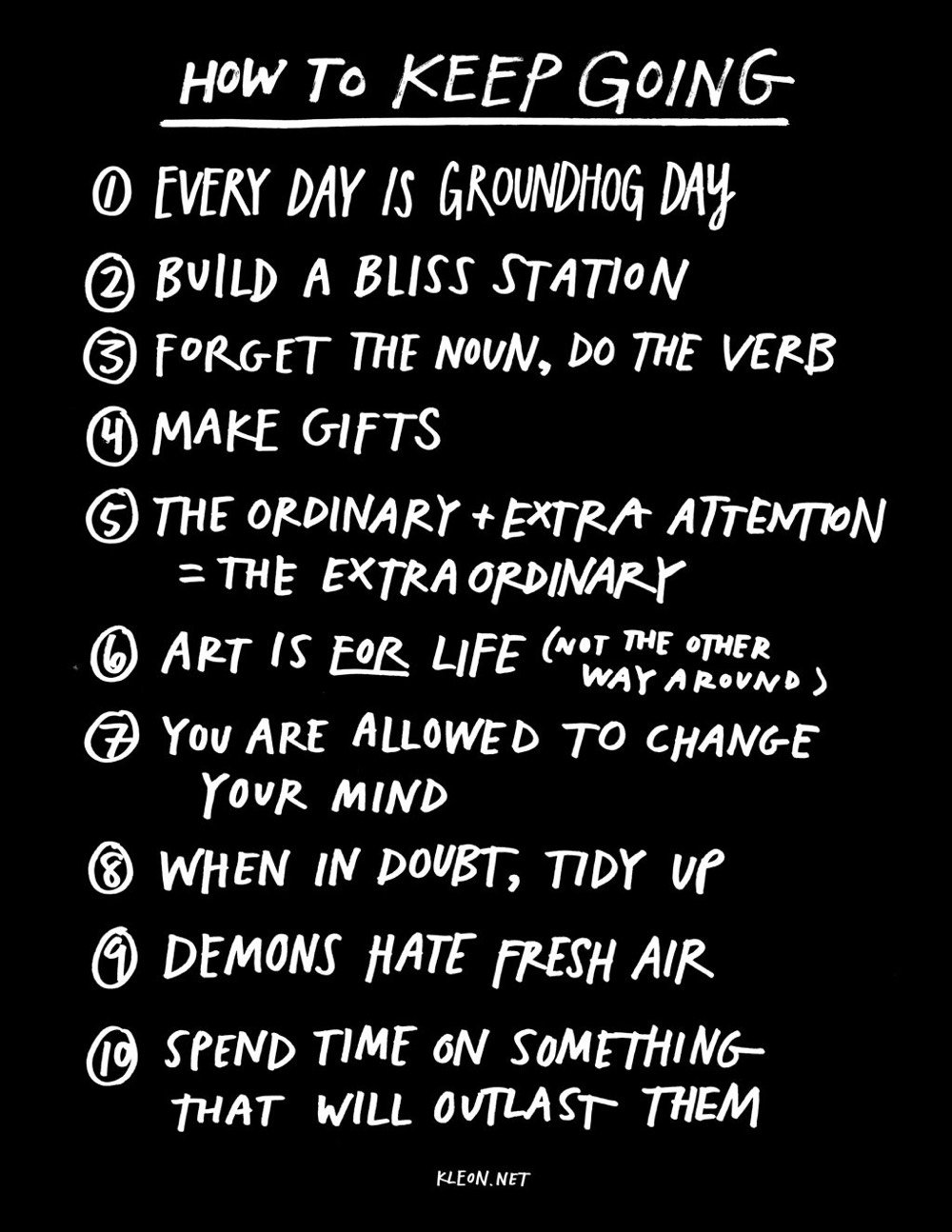
How to Keep Going
I really enjoyed listening to Austin Kleon’s recent talk about how to press forward when doing creative work, even when times get challenging. He talked about ten strategies for keeping yourself moving forward. In addition to “you’re allowed to change your mind”, I particularly liked “forget the noun, do the verb” (don’t worry about being a writer, focus on writing) and “the ordinary + extra attention = the extraordinary” (because sometimes I feel like 80% of what I do on this here site is pay more attention than everyone else…like, that’s the secret sauce).
Update: Kleon posted a transcript of his talk on Medium. Here’s a list of his 10 ways to keep going:
GIFs of ancient ruins restored

From Expedia, a series of animated GIFs that show what ancient ruins from around the world would look like if they were restored. They did The Parthenon (above), Pompei’s Temple of Jupiter, Hadrian’s Wall, the Luxor Temple in Eqypt, and the Nohoch Mul Pyramid in Mexico:

I climbed Nohoch Mul during a recent visit to Coba. (via colossal)
Being Serena
Being Serena is a five-art HBO documentary series on Serena Williams that focuses on her pregnancy, the birth of her daughter, and her determination to get back on the court and compete at a championship level.
I don’t know if there’s anything left for me in tennis, but I’m not done yet.
The first episode will air on May 2. Deadline has further details.
Retired Supreme Court Justice John Paul Stevens: Repeal the Second Amendment
In an opinion piece for the NY Times, former Supreme Court Justice John Paul Stevens advocates for the repeal of the Second Amendment.
That support is a clear sign to lawmakers to enact legislation prohibiting civilian ownership of semiautomatic weapons, increasing the minimum age to buy a gun from 18 to 21 years old, and establishing more comprehensive background checks on all purchasers of firearms. But the demonstrators should seek more effective and more lasting reform. They should demand a repeal of the Second Amendment.
Concern that a national standing army might pose a threat to the security of the separate states led to the adoption of that amendment, which provides that “a well regulated militia, being necessary to the security of a free state, the right of the people to keep and bear arms, shall not be infringed.” Today that concern is a relic of the 18th century.
I completely agree with this. Weaponry deserves no special place in our country’s Bill of Rights and hasn’t for decades.
Socials & More