Entries for January 2017
Poker is famously hard for machines to model because you have limited information, you have to iterate your strategies over time, and react to shifts in your interactions with multiple other agents. In short, poker’s too real. Sounds like fun! A couple of researchers at Carnegie Mellon found a way to win big:
Carnegie Mellon professor Tuomas Sandholm and grad student Noam Brown designed the AI, which they call Libratus, Latin for “balance.” Almost two years ago, the pair challenged some top human players with a similar AI and lost. But this time, they won handily: Across 20 days of play, Libratus topped its four human competitors by more than $1.7 million, and all four humans finished with a negative number of chips…
According to the human players that lost out to the machine, Libratus is aptly named. It does a little bit of everything well: knowing when to bluff and when to bet low with very good cards, as well as when to change its bets just to thrown off the competition. “It splits its bets into three, four, five different sizes,” says Daniel McAulay, 26, one of the players bested by the machine. “No human has the ability to do that.”
This makes me suspect that, as Garry Kasparov discovered with chess, and Clive Thompson’s documented in many other fields, a human player working with an AI like Libratus would perform even better than the best machines or best players on their own.
Update: Sam Pratt points out that while Libratus played against four human players simultaneously, each match was one-on-one. Libratus “was only created to play Heads-Up, No-Limit Texas Hold’em poker.” So managing that particular multidimensional aspect of the game (playing against players who are also playing against each other, with infinite possible bets) hasn’t been solved by the machines just yet.
Politics happens in (at least) three places:
- political institutions, like legislatures, courthouses, and executive offices, places governed by elaborate rules and traditions;
- public spaces, like debates, protests, and media appearances, which are ruled by law and economics but driven by rhetoric;
- bodies and matter, where people, often but not always government and other political agents, use power, violence (direct or indirect), and the threat of violence (same) to hurt people and take their stuff. And sometimes (for most of us, probably more rarely/indirectly), to help people and give them more stuff.
These categories all bleed into each other and still leave a whole lot out, but for a quick and dirty chop-job of the universe, well, I’ve seen worse. (And done worse.)
It helps to focus on one but not forget about the others. Keep your head on a swivel, like my football coach used to say. And each sphere has its own grammar, its invisible rules.
Some of the best writing about the Trump regime has been on the second, imaginary sphere, by TV critics on the politics of media. You might think this is the easiest of the three to tell stories about, but the degree of difficulty is absurdly high if you aim to do more than just summarize or react to the thing we’ve all just seen. Help me see. Change my vocabulary. Show me how it works. Show me why it works.
Lili Loofbourow’s glossary of Kellyanne Conway’s rhetorical moves helps you see.
Concept scrabble
“Most Americans are very focused on what their tax returns will look like while President Trump is in office, not what his look like.”
Conway frequently takes the words from the question — tax returns, Trump, Americans — and recombines them. It gives the impression of straightforwardness. The question, you’ll recall, was how Trump will respond to a petition signed by 200,000 Americans demanding that he release his tax returns. Conway takes those concepts — “the people,” “tax return” — and reshuffles them in a way that a) denies the premise (the 200,000 Americans who signed that petition fall out of her framing — let me tell you what the people care about, she says), and b) removes Trump from the sentence as an agent called upon to respond.
Besides “concept scrabble,” there’s “faux frankness,” “impatience signaling,” “Cool girling,” “Agenda Mad Libs,” and more, all illustrated with examples.
Emily Nussbaum’s “How Jokes Won the Election” helps you see — in this case, how many of Trump’s outrageous statements during the campaign had the structure of jokes. A lot of people have made a lot hay out of the “seriously”/”literally” dichotomy breaking down, but Nussbaum focuses instead on how it limits your ability to react, especially when you’re the subject of the “joke”:
The political journalist Rebecca Traister described this phenomenon to me as “the finger trap.” You are placed loosely within the joke, which is so playful, so light—why protest? It’s only when you pull back—show that you’re hurt, or get angry, or try to argue that the joke is a lie, or, worse, deny that the joke is funny—that the joke tightens. If you object, you’re a censor. If you show pain, you’re a weakling. It’s a dynamic that goes back to the rude, rule-breaking Groucho Marx—destroyer of elites!—and Margaret Dumont, pop culture’s primal pearl-clutcher.
When Hillary described half of Trump’s followers as “deplorables,” she wasn’t wrong. But she’d walked right into the finger trap. Trump was the hot comic; Obama the cool one. Hillary had the skill to be hard-funny, too, when it was called for: she killed at the Al Smith charity dinner, in New York, while Trump bombed. It didn’t matter, though, because that was not the role she fit in the popular imagination. Trump might be thin-skinned and easily offended, a grifter C.E.O. on a literal golden throne. But Hillary matched the look and the feel of Margaret Dumont: the rich bitch, Nurse Ratched, the buzzkill, the no-fun mom, the one who shut the joke down.
Conway can float in and out of different modes than Clinton can, partly because she has different political talents, but partly because she’s under different rhetorical constraints. These things are all imaginary, yes — but they work.
Still, Conway can be wrongfooted, too — here’s Loofbourow again:
In thinking about how to transcend the Conway effect, it’s instructive to study the people who’ve effectively interviewed her. Seth Meyers turned out to be a master at it: Comedians have a lot of experience quickly analyzing and calling out behaviors and tricks in ways that scan as funny rather than aggressive…
Meyers took Conway’s statement — meant to discredit a press report — and took its interpretation away from her. In his hands, her statement became the terrifying story of a president-elect who couldn’t be bothered to read his own intelligence briefs, even when they were about him. And he did it by using a more complex version of Conway’s multifactorial rhetoric.
There are limits to what we can learn about politics from comedians and comedy tropes — most of the time, the battles over laws and bodies exceed anybody’s ability to turn a phrase. But this imaginative sphere, too, is all part of the bigger combat, and there are still so many things we can learn about how the fight is fought.
Smartphones have been getting more water-resistant for a while now, but this is pretty crazy. Via Ina Fried at Recode, who writes:
The phone is a successor to an earlier handset that worked only with certain types of hand soap. The washable phone can be used with a range of soaps, including foaming body wash and hand soap… Waterproof phones have long been a thing in Japan, so it’s not too much of a stretch to think there might be an appetite for soap-proof devices.
In the US, smartphones have gotten so ubiquitous as to be boring — all of them big, flat, and offering slightly different versions of the same thing. I don’t know — maybe that’s an unfair characterization. But I wish the market were just a little weirder, wilder, offering different things to different people with different needs and lives.
I used to work at Wired, and later at The Verge, and at both places we had a lot of reverence for “Wired in the 90s.” You’d say it fast like that, too — “wired-in-the-90s” — and it was a universally recognized shorthand for relevance, cool, slick design, smart writers, the “culture of now.” I suspect it probably stands for that for a lot of Kottke readers too.
Yesterday, for reasons unknown, my RSS reader spit up a random Kevin Kelly post from 2012 called “Predicting the Present” that excerpts a bunch of quotes from the early years of Wired. Here are some of them (I tried to pick fun ones):
We as a culture are deeply, hopelessly, insanely in love with gadgetry. And you can’t fight love and win.
— Jaron Lanier, Wired 1.02, May/June 1993, p. 80
The idea of Apple making a $200 anything was ridiculous to me. Apple couldn’t make a $200 blank disk.
— Bill Atkinson, Wired 2.04, Apr 1994, p. 104
Marc Andreessen will tell you with a straight face that he expects Mosaic Communications’s Mosaic to become the world’s standard interface to electronic information.
— Gary Wolf, Wired 2.10, Oct 1994, p. 116
The human spirit is infinitely more complex than anything that we’re going to be able to create in the short run. And if we somehow did create it in the short run, it would mean that we aren’t so complex after all, and that we’ve all been tricking ourselves.
— Douglas Hofstadter, Wired 3.11, Nov 1995, p. 114
Of all the prospects raised by the evolution of digital culture, the most tantalizing is the possibility that technology could fuse with politics to create a more civil society.
— Jon Katz, Wired 5.04, Apr 1997
It is the arrogance of every age to believe that yesterday was calm.
— Tom Peters, Wired 5.12, Dec 1997
Separately, Ingrid Burrington was leafing through a 1996 issue of Wired and found this beauty:
AI-based investment systems will cut a swath through Wall Street, automating thousands of jobs or downgrading their skills.
— Clive Davidson, freely quoting Ron Liesching, Wired 4.12, Dec 1996

Print book sales are increasing (slightly) while e-book sales continue to fall (sharply), says Nielsen’s Jonathan Stolper. Which means for the first time in more than four years, hardcover books are outselling e-books. Stolper lists a few factors driving the switch: the price of e-books has gone up, and fewer people are using dedicated e-readers. Even people buying and reading e-books are doing it on their phones and tablets, not Kindles or Nooks or what-have-you.
Whatever the causes for the decrease in e-book sales, the decline has resulted in something that many publishing experts thought would never happen—unit sales of hardcovers overtook unit sales of e-books. With hardcover units up 5% in 2016 over 2015, hardcover’s 188 million units sold topped that of e-books for the first time since Borders closed in 2012, Stolper said.
I have a pet theory about this, and it’s very simple: it’s about the stores. Here’s how it works.
- E-bookstores expand to country after country, publisher after publisher => sales of e-books go up.
- Borders and other chain bookstores shut down => sales of print books go down.
- Barnes & Noble and other e-bookstores shut down, leaving Amazon basically the only game in town => sales of e-books go down. (Also prices go up.)
- People stop using devices that are basically stores with readers attached, and use phones and tablets where it’s harder to buy => sales of e-books go down some more.
It’s the same boom-and-bust that we had when the new chain bookstores came through thirty years ago and gradually killed each other off! Lots of places to buy books, then hardly any places to buy books.
Meanwhile, indie bookstores are weathering the storm and big box stores are still pushing books at a discount, keeping print books afloat. Which is exactly what the publishers and a lot of other players in the market have always wanted: a high e-book prices, both to preserve a revenue floor and to keep the entire print market chain in business. And Amazon’s fine with it — they got the near-monopoly on e-retail they wanted.
Meanwhile, readers are paying more for books and have fewer places from which to buy them. As much as I like a good hardcover, that hardly feels like a win.
Buying a book is what they call a crime of opportunity. If there were more viable e-bookstores (and if DRM weren’t such a monster, there’s no reason every website couldn’t be an e-bookstore), we’d have better competition on price (collusion and market choices aside) and everyone would sell a whole lot more e-books.
Update: I screwed up the first draft of this and conflated hardcover units with total print sales. (I also forgot to include the link to the Publishers Weekly story I quoted.) To be clear, hardcovers are outselling e-books now, from the publishers covered in Nielsen’s survey. E-books have never outsold all print books — even rosy projections back in 2014, when e-book sales were about a third of the market, didn’t think they’d cross that 50/50 threshold until well into this decade. Thanks to Doug Gates who spotted the error.
Update 2: Dan Cohen pointed out a number of other factors tipping sales measurement in favor of print: “dark” but legal reading of e-books that doesn’t get counted (libraries, open e-books, DRM-free private sales by authors and indies), and increased sales of audiobooks, which eats away at the e-book market. E-readers, too, haven’t really improved much; neither have the aesthetics of the books themselves. Other readers pointed out that readers feel burned by stores and services failing.
In short, “cost” is probably the biggest factor, broadly defined — but what exactly that means and how it plays out in readers’ choices is a lot more complex than a binary choice between e-books and print.

The United Kingdom’s Royal Mail is releasing a limited edition of ten stamps honoring David Bowie, available on March 14 (although you can preorder now).
The images include Bowie in concert on the Ziggy Stardust tour of 1973; the famous zigzag lightning bolt across his face on the “Aladdin Sane” cover; and the covers of his “Heroes” (1977), “Let’s Dance” (1983) and “Earthling” (1997) albums. An image from Bowie’s final LP, “Blackstar,” released days before his death, is also part of the set…
The Royal Mail said that this will be the first time it has dedicated a full set of stamps to a single musician. Philip Parker, the stamp strategy manager at the Royal Mail, said in a statement that the stamp issue honored Bowie’s “many celebrated personas.”
He said: “For five decades David Bowie was at the forefront of contemporary culture, and has influenced successive generations of musicians, artists, designers and writers.”
I would love for the USPS to do something similar for Prince. I don’t know if we have any other stamps that honor royalty. (Besides maybe Wonder Woman.)

This is from Walter Benjamin’s essay “On the Concept of History,” but I’m going to use the old translation back when it was called “Theses on the Philosophy of History,” and mess with the line breaks a little. If you’ve read this a million times, forgive me; it’s always worth reading again.
A Klee painting named “Angelus Novus” shows an angel looking as though he is about to move away from something he is fixedly contemplating. His eyes are staring, his mouth is open, his wings are spread.
This is how one pictures the angel of history. His face is turned toward the past. Where we perceive a chain of events, he sees one single catastrophe which keeps piling wreckage and hurls it in front of his feet.
The angel would like to stay, awaken the dead, and make whole what has been smashed.
But a storm is blowing in from Paradise; it has got caught in his wings with such a violence that the angel can no longer close them. The storm irresistibly propels him into the future to which his back is turned, while the pile of debris before him grows skyward.
This storm is what we call progress.
Benjamin wrote this in 1940, in Paris; he’d left Germany shortly before the Nazis seized power. After the Nazis invaded France, he fled to Spain, with a precious travel visa to the United States. Spain’s government then cancelled all transit papers. The police told Benjamin and all the other Jewish refugees in his group would be returned to France. He killed himself.
His friend Hannah Arendt later made it across the border safely; she had the manuscript of this essay. Which is why it exists.
Why is this useful?
These are chaotic times. But to the angel of history, it’s not a sudden eruption of chaos, but a manifestation of an ongoing vortex of chaos that stretches back indefinitely, without any unique origin. When we’re thrust into danger, in a flash we get a more truthful glimpse of history than the simple narratives that suffice in moments of safety. As Benjamin puts it, “the tradition of the oppressed teaches us that the ‘state of emergency’ in which we live is not the exception but the rule.”
Global refugees, the stubborn pervasiveness of white supremacy, the arbitrary power of the state, the fragility of national and international institutions — we’ve been here for some time now, haven’t we? One day, you stir, and there you are — right where you’ve always been. With nothing under your feet, and ghosts pausing for breath next to your cheek.
This is not normal — and yet it’s the same as it’s always been. Because there is no normal. Not really. Just a series of accidents, a trick of the light, a collective hallucination we’ve all worked to diligently maintain.
Even now, most of us are working to impose an order on the world, to see a plan at work, to sort the chaos into “distractions” and “reality,” whether it’s “real news,” uncovering the secret aims of an unseen puppet master, or articulating the one true politics that can Fix Everything. We can’t help it; it’s what we do.
Remembering the angel helps ameliorate that impulse. Yes, there are opportunists everywhere, and real losses and victories, but the perfect theory that links events into beautiful chains of causality is elusive enough to be a dream for a fallen people. “Only a redeemed mankind receives the fullness of its past — which is to say, only for a redeemed mankind has its past become citable in all its moments.” For now, it’s all part of the storm; we’re all going to have to improvise.
For all his pessimism, rooted in a contempt and longing for a safety he couldn’t enjoy, Benjamin (I think) really did believe in the possibility of a Messiah, who would appear at a moment of great danger. It was a Jewish and a Marxist belief for someone who had great difficulty believing in either Judaism or Marxism in any of their existing forms.
There are a lot of people, on the left and the right, who share a version of this idea as a matter of dogma, without anything like the Kierkegaardian leap of faith Benjamin took in order to suspend his disbelief in it. Better to knock everything down, to build something new to replace it; heighten the stakes, so we have no choice but to take drastic steps to build paradise. I’m a lot less sure. I know what it took to build those things, and the emergencies that forced us to build them. It’s not an algebra problem to me, a clever lecture, a witty conjecture. I like those. Those are fun. This is not fun. This is blood and bones and broken things that do not come back. It would be nice to have a political or religious framework in which all those things can be mended or redeemed. It’s not available to me, except in its absence.
But for all that, I think I do believe in something smaller, more limited:
- I believe that moments of emergency are shot through with new possibilities;
- I believe there are more of us and there is more to us than we know;
- I think that we are always becoming something new;
- and this is because we don’t have a choice in the matter.
I think James Baldwin is right (Baldwin, like Benjamin, is somehow always right) when he writes in “Stranger in the Village” that while so many “American white men still nourish the illusion that there is some means of recovering the European innocence, of returning to a state in which black [and brown] men [and women] do not exist,” that
This is one of the greatest errors Americans can make. The identity they fought so hard to protect has, by virtue of that battle, undergone a change: Americans are as unlike any other white people in the world as it is possible to be. I do not think, for example, that it is too much to suggest that the American vision of the world — which allows so little reality, generally speaking, for any of the darker forces in human life, which tends until today to paint moral issues in glaring black and white — owes a great deal to the battle waged by Americans to maintain between themselves and black men a human separation which could not be bridged. It is only now beginning to be borne in on us — very faintly, it must be admitted, very slowly, and very much against our will— that this vision of the world is dangerously inaccurate, and perfectly useless. For it protects our moral high-mindedness at the terrible expense of weakening our grasp of reality. People who shut their eyes to reality simply invite their own destruction, and anyone who insists on remaining in a state of innocence long after that innocence is dead turns himself into a monster.
The time has come to realize that the interracial drama acted out on the American continent has not only created a new black man, it has created a new white man, too. No road whatever will lead Americans back to the simplicity of this European village where white men still have the luxury of looking on me as a stranger. I am not, really, a stranger any longer for any American alive. One of the things that distinguishes Americans from other people is that no other people has ever been so deeply involved in the lives of black men, and vice versa. This fact faced, with all its implications, it can be seen that the history of the American Negro problem is not merely shameful, it is also something of an achievement. For even when the worst has been said, it must also be added that the perpetual challenge posed by this problem was always, somehow, perpetually met. It is precisely this black-white experience which may prove of indispensable value to us in the world we face today. This world is white no longer, and it will never be white again.
In short, I believe in the future — not a paradise, not a tranquil place, not a reward, but in all its mundane possibility and broken uncertainty. I choose to believe in the future, simply because we have nowhere else to go.
It’s been a (very!) eventful two weeks, but I still can’t stop thinking about Hanif Willis-Abdurraqib’s terrific appreciation of Ernest Dickerson’s 1992 film Juice. That’s as good a reason as any to share it here.
Juice might be Tupac Shakur’s signature performance as an actor: he’s charming and frustrating, thoughtful and thoughtless — accelerating through emotions and personalities like an athlete changing speed mid-play — beautiful and wrathful and doomed, like Achilles or James Dean. Or, like Tupac.
Willis-Abdurraqib zeroes in a key part of the story, and of the best art from the era in which the film was made — “what so rarely happens with black people who live and die and do wrong today: an ability to visualize a complete life behind simply a finger that pulls a trigger, and a willingness to understand what drove them there.”
Juice came at a time when the black nihilist was being visualized and reconsidered onscreen in ways that had traditionally been afforded to and reheated for white actors and their stories. Movies like New Jack City, Menace II Society, and Boyz n the Hood showed black characters who either gained things with no moral code, or who were deeply aware of how little they had to live for, and conducted themselves in a manner that showed that awareness regardless of whom it hurt. These characters were sometimes sympathetic and complex, but none were like Tupac’s Bishop — in part because it was Tupac playing the role, but also because of the way we find Bishop, and how he ends up. By the time I was old enough to understand the emotion of his narrative, when I watched Bishop fall from the rooftop and heard the sound of a body hitting concrete that followed, I felt like I had lost a friend — a friend who, like some of my actual friends, had drifted into the machinery of some vice and had not felt loved or seen enough to shake their way out of it…
A tragedy is defined by the fatal flaw that plagues its central character, and the ways in which that flaw echoes down to all the other characters, leading to a brief and immediate reversal of fortune. The Greeks referred to this kind of flaw as hamartia — literally, a missing of the mark. Hamartia is to aim for a target and not hit it, and to have yourself end up on the other side of tragedy. It is, perhaps, to aim a gun at someone you want to kill and then pull the trigger, hitting them instead in an arm that they will soon need to pull your body back to safety. The true reversal of fortune rests in the brief moment before Bishop falls to the ground, when you realize that Quincy wants to save him, but can’t.
I should add, especially for readers who’ve never seen it, that Juice is beautiful. Dickerson was/is one of the best cinematographers alive before he became a director, and it shows. And the soundtrack is amazing. You could say it was a forgotten movie, but it’s just so unforgettable.

The Infatuation has an interactive map of the best places to get soup dumplings, fried dumplings, wontons, and all that good stuff in NYC, plus ordering recommendations for each place.
You could easily quibble with the list itself — the numbers 1-17 aren’t supposed to be rankings per se, but it starts with lower Manhattan, then gets to Flushing and Sunset Park, and that’s it. Still, the nice thing about a map interface is that you don’t need to worry about who’s number 1 and who’s number 10 quite so much when you’re just trying to find a place in a nearby neighborhood that can deliver the goods. (God, I miss New York.)
Update: I mistook the numbers in the map’s list view for rankings and was all grumpy about all the Chinatown places being ahead of the Queens ones. As it turns out, some of the places have number ratings, some don’t, and the list is more a geographic sequence than anything else.
It feels like a stretch to call this “An Oral History of Homestar Runner” — the author only interviews two people, and it zips through time while all the details are kinda glossed over in a way that’s not entirely satisfying.
However. It’s still a solid interview with the two creators of Homestar Runner, which was easily the best all-ages cult video site from a time (the early 00s) when there weren’t exactly a lot of any of those things around.
It’s also a memory of a time when the web, or at least some corners of it, were a respite from the awfulness of the world, without being wholly removed from it. For example, I was introduced to it by a friend who’d just moved to lower Manhattan for grad school in 2002. We went and saw Ground Zero, commiserated about the upcoming midterm elections and the possibility of war with Iraq, and then he showed me a Strong Bad email. None of this seemed discordant. It was a firehose of new things, good and bad, not a stream of distilled horror demanding constant engagement. I miss that, and I know I’m not the only one.
Emmett Till, 14, was murdered and mutilated for flirting with a white woman, Carolyn Bryant, 21, in August 1955. Some reports say Till whistled at Bryant; others that he said “bye, baby” when leaving her store. Bryant’s husband Roy and his half-brother J.W. Milam kidnapped, tortured, and killed Till, then dumped his body in the river. Bryant and Milam were acquitted by an all-white, all-male jury that September. Till’s lynching and the Brown v. Board of Education Supreme Court decision the year before mark the beginning of the modern civil rights movement in the United States.
There are two new books about Emmett Till — or rather, partly about Till and partly about the world around him, which is not so far from ours as we might like. Timothy B. Tyson’s The Blood of Emmett Till includes interviews with Carolyn Bryant Donham, now 82, where she recants much of her testimony in the Till case, including her claim that Till made verbal or physical advances on her.
Clearly, he observed, she had been altered by the social and legal advances that had overtaken the South in the intervening half century. “She was glad things had changed [and she] thought the old system of white supremacy was wrong, though she had more or less taken it as normal at the time.” She didn’t officially repent; she was not the type to join any racial reconciliation groups or to make an appearance at the new Emmett Till Interpretive Center, which attempts to promote understanding of the past and point a way forward.
But as Carolyn became reflective in Timothy Tyson’s presence, wistfully volunteering, “Nothing that boy did could ever justify what happened to him.”
John Edgar Wideman’s Writing to Save A Life takes up the story of Till’s father Louis, who beat his wife, left the family destitute, chose the army over prison, then was court-martialed and hanged in Italy during World War 2 on thinly substantiated rape charges. When it comes to sex and race, the lines we might draw between legal and extralegal punishment, rough familial revenge and precise military bureaucracy, gets blurrier and blurrier. What Wideman finds instead in both Till cases, father and son, is a “crime of being.”
I had never once thought of nor seen Louis Till before Wideman painted him so exquisitely, and now I have to acknowledge that he is all around me. Walter Scott? He’s Louis Till; so is Eric Garner. Michael Brown, unsympathetic as he appears on that convenience-store video — I can no longer see him without conjuring Emmett’s father. Seventeen-year-old Laquan McDonald, wandering through the Chicago night until his body jumps and jerks from 16 shots? Louis (Saint) Till. Poor Philando Castile — pulled over at least 49 times in 13 years before the final and fatal interaction that left him bleeding in front of his girlfriend and her daughter and all the rest of us on Facebook Live — is a high-tech Louis Till. Ditto Alton Sterling down in Baton Rouge, Freddie Gray up in Baltimore and “bad dude” Terence Crutcher out in Tulsa: all these men are Louis Tills. Trayvon Martin and 12-year-old Tamir Rice are something else altogether, heart-rending combinations of both Tills, père and fils, doomed man-children in the fretful, trigger-happy imagination of American vigilantes and law enforcement. Whatever other crimes may or may not have been committed, may or may not have potentially been on the brink of being committed, these were all crimes of being before they were anything else.
It may be too hard to hold all of this in our heads — the elderly woman making gestures of repentance but still complicit in that horrible, racist crime, and the mysterious, violent man ground to dust by racist military machinery — and also recognize that this is still living memory: that Emmett Till and so many others should still be here to tell the stories of their lives, not have others speak for them. At the same time, when the horrors of World War 2 and Jim Crow suddenly in some ways feel closer than ever, how can we not strain to hear whatever they have to tell us?
I’m now about the same age as the oldest competitive pro athletes. Correspondingly, I think this year’s Australian Open finals slate is awesome. I don’t know if I’ll be able to stay awake long enough this weekend to watch the matches live, but I’m excited all the same.
- Serena Williams (2) vs. Venus Williams (13), Saturday 3:30 AM ET
- Rafael Nadal (9) vs. Roger Federer (17), Sunday 3:30 AM ET
Sports are also great because commentators talk about athletes in their mid-thirties like they’re historical landmarks in need of restoration and repair. All four of these finalists are born-in-the-80s millennials; nobody talks about them like they talk about other millennials. Maybe because they already came for our jobs with their boundless talent and energy twenty years ago when they were still teenagers, I don’t know. Rafa’s the youngest of them at 30 and looks the oldest. Maybe because the Williams sisters and Federer are actual engineered superhumans. Again, I don’t know. All I know is that Nadal looks like Deathlok now. A sexy, sexy Deathlok.
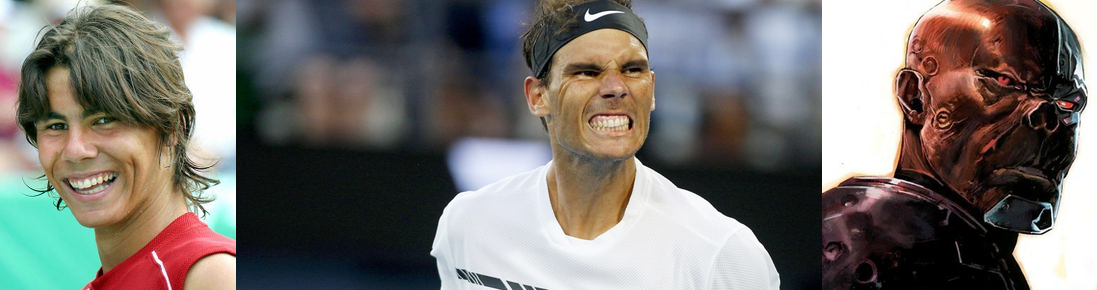
Again, this comforts me, because I feel like Deathlok too. A less conventionally sexy Deathlok, but a cybernetic monstrosity of meat and metal all the same.
The old man bond makes me like athletes I hated. I never liked Vince Carter or Paul Pierce when they were young. Now that they’re two of the only NBA players who are older than me, I hope they never leave.
Vince, Paul, and Dirk Nowitzki are the only players still around from the 1998 NBA draft class. (Tyronn Lue is still around too, but he’s a head coach.) This is Vince talking about Dirk:
He’s a professional scorer. I say this about myself, too, and you could probably say it about Paul as well: When you see him walk into the arena before a game, you could probably say there’s no way in hell that those guys are playing tonight. Then Dirk will come in and drop 35. Regardless of how he feels before the game, once the big lights are on and you come on the court, he knows how to get it done, plain and simple.
When Dirk Nowitzki was drafted in 1998, Ross Perot owned Dallas’s team. I like having guys around who can drop 35 and knew Ross Perot. I think we need that in our lives. For just a little longer.
Update: Serena beat Venus in two tough sets, winning her 23rd Grand Slam championship, a record in the open era and just one behind Margaret Court for most all-time. And Federer beat Nadal in five sets of amazing tennis from both men, improbably beating his way back, backhand after brilliant backhand, after being down three games to one in the final set. The two best tennis players of our time (maybe of all time), each beating their toughest opponents. Just a perfect pair of finals.
Lin-Manuel Miranda recently released the early drafts of eight Hamilton songs on Soundcloud. Miranda sings all the parts himself and they’re a lot less showtuney and more hip-hoppy than the finished product. Worth a listen for fans of process.
Joshua Glenn and Rob Walker have collected a group of writers to tell stories about political objects they own.
Batches of POLITICAL OBJECTS stories will appear on HILOBROW before, on, and just after the inauguration, and will continue to roll out through the end of March. The objects include overtly political artifacts both charismatic and absurd, and items whose stealthily political nature will surprise you; the stories range from the uplifting to the poignant to the unexpectedly illuminating. It’s a terrific collection.
Stephen Duncombe wrote about a God Bless Hysteria protest sign and Ben Greenman wrote about a Matchbox car.
Soon enough, I found what I didn’t know I was looking for — a Corvette. This was early May of 2016. Prince had just died. I had just started writing a book about him. I knew that I needed a little red Corvette, somehow, as a talisman. The only problem was that the one from the bin was black. I bought it. I took it home. I went into the closet and found the model paints that my sons no longer use. I painted it red.



I love these colorfully imaginative drawings of animals by illustrator Lisa Ericson; fish with coral reef tails and mice with butterfly wings. Sadly her prints are sold out, but hopefully she’ll make more available soon.
BTW, Ericson’s husband is Josh Keyes, whose grafitti-themed art I featured last week. Talented household.
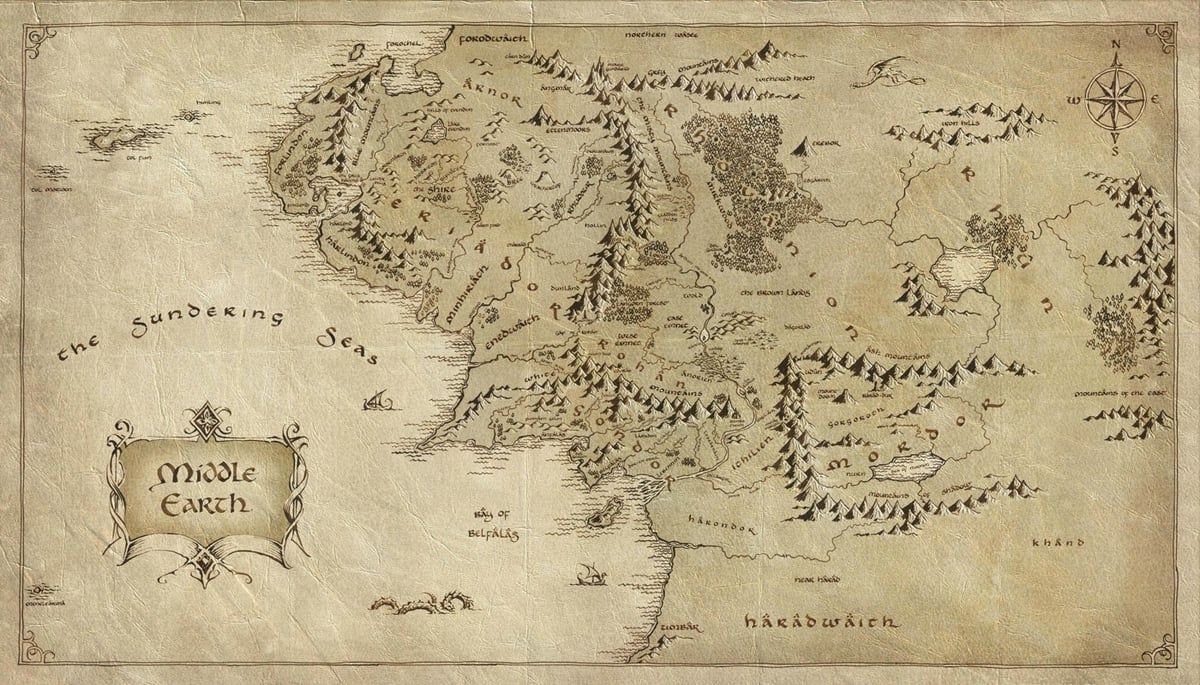
At The Awl, Victoria Johnson fondly remembers the books of her youth that contained extra material. Like maps.
If I ruled the world, or at least a publishing company, all books would contain as much supplementary information as possible. Nonfiction, fiction — doesn’t matter. Every work would have an appendix filled with diagrams, background information, digressions and anecdata. And of course, maps. Lots and lots of maps.
The Hobbit, Winnie the Pooh, and The Wizard of Oz all included great maps that expanded the story in the mind of the reader. Near the end of the piece, Johnson notes that The Hunger Games didn’t include a map of Panem and links to this fan-drawn map (image here):

The Capitol is in Denver.
D12 is Appalachia.
D11 shares a border with D12, is one of the largest districts, is South of D12, and is primarily used for growing grain and produce.
D10 is primarily used for raising livestock. They do NOT process the livestock in D10. However, to feed an entire nation, D10 is likely another very large District.
D9 processes food for the Capitol and the tesserae; therefore, it likely shares borders with the food production Districts (D4, D10, D11).
D8 produces and treats textiles and is a factory District. It is POSSIBLE to reach D12 from D8 on foot over a course of weeks/months. Therefore, it does not cross a large body of water.
May the maps be ever in your books.
Back in November, former Obama administration official Cass Sunstein came up with a list of five books that conservatives should read to in order to learn something about contemporary progressivism. On the list is Success and Luck: Good Fortune and the Myth of Meritocracy by Robert Frank:
In Frank’s view, we overstate the role of individual merit and underestimate the massive role of luck in producing individual success or failure — being born into the right family, finding oneself in the right place at the right time, having a good mentor. He makes “there but for the grace of God go I” into a rallying cry.
A month earlier, Sunstein offered a similar list of books liberals should read to learn something about conservatives, including Jonathan Haidt’s The Righteous Mind:
Do conservatives have moral commitments that progressives may not even recognize? Haidt says yes, and he identifies three: authority, loyalty and sanctity. If, for example, someone has betrayed a trust, or treated a boss or a parent disrespectfully, conservatives are far more likely to be outraged than progressives.
Haidt is not himself a conservative, but he offers a sympathetic explanation of why progressives often fail to understand their political adversaries. He also shows that the moral commitments that resonate among conservatives have deep roots in human history — and that it is a form of blindness not to acknowledge and respect those commitments.
I don’t know about you, but I could watch milling machines grinding down metal all day long (and very nearly did). Seeing metal behave like soft butter is weiiiird. Those blades are shaaaarp. Some words can be made looooong by repeating voooooowels. (via @rands)
In an interview with Yahoo Movies UK, Rogue One editor Colin Goudie shares how he made a full-length story reel for director Gareth Edwards from similar scenes from 100s of other movies so that Edwards could work out the pacing for the action and dialogue.
There was no screenplay, there was just a story breakdown at that point, scene by scene. He got me to rip hundreds of movies and basically make ‘Rogue One’ using other films so that they could work out how much dialogue they actually needed in the film.
It’s very simple to have a line [in the script] that reads “Krennic’s shuttle descends to the planet”, now that takes maybe 2-3 seconds in other films, but if you look at any other ‘Star Wars’ film you realise that takes 45 seconds or a minute of screen time. So by making the whole film that way — I used a lot of the ‘Star Wars’ films — but also hundreds of other films too, it gave us a good idea of the timing.
For example the sequence of them breaking into the vault I was ripping the big door closing in ‘Wargames’ to work out how long does a vault door take to close.
So that’s what I did and that was three months work to do that and that had captions at the bottom which explained the action that was going to be taking place, and two thirds of the screen was filled with the concept art that had already been done and one quarter, the bottom corner, was the little movie clip to give you how long that scene would actually take.
Then I used dialogue from other movies to give you a sense of how long it would take in other films for someone to be interrogated. So for instance, when Jyn gets interrogated at the beginning of the film by the Rebel council, I used the scene where Ripley gets interrogated in ‘Aliens’.
So you get an idea of what movies usually do.
That’s super interesting! Like a moving Pinterest mood board or something. Oh, what I wouldn’t give to see that story reel.
In a 45-minute video called Riding Light, Alphonse Swinehart animates the journey outward from the Sun to Jupiter from the perspective of a photon of light. The video underscores just how slow light is in comparison to the vast distances it has to cover, even within our own solar system. Light takes 8.5 minutes to travel from the Sun to the Earth, almost 45 minutes to Jupiter, more than 4 years to the nearest star, 100,000 years to the center of our galaxy, 2.5 million years to the nearest large galaxy (Andromeda), and 32 billion years to reach the most remote galaxy ever observed.1 The music is by Steve Reich (Music for 18 Musicians), whose music can also seem sort of endless.
If you’re impatient, you can watch this 3-minute version, sped up by 15 times:
In 1937, Ernest Hemingway devised a cocktail called Death in the Gulf Stream for dealing with hard times.
Take a tall thin water tumbler and fill it with finely cracked ice.
Lace this broken debris with 4 good purple splashes of Angostura, add the juice and crushed peel of 1 green lime, and fill glass almost full with Holland gin…
No sugar, no fancying. It’s strong, it’s bitter — but so is English ale strong and bitter, in many cases.
We don’t add sugar to ale, and we don’t need sugar in a “Death in the Gulf Stream” — or at least not more than 1 tsp. Its tartness and its bitterness are its chief charm.
More drinks should involve lacing broken debris with alcohol. So the next time you feel like Hemingway kicking this can…
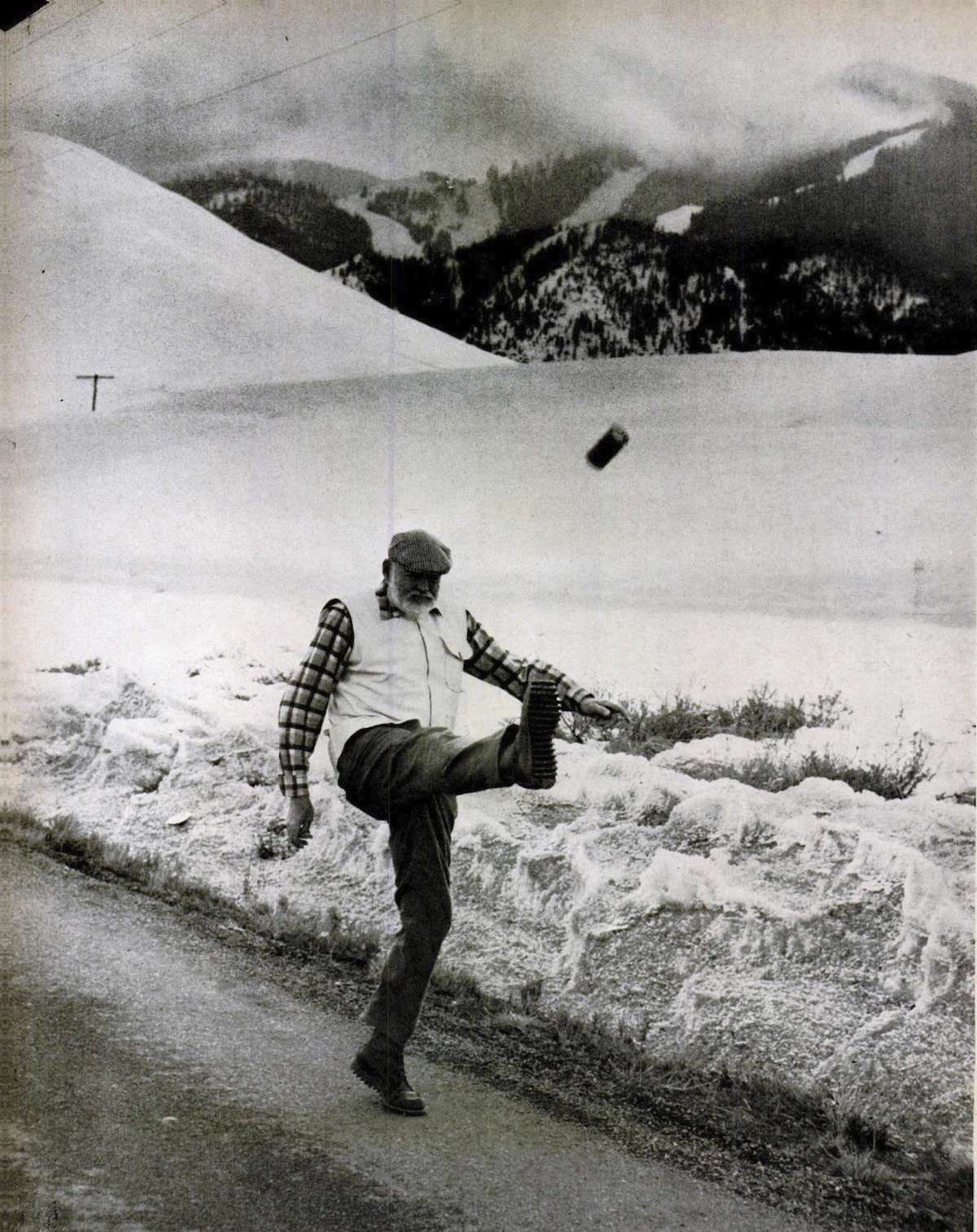
…you’ll have something to drink. (via rands in repose)
Over at Bloomberg, Tyler Cowen provides an explanation as to why Donald Trump and his staff are lying.
By requiring subordinates to speak untruths, a leader can undercut their independent standing, including their standing with the public, with the media and with other members of the administration. That makes those individuals grow more dependent on the leader and less likely to mount independent rebellions against the structure of command. Promoting such chains of lies is a classic tactic when a leader distrusts his subordinates and expects to continue to distrust them in the future.
Another reason for promoting lying is what economists sometimes call loyalty filters. If you want to ascertain if someone is truly loyal to you, ask them to do something outrageous or stupid. If they balk, then you know right away they aren’t fully with you. That too is a sign of incipient mistrust within the ruling clique, and it is part of the same worldview that leads Trump to rely so heavily on family members.
This is interesting throughout, particularly the bit about “higher-status mistruths and lower-status mistruths”.
Note that these tactics do not require a strategic masterplan.1 We know Trump acts mostly on instinct, so all the lying is just how he’s found success doing business in the past. I’ve been listening to The Power Broker on audiobook for the past few months and the similarities between how Robert Moses operated (particularly in NYC at the height of his powers) and Trump’s tactics are downright eerie, right down to the outright lies, ignoring outside counsel, and favoring short-term results over deeper long-term consequences.2 Both men had so much power and (especially in Moses’ case) capability that they could have really helped people and made a difference in the lives of millions but instead used it mainly to get their own way.
I watched Finding Dory with my daughter this weekend. It was our second time through and while I’d enjoyed it when we saw it in the theater, this time the theme really hit home. At the most basic level, Finding Dory is about animals with disabilities, how their supposed weaknesses can be strengths, and the challenges faced and strategies employed by parents of children with disabilities. The characters from the movie use their varying abilities in many different to help their friends.
Hank is an octopus who is missing a tentacle and struggles with anxiety about the open ocean. He’s able to fight through that anxiety to form a fast bond with Dory and return to the ocean.
Becky is a loon who appears unbalanced but is a very loyal friend once you’ve made a personal connection with her. Nemo believes in Becky and she comes through in a crucial moment in the movie. (Note that “loon” is a bird but is also slang for someone who is mentally ill.)
One of Nemo’s fins is smaller than the other. It doesn’t slow him down. In this film as well as in Finding Nemo, Nemo journeys across the ocean and helps his friends out of numerous scrapes.
Marlin, Nemo’s father, struggles with anxiety related to parenthood1 after he lost his mate and all but one of his children in a terrible accident. In Finding Nemo, that anxiety fuels him as he searches an entire ocean for his missing son, but at a crucial moment he also realizes that it’s damaging his relationship with his son and holding him back. In this movie, he comes to accept Dory and her full abilities and, with the help of his son, is able to put himself in her shoes — “What would Dory do?” — to make a timely escape.
Destiny is a nearsighted whale shark who nevertheless has a keen ability to help people find their way using her superior verbal communication skills. With the help and encouragement of friends, she is able to escape her tank and help rescue her friend Dory.
Bailey is a beluga whale who temporarily loses his echolocation and struggles with a lack of confidence. With their friends in need, Destiny encourages Bailey to rediscover his ability to help. (Basically, Bailey and Destiny help each other “see” in different ways.)
Jenny and Charlie are Dory’s parents. When Dory was young, they taught her to face her disability head-on and spent countless hours providing her with the encouragement and skills that she needed to become self-sufficient. And after Dory disappeared, they escaped to the ocean, built an elaborate display designed to help Dory find her way back to them, and waited years for her to return.
And Dory, the hero of the story, has short-term memory loss. Her inability to remember things for more than a minute or two has equipped her with a fierce sense of loyalty for her friends & family, a canny impulse for action when they are in need, and an infectious enthusiasm. Again and again, she acts when something needs to be done without the burden of past or future holding her back. In the end, with the help of Nemo and Marlin, she comes to see that her disability is a great strength and uses it to save her friends and find her parents.
Yeah, Pixar makes movies for children that are fun and full of gags & engaging characters. But time and again, from The Incredibles to Wall-E to Ratatouille to Inside Out, Pixar challenges audiences of all ages with larger themes relevant to society at large. If you missed it the first time around or just left your kids to watch it alone, I encourage you to give Finding Dory a chance. Bona fide blockbuster movies 1 that deal intelligently and with care about marginalized issues like disability are hard to come by.
The United States Government Manual is the official handbook of the US federal government. Here is the org chart for our government…take notice of what’s right at the top:

I’m no constitutional scholar, but that particular document starts off:
We the People of the United States, in Order to form a more perfect Union, establish Justice, insure domestic Tranquility, provide for the common defence, promote the general Welfare, and secure the Blessings of Liberty to ourselves and our Posterity, do ordain and establish this Constitution for the United States of America.
I realize the current executive administration doesn’t care and the current majority in the legislative branch barely cares, but remembering exactly who our government works for will be helpful over the next few years. (via @monstro)
My Perfect Country is a BBC radio program that looks at how you would build a perfect country by looking at policies that work from countries around the world. So far, they have explored teaching mathematics in Shanghai, Japanese gun control, Costa Rica’s progressive energy policy, and drug decriminalization in Portugal.
In 2001 the use of all drugs was decriminalised meaning possession of drugs was now identified as a public health issue rather than a criminal offence. Today, whilst drugs remain illegal, users do not receive a criminal record and are instead referred to rehabilitation and treatment programmes. Drug related deaths, HIV infection rates and use of legal highs are at an all-time low.
I hope they take a look at Iceland’s teen substance abuse policies in a future program:
Young people aren’t hanging out in the park right now, Gudberg explains, because they’re in after-school classes in these facilities, or in clubs for music, dance or art. Or they might be on outings with their parents.
Today, Iceland tops the European table for the cleanest-living teens. The percentage of 15- and 16-year-olds who had been drunk in the previous month plummeted from 42 per cent in 1998 to 5 per cent in 2016. The percentage who have ever used cannabis is down from 17 per cent to 7 per cent. Those smoking cigarettes every day fell from 23 per cent to just 3 per cent.
The way the country has achieved this turnaround has been both radical and evidence-based, but it has relied a lot on what might be termed enforced common sense. “This is the most remarkably intense and profound study of stress in the lives of teenagers that I have ever seen,” says Milkman. “I’m just so impressed by how well it is working.”
(via @dunstan)
Update: This is similar to Michael Moore’s recent film, Where to Invade Next:
The film, in the style of a travelogue, has Moore spending time in countries such as Italy, France, Finland, Tunisia, Slovenia, and Portugal where he experiences those countries’ alternative methods of dealing with social and economic ills experienced in the United States.
(thx, jemal)
President Obama is a reader. NY Times book critic Michiko Kakutani interviewed Obama about his reading just before he left office.
Last Friday, seven days before his departure from the White House, Mr. Obama sat down in the Oval Office and talked about the indispensable role that books have played during his presidency and throughout his life — from his peripatetic and sometimes lonely boyhood, when “these worlds that were portable” provided companionship, to his youth when they helped him to figure out who he was, what he thought and what was important.
During his eight years in the White House — in a noisy era of information overload, extreme partisanship and knee-jerk reactions — books were a sustaining source of ideas and inspiration, and gave him a renewed appreciation for the complexities and ambiguities of the human condition.
During his tenure in office, the President publicly recommended 86 different books, compiled into one list by Entertainment Weekly. Here are several of them, some of which I have also read and recommended on this very site:
Being Mortal: Medicine and What Matters in the End, Dr. Atul Gawande
One Hundred Years of Solitude, Gabriel García Márquez
Seveneves, Neal Stephenson
Sapiens: A Brief History of Humankind, Yuval Noah Harari
The Sixth Extinction, Elizabeth Kolbert
Where the Wild Things Are, Maurice Sendak
Barbarian Days: A Surfing Life, William Finnegan
The Power Broker, Robert A. Caro
Souls of Black Folk, W.E.B. Du Bois
The Underground Railroad, Colson Whitehead
Working, Studs Terkel
Washington: A Life, Ron Chernow
The Harry Potter series, J.K. Rowling
Team of Rivals: The Political Genius of Abraham Lincoln, Doris Kearns Goodwin
What Is the What, Dave Eggers
Our most widely read US President, for sure.
Update: I’m getting some pushback on my assertion that Obama was “our most widely read US President”. Since “widely read” seems to have multiple meanings, I should have been more explicit on what I meant. I didn’t mean that he had written the most books read by the most people (that is perhaps Teddy Roosevelt) or had read the most books (George W. Bush and Roosevelt were both voracious readers, as were Jefferson, Clinton, and Lincoln). I meant that compared to previous Presidents, Obama has read books from the widest spectrum of viewpoints and authors. Among the list of 86 (which are not the books he read in office but just the ones he publicly recommended) are books on politics (of course), science, economics, sports, and medicine, some classics, children’s books, plenty of fiction, and science fiction. Most importantly, the list includes many books written by women and persons of color. Judging by this (partial) George W. Bush reading list (which includes only two books written by women (one of whom is his daughter)), outside of Clinton and perhaps Carter, I would wager very few Presidents have read many books by women and no more than a token few books by black authors.
The Pixar Theory is an idea forwarded by Jon Negroni that all of Pixar’s movies take place in the same universe and are all connected to each other somehow. (Negroni turned the theory into a 100-page book.)
Centuries later, the animals from Brave that have been experimented on by the witch have interbred, creating a large-scale population of animals slowly gaining personification and intelligence on their own.
There are two progressions: the progression of the animals and the progression of artificial intelligence. The events of the following movies set up a power struggle between humans, animals, and machines.
The stage for all-out war in regards to animals is set by Ratatouille, Finding Nemo, and Up, in that order. Notice I left out A Bug’s Life, but I’ll explain why later.
Last week, the official Toy Story account released a video on Facebook that make explicit many of the connections between the films:
One of the dinosaurs from The Good Dinosaur shows up in Inside Out, a Monsters Inc. character is pictured in Brave, a Lightning McQueen toy is in Toy Story 3, a moped from Ratatouille is in Wall-E’s junkyard, etc. etc. This is a perfect bit of superfan trolling from the Pixar team. Kudos.
Abstract is an upcoming documentary series from Netflix that explores the art of design. Each of the eight episodes profiles a designer at the top of their discipline: photographer Platon, graphic designer Paula Scher, stage designer Es Devlin, illustrator Christoph Niemann, architect Bjarke Ingels, shoe designer Tinker Hatfield, interior designer Ilse Crawford, and automotive designer Ralph Gilles.
Step inside the minds of the most innovative designers in a variety of disciplines and learn how design impacts every aspect of life.
Looks like a Chef’s Table for design. All episodes will be available February 10.
Reckoning with the post-antibiotic era. “We will miss antibiotics when they’re gone.”
Why is drug-resistant tuberculosis on the rise? Because it’s spreading through the air. (This is bad news.)
Robert Hickey is the deputy director of The Protocol School of Washington, which provides etiquette and protocol training. In his book Honor & Respect, he covers the “correct written and oral forms of address for everyone from local officials to foreign heads of state”. For The President of the United States, the proper forms of address are:
Letter salutation: Dear Mr. President:
Complimentary close: Most respectfully,
Announced: The President of the United States
Introduction: Mr. President, may I present …
Conversation: Mr. President
And contrary to how many media outlets refer to former US Presidents, they should not be referred to as “President” (e.g. “President Bush”):
“While it is common practice in the media and elsewhere to address and identify former presidents as ‘President (Name),’ this is a mistake,” said Hickey. “Serving as President of the United States does not grant one the personal rank of ‘President’ for life. The office of President is a one-person-at-a-time role that a specific individual holds and then hands off to the next person.”
“Courtesies, honors, and special forms of address are symbols of the power of the office. They belong to the office and to the citizens, not former office holders.”
Hickey recommends “The Honorable” as an official title (e.g. “The Honorable Jimmy Carter”) and “Mr./Ms.” for conversation or salutation (e.g. “Mr. Clinton”).
While Donald Trump was officially sworn in as the President on Friday, this site will continue to refer to Trump as “Trump” or “Donald Trump”1 and not as “President Trump”. Again and again, almost to a pathological degree, Trump has demonstrated, in word and deed, that he has not earned and does not deserve our respect and the title of his office. It’s a small protest by a small “media outlet”, perhaps petty, but as long as the First Amendment still applies, I will publish what I like on my own damn website.
And since I am all for the “one-person-at-a-time” rule, this site will also continue to refer to Barack Obama as “President Obama”. He’s earned it many times over.
Older posts






Socials & More