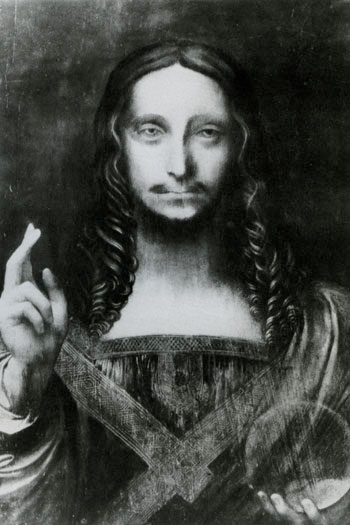
Simon brought the panel to the Metropolitan Museum of Art about two years ago to have it examined by several curators and conservators. “It was brought in for inspection in the conservation studio,” said a person close to the Metropolitan who asked not to be identified. “The painting was forgotten for years. When it turned up at auction, Simon thought it was worth taking a gamble. It had been heavily overpainted, which makes it look like a copy. It was a wreck, dark and gloomy. It had been cleaned many times in the past by people who didn’t know better. Once a restorer put artificial resin on it, which had turned gray and had to be removed painstakingly. When they took off the overpaint, what was revealed was the original paint. You saw incredibly delicate painting. All agree it was painted by Leonardo.”
I hope that every time Jay leaves the house, he sees these posters — and as he looks at them or tries to tear them down he thinks about how evil what he did was. Maybe he’ll realize that at some level all art borrows from other art, and suing another artist for fair use appropriation undermines all artists. Maybe he’ll feel guilty about being such a thief. And then maybe he’ll think about giving that money back — or donating it to charity or something. But probably not.
Something tells me this isn’t going to end well. (via @jakedobkin)
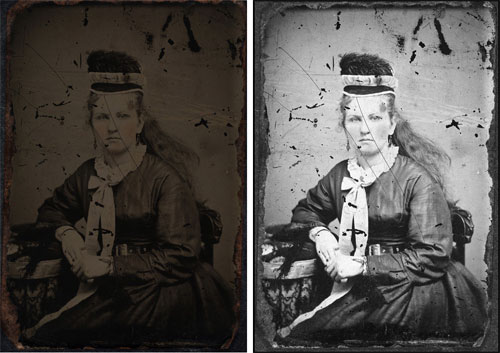
My standard operating procedure is to use an ultra-high resolution camera combined with a top-of-the-line macro lens to photograph tintypes. I use strobe lights to illuminate the artwork. Strobes produce “hard” light, much like the sun on a clear day. In addition to the strobes, I place a polarizer over the camera lens and polarizer gels over the strobe lights. This eliminates all reflections and enables the camera to pick up a greater tonal range along with more detail.
The original photo is on the left and an intermediate step on the right; you’ll need to click through to see the finished product.
Update:This is a better restoration…the one above is too airbrushed, like the photo on the cover of a fashion magazine.
As a general rule, do not use the serial/Oxford comma: so write ‘a, b and c’ not ‘a, b, and c’. But when a comma would assist in the meaning of the sentence or helps to resolve ambiguity, it can be used — especially where one of the items in the list is already joined by ‘and’.
The kottke.org style guide still advocates the use of the Oxford comma, but take that with a grain of salt; I also misuse semicolons, use too many (often unnecessary) parentheses — not to mention m-dashes that are actually rendered as two n-dashes in old-school ASCII fashion — use too many commas, and place punctuation outside quotation marks, which many people find, in the words of Bill S. Preston Esq. and Ted “Theodore” Logan, “bogus”. Oh, and in another nod to the old-school, I also use “dumb quotes” instead of the fancier and, I guess, technically more correct “smart quotes”. (via, who else?, @tcarmody (or should that be “whom else?”))
Update:The document I linked to above is from a branding style guide for Oxford University. It recommends against using the Oxford comma in most cases. The Oxford Style Manual, meant for the general public and last published in 2003 by Oxford University Press, “a department of the University of Oxford”, recommends using the Oxford comma in all cases. So basically, Oxford is telling us to use the Oxford comma but isn’t going to use it internally. Oxford gone schizo, y’all! (thx, @rchrd_h)
So how did I choose to define myself in this new world? I booted up my parents’ modem and launched head-first into online forums with an alias inspired by my cat’s name. Later, I spent hours negotiating with AOL’s log-in field, testing out various combinations of Nine Inch Nails lyrics until I found one that hadn’t already been snagged by an equally tortured soul (I was later forced to explain to a college admissions counselor why my e-mail address was [email protected]).
My first handle was “derbis”, which is how I thought “debris” was spelled until far later in my schooling than one might expect of a native English speaker. It actually started as a self-imposed nickname IRL…these guys I knew in college DJ’d parties and they all had their DJ names and not wanting to be left out, I picked one for myself. To date, I still have not DJ’d a single event, but the first thing I ever designed was a flyer for a friend’s rave party; I signed it “cybergraphics by derbis” (all lowercase, naturally). It had a lot of fractals on it.
And if you thought that wasn’t sufficiently embarrassing, my AIM name is still “damptrousers”. IIRC, Greg remarked that the phrase “damp pants” was hilarious right around the time I signed up for AIM but “damppants” was taken (?!!) so yeah. (via ★natalie)
Can’t remember who tipped me off to this (Cederholm? Hoefler? Pieratt?), but Colossal is a top-notch visual art/design blog. There are a dozen things on the first two pages that could slide right into kottke.org quite easily. He’s on Stellar too!
From 1982, a NY Times article on a study from the Institute for the Future commissioned by the NSF that made predictions about how internet-like technology would transform life in the US. They got the details wrong but many of the broad strokes were spot on:
- The home will double as a place of employment, with men and women conducting much of their work at the computer terminal. This will affect both the architecture and location of the home. It will also blur the distinction between places of residence and places of business, with uncertain effects on zoning, travel patterns and neighborhoods.
- There will be a shift away from conventional workplace and school socialization. Friends, peer groups and alliances will be determined electronically, creating classes of people based on interests and skills rather than age and social class.
Over time, however, championing same-sex marriage had become personal for Mr. Cuomo. He campaigned on the issue in the race for governor last year, and after his election, he was staggered by the number of gay couples who sought him out at restaurants and on the street, prodding him, sometimes tearfully, to deliver on his word.
The pressure did not let up at home. Mr. Cuomo’s girlfriend, Sandra Lee, has an openly gay brother, and she frequently reminded the governor how much she wanted the law to change.
Something else weighed on him, too: the long shadow of his father, Mario, who rose to national prominence as the conscience of the Democratic Party, passionately defending the poor and assailing the death penalty. During his first few months in office, the younger Mr. Cuomo had achieved what seemed like modern-day miracles by the standards of Albany - an austere on-time budget and a deal to cap property taxes. But, as Mr. Cuomo explained by phone to his father a few weeks ago, he did not want those accomplishments to define his first year in office.
“They are operational,” he told his father. Passing same-sex marriage, by contrast, “is at the heart of leadership and progressive government.”
UBS: If we were playing Russian roulette and had one bullet, I randomly spun the chamber and fired but nothing was fired. Would you rather fire the gun again or respin the chamber and then fire on your turn?
I’d rather get the fuck out of your office and run away very fast. What the hell are you people on? Haven’t you heard of email? Or official dispute procedures? Jesus.
Based on his answer to P&G’s “sell me an invisible pen”, I’d hire Turnbull in a second if I were selling invisible pens.
I’m going to link again to Errol Morris’ piece on his brother’s role in the invention of email…the final part was posted a few hours ago…the entire piece is well worth a read. As is the case with many of his movies, Morris uses the story of a key or unique individual to paint a broader picture; in this instance, as the story of his brother’s involvement with an early email system unfolds, we also learn about the beginnings of social computing.
Fernando Corbato: Back in the early ’60s, computers were getting bigger. And were expensive. So people resorted to a scheme called batch processing. It was like taking your clothes to the laundromat. You’d take your job in, and leave it in the input bins. The staff people would prerecord it onto these magnetic tapes. The magnetic tapes would be run by the computer. And then, the output would be printed. This cycle would take at best, several hours, or at worst, 24 hours. And it was maddening, because when you’re working on a complicated program, you can make a trivial slip-up - you left out a comma or something - and the program would crash. It was maddening. People are not perfect. You would try very hard to be careful, but you didn’t always make it. You’d design a program. You’d program it. And then you’d have to debug it and get it to work right. A process that could take, literally, a week, weeks, months -
People began to advocate a different tactic, which came to be called time-sharing. Take advantage of the speed of the computer and have people at typewriter-like terminals. In principle, it seemed like a good idea. It certainly seemed feasible. But no manufacturer knew how to do it. And the vendors were not terribly interested, because it was like suggesting to an automobile manufacturer that they go into the airplane business. It just was a new game. A group of us began to create experimental versions of time-sharing, to see if it was feasible. I was lucky enough to be in a position to try to do this at MIT. And we basically created the “Compatible Time Sharing System,” nicknamed CTSS from the initials, that worked on the large mainframes that IBM was producing. First it was going to be just a demo. And then, it kept escalating. Time-sharing caught the attention of a few visionary people, like Licklider, then at BBN, who picked up the mantle. He went to Washington to become part of one of the funding agencies, namely ARPA. ARPA has changed names back and forth from DARPA to ARPA. But it’s always the same thing.
And it was this shift from batch processing to time-sharing that accidentally kickstarted people using computers in a social way…programming together, sending notes to each other, etc.
Robert Fano: Yes, the computer was connected through telephone lines to terminals. We had terminals all over the MIT campus. People could also use CTSS from other locations through the teletype network. CTSS was capable of serving about 20 people at a time without their being aware of one another. But they could also communicate with each other. A whole different view of computers was generated.
Before CTSS, people wrote programs for themselves. The idea of writing programs for somebody else to use was totally alien. With CTSS, programs and data stored could be stored in the common memory segment and they were available to the whole community. And that really took off. At a certain point, I started seeing the whole thing as a system that included the knowledge of the community. It was a completely new view. It was a remarkable event. In retrospect, I wish I had gotten a very smart social psychologist on the premises to look at and interpret what was happening to the community, because it was just unbelievable.
There was a community of people using the computer. They got to know each other through it. You could send an e-mail to somebody through the system. It was a completely new phenomenon.
It seems completely nutty to me that people using computers together — which is probably 100% of what people use computers for today (email, Twitter, Facebook, IM, etc.) — was an accidental byproduct of a system designed to let a lot of people use the same computer separately. Just goes to show, technology and invention works in unexpected ways sometimes…and just as “nature finds a way” in Jurassic Park, “social finds a way” with technology.
The SnorriCam is the chest-mounted camera that directors like Darren Aronofsky have used to great effect. You can see a bit of Aronofsky’s use of the SnorriCam in theseclips from Requiem for a Dream. (Note: that second clip is a bit graphic.)
Rave On Buddy Holly is an album-length compilation of Buddy Holly cover songs sung by the likes of Cee Lo Green, Fiona Apple, Lou Reed, and Paul McCartney. You can listen now on Soundcloud, via the embed below, or pre-order the album on Amazon.
After seven months of legal wrangling, we reached a settlement. Last September, I paid Maisel a sum of $32,500 and I’m unable to use the artwork again. (On the plus side, if you have a copy, it’s now a collector’s item!) I’m not exactly thrilled with this outcome, but I’m relieved it’s over.
But this is important: the fact that I settled is not an admission of guilt. My lawyers and I firmly believe that the pixel art is “fair use” and Maisel and his counsel firmly disagree. I settled for one reason: this was the least expensive option available.
At the heart of this settlement is a debate that’s been going on for decades, playing out between artists and copyright holders in and out of the courts. In particular, I think this settlement raises some interesting issues about the state of copyright for anyone involved in digital reinterpretations of copyrighted works.
Unfortunately, Baio’s post does nothing to dissuade me that Maisel is a joyless putz. Seeing this kind of behavior from large clueless companies is almost expected but from a a fellow creative artist? Inexcusable. Surely some reasonable arrangement could have been made without visiting enormous stress and a $30K+ bill onto a man with a young family. Disgusting.
Everyone has shaken hands with everyone else, so Mad Men season five can finally happen. But here’s the part you’re not going to like…the new episodes won’t air until March 2012.
The tsunami of cheap credit that rolled across the planet between 2002 and 2008 was more than a simple financial phenomenon: it was temptation, offering entire societies the chance to reveal aspects of their characters they could not normally afford to indulge.
Icelanders wanted to stop fishing and become investment bankers. The Greeks wanted to turn their country into a pi~nata stuffed with cash and allow as many citizens as possible to take a whack at it. The Germans wanted to be even more German; the Irish wanted to stop being Irish.
Michael Lewis’s investigation of bubbles beyond our shores is so brilliantly, sadly hilarious that it leads the American reader to a comfortable complacency: oh, those foolish foreigners. But when he turns a merciless eye on California and Washington, DC, we see that the narrative is a trap baited with humor, and we understand the reckoning that awaits the greatest and greediest of debtor nations.
No Kindle version available yet, just like last time. If you’d like to see one, click on the “I’d like to read this book on Kindle” below the cover image. (thx, brian)
Update: Just got word from Lewis’ publisher that the ebook version (including Kindle) will be available the same day as the hardcover.
For this coming weekend’s NY Times Magazine, journalist Jose Antonio Vargas shares the story of his Life as an Undocumented Immigrant.
One day when I was 16, I rode my bike to the nearby D.M.V. office to get my driver’s permit. Some of my friends already had their licenses, so I figured it was time. But when I handed the clerk my green card as proof of U.S. residency, she flipped it around, examining it. “This is fake,” she whispered. “Don’t come back here again.”
At a Boston ice cream shop, the cost of ice cream cone has risen 10% in the last four months. The Boston Globe investigated down the supply chain and detailed where the price increases are coming from.
Ice cream may be a deliciously simple combination of milk, butter, and sugar, but the true cost of an ice cream cone is no simple business calculation. Toscanini’s price tag is part of complex and increasingly interconnected world economy, one that links a dairy farm in the tiny Western Massachusetts town of Colrain to the sprawling neighborhoods of Beijing.
Also of note: pistachio ice cream might be difficult to find this summer because the cost of pistachios has increased sharply in recent months. (via girlhacker)
The US military is often thought of by many Americans as being identified with conservative politics, making it an unlikely blueprint for progressive reform. But a recent pair of articles demonstrates that the US as a whole might have something to learn about the US Armed Forces’ liberal leanings. In the NY Times, Nicholas Kristof argues that the US military’s universal healthcare and focus on education is worth looking at as a model:
The military is innately hierarchical, yet it nurtures a camaraderie in part because the military looks after its employees. This is a rare enclave of single-payer universal health care, and it continues with a veterans’ health care system that has much lower costs than the American system as a whole.
Perhaps the most impressive achievement of the American military isn’t its aircraft carriers, stunning as they are. Rather, it’s the military day care system for working parents.
While one of America’s greatest failings is underinvestment in early childhood education (which seems to be one of the best ways to break cycles of poverty from replicating), the military manages to provide superb child care. The cost depends on family income and starts at $44 per week.
Article 1, Section 8 of the Constitution is pretty simple, It says, ‘Raise an army.’ It says absolutely nothing about race, color, creed, sexual orientation. You all joined for a reason: to serve. To protect our nation, right? How dare we, then, exclude a group of people who want to do the same thing you do right now, something that is honorable and noble? … Get over it. We’re magnificent, we’re going to continue to be. … Let’s just move on, treat everybody with firmness, fairness, dignity, compassion and respect. Let’s be Marines.
Now that’s some semper fi I can get behind. (thx, meg)
Before embarking on writing his new book, Steve Silberman asked a bunch of authors (like Cory Doctorow, Jonah Lehrer, and Carl Zimmer) for their best advice about writing books.
A few things became clear as soon as their replies came in. First of all, I’ll have to throttle back my use of Twitter and Facebook to get this writing done (and I may never rev up my idle Quora account after all.) Secondly, scheduling intervals of regular exercise and renewal amid the hours of writing will be essential.
From the Oct 11, 1982 issue of New York magazine, a profile of Eddie Murphy. Murphy was then two years into his four-year stay on SNL and only a couple months away from his feature film debut in 48 Hrs.
Murphy heads downstairs to do his first stand-up routine in months. The audience is mostly black. He goes onstage after a CBS vice-president, who has spoken at great length about the perilous state of the record industry. Murphy aggresively thanks CBS for signing him to do an album just when “things are all f—-ed up.” Cheap humor, but the crowd loves it. Murphy zips through his routines (“Guy who shot the pope wants to go straight to hell”) and then puts sunglasses and staggers around the stage, doing a cruelly accurate — and funny — impression of Stevie Wonder, complete with a rendition of the blind singer’s wandering smile.
Murphy finally sits back down at his table and is astonished when Stevie Wonder is led over to meet him. They have never met before. Murphy rises. Wonder shakes his hand and then throws a right fist at Murphy and says, “Mutha, you do me one more time and I’ll whip you!” But he’s laughing and so is Murphy.
I accompanied Kish on several occasions as he cruised the busy streets of Long Beach. The outside world is an absolute cacophony. Every car, person, dog, stroller, and bicycle makes a sound. So do gusts of wind, bits of blowing garbage, and rustling leaves. Doors open and close. Change jangles. People talk. Then there are the silent obstacles — what Kish calls urban furniture: benches, traffic signs, telephone poles, postal boxes, fire hydrants, light posts, parked vehicles. Kish hears the sonic reflections from his click even in a place teeming with ambient noise. “It’s like recognizing a familiar voice in a crowd,” he says. The load upon his mind is undoubtedly immense. Yet he casually processes everything, constructing and memorizing a mental map of his route, all while maintaining an intricate conversation with me. It’s so extraordinary that it seems to border on the magical.
When we walk into a restaurant - never a simple choice with Kish, since he’s a strict vegan - he makes a much quieter click. Kish describes the images he receives as akin to a brief flick of the lights in a dark room; you get enough essential information — tables here, stairway there, support pillars here — to navigate your way through. “It becomes as ridiculous for blind people to run into a wall as it is for sighted people,” he once wrote in his FlashSonar manual. He strolls casually across the restaurant, making one or two more clicks as we approach our table, then sits down. It’s both smooth and subtle. Kish says that it is rare a sighted person even notices he’s making an unusual noise. Almost all blind people instantly do.
It’s a little more chill than their usual stuff — “Trillwave is the soundtrack to the party after the afterparty or maybe to a sun-drenched backyard barbecue the next day” — but I like it a lot so far. (via @djgeekdout)
The third episode of Kirby Ferguson’s excellent Everything is a Remix has been posted. The first episode was about music, the second dealt with movies, and the third is on technological innovation.
“I invented nothing new. I simply assembled the discoveries of other men behind whom were centuries of work. Had I worked fifty or ten or even five years before, I would have failed. So it is with every new thing. Progress happens when all the factors that make for it are ready and then it is inevitable. To teach that a comparatively few men are responsible for the greatest forward steps of mankind is the worst sort of nonsense.” — Henry Ford
FYI: the credits are actually in the middle of the video…there’s another few minutes of material after they run.
Myth #5 - Introverts don’t like to go out in public. Nonsense. Introverts just don’t like to go out in public FOR AS LONG. They also like to avoid the complications that are involved in public activities. They take in data and experiences very quickly, and as a result, don’t need to be there for long to “get it.” They’re ready to go home, recharge, and process it all. In fact, recharging is absolutely crucial for Introverts.
The years leading up to the declaration of war between the Axis and Allied powers in 1939 were tumultuous times for people across the globe. The Great Depression had started a decade before, leaving much of the world unemployed and desperate. Nationalism was sweeping through Germany, and it chafed against the punitive measures of the Versailles Treaty that had ended World War I. China and the Empire of Japan had been at war since Japanese troops invaded Manchuria in 1931. Germany, Italy, and Japan were testing the newly founded League of Nations with multiple invasions and occupations of nearby countries, and felt emboldened when they encountered no meaningful consequences. The Spanish Civil War broke out in 1936, becoming a rehearsal of sorts for the upcoming World War — Germany and Italy supported the nationalist rebels led by General Francisco Franco, and some 40,000 foreign nationals traveled to Spain to fight in what they saw as the larger war against fascism.
This is the first part of a five-part blog post by Errol Morris investigating whether his brother Noel Morris
co-wrote the first working email system at MIT in the mid-1960s. From an MIT colleague of Noel’s, Tom Van Vleck:
In 1965, at the beginning of the year, there was a bunch of stuff going on with the time-sharing system that Noel and I were users of. We were working for the political science department. And the system programmers wrote a programming staff note memo that proposed the creation of a mail command. But people proposed things in programming staff notes that never got implemented. And well, we thought the idea of electronic mail was a great idea. We said, “Where’s electronic mail? That would be so cool.” And they said, “Oh, there’s no time to write that. It’s not important.” And we said, “Well, can we write it?” And we did. And then it became part of the system.
Van Vleck maintains a web page about what he, Noel Morris, and their team were working on at the time. To go along with Morris’ article, the NY Times has an MIT Compatible Time Sharing System emulator that you can use to send email much as you could back in the 60s.
We cannot end this discussion without addressing this guy. He has seen just enough basketball to notice that players occasionally set picks, but not enough to understand what they are actually for. He rightly recognizes that he best serves society as a fencepost, but his picks, which he sets on nearly every play, are usually counterproductive.
Unbelievably, he often sets picks on his own teammates, and on one occasion, I have actually heard him express disapproval when his pick was ignored. “I picked you, dude!”
The Inn at the Crossroads is a blog dedicated to exploring the cuisine of George R.R. Martin’s Fire and Ice book series, from which HBO’s Game of Thrones is adapted.
The Queen took a flagon of sweet plum wine from a passing servant girl and filled Sansa’s cup. “Drink,” she commanded coldly. “Perhaps it will give you courage to deal with truth for a change.”
We get a much clearer picture of the real standing of countries if we consider economic growth and GDP per capita. Western Europe GDP per capita was higher than that of both China and India by 1500; by 1600 it was 50% higher than China’s. From there, the gap kept growing. Between 1350 and 1950 — six hundred years — GDP per capita remained roughly constant in India and China (hovering around $600 for China and $550 for India). In the same period, Western European GDP per capita went from $662 to $4,594, a 594 percent increase.
But in the future, corporations will find it more difficult to achieve such easy growth:
Attention behaves the same way. Take an average housewife, the target of much time mining early in the 20th century. It was clear where her attention was directed. Laundry, cooking, walking to the well for water, cleaning, were all obvious attention sinks. Washing machines, kitchen appliances, plumbing and vacuum cleaners helped free up a lot of that attention, which was then immediately directed (as corporate-captive attention) to magazines and television.
But as you find and capture most of the wild attention, new pockets of attention become harder to find. Worse, you now have to cannibalize your own previous uses of captive attention. Time for TV must be stolen from magazines and newspapers. Time for specialized entertainment must be stolen from time devoted to generalized entertainment.
[…]
Each new pocket of attention is harder to find: maybe your product needs to steal attention from that one TV obscure show watched by just 3% of the population between 11:30 and 12:30 AM. The next displacement will fragment the attention even more. When found, each new pocket is less valuable. There is a lot more money to be made in replacing hand-washing time with washing-machine plus magazine time, than there is to be found in replacing one hour of TV with a different hour of TV.
While only 6 per cent of the non-African modern human genome comes from other hominins, the share of HLAs acquired during interbreeding is much higher. Half of European HLA-A alleles come from other hominins, says Parham, and that figure rises to 72 per cent for people in China, and over 90 per cent for those in Papua New Guinea.
This suggests they were increasingly selected for as H. sapiens moved east. That could be because humans migrating north would have faced fewer diseases than those heading towards the tropics of south-east Asia, says Chris Stringer of the Natural History Museum in London.
The author of the A Girl and Her Bike blog tells the story of how she and her bike were “nudged” from behind by a car (twice, on purpose) and what happened when the driver discovered that she was a police officer.
The light turned green and I started to proceed. And then I felt *BUMP!!!!!* again, this time a bit harder.
Oh no. No. No. No. I can’t ignore this. I just can’t.
So I stopped. Pulled out my police badge (yes, I’m a cop if you didn’t know before. No I really don’t want to talk about it, thanks) showed it to the driver and motioned him to stay right where he was.
For completenessesses’s sake, here’s Werner Herzog reading Go the Fuck to Sleep. The video was shot at the book’s launch at the New York Public Library last night.
See also Samuel L. Jackson’s reading. All we need now are readings by Walken, Pacino, Oprah, Ian McShane, Joan Cusack, Alec Baldwin, David Ogden Stiers, David Attenborough, and Yeardley Smith as Lisa Simpson. Internet, make it happen!







Socials & More