



The Frick Collection’s secrets
I love this “bowling saloon” in the basement of The Frick Collection museum in NYC.

Gothamist has a bunch more photos of the Frick’s secret places.

This site is made possible by member support. 💞
Big thanks to Arcustech for hosting the site and offering amazing tech support.
When you buy through links on kottke.org, I may earn an affiliate commission. Thanks for supporting the site!
kottke.org. home of fine hypertext products since 1998.
Beloved by 86.47% of the web.
I love this “bowling saloon” in the basement of The Frick Collection museum in NYC.
Gothamist has a bunch more photos of the Frick’s secret places.
Ever since designing the site back in 2001, I’ve been the webmaster for Susan Orlean’s web site. Susan is my favorite client, but I don’t have the time to devote to the site anymore so Susan and I are looking for someone to take over. Here are some rough requirements for the position:
- The site and its administration are pretty simple; you should be comfortable with editing HTML, CSS, the Unix command line, Movable Type, SFTP, and such.
- You should possess a little bit of design sense. Your immediate task will be to flesh out the page for Susan’s upcoming book about Rin Tin Tin, so you’ll need to figure out how to fit the required content into a clean well-presented readable layout. There’s not a lot of heavy Photoshop or Illustrator work required…this is not a redesign-the-site project.
- On-going maintenance is fairly minimal…occasional text updates, new article additions, dealing with very infrequent site outages, etc. You know, good old fashioned webmastering. Your monthly time commitment for maintenance will be in the ballpark of 0-30 minutes.
If this sounds like something you might be interested in, please contact Susan with a short note about who you are, the work you do, links (not attachments!) to a portfolio or resume, that sort of thing. Make sure the subject line clearly references this project somehow. Thanks!
Paul May keeps track of the dozens of molecules that have unusual names. Like moronic acid, betweenanene, and draculin:
Draculin is the anticoagulant factor in vampire bat saliva. It is a large glycoprotein made from a sequence of 411 amino acids.
(via prosthetic knowledge)
Seed Magazine asked a number of thinkers to provide statements about their respective fields containing “the most information in the fewest words” a la Richard Feynman:
If, in some cataclysm, all of scientific knowledge were to be destroyed, and only one sentence passed on to the next generations of creatures, what statement would contain the most information in the fewest words? I believe it is the atomic hypothesis (or the atomic fact, or whatever you wish to call it) that all things are made of atoms-little particles that move around in perpetual motion, attracting each other when they are a little distance apart, but repelling upon being squeezed into one another. In that one sentence, you will see, there is an enormous amount of information about the world, if just a little imagination and thinking are applied.
…is called Grantland and will feature writing from Chuck Klosterman, Dave Eggers, Malcolm Gladwell, Katie Baker, Molly Lambert, and others.
Hedge funds managed by women outperformed those managed by men over the past nine years.
From the NYC transit authority, a 1988 video about the consequences of painting graffiti in the subway.
Intense! (via ★vuokko)
Over at Forbes, Susannah Breslin is documenting the process that she goes through as she works on a story.
I’m neither Woodward nor Bernstein. This doesn’t mean I am a lousy journalist. This means that I am a certain kind of journalist. Basically, who I am as a journalist is who I am as a person. I am an observer. I am not a run-after-you-with-a-mic-in-your-face type of journalist. I am a get-out-of-the-way-and-the-story-will-present-itself-to-you type of journalist.
Watch as a spider quickly subdues an ant in its web…and then something unexpected happens.
This is the Sixth Sense of spider nature videos.
From Wikipedia, a list of unusual software bugs, including the Mandelbug and Heisenbug. My favorite is the Schrödinbug:
A schrödinbug is a bug that manifests only after someone reading source code or using the program in an unusual way notices that it never should have worked in the first place, at which point the program promptly stops working for everybody until fixed.
(via @greglopp)
Melissa Febos writes about crying in public in NYC…as well as other private things that people do in public here.
One afternoon, I was riding a Brooklyn-bound Q train with my mother, who was visiting from Cape Cod, when our conversation lulled. We each glanced around the subway car at the other passengers, their heads bobbing in unison, the eyes of the man across from us doing a creepy back-and-forth twitch as he watched a train whizzing by in the opposite direction behind us. Some people read, or pushed buttons on their smart phones, but most just stared without expression at the floor or the garish overhead posters for Dr. Zizmor’s cosmetic dermatology. My mother (who is, notably, a psychotherapist) leaned into my shoulder and whispered, “Everyone on this train looks depressed.”
I snorted, whispering back: “No, Mom, they just have their train-faces on.” In a place where we are so rarely alone, we find privacy in public.
The “privacy in public” thing is essential in understanding New York.
AVOS, a new internet company founded by YouTube founders Chad Hurley and Steve Chen, has acquired the social bookmarking service Delicious from Yahoo!
Why has Yahoo! chosen to transition Delicious to AVOS?
While we love Delicious (and our users love Delicious), we wanted to find a home for the product where it can receive more love and attention. We think AVOS is that place.When will AVOS officially start running Delicious?
We anticipate Delicious in its current form will be available until approximately July 2011. By agreeing to AVOS’s terms of service upfront, you will allow us to move your data when the time comes to transfer control to AVOS.
Delicious founder Josh Schachter reacted to the news on Twitter, saying:
inbox asplode!
From the NY Times Lens blog, a photo essay by Diana Markosian featuring a Ukrainian town near Chernobyl where only five families remain; the rest of the 1000 original residents evacuated after the disaster 25 years ago.
But life can be grim and lonely. Twenty-five years ago, Ms. Masanovitz was a nurse. Her husband was a farmer on a collective farm. Now he spends his time drinking.
While she was photographing the couple one day, Ms. Markosian watched as Ms. Masanovitz picked up the phone in astonishment. It was the first time it had worked in a year.
More photos are available on Markosian’s web site. (via @hchamp)
The Tempest Academy is a training facilty in LA for people interested in freerunning and parkour.
The world’s only indoor Parkour Playground, made up of more than seven thousand square feet of X Games genius! Why X-Games you ask? Well as you know, Tempest is all about going big. So, we hired our good friend Nate Wessel (world famous X Games ramp builder) to design and build our dream playground. With his creative genius, and our eye for style, we’ve created an indoor city that is unrivaled in the freerunning world. Next to Disneyland it’s the most MAGICAL place on earth!
(via ★mathowie)
Why can’t you get a slice of pizza at John’s on Bleecker or Patsy’s? Allegedly because of Al Capone:
In his 1981 book on the mob called Vicious Circles: The Mafia in the Marketplace, the late Jonathan Kwitny detailed how Al Capone — who owned a string of dairy farms near Fond Du Lac, Wisconsin — forced New York pizzerias to use his rubbery mob cheese, so different from the real mozzarella produced here in New York City since the first immigrants from Naples arrived in Brooklyn around 1900.
As the story goes, the only places permitted to use good mozzarella made locally were the old-fashioned pizza parlors like Lombardi’s, Patsy’s, and John’s, who could continue doing so only if they promised to never serve slices. According to Kwitny, this is why John’s Pizzeria on Bleecker Street still has the warning “No Slices” on its awning today.
(via ★kathryn)
Due to a lack of funding, SETI Institute shut down the radio telescope array they were using to look for evidence of extraterrestrial life outside our solar system.
The timing couldn’t be worse, say SETI scientists. After millenniums of musings, this spring astronomers announced that 1,235 new possible planets had been observed by Kepler, a telescope on a space satellite. They predict that dozens of these planets will be Earth-sized — and some will be in the “habitable zone,” where the temperatures are just right for liquid water, a prerequisite of life as we know it.
(via ★genmon)
In the near term, companies making iPhone and iPad competitors are never going to beat Apple at their own game. Apple has supply chain advantages, a massive number of their customers’ credit card numbers (why do you think Jobs brings this up at every single Apple event…it’s important!), key patents, one-in-lifetime personnel like Steve Jobs and Jony Ive, solid relationships with key media companies, and an integrated ecosystem of stores, apps, applications, and hardware. They are an imposing competitor.
But Apple also has some weak spots which a canny competitor should be able to exploit to make compelling products that Apple won’t be able to duplicate or directly compete with.
1. Apple doesn’t do social well on a large scale. Ping? Game Center? Please. Social applications don’t seem to be in Apple’s DNA…their best applications are still single-player or 2/3/4-player. Someone should figure out how to leverage Facebook’s social graph to make the phone/app/gaming/music/video experience significantly better than on the iPhone/iPad and then partner exclusively with Facebook to make it happen. The Facebook Fone would be a massive hit if done right.
2. Apple can’t do the cloud either. Mobile Me has been around since January 2000 (when it was called iTools) and the service is still not as compelling as newcomer Dropbox. iPods, iPhones, and iPads are still very much tethered to plain-old desktop/laptop computers and iTunes…there’s an opportunity here for a better way.
3. iTunes is getting long in the tooth. The cloud and social are the two Apple weaknesses, but iTunes is showing its age and over the years has become a bloated collection of functionalities…music store, video store, app store, mobile device manager, “social” network, and, oh, by the way, you can also use it to play your music. Spotify, Pandora, and Rd.io point the way to a different approach.
4. I can’t remember if this is my own theory or I read about this on Daring Fireball or something, but the Apple products & services that Apple does well are the ones that Steve Jobs uses (or cares about) and the ones he doesn’t use/care about are less good (or just plain bad). Jobs uses Keynote and it’s very good…but I’m pretty sure Jobs never has had to schedule his own appointments with iCal so that program is less good. Cloud apps and social apps are at the top of this list for a reason…I just don’t think Jobs cares about those things. I mean, he cares, but there’s not a lot of passion there…they aren’t a priority for him so he doesn’t really know how to think about them and attack those problems.
And then there are a couple of Apple weaknesses that actually aren’t weaknesses at all:
1. Price. Everyone still thinks that Apple products are expensive, or, more to the point, overpriced. But no one else has made a compelling tablet for under $500 yet. And if you attack Apple on price, potential gothchas lurk: Apple is absurdly profitable and cash-rich; if they feel the need to compete with anyone on price in order to protect their business interests, they can do so with price cuts deep enough and long enough to drive most potential competitors out of business.
2. Openness and secrecy. Competitors should take a page from Apple’s playbook here and be open about stuff that will give you a competitive advantage and shut the hell up about everything else. Open is not always better.
I love this observation about taste and creative work from Ira Glass:
Nobody tells this to people who are beginners, I wish someone told me. All of us who do creative work, we get into it because we have good taste. But there is this gap. For the first couple years you make stuff, it’s just not that good. It’s trying to be good, it has potential, but it’s not. But your taste, the thing that got you into the game, is still killer. And your taste is why your work disappoints you. A lot of people never get past this phase, they quit.
The quote is an abridged version of the transcript from this video interview with Glass:
On the eve of the release of the Beastie Boys’ latest album, New York Magazine has an interesting history of the band as told through interviews of the band and others who were there.
They accidentally knew what they were doing.
Following a leak of the new album, Hot Sauce Committee Part Two, the band is now streaming the full album on their web site. (via stellar)
Eric Schlosser’s Fast Food Nation came out ten years ago but this chapter on how much the taste and smell of food is chemically manipulated is still well worth a read.
Today’s sophisticated spectrometers, gas chromatographs, and headspace-vapor analyzers provide a detailed map of a food’s flavor components, detecting chemical aromas present in amounts as low as one part per billion. The human nose, however, is even more sensitive. A nose can detect aromas present in quantities of a few parts per trillion — an amount equivalent to about 0.000000000003 percent. Complex aromas, such as those of coffee and roasted meat, are composed of volatile gases from nearly a thousand different chemicals. The smell of a strawberry arises from the interaction of about 350 chemicals that are present in minute amounts. The quality that people seek most of all in a food — flavor — is usually present in a quantity too infinitesimal to be measured in traditional culinary terms such as ounces or teaspoons. The chemical that provides the dominant flavor of bell pepper can be tasted in amounts as low as 0.02 parts per billion; one drop is sufficient to add flavor to five average-size swimming pools. The flavor additive usually comes next to last in a processed food’s list of ingredients and often costs less than its packaging. Soft drinks contain a larger proportion of flavor additives than most products. The flavor in a twelve-ounce can of Coke costs about half a cent.
In the late 70s, Anton Perich built something resembling an inkjet printer to make large-scale paintings like this:

The photography section of Perich’s web site is also worth a look…lots of photos of the Warholish NYC scene in the 70s and 80s: Warhol, Jagger, Mapplethorpe, John Waters, etc. (via today and tomorrow)
In 1888, the 460-foot-long 5000-ton Brighton Beach Hotel was moved more than 500 feet back from the Atlantic Ocean. They put the entire structure on top of 112 flat trucks and pulled it all in one piece with six train locomotives.

To witness the moving of this immense structure, crowds of people came from the neighbouring cities, and great enthusiasm reigned. Nothing like it had ever been known before in the United States, and when the engines were ready to start, the excitement was at its highest point. Mr. Miller gave the signal to start, and, in the glowing words of a Metropolitan reporter, “simultaneously six throttles were thrown open — first gradually, then to their full. The music of the guy-ropes and tackle was weird and Wagnerian; then the tug of war began. Panting and puffing, the iron horses strained every fibre of their mechanical muscle.”
(via architizer)
From the January 3, 1983 issue of Time magazine, an early mainstream profile of Steve Jobs.
He is 27 years old. He lives in Los Gates, Calif., and works 20 minutes away in Cupertino, a town of 34,000 that his company has so transformed that some San Franciscans, about 35 miles to the north, have taken to calling it Computertino. There is no doubt in any case that this is a company town, although the company, Apple, did not exist seven years ago. Now, Apple just closed its best year in business, racking up sales of $583 million. The company stock has a market value of $1.7 billion. Jobs, as founder of Apple, chairman of the board, media figurehead and all-purpose dynamo, owns about 7 million shares of that stock. His personal worth is on the balmy side of $210 million. But past the money, and the hype, and the fairy-tale success, Jobs has been the prime advanceman for the computer revolution. With his smooth sales pitch and a blind faith that would have been the envy of the early Christian martyrs, it is Steven Jobs, more than anyone, who kicked open the door and let the personal computer move in.
The article contains some really interesting stuff: perhaps the first mention of Jobs’ “reality-distortion field”, a prescient comment that Jobs “should be running Walt Disney”, and a description of Steve Wozniak as “a Steiff Teddy bear on a maintenance dose of marshmallows”.
Two in a row from Product by Process, but I can’t resist this video of a group of Canadian Army engineers taking a Jeep apart and putting it back together again in less than four minutes total.
See also the Royal Navy Field Gun Competition. (via product by process)
Footage from a Ford factory of assembly line workers making Model T cars.
(via product by process)
Not just a Cold War-era relic…

…the use of radiation to introduce genetic changes in food (aka “atomic gardening”) is alive and well today.
What’s more, the Times adds, nearly 2,000 gamma radiation-induced mutant crop varieties have been registered around the world, including Calrose 76, a dwarf varietal that accounts for about half the rice grown in California, and the popular Star Ruby and Rio Red grapefruits, whose deep colour is a mutation produced through radiation breeding in the 1970s. Similarly, Johnson tells Pruned that “most of the global production of mint oil,” with an annual market value estimated at $930 million, is extracted from the “wilt-resistant ‘Todd’s Mitcham’ cultivar, a product of thermal neutron irradiation.” She adds that “the exact nature of the genetic changes that cause it to be wilt-resistant remain unknown.”
The atomic gardening photos from Life magazine in 1961 are kind of great.
Project Cafe, or the Wii 2 as everyone else is calling it, is Nintendo’s next gaming box. IGN has some details:
According to sources with knowledge of the project, Nintendo’s next console could have a retail price of anywhere between $350 and $400 based on manufacturing costs, and will ship from Taiwanese manufacturer, Foxconn, this October, putting the earliest possible retail release anywhere between mid-October and early November.
The article about Dan McLaughlin’s quest to go from zero-to-PGA Tour through 10,000 hours of deliberate practice got linked around a bunch yesterday. Several people who pointed to it made a typical mistake. Malcolm Gladwell wrote about the 10,000 hours theory in his book, he did not come up with it. It is not “Gladwell’s theory” and McLaughlin is not “testing Gladwell”. The 10,000 hours theory was developed and popularized by Dr. Anders Ericsson (here for instance) — who you may have heard of from this Freakonomics piece in the NY Times Magazine — before it became a pop culture tidbit by Gladwell’s inclusion of Ericsson’s work in Outliers.
Michael Pollan: “Eat food. Not too much. Mostly plants.”
Alex Balk: “Drink alcohol. Quite a bit. Mostly bourbon.”
A three-minute film on how an hourglass is made.
Each hand made hourglass comprises highly durable borosilicate glass and millions of stainless steel nanoballs, and is available in a 10 or 60 minute timer.
(via ★robinsloan)
The Between the Pages blog tracked down the original set of five pitch documents for Doctor Who. It wasn’t until the fourth document, the Tom Baker of the group, that Doctor Who was explicitly mentioned by name.
The Secret of Dr. Who: In his own day, somewhere in our future, he decided to search for a time or for a society or for a physical condition which is ideal, and having found it, to stay there. He stole the machine and set forth on his quest. He is thus an extension of the scientist who has opted out, but he has opted farther than ours can do, at tne moment. And having opted out, he is disintegrating.
[Handwritten note from Sydney Newman: “Don’t like this at all. Dr Who will become a kind of father figure — I don’t want him to be a reactionary.”]
One symptom of this is his hatred of scientist, inventors, improvers. He can get into a rare paddy when faced witn a cave man trying to invent a wheel. He malignantly tries to stop progress (the future) wherever he finds it, while searching for his ideal (the past). This seems to me to involve slap up-to-date moral problems, and old ones too.
In story terms, our characters see the symptoms and guess at the nature of his trouble, without knowing details; and always try to help him find a home in time and space. wherever he goes he tends to make ad hoc enemies; but also there is a mysterious enemy pursuing him implacably every when: someone from his own original time, probably. So, even if the secret is out by the 52nd episode, it is not the whole truth. Shall we say:
The Second Secret of Dr. Who: The authorities of his own (or some other future) time are not concerned merely with the theft of an obsolete machine; they are seriously concerned to prevent his monkeying with time, because his secret intention, when he finds his ideal past, is to destroy or nullify the future.
[Handwritten note from Sydney Newman: “Nuts”]
The WVIL (Wireless Viewfinder Interchangeable Lens) is a concept camera that uncouples the lens from the viewfinder. Here’s a 60-second demo:
I imagine it wouldn’t be too difficult to make something similar to control a dSLR with an iPhone app via Bluetooth. (via ★pb)
Logo Tourist is a project by Risto-Jussi Isopahkala that depicts cityscapes and famous Parisian landmarks made up of famous logos. Here’s the Arc de Triumph (sponsored by Pepsi and Adidas):
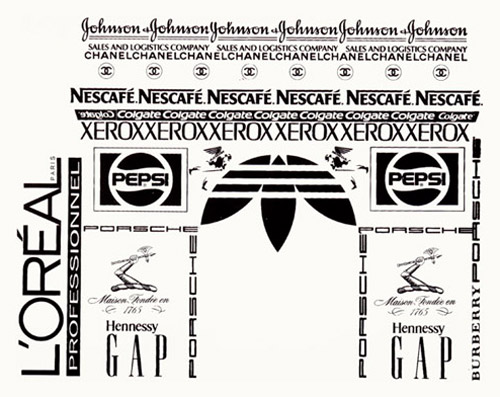
See also Logorama.
There’s just not enough time in a lifetime to see every movie, read every book, travel to every country, hear every song, watch every show, or view every sculpture. And that’s ok:
It’s sad, but it’s also … great, really. Imagine if you’d seen everything good, or if you knew about everything good. Imagine if you really got to all the recordings and books and movies you’re “supposed to see.” Imagine you got through everybody’s list, until everything you hadn’t read didn’t really need reading. That would imply that all the cultural value the world has managed to produce since a glob of primordial ooze first picked up a violin is so tiny and insignificant that a single human being can gobble all of it in one lifetime. That would make us failures, I think.
Dan McLaughlin read about the 10,000 hour theory in Malcolm Gladwell’s Outliers — basically that it takes someone 10,000 hours of deliberate practice to become really good at something — and decided to try it for himself. He plans to practice playing golf for six hours a day, six days a week, for six years in order to have a shot at making the PGA Tour. He’s already a year in.
Here’s how they have Dan trying to learn golf: He couldn’t putt from 3 feet until he was good enough at putting from 1 foot. He couldn’t putt from 5 feet until he was good enough putting from 3 feet. He’s working away from the hole. He didn’t get off the green for five months. A putter was the only club in his bag.
Everybody asks him what he shoots for a round. He has no idea. His next drive will be his first.
In his month in Florida, he worked as far as 50 yards away from the hole. He might — might — have a full set of clubs a year from now.
You can follow Dan’s progress at his Dan Plan site. (via @choire)
The first ascent of the north face of Eiger, a mountain in the Swiss Alps (13,025 feet tall), happened in 1938 and took three days. Watch as Ueli Steck climbs it in 2 hours, 47 minutes, and 33 seconds.
The whole thing is pretty much insane, but you’ll really want to start paying attention around the 2:15 mark. He’s running up that mountain! (via devour)
Elisabeth Sladen, the actress who played Sarah Jane Smith on Doctor Who, has died at the age of 63.
If there was a Star Wars version of Coachella, some of the bands playing at the festival would be called Kessel Run DMC, Guided by Millions of Voices That Suddenly Cried Out in Terror and Were Suddenly Silenced, and C-3PO Speedwagon.
In December 1952, a thick smog settled over London for several days. This was a particularly bad episode of the London Fog, which was hardly a natural occurrence…the “fog” was mostly due to the burning of soft coal. It is now thought that the Great Smog resulted in around 12,000 deaths.
Here’s a collection of photos of the smog, including this daytime shot.

That dim greyish-orange ball in the sky is the Sun.
Otomata is a generative sequencer…it play music in a loop determined by the motions of cells like those in Conway’s Game of Life. Fun stuff.
This set of rules produces chaotic results in some settings, therefore you can end up with never repeating, gradually evolving sequences. Go add some cells, change their orientation by clicking on them, and press play, experiment, have fun.
(via stellar)
The stores, they are a’changin’ orig. from Apr 18, 2011
* Q: Wha? A: These previously published entries have been updated with new information in the last 24 hours. You can find past updates here.
On April 29th, Google is shutting down playback at Google Video. Instead of transitioning everything over to YouTube (which would seemingly make a lot of sense), they’re just shutting it down with two weeks notice. If you’re comfortable with the command line (can’t they make this easier?), you can help archive.org save some of the best of Google Video. (via waxy)
Related to the regex generator I posted last week, here’s a regular expression tester…you plug in your regex and it’ll match test strings as you type. (thx, chris)
Great series of photos of a Harlem store front, taken every 2-5 years from 1977 to 2004. (via ★vuokko)
Update: These photos were taken by Camilo Jose Vergara; there are many more like them at his web site. (thx, andrew)
Pitch-perfect take-off of BBC’s Human Planet nature series. The subject is The Douche, an urban-dwelling bottom feeder.
Among the progressive forward-thinking citizens, there stands a great cancer, a type of human that is not evolved like the rest of the race: The Douche. For the poor Douche, hunting is still its main priority. This type of human does not hunt for food; they are consistently trying to find their own self esteem.
Human Planet is a pretty great show, but I would love to see an entire series like this: Soccer Moms, The Hipster, Nerds, Trophy Wives, Eurotrash, The Academic, etc. (via devour)
Starting April 29, the IFC Center in NYC will start showing Werner Herzog’s Cave of Forgotten Dreams in 3-D. A refresher on the film:
The visionary director of Grizzly Man leads us on an unforgettable journey 32,000 years back in time to explore the earliest known images made by human hands. Discovered in 1994, France’s Chauvet caves contain the rarest of the world’s historic treasures, restricted to only a handful of researchers. Granted once-in-a-lifetime access and filming in 3D, Herzog captures the beauty of a truly awe-inspiring place, while musing in his inimitable fashion about its original inhabitants, the birth of art and the curious people surrounding the caves today.
Herzog first heard of the Chauvet caves from this Judith Thurman piece in the New Yorker.
Spike Jonze caught a collaboration between dancer Lil Buck and cellist Yo-Yo Ma on video the other day:
The style of dancing is called jookin and is very similar to what these fellows and David Elsewhere. (via @veen)
Kubrick’s lost first film orig. from Apr 15, 2011
* Q: Wha? A: These previously published entries have been updated with new information in the last 24 hours. You can find past updates here.
In the next two and a half weeks, Spain’s two best soccer teams — FC Barcelona and Real Madrid — play each other four times. There was today’s regular season La Liga game, April 20’s Copa del Rey final, and then two semifinal games in the Champions League, the European championship. As Mike Madden said on Twitter:
Barça-Madrid 4 times in 18 days. Would be like if Michigan and Ohio State played every week for a month, and everyone in U.S. was an alum.
Socials & More