What I am worried about and don’t want to fall into, is dependence on too many screens to play a set. It’s bad enough having one computer screen. After all, it’s all about the performance and the people. I want to be looking at the crowd and them looking at me, interacting with one another. If we start getting dependant on screens it is going to ruin the art of performance.
6. I have means by secret and tortuous mines and ways, made without noise, to reach a designated spot, even if it were needed to pass under a trench or a river.
So, Leonardo was pretty much Q from the Bond films or Lucius Fox from Batman. But the artist was in there as well…at the bottom of his list, stuck in almost as an afterthought:
11. I can carry out sculpture in marble, bronze, or clay, and also I can do in painting whatever may be done, as well as any other, be he who he may.
Update: If Leonardo was a programmer, his letter might have read something like this:
4. Again, I have kinds of functions; most convenient and easy to ftp; and with these I can spawn lots of data almost resembling a torrent; and with the download of these cause great terror to the competitor, to his great detriment and confusion.
Someone sent this to me ages ago and I forgot to post it but luckily I ran across it again this morning: A Failed Entertainment is a show at The LeRoy Neiman Gallery featuring the films of James Incandenza…you know, the ones from the 8-page footnote in Infinite Jest.
Included as a footnote in Wallace’s novel is the Complete filmography of James O. Incandenza, a detailed list of over 70 industrial, documentary, conceptual, advertorial, technical, parodic, dramatic non-commercial, and non-dramatic commercial works. The LeRoy Neiman Gallery has commissioned artists and filmmakers to re-create seminal works from Incandenza’s filmography.
No word on whether any of the filmmakers made JOI’s Infinite Jest…I guess we’ll find out if anyone emerges from the opening reception tonight.
The Indianapolis Museum of Art and the New Orleans Museum of Art have a Super Bowl bet…the loser loans a significant piece of art to the winner for three months. The directors of the two museums trash talked back and forth via email and Twitter before agreeing on the paintings to be loaned.
“Max Anderson must not really believe the Colts can beat the Saints in the Super Bowl. Otherwise why would he bet such an insignificant work as the Ingrid Calame painting? Let’s up the ante. The New Orleans Museum of Art will bet the three-month loan of its Renoir painting, Seamstress at Window, circa 1908, which is currently in the big Renoir exhibition in Paris. What will Max wager of equal importance? Go Saints!”
Remember those CNN videos of Haiti that I linked to last week? The ones where you could pan around in the scene as the video played? It’s probable that CNN used the Yellowbird camera to do them.
The camera uses six cleverly divided lenses in order to capture every possible viewing direction. The data stream generated by the camera is impressive. Through a double glass-fiber connection, a stream of 1200 Mbit per second is captured and saved in an uncompressed format.
At a laundromat in Brooklyn, a revolving cast of characters conduct business, people-watch, sell, argue, flirt, and gossip. Oh, and do their laundry.
Every other Saturday, Carlene James climbs into bed at 10 and sets her alarm for 2:30 a.m. She rises without rousing her husband and four kids. By 3, she is at the Clean Rite. She chooses this moment to do her linens. She requires three super-giant washers, and there are exactly three. At this ungodly hour, competition is zero.
She is 36, a school office manager. Her apartment building has its own laundry room, but it’s too slow there. “I’m very fussy with my clothes,” she said. “I put soap in during both cycles. I’m always here when they’re done so no one touches my clothes. I once got in an argument with a guy who said I was taking too many dryers. That’s why it’s good to come at 3 a.m.”
Efforts are underway to find and recover a circa-1924 camera from near the summit of Mount Everest. The camera may contain photographic evidence that George Mallory and Andrew Irvine reached the highest point on Earth almost 30 years before Tenzing Norgay and Sir Edmund Hillary in 1953.
All 101 episodes of Lost are available on Hulu right now (US only). The season premiere is in 5 days…plenty of time to catch up on all ~73 hours of plane-crashing, hippie-communing, smoke-monstering, eye makeup-wearing, nicknaming, time-jumping weirdness.
elBulli, the Spanish restaurant routinely named the number one restaurant in the world, will close for two years beginning in 2012.
Adrià and his team will still be working at elBulli, developing ideas and trying to figure out what comes next. But he says the restaurant’s current format is finished. “When we come back in 2014, it’s not going to be the same,” Adrià says.
Heard your NPR interview and you were boring. You couldn’t have dragged me to see THE THIN BLUE LINE if my life depended on it. It’s time you start being a performer and understand the media.
If you don’t like the prices in Apple’s iBook Store, just use Amazon’s Kindle app on the iPad.
No 3G? No contracts? (Might be saving this for last/later.)
I’m looking on the photos of this thing and there doesn’t seem to be a camera, video or otherwise.
The iPad appears to be a device that you use sitting down. Can you type on it while holding it standing up?
Ok, there’s 3G. $15/mo for 250 MB of data. $30/mo for “unlimited”.
iPad is unlocked. International SIM cards “will just work”.
Price: $500. Boom. That’s for the low-end model with no 3G.
Ooh, keyboard dock. If they could outfit that with a hinge and some sort of latching device, I wonder what that kind of thing would look like? (Will the keyboard work with the iPhone — er, iPad nano — as well?)
Will there be an iBook Reader/Store app for the iPhone?
Oh, from earlier: Jobs repositioned Apple as a “mobile devices company”.
Right at the end, Jobs showed a street sign marking the intersection of “Technology” and “Liberal Arts”. I guess that means that kottke.org is now in direct competition with Apple, Inc. YOU’RE GOING DOWN, STEVE!
The iPad makes the Kindle look like it’s from the 1980s.
Amazon’s stock price is up…it dipped a bit when the iPad’s price was announced but recovered shortly after. I have heard more than a few people say that the Kindle is “dead”. But one minus in the iPad column is that readability in the outdoors is not going to be so good…the iPhone in the sunshine might as well be a stone for how useful it is.
If you watch the video on Apple’s site, there are now (at least) three different keyboard interactions people need to know to use Apple products. There’s 10-fingered touch typing on analog keyboards, thumb typing on the iPhone keyboard, and (about 2:30 into the video) the really odd 4-fingered no-thumbs way of typing on the iPad.
Thinking ahead to the iPad 2, they’ll add a video camera, right? What else?
Whoa, the zooming on the Google Maps apps (@ 3:45 in the video) looks incredible. The page flipping animation in the iBooks app though? Super cheesy. It’s like in the early days of cars where they built them to look like horse-drawn carriages. Can’t we just scroll?
The orientation on the keyboard dock is wrong…it should be horizontal, not vertical.
Gruber gleefully reports that there’s no Flash on the iPad. Which is a genuine bummer because this thing is perfect for playing all the (free!) addictive Flash games that I so love.
iPad is not a good name. Too close to iPod for one thing. But mainly just blah.
If the iPhone is any indication, this thing is going to be great for kids. Ollie likes playing games and looking at videos on the iPhone but the larger screen size of the iPad allows for more collaborative play…one kid + one adult or two kids using it together. The iPhone is for solitary use; the iPad can be collaborative (or at least collective). Later: Sippey calls the iPad the family computer:
It looks like a great machine to travel from the living room to the kitchen to the kids room to the bedroom. We’ll search the web on it, read the news on it, the kids will do email on it, play Brushes and Bejeweled on it, and it’ll be the perfect complement to the Sunday afternoon TV football ritual. We’ll use it to control the music in the house, and do some quick bet-settling during dinner. I’m sure we’ll eventually enjoy some multiplayer “board” games on it, or read a book on it, or watch a TV show on it. And the kids will argue with each other over who gets it next. (Dad will.)
For more than twenty-five years, he was the keenest observer of the global theater of human affairs — and one of the great portraitists of the twentieth century. MoMA’s retrospective, the first in the United States in three decades, surveys Cartier-Bresson’s entire career, with a presentation of about three hundred photographs, mostly arranged thematically and supplemented with periodicals and books.
After MoMA, the exhibition will visit Chicago, SF, and Atlanta. Quite excited for this one.
As usual, several media outlets will bring you breathless coverage of Apple’s shiny new thing, in this case, some sort of tablet-y device/service. The event starts at 1pm ET; you can follow along on Ars Technica, Engadget, gdgt, NY Times’ Bits blog, or Gizmodo (which is often irritating).
So what do the networks do with the other 174 minutes in a typical broadcast? Not surprisingly, commercials take up about an hour. As many as 75 minutes, or about 60% of the total air time, excluding commercials, is spent on shots of players huddling, standing at the line of scrimmage or just generally milling about between snaps.
I feel like I’ve linked to this before but in case I haven’t: the BBC and The British Museum are collaborating on a radio series (and more) called A History of the World.
At the heart of the project is the BBC Radio 4 series A History of the World in 100 objects. 100 programmes, written and narrated by Neil MacGregor, Director of the British Museum, and focusing on 100 objects from the British Museum’s collection. The programmes will travel through two million years from the earliest object in the collection to retell the history of humanity through the objects we have made. Each week will be tied to a particular theme, such as ‘after the ice age’ or ‘the beginning of science and literature’.
I don’t know if these two photos depict the rumored Apple tablet or not, but I *do know* I want 5000 words from Errol Morris that attempt to answer these two seemingly related questions in an attempt to determine their authenticity:
1. Which photo was taken first?
2. Why was the tablet moved between photos?
In truth, I think it is clear that morally, the act of pirating a product is, in fact, the moral equivalent of stealing… although that nagging question of what the person who has been stolen from is missing still lingers. Realistically and financially, however, I feel the impact of e-piracy is overrated, at least in terms of ebooks.
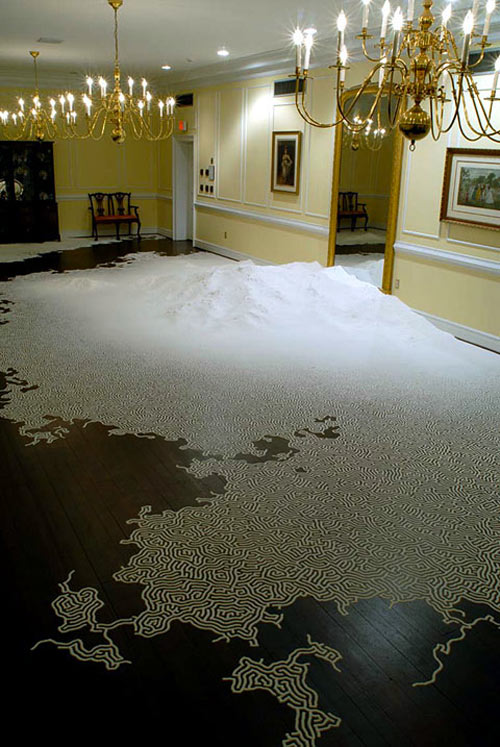
Artist Motoi Yamamoto creates intricate large scale mazes using salt. I love this one, an installation at the Sumter County Gallery of Art in South Carolina:
His Utsusemi installations are worth checking out as well.
The colors in Hubble images, which are assigned for various reasons, aren’t always what we’d see if we were able to visit the imaged objects in a spacecraft. We often use color as a tool, whether it is to enhance an object’s detail or to visualize what ordinarily could never be seen by the human eye.
This is a pretty amazing effect: CNN is doing panoramic videos that allow the user to pan around while the video plays. Watching and panning feel as though you’re actually walking around in the scene holding the camera. (thx, jed)
Kids can remember hundreds of Pokemon characters but very few animals. The solution? The Phylomon Project is an open source initiative aiming to make Pokemon-type cards for actual animals.
Phil Gyford recently compared the speeds of six different writing input devices: the handwriting recognition of the Apple Newton, the graffiti on the Palm V, the small QWERTY keyboard on a Palm Treo, the iPhone’s software keyboard, pen & paper, and a full-size QWERTY keyboard. Surprisingly, the iPhone keyboard came in second. (via df)
Popeye finally came clean Monday, admitting he used spinach when he delivered a savage and unlikely beating to romantic rival Bluto in 1998. Popeye said in a statement sent to The Associated Press on Monday that he used spinach on and off for nearly a decade. “I wish I had never touched spinach,” Popeye said in a statement. “It was foolish and it was a mistake. I truly apologize. Looking back, I wish I had never sailed during the spinach era.”
We can imagine wild wolves scavenging on a rubbish tip on the edge of a village. Most of them, fearful of men throwing stones and spears, have a very long flight distance. They sprint for the safety of the forest as soon as a human appears in the distance. But a few individuals, by genetic chance, happen to have a slightly shorter flight distance than the average. Their readiness to take slight risks — they are brave, shall we say, but not foolhardy — gains them more food than their more risk-averse rivals. As the generations go by, natural selection favours a shorter and shorter flight distance, until just before it reaches the point where the wolves really are endangered by stonethrowing humans. The optimum flight distance has shifted because of the newly available food source.
The latest issue of Five Dials, a free PDF-only literary magazine published by Hamish Hamilton, features reprints of tributes to David Foster Wallace given by his family and friends shortly after his death in late 2008. Included are tributes by Zadie Smith, Amy Wallace-Havens (DFW’s sister), George Saunders, and Don DeLillo. The introduction is from A Supposedly Fun Thing:
Finally, know that an unshot skeet’s movement against the vast lapis lazuli dome of the open ocean’s sky is sun-like — i.e. orange and parabolic and right-to-left — and that its disappearance into the sea is edge-first and splashless and sad.
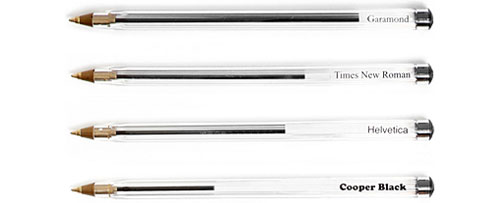
Clever idea: you can measure the amount of ink required to print different typefaces simply by writing them out with ballpoint pens. The pens themselves become the usage graph:
His forecast model predicts a country’s Olympic performance using per-capita income (the economic output per person), the nation’s population, its political structure, its climate and the home-field advantage for hosting the Games or living nearby. “It’s just pure economics,” Johnson says. “I know nothing about the athletes. And even if I did, I didn’t include it.”
For the upcoming 2010 games in Vancouver, Johnson predicts that Canada, the US, Norway, Austria, and Sweden will end up with the most medals. (thx, brandon)
What does that mean exactly? I have made some ground rules that I will be living by over the year. Here they are:
- I will start with $2,500 that I’ve saved during college - I will have a car, a phone, a computer and cameras to document the trip - I am not allowed to live out of my car - I am not allowed to live with someone I know for longer than a week at the beginning of each city - I am allowed one large bag containing clothes and a few staple foods - I am not allowed to initiate contact with someone unless it is through an online interaction
This means, put simply, I will find jobs, housing, friends, food and other necessities entirely via Craigslist.
Update:Craigslist Joe is a documentary film with the same premise. (thx, dennis)
This video deftly skewers the food industry’s current fixations, including This-Is-Why-You’re-Fat-grade hamburgers, fancy TV dinners, and junk food masquerading as wholesome:
We take the finest ingredients and put them in a bowl with salt and butter.
And “hide your salad” describes my salad dressing technique perfectly…it ends up more like ranch soup, really.
Washington also failed to see the potential of a campaign against the British in Virginia in 1780 and 1781, prompting Comte de Rochambeau, commander of the French Army in America, to write despairingly that the American general “did not conceive the affair of the south to be such urgency.” Indeed, Rochambeau, who took action without Washington’s knowledge, conceived the Virginia campaign that resulted in the war’s decisive encounter, the siege of Yorktown in the autumn of 1781.
Antarctic ice isn’t melting as much as predicted because the overall global warming trend and the Antarctic hole in the ozone are at cross purposes with each other. Temporarily.
As the ozone hole heals in the coming decades, the winds will weaken, the continent will become much warmer in summer — and melting will increase.



Socials & More