
Gene Kelly tap dancing on roller skates
Video clip from It’s Always Fair Weather of Gene Kelly dancing with roller skates on.
The good stuff starts around 2:00. As David says, “putting Kelly on roller skates is like adding polish to wax”.

This site is made possible by member support. 💞
Big thanks to Arcustech for hosting the site and offering amazing tech support.
When you buy through links on kottke.org, I may earn an affiliate commission. Thanks for supporting the site!
kottke.org. home of fine hypertext products since 1998.
Beloved by 86.47% of the web.
Video clip from It’s Always Fair Weather of Gene Kelly dancing with roller skates on.
The good stuff starts around 2:00. As David says, “putting Kelly on roller skates is like adding polish to wax”.
The trailer for Transcendent Man, a documentary film about Ray Kurzweil that’s based on his book, The Singularity is Near. You may recall that Kurzweil plans to never die.
Update: Two reviews: Transcendent Man Wows At Tribeca Film Festival Premier and Film About Kurzweil Gets Two Nano-Enhanced Cyberthumbs Up. (thx, david)
This SLR camera bag that looks like a bowling bag seems like the sort of thing that some of you may “dig”.
So, this happened: video of Andy Warhol painting Debbie Harry on an Amiga computer.
Update: AmigaWorld did an interview with Warhol about his Amigas (he owned two at the time).
The thing I like most about doing this kind of art on the Amiga is that it looks like my work.
(thx, paul)
Bummed that I can’t use Hatchet with the iPhone Kindle app. AFAIK, you need a Kindle to get the email address that you can use to send attachments to your devices. Perhaps I should just use Instapaper but I’ve gotten used to page-flipping interface on the Kindle app.
In 1959 at the University of Arkansas, a group of fraternity brothers protested the lack of chairs on campus by squatting on the balls of their feet for long periods of time.

The hunkerin’ fad was born. The Wikipedia article on hunkerin’ is worth quoting at length.
Hunkerin’ (also known as “Hunkering”) had been in use in different cultures, particularly in Asia, for centuries when it suddenly became a fad in the United States in 1959. Time reported that the craze started at the University of Arkansas when a shortage of chairs at a fraternity house led students to imitate their Ozark forefathers, who hunkered regularly.
Before long, hunkerin’ had spread, firstly to Missouri, Mississippi and Oklahoma, thence across the rest of the country. While males were the predominant hunkers, it was reported that females hunkerers were welcomed. Within months, regional hunkerin’ competitions were being held to discover champion hunkerers.
Considered by authorities as much preferable to the craze of the previous year, phonebooth stuffing, people hunkered for hours at a time on car roofs, in phone booths and wherever people gathered. Life referred to it as “sociable squatting”. Different styles of hunkerin’ were reported as “sophisticates” tended to hunker flatfooted while other hunkered with their elbows inside the knees.
From the Effects Measure blog:
Influenza is a virus full of mystery and surprises. The more we study it the more complicated it becomes. Remember the adage: “If you’ve seen one flu pandemic, you’ve seen one flu pandemic.”
This reminds me of the first line of Anna Karenina:
Happy families are all alike; every unhappy family is unhappy in its own way.
(via david archer)
Keep hail afloat with your mouse’s wind to grow it large enough that it can crush houses, skyscrapers, and buildings. Effing Hail! Addiction level: my eyes are bleeding.
More recent Ferris Bueller goodness from Metafilter: the Fight Club theory.
My favorite thought-piece about Ferris Bueller is the “Fight Club” theory, in which Ferris Bueller, the person, is just a figment of Cameron’s imagination, like Tyler Durden, and Sloane is the girl Cameron secretly loves.
One day while he’s lying sick in bed, Cameron lets “Ferris” steal his father’s car and take the day off, and as Cameron wanders around the city, all of his interactions with Ferris and Sloane, and all the impossible hijinks, are all just played out in his head. This is part of the reason why the “three” characters can see so much of Chicago in less than one day — Cameron is alone, just imagining it all.
Whoa. (via cyn-c)
The trailer for Julie and Julia is out, based on the blog and book of the same name.
I can’t figure out if Meryl Streep is almost nailing her Julia Child impression or completely blowing it. Also, Streep is ~5’7”….I don’t know what they’re doing in the movie to make her look so tall, but it doesn’t work.
Update: Michael Ruhlman has seen the movie and has positive things to say about it.
Adam St. Patrick witnesses a public beheading in Saudi Arabia.
In Riyadh, beheadings take place in a downtown public square equipped with a drain the size of a pizza box in its centre. Expatriates call it Chop Chop Square.
File Not Found. Sorry, our princess is in another castle.
This is the about page.
While listing his ten favorite fragrances, NY Times perfume critic Chandler Burr recalls Luca Turin’s definition of chic.
Luca once called something chic, and I asked him why, or rather what “chic” was exactly. He sighed and said despairingly, “Chic is the most impossible thing to define.” He thought about it. “Luxury is a humorless thing, largely. Chic is all about humor. Which means chic is about intelligence. And there has to be oddness — most luxury is conformist, and chic cannot be. Chic must be polite, but within that it can be as weird as it wants.”
(via gold digger)
Sport Science recently tested to see whether professional golfer Padraig Harrington could drive the ball further than normal by employing a Happy Gilmore swing.
The good stuff doesn’t get going until around 3:00. The running swing technique increased Harrington’s distance by an average of 30 yards but his accuracy suffered. The split-screen view of his stationary and running swings is amazing…it’s the same swing.
Bone is a springy and salty wonder that is proving much more functional within the human body than originally thought.
The skeleton is a multipurpose organ, offering a ready source of calcium for an array of biochemical tasks, and housing the marrow where blood cells are born. Yet above all the skeleton allows us to locomote, which means it gets banged up and kicked around. Paradoxically, it copes with the abuse and resists breaking apart in a major way by microcracking constantly. “Bone microcracks, that’s what it does,” Dr. Ritchie said. “That’s how stresses are relieved.” […] But like all forms of health care, bone repair doesn’t come cheap, and maintaining skeletal integrity consumes maybe 40 percent of our average caloric budget.
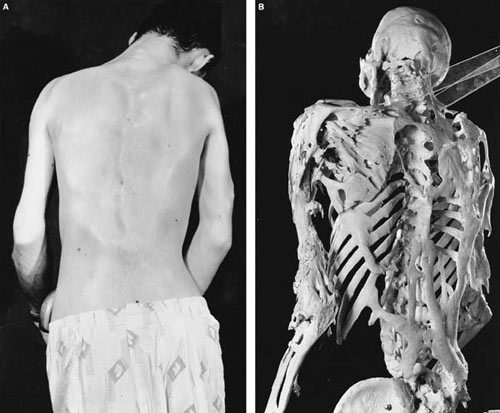
The article leads off with the story of Harry Eastlack, whose body repaired itself with bone-building cells no matter what the injury, essentially giving him a not-so-Wolverine-like second skeleton. Here’s a photo I found of Eastlack’s skeleton, which is housed at the Mutter Museum of the College of Physicians.
How to be a successful evil overlord and avoid all the mistakes that bad guys usually make in books, movies, and TV.
5. The artifact which is the source of my power will not be kept on the Mountain of Despair beyond the River of Fire guarded by the Dragon of Eternity. It will be in my safe-deposit box. The same applies to the object which is my one weakness.
25. No matter how well it would perform, I will never construct any sort of machinery which is completely indestructible except for one small and virtually inaccessible spot.
(via memeticians)
The Book Cover Archive Blog gets the skinny on using NASA images in creative work.
All of the media produced by NASA is public domain, meaning that anyone can use it any way (as long as they obey restrictions of publicity and privacy).
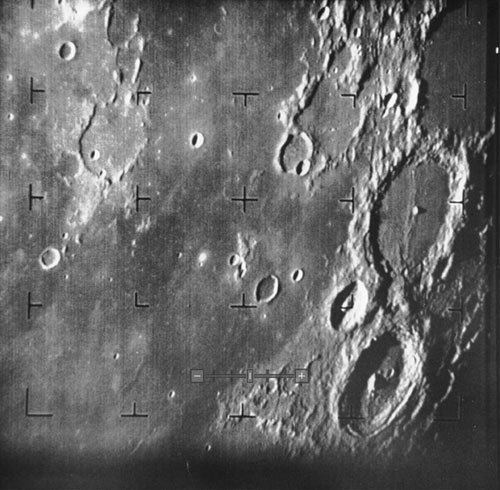
They also point to NASA Images, which is operated by Internet Archive and contains a copy of almost every image that NASA has ever produced. Just for the heck of it, here’s the first photo of the Moon taken by a US spacecraft.
Food, Inc. opens on June 12; here’s the trailer.
Our nation’s food supply is now controlled by a handful of corporations that often put profit ahead of consumer health, the livelihood of the American farmer, the safety of workers and our own environment. Food, Inc. reveals surprising — and often shocking truths — about what we eat, how it’s produced, who we have become as a nation and where we are going from here.
Gay Talese is writing a new book about his marriage to Nan A. Talese, a union that was almost ruined by a previous book Gay wrote about the sexual revolution.
The book, originally published in 1980, is about the sexual revolution, which Talese believed would be the most important cultural shift in decades, and which he spent most of the seventies intimately researching. It’s the research itself — particularly Talese’s tendency to take the participant-observer concept to the extreme — that turned out to be the unintended legacy of the project. “If you want to write about orgies,” says Talese, who at 77 is still slim and handsome, “you’re not going to be in the press box with your little press badge keeping your distance. You have to have a kind of affair with your sources. You have to hang out! I wanted to write about sexuality and the changing definition of morality. Maybe if I had put that in a subhead on the cover I might have gotten a better hearing.”
As detailed in a 1973 New York article (written seven years before Talese’s book came out), part of Talese’s research included managing two massage parlors, living in a California sex commune for six months, and attending orgies.
In a post on his great blog, The Year in Pictures, James Danziger discusses some of the photography featured in a forthcoming book, The Final Four of Everything, including Danziger’s own selections for Iconic American Photographs. The Final Four of Everything seems to be a sequel of sorts to The Enlightened Bracketologist by the same authors…or perhaps just the same book with a much better title.
According to an article published in The International Journal of Press/Politics, both liberals and conservatives find The Colbert Report funny, but the two groups differ in their perception of Stephen Colbert’s actual ideological allegiances.
Additionally, there was no significant difference between the groups in thinking Colbert was funny, but conservatives were more likely to report that Colbert only pretends to be joking and genuinely meant what he said while liberals were more likely to report that Colbert used satire and was not serious when offering political statements. Conservatism also significantly predicted perceptions that Colbert disliked liberalism.
(via cyn-c)
For the cover of Esquire’s June issue, photographer Greg Williams shot ten minutes of video footage of Megan Fox, from which the best stills were selected for the cover and inside the magazine.
As resolution rises & prices fall on video cameras and hard drive space, memory, and video editing capabilities increase on PCs, I suspect that in 5-10 years, photography will largely involve pointing video cameras at things and finding the best images in the editing phase. Professional photographers already take hundreds or thousands of shots during the course of a shoot like this, so it’s not such a huge shift for them. The photographer’s exact set of duties has always been malleable; the recent shift from film processing in the darkroom to the digital darkroom is only the most recent example.
Esquire’s moving cover reminds me of two other things.
1. Flickr encourages their members to think of short videos as long photos. When he guest edited kottke.org last year, Deron Bauman wrote about short video as a contemporary version of the photograph. Matt Jones argued that looping short video is the real long photography. So maybe the photograph of 10 years from now might not even be a still image.
2. In order to get the jaw-dropping slow-motion footage of great white sharks jumping out of the ocean, the filmmakers for Planet Earth used a high-speed camera with continuous buffering…that is, the camera only kept a few seconds of video at a time and dumped the rest. When the shark jumped, the cameraman would push a button to save the buffer.
/film has an interesting list of the most influential films of the last ten years. You’d expect to see The Matrix and The Bourne Ultimatum on there but Sky Captain? The Polar Express? The comments contain some better choices.
The account of how the folks at 4chan hacked Time’s Most Influential Person poll is worth reading for their clever manipulation of the reCAPTCHA mechanism. But the author unfairly dumps on Time.com…it sounds like they knew the poll was being manipulated, did what they could, but were fully aware of the futility of securing such a thing from a large group of determined distributed attackers. (via waxy)
It’s worth noting the difference in Time’s approach to this hack and a similar one from several years ago. In 1999, some friends of mine and I conspired to place ourselves on top of Time’s Digital 50 poll. Scripts were written, readers were enlisted, and a few of us soon passed the likes of Bill Gates and Linus Torvalds on the list. Unlike today, when Time not only let moot stay on the list but win the entire poll, Time repeatedly deleted us from the Digital 50 list entirely and none of us made it anywhere near the final listing. I’d say that’s progress on Time’s part.
Many people seem to think that if you talk about something recent, you’re in favor of it. The exact opposite is true in my case. Anything I talk about is almost certain to be something I’m resolutely against, and it seems to me the best way of opposing it is to understand it, and then you know where to turn off the button.”
That’s Marshall McLuhan. (via submitted for your perusal)
The Virginia Quarterly Review has a list of the ten most popular titles for the submissions they receive, including Untitled, Night, and Drowning. Interestingly, there’s no overlap in titles from a previous list.
The Game Boy just turned 20; here are six reasons why it was so successful. Surprisingly, the list is not:
1. Tetris
2. Tetris
3. Tetris
4. Tetris
5. Tetris
6. Tetris
Tetris didn’t start with the Game Boy, of course (Pajitnov created it for the PC in 1985), but the Game Boy made it mainstream. Ultimately, Tetris proved so popular that it quickly drove sales of Nintendo’s handheld console into the millions. Tetris’s grown-up gameplay also attracted adults to Nintendo’s new platform, expanding Game Boy’s potential audience beyond the usual adolescent NES set.
Somewhere, I still have an original Game Boy with a Tetris cart wedged into it.
The whole-earth nature documentary space is quickly becoming crowded. We’ve got:
The Blue Planet, 2001
Deep Blue, 2003
Planet Earth, 2006
Earth, 2009
Nature’s Great Events, 2009
Oceans, 2010
The last one on the list is from Disney. If you watch the trailer, the company is attempting to say, “Planet Earth? Ha! Disney was down with nature all along!” Pfft. A point in Disney’s favor however is that Oceans is being done by Jacques Perrin, the man responsible for Microcosmos and Winged Migration. Points against: the film has cost $75 million so far (for a documentary!), the footage in the trailer looks like it was lifted directly from The Blue Planet and Planet Earth, and no David Attenborough narration.
Update: I added Earth to the list, also from Disney. Here’s the trailer. BBC and Discovery are listed as partners so it’s likely that the footage in the film is from Planet Earth. (thx, @gjdsalinger)
Update: Earth is indeed mostly material taken from Planet Earth. Disney helped bankroll the production in the first place.
Update: I added Deep Blue to the list as well, a feature-length version of The Blue Planet. (thx, @aknock)
Plot-wise, Little Dorrit is just as ridiculous as Lost, frozen donkey wheel and all. Discuss.
Alison Gopnik and Jonah Lehrer take a look at how babies’ brains develop.
Gopnik argues that, in many respects, babies are more conscious than adults. She compares the experience of being a baby with that of watching a riveting movie, or being a tourist in a foreign city, where even the most mundane activities seem new and exciting. “For a baby, every day is like going to Paris for the first time,” Gopnik says. “Just go for a walk with a 2-year-old. You’ll quickly realize that they’re seeing things you don’t even notice.”
Ask Metafilter tackles the important questions of the day….like the crimes committed by Ferris Bueller and his friends on his day off.
At the restaurant, on the phone with the Maitre D’ he says, “This is Sgt. Peterson, Chicago Police.” Violation of 720 ILCS 5/32-5.1: False Personation of a Peace Officer. A person who knowingly and falsely represents himself or herself to be a peace officer commits a Class 4 felony.
In a bit of a sequel to Proust Was a Neuroscientist, Jonah Lehrer talks to Teller (of Penn and Teller) and learns how the tricks that magicians do can be explained by neuroscience.
Our brains don’t see everything — the world is too big, too full of stimuli. So the brain takes shortcuts, constructing a picture of reality with relatively simple algorithms for what things are supposed to look like. Magicians capitalize on those rules. “Every time you perform a magic trick, you’re engaging in experimental psychology,” Teller says. “If the audience asks, ‘How the hell did he do that?’ then the experiment was successful. I’ve exploited the efficiencies of your mind.”
Michael Oher, the subject of Michael Lewis’ The Blind Side, got drafted in the first round of the NFL Draft by the Baltimore Ravens. Oher was chosen 23rd.
Update: Lewis comments on the draft here and here. (via unlikely words)
Many thanks to this week’s RSS sponsor, radar.net. Radar is a service focused on easy-but-powerful mobile sharing of photos; basically trying to make it easy to take photos from your cameraphone and share them with friends, either on radar.net or a number of other sites like Facebook, Twitter, and Flickr. (If you’d like, you could call it a Twitterized Flickr.) Although they are currently promoting their iPhone app and the service’s recent integration with Flickr, they also have versions of the Radar app available for other phones, including the Blackberry and Sidekick.
To check Radar out, get the Radar app from the App Store and sign up for an account at radar.net.
There’s just too much good stuff on the internet today. So rather than flood the site with a bunch of posts, I’m going to clear out my tabs and round them up here.
Dear Prudence: “I cheated on my wife while sleepwalking. What do I do now?” I’ve heard quite a few weird/bad things about Ambien in the past few months. Also, paging Emily Gould from The Awl, please A this Q.
Rocketboom covers Single Serving Sites in their spin-off series, Know Your Meme.
The Big Picture peers into North Korea with a collection of photos of the dictatorship taken from neighboring China.
Maira Kalman visits Ruth Bader Ginsburg at the Supreme Court, illustrating the story beautifully as usual.
I return to the court to hear Justice Ginsburg speak to law students. And in answer to the question “How does it feel to be the only woman on the court?” she answers simply, “Lonely.”
The Society of Publication Designers has been busy posting nominees for their upcoming annual awards on their blog. Last year’s winners are here. (thx, david)
Jamie Zawinski has used his keyboard so much over the past eight years that he’s carved grooves into the M and N keys (with his fingernails?) and completely worn through part of his Alt key.
Have Spanish scientists found a cure for colony collapse disorder, which affects millions of honeybees around the world? The sole cause, according to the scientists, is a fungal parasite called nosema ceranae. This finding doesn’t jibe with the recent Scientific American article written by two American CCD investigators. They say that nosema is one factor out of many.
In the gut contents we found spores of nosema, single-celled fungal parasites that can cause bee dysentery. The spore counts in these and in subsequent samples, however, were not high enough to explain the losses. Molecular analysis of Hackenberg’s bees, performed by the other of us (Cox-Foster), also revealed surprising levels of viral infections of various known types. But no single pathogen found in the insects could explain the scale of the disappearance.
(via waxy)
Update: Some beekeepers have solved bee death problems in their hives by using comb with smaller cell sizes.
In case you weren’t aware, and I wasn’t for a long time, the foundation in common usage by beekeepers results in much larger bees than what you would find in a natural hive. I’ve measured sections of natural worker brood comb that are 4.6mm in diameter. This 4.6mm comb was drawn by a hive of commercial Carniolans and this 4.7mm comb was drawn on the first try by a package of commercial Carniolans. What most beekeepers use for worker brood is foundation that is 5.4mm in diameter. If you translate that into three dimensions, instead of one, that produces a bee that is about half again as large as is natural. By letting the bees build natural sized cells, I have virtually eliminated my Varroa and Tracheal mite problems.
The cell size in commercially available combs has been increased over the years to increase the honey yield. (thx, brian)
The cow genome has been published and the results show changes due to millions of years of natural selection but also to the thousands of years of selective breeding by humans.
Both types of cattle show evidence of natural selection in genes that appear to be involved in making the animals — large, horned and potentially dangerous — docile. In some breeds, specific variants of behavior-related genes are “fixed,” or seen in essentially every animal. Curiously, some of those genes are in regions that in the human genome seem to be involved in autism, brain development and mental retardation.
So…by “docile”, you really mean “mentally retarded”. (via long now)
Todd Marinovich was supposed to be the best quarterback of all time. Instead, his life got derailed by drugs and alcohol and even more drugs. His dad has to be the all-time worst sports parent in the history of horrible sports parents…it was difficult to get through page 2 without wanting to FedEx Marinovich Sr. a punch in the face.
For the nine months prior to Todd’s birth on July 4, 1969, Trudi used no salt, sugar, alcohol, or tobacco. As a baby, Todd was fed only fresh vegetables, fruits, and raw milk; when he was teething, he was given frozen kidneys to gnaw. As a child, he was allowed no junk food; Trudi sent Todd off to birthday parties with carrot sticks and carob muffins. By age three, Marv had the boy throwing with both hands, kicking with both feet, doing sit-ups and pull-ups, and lifting light hand weights. On his fourth birthday, Todd ran four miles along the ocean’s edge in thirty-two minutes, an eight-minute-mile pace. Marv was with him every step of the way.
Update: In 1988 Sports Illustrated ran an article about Marinovich while he was still in high school: Bred To Be A Superstar. (via josh)
Since I don’t use Adderall or Provigil, it took me a few days to get through this New Yorker article about neuroenhancing drugs. The main takeaway? Like cosmetic body modification in the 80s, mind modification through prescription chemical means is already commonplace for some and will soon be for many.
Chatterjee worries about cosmetic neurology, but he thinks that it will eventually become as acceptable as cosmetic surgery has; in fact, with neuroenhancement it’s harder to argue that it’s frivolous. As he notes in a 2007 paper, “Many sectors of society have winner-take-all conditions in which small advantages produce disproportionate rewards.” At school and at work, the usefulness of being “smarter,” needing less sleep, and learning more quickly are all “abundantly clear.” In the near future, he predicts, some neurologists will refashion themselves as “quality-of-life consultants,” whose role will be “to provide information while abrogating final responsibility for these decisions to patients.” The demand is certainly there: from an aging population that won’t put up with memory loss; from overwrought parents bent on giving their children every possible edge; from anxious employees in an efficiency-obsessed, BlackBerry-equipped office culture, where work never really ends.
The article is full of wonderful vocabulary. Like the “worried well”: those people who are healthy but go to the doctor anyway to see if they can be made more healthy somehow. Being concerned about how good you’ve got it and attempting to do something about it seems to be another one of those uniquely American phenomena caused by an overabundance of free time & disposable income and the desire to overachieve. See also the impoverished wealthy, the dumb educated, and fat fit.
The Ministry of Type has a look at The St. John’s Bible, a modern-day hand-lettered Bible.
Jackson has brought together an incredible range of styles for the bible, from rich, lush, gold-encrusted illuminations reminiscent of Eastern Orthodoxy to crisp and spare compositions more like the modern style of the Church of England (to my mind at least).
Looks nice. A Heritage Edition is available for $145,000.
Georg Jensen aruges that the USPS has, in effect, turned into a huge mail spamming operation (among other problematic aspects of the organization).
Just as General Motors has in effect subsidized Big Oil by continuing to build gas-guzzlers in recent years, so has the USPS continued to subsidize Big Mail by shaping its operations to encourage what it now calls, revealingly, “standard mail” — that is, advertising junk mail. Most American citizens are blissfully unaware of the degree to which USPS subsidizes U.S. businesses by means of the fees it collects from ordinary postal customers. For example, if you wish to mail someone a large envelope weighing three ounces, you’ll pay $1.17 in postage. A business can bulk-mail a three-ounce catalog of the same size for as little as $0.14.
New York magazine has a great feature where they asked well-known New Yorkers about their first days in New York City. I could read these all day. Some of my favorite bits follow. Keith Hernandez, after the Mets won the 86 World Series:
It’s one thing to become a New Yorker; it’s so much weirder to become a New Yorker that all the other New Yorkers know.
Lauren Hutton wasn’t going to stay in NYC at all:
I was supposed to meet a friend in New York, and we were going to take a tramp steamer to Tangier. It was going to cost $140. Once I got there, my plan was to take a bus for ten cents to the outskirts of town and see elephants and rhinoceroses and giraffes. I was as ignorant as a telephone pole.
Richie Rich (this one, not that one):
The first night I moved here, I met Madonna. She walked up to me at the opening of Club USA with a lollipop and a beer, and she was like, “Hmmm, you look cute.” And I was like, “You’re Madonna!” I’m like, This is New York. Wow.
Danny Meyer eventually realized he should be in the food business:
I entertained all the time, hosting lovely brunches where I would go out and source the best cheeses and pates I could find, which was a big deal for a 22-year-old back then.
Nick Denton moved here from San Francisco:
I finally decided to come here after 9/11. The foreign press was full of love letters to New York. Writers like Martin Amis were waking up and thinking, “Oh my God, we almost lost it!” I know it sounds sentimental, but no one would ever write a love letter to San Francisco.
My wife and I decided to move here after a visit in early 2002, which visit was influenced by some of the same writing Nick refers to. All these people writing so passionately about a place, it must be pretty special. We decided to check it out. But more specifically, we moved here so that Meg could start a company with Nick.
While the company didn’t work out so well, moving here was one of the best decisions we’ve ever made. We picked the smallest apartment on the fifth floor of the crappiest building on one of the best blocks in NYC. I sporadically freelanced for Gawker and a few other companies but didn’t find a full-time job until about 6 months in. But a pleasant walk home down tree-lined streets, good light into our small bedroom, an apartment layout suited perfectly to our furniture, and the intense immensity of the city made all the difference.
Update: Ricky Van Veen shares his story about moving to NYC. Great story.
Everything was still new and exciting to us. Your first year in New York is great because there’s so much you think you and your friends discovered, like “a great little burger place called Corner Bistro” or “the best corn in the world at this place Cafe Habana.”
Ha! Meg and I discovered “these great cupcakes at this place called The Magnolia Bakery” shortly after moving here.
I met one of Ricky’s partners, Zach Klein, through Nick Denton (him again!); we had brunch together one Satuday morning shortly before their New Yorker piece ran. The meal probably couldn’t have gone much worse. I’d just had all four of my wisdom teeth pulled the day before, so I was all bloody and jacked up on Vicodin, trying to eat salad even though I don’t care for it very much and wasn’t that hungry anyway, and wondering why in the hell Nick wanted me to meet this guy who ran a joke and boobs site for college kids. After recovering my health and senses, I eventually met Ricky, Josh, and Jakob and got to go to a couple of those fantastic parties. The cabinet of crystal was indeed weird. (thx, andy)
Something tells me that Steve Wozniak is not down with Last Year’s Model.
I have such a crowded life and crowded schedule. When people send me a link with a gadget, I’ll look at it and buy it if it looks interesting, but I don’t have time to check out everything I’d like to. […] As far as the mobile devices, I’ve gone through all the different smartphones, all the different gadgets. For a while I was using a Razr for voice and messing with mobile devices, but now I’m traveling with an iPhone and a BlackBerry.
A year ago, I collected a bunch of links related to what makes NYC pizza taste like it does. New York’s fantastic tap water was a leading candidate. In a recent blind taste test of identical pies, a panel of judges — including some noted NYC pizza chefs — chose a pizza made with NYC municipal water over those made from LA and Chicago water.
Also, I just ran across this map showing NYC pizzerias which are outfitted with coal ovens. There are many more than I would have thought.
The voice modulation technology isn’t just for pop songs anymore. Check out Blake tries to talk to Jack about the homepage:
Babies crying in Auto-Tune is pretty hilarious: Baby T-Pain 1, Baby T-Pain 2.
But Auto-Tuning the News takes the prize.
Pay particular attention to Katie Couric at 1:20. Awesome. (thx, matt)
Update: Whoa, Martin Luther King’s I Have A Dream speech run through Auto-Tune. (thx, matthew)
Update: Winston Churchill + Auto-Tune = [you don’t need me to tell you the answer to this].
Yahoo is closing Geocities “later this year”. Yahoo bought the service in 1999 for $3.57 billion.
Ha! Maureen Dowd interviews Alexander Graham Bell, the inventor of the telephone.
ME: The telephone seems like letter-writing without the paper and pen. Is there any message that can’t wait for a passenger pigeon?
BELL: Possibly the message I’d like to deliver to you right now.
ME: Why did you think the answer to telegrams was a noisy new telegram?
BELL: We have designed the receiver so you can leave it off the hook.
See also The Victorian Internet. (thx, @evamaria_m)
After a thorough review, Typographica has chosen their favorite typefaces of 2008.
Sensationalism aside, it’s significant that the ever-increasing quality in type design these days — dubbed by some as the new “golden age” of type — has caused this year’s list to supersede previous lists in many ways.
Which actor dies the most in his movies? Two problems with this list: 1) lots of spoilers, and 2) where are the women? There’s not a single one in the list.
Update: Cinemorgue is an extensive listing of actors and actresses and how many times they’ve died in movies. (thx, andy)
Socials & More