kottke.org posts about video games
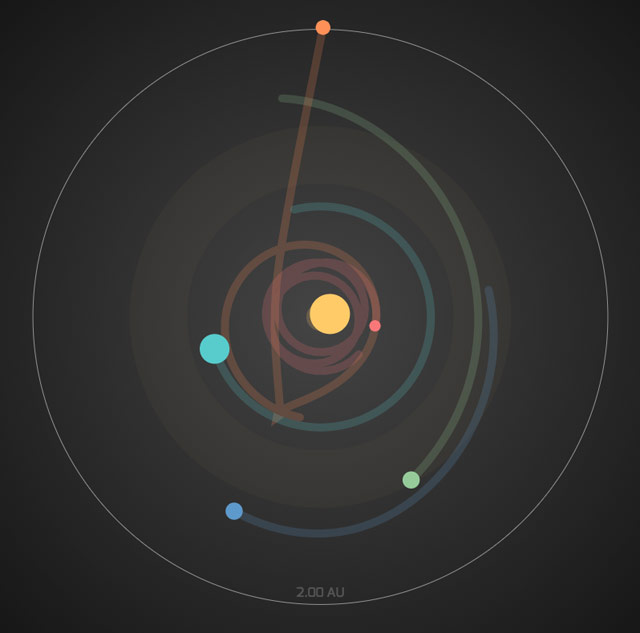
Super Planet Crash is half game, half planetary simulator in which you try to cram as much orbital mass into your solar system without making any of your planets zing off beyond the Kuiper belt. You get bonus points for crowding planets together and locating planets in the star’s habitability zone. Warning: I got lost in this for at least an hour the other day.
2008 article by Clive Thompson on how Weight Watchers is like a RPG (role playing game).
Think about it. As with an RPG, you roll a virtual character, manage your inventory and resources, and try to achieve a goal. Weight Watchers’ points function precisely like hit points; each bite of food does damage until you’ve used up your daily amount, so you sleep and start all over again. Play well and you level up — by losing weight! And the more you play it, the more you discover interesting combinations of the rules that aren’t apparent at first. Hey, if I eat a fruit-granola breakfast and an egg-and-romaine lunch, I’ll have enough points to survive a greasy hamburger dinner for a treat!
Even the Weight Watchers web tool is amazingly gamelike. It has the poke-around-and-see-what-happens elegance you see in really good RPG game screens. Accidentally snack on a candy bar and ruin your meal plan for the day? No worries: Just go into the database and see what spells — whoops, I mean foods — you can still use with your remaining points.
And those 35 extra points you get every week? They’re like a special buff or potion — a last-ditch save when you’re on the ropes.
It’s funny how quaint this seems now…the quantified self and gamification of diet & health is everywhere now. (via @arainert)

Whoa, Ben Purdy made a 16x16 pixel remake of The Legend of Zelda in 48 hours. Here’s how he did it.
Over the two days of work, I built the game from the map forward. What I mean is that my first goal was to get individual map pages rendering on screen. From there I moved on to the game manager component, building out the startup logic and render loop. This lead to the entity system, which in turn lead to the player entity. Once I had the player moving around I built code to check for collisions with obstacles in the map and changing the view when the player hits the edges of the screen. At this point you could explore the whole world map! It was pretty boring though.
Next I started making monsters and items for the player to interact with. Since I had common code to check for collisions, get lists of entities occupying particular squares, etc, the monsters weren’t terribly difficult to implement. The most time consuming part was getting the combat mechanics to a good place where it was challenging but not frustrating.
(via waxy)
Mini Metro is an upcoming game in the style of Sim City, except you’re only building subway lines.
Mini Metro is an upcoming minimalistic subway layout game. Your small city starts with only three unconnected stations. Your task is to draw routes between the stations to connect them with subway lines. Everything but the line layout is handled automatically; trains run along the lines as quickly as they can, and the commuters decide which trains to board and where to make transfers.
However the city is constantly growing, along with the transport needs of its population. How long can you keep the subway system running before it grinds to a halt?
Oh man, this is great fun for transportation nerds. Site says it’ll be out in “early 2014” for PC, Mac, Linux, iPad, and Android. You can play an early version on the site or d/l an alpha version for OS X, Windows, or Linux.
Update: A public transit planning consultant evaluates Mini Metro, which because of its simplicity, simulates the experience of transit network design quite well in some cases.
We have discovered the most realistic thing about Mini Metro: If you want to win, think of these “trains” as buses.
In real rail transit systems, you cannot simply abandon a rail line and build a new one — certainly not just to handle an overcrowding problem. But to do well in Mini Metro you must revise the network repeatedly, and the last phase of the game you’ll deploy lots of one-time-only temporary lines In fact, for best results, make sure you also have a spare tunnel, so that if you have to get a train quickly to a station on an island, you can build a temporary line to a destination across the water, deleting it after use.
To a rail engineer, all this is ridiculous, but to a transit network designer, it’s the game’s most realistic feature.
Build a subway line to run one train once, then tear it out? No, this is not how rail transit works, but it’s very much how buses work, and it’s good thing, too. That’s why buses provide a much better sandbox for network design thinking. When you build powerful networks with buses, mistakes cost thousands rather than billions, so they’re more likely to be repaired. Real-life transit networks do need to evolve, usually from radial beginnings to more gridlike structures.
(via @spavis)
The sheng is a free-reed wind instrument dating back to 1100 BCE in China. Using a modern sheng, Li-Jin Lee makes the ancient instrument sound remarkably like Super Mario Bros., including coin and power-up sounds.
And I know the Olympics are over and good riddance and all that, but this Mario Kart speedskating bit is great. Baby Park was one of my favorite tracks on Double Dash.
If you play carefully by not stomping enemies, not collecting coins, not eating mushrooms or flowers, and hopping on the flagpole at the very last second, you can rescue the princess in Super Mario Bros with only 500 points.
One bit is surprisingly tricky:
How tough is that jump in 8-1? Well, the timing of the liftoff, the duration of holding the jump button, and the timing of the wall jump are all frame perfect. NES games run at 60 frames per second, which means all the necessary inputs need to be timed within 1/60 of a second. In addition, the starting position before running I used not only has to be on the right pixel, but also the x sub-pixel has to fall within a certain range (technical stuff blah blah blah). In short, it’s a pretty annoying jump.
When I was a kid, I left my NES on for three straight days to flip the score in SMB, using the 1UP trick and another spot in the game to get many lives and points. Scoring lower would have been a lot quicker.
Your addiction to various things digital might be wasting a lot of your time. But it’s paying off in a big way for companies like King Digital Entertainment, the folks behind the wildly popular Candy Crush Saga. King just announced plans for an IPO. Can a company with one very big hit really go public? On one hand, consider this: “Of the 5000 companies in NASDAQ, only 6 have as much revenue ($1.88b) and fat profit margins (30%) as King.” On the other hand, it’s tough to stay on top in the hit-driven game industry. Want to invest in this IPO? First, you need to consider how long King will wear the crown.
Candy Crush Saga really has created some incredible numbers.
Flappy Bird Space Program is my favorite Flappy Bird riff yet. Instead of maneuvering through pipes, the object is to get as many birds as you can orbiting a tiny planet.

Love how the demise of this game has prompted such a burst of creative exploration of simple game mechanics. Flowers growing in Flappy Bird compost.
This is way more fun that regular Flappy Bird.
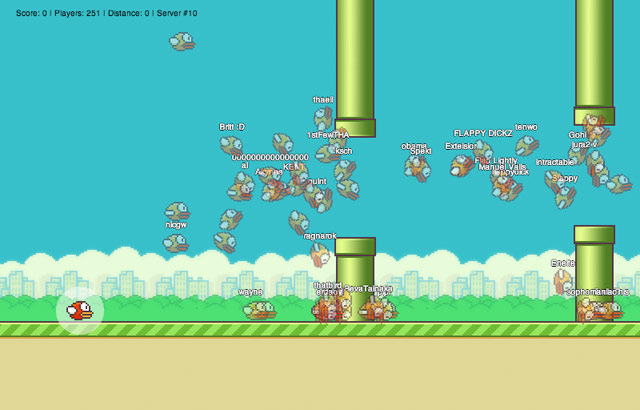
Would love to see a realtime graph of the distribution of scores for the last 1000 players or so. (My current high: 3 4! [Also, the second I put this post up, the server went down. :( ] I’m the guy repeatedly dying at the first pipe.)
100 years ago, Charlie Chaplin put on some floppy shoes, oversized trousers, a bowler, a mustache and became The Tramp. Within a year or two, he was internationally famous and in two years, he was making $670,000/year, an unprecedented figure in those days.
“It was amazingly fast,” says David Robinson, a film critic who has written a definitive biography of Chaplin (His Life and Art) and is giving an already sold-out talk titled “100 Years of the Tramp” at the festival. “By mid-1914 he was already popular. By 1915 he was international. The speed with which it happened, without the modern media, is astonishing.”
50 years ago, The Beatles were virtually unknown in the US and then, less than a year later, the largest TV audience in history watched them perform on the Ed Sullivan Show.
Consider the following: At the end of 1963, virtually no one in America had heard of the Beatles. Yet on Feb. 9, 1964, they drew the largest TV audience in history — 73 million viewers — when they appeared on “The Ed Sullivan Show.” How could such a conquest have occurred so quickly? I once asked my friend Lenny Kaye that question, and he answered: “Everybody was ready for the ’60s to begin.” There’s some truth to that, but of course there’s much more to the story. The explosion of the Beatles in America was the result of combined forces — artistic, social and technological — as well as persistence, showbiz rivalries and more than a bit of luck. So how did it happen that the Beatles came out of nowhere to become the biggest cultural sensation ever, in six weeks?
This year, an iOS & Android game called Flappy Bird, that was originally released in 2013, suddenly rocketed to the top of the App Store bestseller list. (Seriously, look at how quickly it got popular.) The developer, Dong Nguyen, revealed in an interview with The Verge that the game was making $50,000 a day on ads. He’s since made the game unavailable for download.
On February 1st, reviews exploded to 800 in a single hour. 6,500 iTunes App Store reviews in a single day. February 1st is the day Dong Nguyen woke up, stretched, checked email, checked Twitter, checked iTunes, and witnessed millions of downloads happening.
Millions.
You can only imagine what that must have felt like.
This is the same app no one cared about for more than half a year. Just one month prior, it was a great day if Flappy Bird got 20 total reviews on the App Store. Up until January 9th, there had never been an hour in which Flappy Bird received even 10 reviews (most of the time it was under 5).
Think you can distinguish between 80 of the world’s most spoken languages? Play the Great Language Game and find out. (Oof, I am bad at this.)
Oliver Emberton wrote a strategy guide for real life as if it were a video game.
You might not realise, but real life is a game of strategy. There are some fun mini-games — like dancing, driving, running, and sex — but the key to winning is simply managing your resources.
Most importantly, successful players put their time into the right things. Later in the game money comes into play, but your top priority should always be mastering where your time goes.
Jon Bois attempted to create the most lopsided game ever in Madden NFL on his Xbox. He beefed up the players on one team (7’0”, 440 lbs, good at everything) and put a bunch of scrubs on the other team (5’0”, 160 lbs, bad at everything). He started playing and was on pace to score more than 1500 points when…
With just under two minutes left in the first quarter, I was winning 366 to zero. I realized that I was on pace to score 1,500 points in a single game. I had never conceived of such a high score. I’d never even heard anyone talk idly about such a thing. There was absolutely nothing the Broncos could do to slow down my pace. I could score just as surely as someone can point and click. It was great. I wanted to ruin Madden in a way I never had before, and I was doing it.
And then it happened. Before I tell you what happened next, I want to lay out a couple of things: first, I made no actual hacks to this game. I didn’t have some special jailbroken Xbox, nor a special copy of Madden, nor anything like that. I bought my Xbox at Target and bought my copy of Madden off Amazon, and that’s that. Second, I stake whatever journalistic integrity I have upon the statement that I didn’t Photoshop any of this, and that it happened just as I say it did.
This is LOL funny in several places…particularly the GIFs. (via @delfuego)
Coinbox Hero and Cookie Clicker both break the idea of the video game down into the bare essentials: perform an action to get points, use points to power up, repeat. They’re games that show you how games work. (See also Cow Clicker.)
In Cookie Clicker, you click to make cookies until you have enough cookies to hire a cursor to click for you and eventually you get enough points to buy cookie mines, time machines, and antimatter condensers capable of generating millions of cookies a second. There doesn’t seem to be a goal per se…presumably you can keep upgrading until you’re generating trillions of cookies a minute. It’s like Bitcoin except with cookies.
In Coinbox Hero, you start similarly, jumping into a Super Mario-esque coinbox to get coins to buy workers to collect more coins for you. Unlike Cookie Clicker, there’s a clear objective: earn 1,000,000 points to buy a device that will destroy the coinbox.
I found both of these games very satisfying to play, which suggests that a significant amount of my enjoyment of games derives not from the gameplay but from the amassing wealth and power, which, man, I guess I have something to talk to my therapist about this week. (via waxy)
The Hyperkin RetroN 5 is a retro gaming system that plays all your favorite games from NES, SNES, Super Famicom, Genesis, Mega Drive, Famicom, Game Boy, Game Boy Color, and GBA cartridges. I haven’t heard anything about this (is it any good?), but I’ve got a lot of old games I’d like to play on it, starting with NHL ‘94. Pre-order at Amazon for $99. (via @cabel)
Watch as people review video games after eating hot peppers. Here’s Erin Schmalfeld reviewing a Nintendo 3DS game after chewing and swallowing an entire habanero:
(via ★interesting)
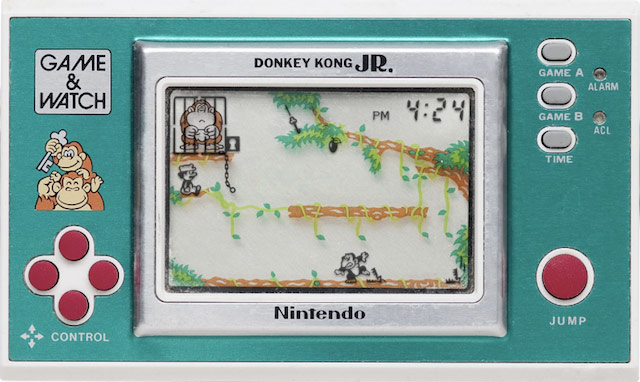
PicaPic is a digitized collection of vintage handheld games made by Hipopotam studio. They’re all free and playable in your browser. It’s a really slick implementation. It even has the plasticy clacking sound of the buttons. (via @kump)
Ecstasy of Order is a documentary about Tetris and the quest to find the game’s grandmasters.
Tetris. We’ve all played it, rotating the pieces (“tetrominoes”) and dropping them in the perfect place, or despairing as we discover a piece won’t fit. You may have even joked about “mastering” the game during a stint of unemployment, or as a child, before you could afford any other Game Boy cartridges. But what about the people who’ve truly mastered Tetris? Where are the Kasparovs and Fischers, the great champions who’ve dedicated their minds to solving its deepest puzzles?
One man made it his mission to find them. In an effort to legitimize Tetris as a pro sport, Tetris super-fan Robin Mihara summoned the greatest Tetris players from around the country to compete in Los Angeles at the 2010 Classic Tetris World Championship. Among them are the only players known to have reached the unthinkable perfect ‘max-out’ score on classic Nintendo Tetris: Jonas Neubauer and Harry Hong. Add in the top players for most lines, Ben Mullen and Jesse Kelkar, as well as newcomer Dana Wilcox and modern-day Tetris Grandmaster Alex Kerr, and a storm of Tetris greatness is brewing.
The film is also on Hulu (US-only) if you don’t mind commercials.
When Grant Hill and Jason Kidd retired from the NBA this week, they were the last players who appeared in the NBA Jam video game from 1994. There are still three active NHL players who appeared in the classic NHL ‘94: Teemu Selanne, Roman Hamrlik, and Jaromir Jagr. Kotaku’s Owen Good takes a look at which athletes were the last men standing from 8-bit and 16-bit sports video games.
Landeta, whose last game was in 2005, is the last man on the Tecmo Bowl roster to appear in an NFL game, beating out the Raiders’ Tim Brown, the 49ers’ Jerry Rice and Minnesota’s Rich Gannon, all of whom retired in 2004.
The makers of Kingdom Rush, probably my all-time favorite iOS game, are out with a brand-new game: Kingdom Rush Frontiers.
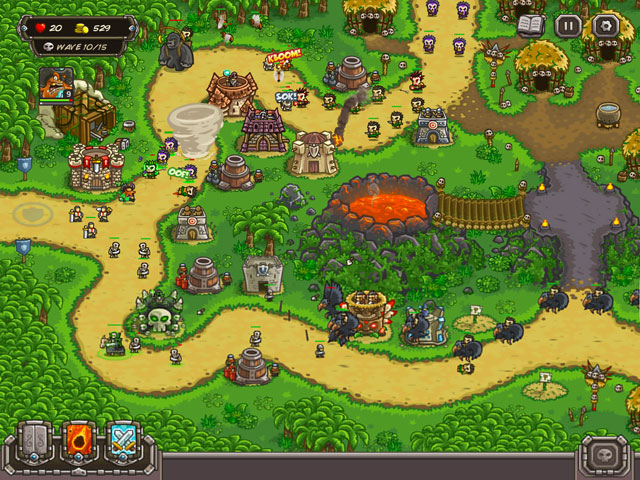
I will see you all in a few days. Tell my wife and kids I love them. (“thx”, @mykeatkinson)
Two controls, one bouncing stick, uneven terrain that eventually falls out from under you, get the stick as far to the right as you can. Harder than it sounds. I got 107.04 on, like, my 2,341st try. (Cheat code: you can get pretty far just by holding ‘A’ down.) Also fun: seeing how far to the left you can get…I couldn’t get much past -48.
If you’re of a certain internet age, from the time when idealistic nerds and not bizdev bros ruled the roost, you probably remember SiSSYFiGHT 2000. (If not, this Salon review of the game from 2000 may lift the fog.) The original creators of the game are bringing it back, open sourced, HTML5, and the whole thing. Funds are being raised on Kickstarter as we speak.
In the mystical years of the late 90s, a little game called SiSSYFiGHT 2000 was born on the web. Hundreds of thousands of players fought as bratty little girls, teasing and tattling and licking their lollipops on the playground. An amazing community sprang up around the game, in which players became fan artists and storytellers, reporters and celebrities, criminals and vigilantes.
There was something special about SiSSYFiGHT. It was one of the first multiplayer games with real-time chat in a browser. It was a social game with actual social gameplay, long before “social games” on Facebook existed. Its stylishly primitive visual look preceded the rise of big-pixel indie games by almost a decade.
Fantastic. (via @jomc)
The first features TAKASKE, a Dance Dance Revolution player with ballerina-quick feet. Here he plays all eight footpads at ludicrous speed.
Then there’s Cara Black, a higly-ranked women’s doubles tennis player with a killer net game. Here she’s practicing volleys off the wall at close range.
She reels off 115 volleys in 43 seconds, beating the performance of her 16-year-old self.
Quora is full of questions college students ask each other while high, except that sometimes they get answered seriously. Case in point: What is the political situation in the Mario universe? The top answer starts out:
Without going into too much detail, Mario generally lives and works in the Mushroom Kingdom, one of the largest geo-political structures on Mushroom World, in the Grand Finale Galaxy in, yes, the Mushroom Universe.
For the purposes of this answer I will deliberately restrict the terms to discussing Mushroom World, as a comprehensive answer on the entire Mushroom Universe would require covering 20-22 (depending on how you count) Galaxies and frankly, I doubt it would be any more fun to read than it would be to write.
Also, Bowser is probably a fascist.
The new iOS gaming hotness is Ridiculous Fishing. In it, you try to get your hook as deep as you can, then catch as many fish as you can on the way up, and finally shoot as many of the fish as you can with a gun. There are also chainsaws and an in-game Twitter clone called Byrdr. This game is ten times more charming than that Arnold on Green Acres and fun as hell. Highly recommended. If you need an extra nudge, here’s the trailer:
Poignant video profile of Ralph Baer, the inventor of the Magnavox Odyssey, the first home console gaming system. He’s still inventing at age 90.
For Polygon, Simon Parkin writes about how Barcade came about and where it’s going.
Younger gamers are, in a sense, both the secret to Barcade’s success and its great ongoing threat. More than players like Chien and the older pros, Barcade attracts young local patrons typical of the Brooklyn bar scene. For many of these visitors the classic arcade hits of the 1980s were released long before they were born, familiar to them primarily as cultural icons rather than living memories.
“When we opened in 2004, some of these games weren’t even 20 years old,” says Kermizian. “But now, eight years on, we find the ideal period of nostalgia keeps shifting on us as our customers are a little bit younger. So we’ve started to go with some early ’90s games. You know, we’ve put Teenage Mutant Ninja Turtles in two of the three arcade locations and that’s our number one most popular game now. People just go crazy playing that.”
On a good night a single Teenage Mutant Ninja Turtles machine will see its coin tray filled. “At the end of the night we just dump a bucket of quarters out of the machine, around 50 bucks worth.”
All these years on, with prices unadjusted for inflation, the aging arcade still offers a viable business. But time continues to be the greatest menace to the arcade, even in the midst of this repackaged revival. For many, this parade of curios whose bleeps and flashes provide an atmospheric link to the past long gone is little more than a hands-on exhibit, where Space Invaders’ and Pac-Man’s iconography is not forgotten but made fashionable. But fashions are transient. How long can the business model sustain?
Chris Higgins travels to the Tetris World Championship and profiles a couple of the game’s top competitors. The issue at heart is: how do approach playing and mastering a game that you can’t actually win?
When Steil achieved his current high score of 889,131 points (and 222 lines) in October of 2012, it felt like a loss. Despite being Steil’s best game to date, it represented a failure to reach the perfection of a max out. When he posted the score on Facebook for his Tetris friends to see, he wrote, “Another new high score, but what a choke job at 222 [lines]. Each new high score is a minor success as well as a monumental failure.”
This attitude pervades competitive Tetris, and it highlights the perverse aspect that the best game is still a loss. Faced with this harsh reality, NES Tetris players have devised ways to compete (the Championship), milestones to achieve (max outs and high numbers of lines per game), and ways to measure performance (max outs achieved starting at higher levels are more difficult due to the game’s speed). Fundamentally, however, players compete against themselves and lose every time.
Here’s what getting a max score on Tetris looks like:
(via @VintageZen66)
The Gameological Society’s Joe Keiser went shopping for video games in Nairobi and found a ton of PlayStation 2 knockoffs. Like Grand Theft Auto: San Andreas: Kirk Douglas:
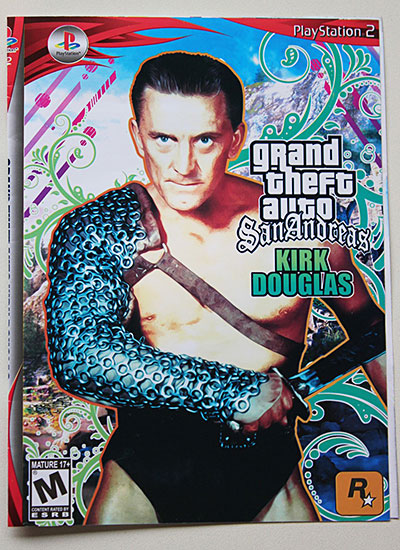
Full disclosure: this article exists so I can tell you all about Grand Theft Auto: San Andreas: Kirk Douglas. Just look at it! It’s exquisite. The game itself is as grand as the cover. It is San Andreas, with the load screens replaced by EXTREME closeups of Kirk Douglas-and occasionally his son Michael Douglas, because hey, close enough, right? In the game, the main character appears to be a rough approximation of Kirk Douglas. Oh, and all the missions have been removed, so there’s nothing to do.
And RoboCop:
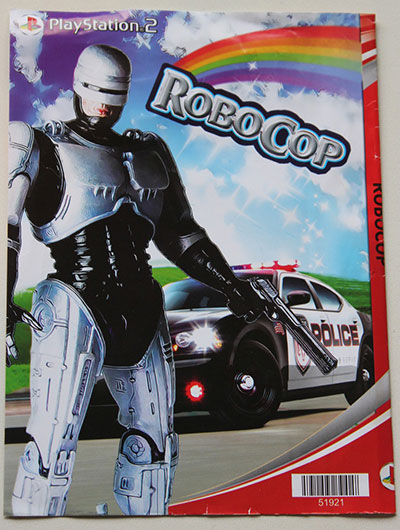
I do not doubt RoboCop’s commitment to Sparkle Motion.
Help Lord Grantham find his cigars, puff up pillows for Anna, and spy on other staff for Lady Mary in this “tastefully exciting” SNES version of Downton Abbey.
Newer posts
Older posts





Socials & More