kottke.org posts about video games

Clive Thompson’s article for the NY Times about Minecraft captures what many players, parents, and teachers find exciting about the game that seems like more than just a game.
Presto: Jordan had used the cow’s weird behavior to create, in effect, a random-number generator inside Minecraft. It was an ingenious bit of problem-solving, something most computer engineers I know would regard as a great hack — a way of coaxing a computer system to do something new and clever.
In addition to learning about logic and computer science, various educators have also touted Minecraft’s lessons in civics, design, planning, and even philosophy. If you’ve ever seen little kids playing with blocks, you’ve noticed that some of those potential lessons there too.
Block-play was, in the European tradition, regarded as a particularly “wholesome” activity; it’s not hard to draw a line from that to many parents’ belief that Minecraft is the “good” computer game in a world full of anxiety about too much “screen time.”
Among the parents I know, Minecraft is not classified as a game…it’s very much tied to education.1 And when listening to the kids and their friends talk about it, if you can get past the endless chatter about zombies and diamond armor, their understanding of the whole world of possibilities is quite sophisticated.
And I can’t resist commenting on this little aside about Lego:
Today many cultural observers argue that Lego has moved away from that open-ended engagement, because it’s so often sold in branded kits: the Hogwarts castle from “Harry Potter,” the TIE fighter from “Star Wars.”
Until very recently, I was in that camp of cultural observers, frustrated by the brands and paint-by-number aspect of contemporary Lego kits. But my kids play with Lego a ton and I’ve observed plenty of open-ended engagement going on. Sure, they sit for 20-30 minutes putting the kits together using directions, but after they’re “done”, the real play begins. Ollie’s Star Wars ships dock at Minna’s birthday party. Soon, beach goers are wearing Stormtrooper helmets and Vader’s eating cupcakes. None of the “finished” products survive more than a few minutes without being augmented or taken apart to make something different. Ships take on wheels from previous kits and become delivery trucks (with cool laser cannons). Parts from every station, house, vehicle, and landscape get remixed into whatever’s necessary for their dramatic play. It’s like jazz with injection molded plastic.

Scott Lininger and Mike Magee built a fully playable WebGL version of the original Legend of Zelda, which came out 30 years ago. Works in any modern web browser. Not sure how long this is going to be up, but it’ll be fun while it lasts.
Lego and Disney are teaming up for a Star Wars: The Force Awakens video game, out this summer. The trailer for it is possibly more fun than the movie was and is well worth watching if you enjoyed The Lego Movie.
One of my video game triumphs as a kid was playing all the way through The Legend of Zelda using only the wooden sword.1 It was difficult. The person in the video above beat Zelda with only three hearts and without using a sword (until right at the end…you need a sword to kill Gannon). Hardcore. Makes me want to fire up the Wii and see what I can do.
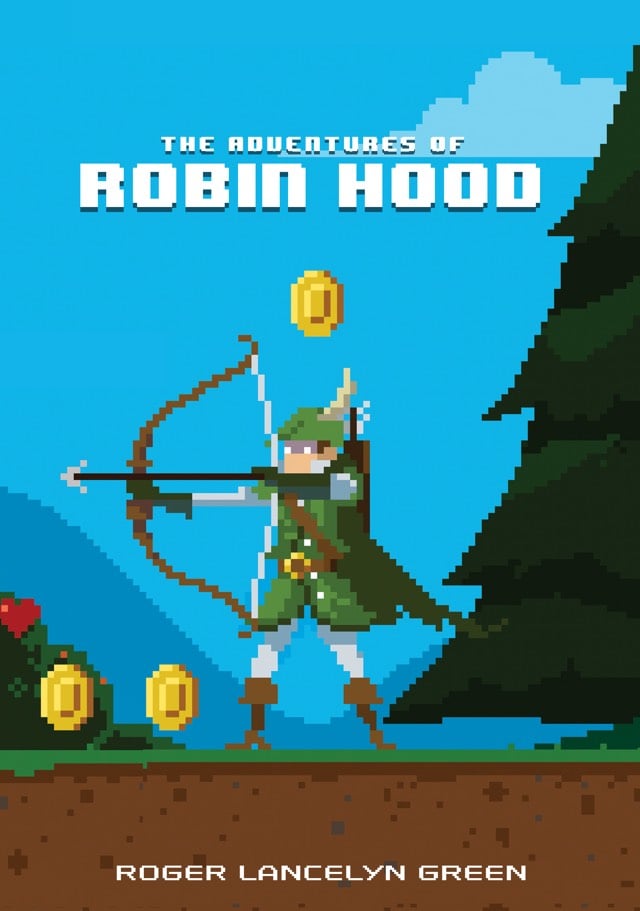
Perhaps attempting to capitalize on the popularity of Minecraft with young boys, Random Penguin1 has released the Puffin Pixels Series of books. The covers of The Swiss Family Robinson, Treasure Island, and four more titles are done in the style of 8-bit video games. The cover illustrations were done by Michael Myers. (via @gavinpurcell)
With its straightforward plot and action sequences, Mad Max: Fury Road would make a pretty good 8-bit video game. (via devour)
Super Mario Brothers was released for Famicom in Japan on September 13, 1985.
When was the game released in the United States? Nobody knows.
Here’s Nintendo’s official anniversary video.
Legendary designers Shigeru Miyamoto and Takashi Tezuka broke down the first level of the game for Eurogamer. (My favorite part? The subtle way that Mario is designed to have “weight,” and how this affects the player’s identification with and affection for the character.)
Kyle Orland at Ars Technica has thirty little-known facts about the game:
The original instruction booklet for Super Mario Bros. details how “the quiet, peace-loving Mushroom People were turned into mere stones, bricks and even field horse-hair plants.” That means every brick you break in the game is killing an innocent mushroom person that would have been saved once Princess Toadstool “return[ed] them to their normal selves.”
Digg has a video on the character’s evolution (including cameo appearances in other Nintendo games):
Samir al-Mutfi’s “Syrian Super Mario” reimagines the game with obstacles faced by Syrian refugees. (Grimly, the player has 22,500,000 lives to lose.)
And of course, Super Mario Maker, the game that lets players make their own Super Mario Bros. levels, was released for Wii U. Users’ levels are already being repurposed for social commentary, from the existential dread of “Waluigi’s Unbearable Existence” to the more lighthearted “Call Your Mother, You’ve Got Time.”
There seem to be two dominant business models for game arcades in 2015:
- run it as a museum;
- sell beer.
And even then, it’s tricky.
“Don’t do quarters,” Wilson says. “Local and state licensing and taxes are geared from the 1980s which makes it impossible to make a buck that way.” The laws aren’t up to date, and owners still have to pay the same amount to register arcade machines, even if revenue is much smaller than it was in the ’80s. Wilson adds that customers often think a quarter should hold the same 25-cent value in 2015 that it did in 1983.
And:
[A]fter all the work that goes into finding these machines, they are then introduced to a world very different from the arcade homes they once knew. It’s akin to taking fragile dinosaur fossils from a museum collection and throwing them into the middle of a party.
“We have 20-30-plus-year-old video games in a very high-traffic, kind of high-energy environment,” Horne says. “The games tend to get pretty beat up.”
It’s surprising how much of a premium is placed on using vintage machines, given the problems with keeping them in repair.
A motherboard fried on KFS’s Off Road cabinet, and Horne has never been able to find a replacement. Some of the early Nintendo titles, such as Super Mario Bros., have systems that won’t work with newer monitors.
A museum is one thing, but you can imagine a working arcade using modular, replicated equipment. Modern computer guts running emulated software in rebuilt or reused cabinets. Call it physical emulation.
Maybe the market’s just not big enough to make it worthwhile. Or it would lack authenticity. It just doesn’t seem like it would be that hard to do (and could make new kinds of games and business models a lot more feasible).
(Related: see Laura June’s 2013 history of arcades.)
From the developer of Crossy Road (aka Infinite Frogger) comes Pac-Man 256, a Pac-Man game with an infinite board that gets eaten from below by the kill screen glitch from the 256th level of the original game. I love riffs on old school video games like this, and the infinite board is a particularly clever one.1 Here’s what the gameplay looks like:
I’m sure everyone is used to this by now (which is sad) but be warned that Pac-Man 256 is one of those games that encourages you to watch ads to level up more quickly or to continue when you’re out of credits…and then to buy more credits as an IAP when you’re out of ads to watch. There’s an option to buy unlimited credits for $7.99, but still. I understand the economics of the situation and why they do it this way, but it just feels so hostile to the player. I want to wholeheartedly recommend this game because the gameplay is so fun, but it feels like you’re constantly wading through a little bit of raw sewage to play it. Which, apparently I don’t mind doing, wading through sewage. :(
Update: Echoing several similar comments on Twitter, John Gruber writes:
Unlike Kottke, I think the option to buy unlimited “credits” with a one-time $7.99 in-app purchase is a fair deal. Think of it as an $8 game that you can optionally play for free if you’re willing to watch ads. That’s a good price for a great game.
$8 is a more than fair price. But the option to buy unlimited credits is difficult to find in the game (you need to run out of credits first and then click the “Play” button anyway) and it doesn’t tell you exactly what you’re getting for your $8. What I want is never to see an ad ever in the game, but I don’t actually think that’s what it is. Paying full price for a game shouldn’t involve hide n’ seek.
But the bigger issue for me is how the game, and many many others in the App Store, feels: icky. Like used car salesman icky. Drug dealer icky. Depressing casino icky. The way the game presents itself, the developers seemingly want one thing: your money. Do they want me to have a good time playing the game? Eh, maybe? I don’t know, it just seems really cynical to me, like a game built by a bank instead of people that love gaming or Pac-Man.
I really *really* wish the App Store had a trial period option available for apps. 20 minutes into Pac-Man 256 and I would have ponied up $8-10, no problem. I suspect App Store users would love this feature but game developers would hate it because using ads and casino tactics to upsell in your app makes a lot more money than straight sales.
These folks created a real-life first person shooter game and invited strangers on Chatroulette to control the action.
Here’s a behind-the-scenes look at how they did it. (thx, oren)
In talking about an upcoming game (more on that in a bit), Nintendo’s Shigeru Miyamoto and Takashi Tezuka discuss the process they used in designing the levels for the original Super Mario Bros. Much of the design work happened on graph paper.1

Back in the day, we had to create everything by hand. To design courses, we would actually draw them one at a time on to these sheets of graph paper. We’d then hand our drawings to the programmers, who would code them into a build.
Here’s the full video discussion:
Now, about that game… Super Mario Maker is an upcoming title for Wii U that lets you create your own Super Mario Bros levels with elements from a bunch of different Mario games. So cool…I might actually have to get a Wii U for this.
SethBling wrote a program made of neural networks and genetic algorithms called MarI/O that taught itself how to play Super Mario World. This six-minute video is a pretty easy-to-understand explanation of the concepts involved.
But here’s the thing: as impressive as it is, MarI/O actually has very little idea how to play Super Mario World at all. Each time the program is presented with a new level, it has to learn how to play all over again. Which is what it’s doing right now on Twitch. (via waxy)
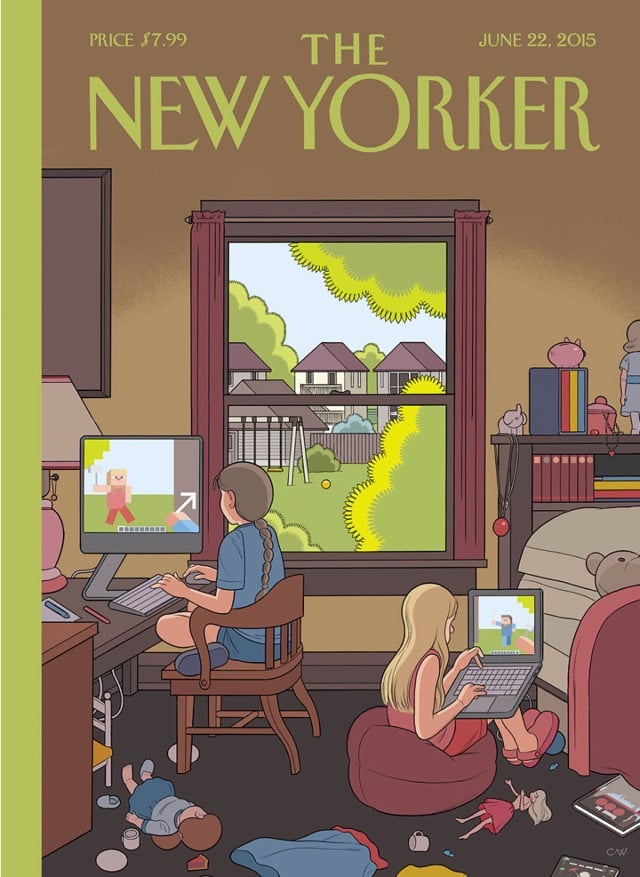
Chris Ware’s cover for this week’s issue of the New Yorker featuring a Minecraft playdate is spot on.
Clara has spent hours, days, weeks of the past two years building and making navigable block worlds fuelled from the spun-off fizz of her accreting consciousness: giant ice-cream-layered auditoriums linked to narrow fifty-foot-high hallways over glass-covered lava streams, stairs that descend to underground classrooms, frozen floating wingless airplanes, and my favorite, the tasteful redwood-and-glass “writer’s retreat.” (It has a small pool.) She made a meadow of beds for my wife-a high-school teacher who craves unconsciousness-and a roller coaster to take her there. Though Clara mostly “plays” Minecraft by herself, the game allows her friends to drop into these worlds, too, and I’ve even spent some strange virtual afternoons as a floating block-self, guided by my angelic block-hammer-wielding block-daughter, zipping around a dreamscape that feels, really, less like life and maybe more like death, but in a sweet sort of way. If architecture somehow mirrors the spaces we carve in our memories and make in our minds, then something pretty interesting is going on here.
Ollie wanted a Minecraft playdate for his birthday, basically him and three or four of his friends sitting around playing the game on various devices. We managed to talk him into some good old fashioned real-world bowling instead, but I doubt that will work next year.
Screentendo is an OS X application that converts a selection of your computer screen into a playable Super Mario Bros game. Here’s a demo using the Google logo:
The source code is here if you want to try it out. (via prosthetic knowledge)
Newer posts
Older posts






Socials & More