kottke.org posts about sports
Leveraging the high number of specialized heat-transfer veins in the palm of the human hand, researchers at Stanford have developed a thermal exchange glove that is able to cool a person’s core temperature in a matter of minutes. Turns out this is helpful for athletes.
The glove’s effects on athletic performance didn’t become apparent until the researchers began using the glove to cool a member of the lab — the confessed “gym rat” and frequent coauthor Vinh Cao — between sets of pull-ups. The glove seemed to nearly erase his muscle fatigue; after multiple rounds, cooling allowed him to do just as many pull-ups as he did the first time around. So the researchers started cooling him after every other set of pull-ups.
“Then in the next six weeks he went from doing 180 pull-ups total to over 620,” said Heller. “That was a rate of physical performance improvement that was just unprecedented.”
The researchers applied the cooling method to other types of exercise — bench press, running, cycling. In every case, rates of gain in recovery were dramatic, without any evidence of the body being damaged by overwork - hence the “better than steroids” claim.
The cooling resets a temperature-sensitive enzyme that muscles need to generate energy, “essentially resetting the muscle’s state of fatigue”. I expect this will be either everywhere in pro sports in a couple of years or banned. (via @jsnell)
Or rather, just an amazing performance, full stop. I was alerted to this video by Dunstan Orchard who tweeted “this must be the most remarkable track race I’ve ever seen”. I don’t want to spoil it too much but pay attention to the guy in last place coming out of the curve.
Like a freight train! I’ve watched this race about 8 times now and it never gets old. The runner, Richard Whitehead, set the world record in the race. He also owns the world record in the marathon, which, amazing! Oh, and this table tennis shot is pretty great too.
If you had any remaining doubts about Lance Armstrong’s involvement in doping, Tyler Hamilton’s book should put those to rest. Hamilton was Armstrong’s teammate on the U.S. Postal Service team, and in the book, he tells the story (corroborated by no fewer than nine former Armstrong/Hamilton teammates) of how Armstrong, the USPS team, and practically everyone else on the racing circuit doped in the 1990s/2000s. From an early look at the book by Christopher Keys at Outside Magazine:
The drugs are everywhere, and as Hamilton explains, Armstrong was not just another cyclist caught in the middle of an established drug culture — he was a pioneer pushing into uncharted territory. In this sense, the book destroys another myth: that everyone was doing it, so Armstrong was, in a weird way, just competing on a level playing field. There was no level playing field. With his connections to Michele Ferrari, the best dishonest doctor in the business, Armstrong was always “two years ahead of what everybody else was doing,” Hamilton writes. Even on the Postal squad there was a pecking order. Armstrong got the superior treatments.
What ultimately makes the book so damning, however, is that it doesn’t require readers to put their full faith in Hamilton’s word. In the book’s preface, which details its genesis, Coyle not so subtly addresses Armstrong’s supporters by pointing out that, while the story is told through Hamilton, nine former Postal teammates agreed to cooperate with him on The Secret Race, verifying and corroborating Hamilton’s account. Nine teammates.
No wonder he gave up.
As it received high marks from friends, I wanted to like John Jeremiah Sullivan’s recent NY Times Magazine profile of Venus and Serena Williams more than I did, but I think Sullivan had so little access to the sisters that it turned into more of a sick Frank story than expected.
The story has been told so many times, of these early years, when Compton got used to the sight of the little girls who would always be playing tennis at the public park — or riding around in their faded yellow VW bus with the middle seat taken out to accommodate the grocery cart full of balls — but somehow the strangeness and drama of it retain a power to fascinate. The idea of this African-American family organizing itself, as a unit, in order to lay siege to perhaps the whitest sport in the world and pulling it off somehow. “I remember even talking to my sisters and brothers,” Oracene said, recalling a time before anyone had ever heard of the Williams sisters, “and telling them: ‘The girls are going to be professional. We’re going to need a lawyer, and we’re going to need an accountant.’ “
Isha, the middle daughter — sharply funny and practical, fiercely loyal to the family — told me: “Life was get up, 6 o’clock in the morning, go to the tennis court, before school. After school, go to tennis. But it was consistency. I hate to put it [like this], but it’s like training an animal. You can’t just be sometimey with it.” She still can’t sleep past 6.
My favorite observation from the story was actually from a behind-the-story piece that ran on the magazine’s blog.
One thing Venus talked about that was interesting was how easy it is for professional athletes to pick up other sports. So what they are good at is not the sport itself, but it’s just a way of being in the world. It’s a sense of their own bodies and an ability to manipulate their own bodies and have sort of a visual map in your head of what the different parts are doing. At one point she was talking about doing a benefit with Peyton and Eli Manning. They’d almost never played tennis before and they started out awful, and she said it was amazing to watch them. It was like watching a film. Every stroke they hit was noticeably better than the last. Every time they hit the ball. She said you could almost watch their brains working and by the end of it they were totally competent tennis players.
The Super Manning Bros anecdote hits because, as David Foster Wallace pointed out in his evisceration of tennis player Tracy Austin’s biography, it can be difficult for gifted athletes to talk about why and how they are able to do what they do. But Venus obviously can and I wish there’d been more of that in the main essay.
Perplexed and irritated that I couldn’t find any Barcelona FC matches on TV for the past few weeks, I finally did some research and it turns out that’s because Qatar-based Al Jazeera bought up the TV rights to several European leagues but doesn’t actually have a channel to show the games to most American viewers.
Lionel Messi’s and Cristiano Ronaldo’s league matches will disappear from the television sets of many American soccer fans, starting this weekend.
That’s because the U.S. television rights to Spain’s La Liga have switched from GolTV to the new beIN Sport USA network, launched this week by the Al-Jazeera Sport Media Network and available in only about 8 million homes to viewers of DirecTV and DISH Network.
And it’s not just Spain’s soccer that is affected.
Italy’s Serie A, France’s Ligue 1, England’s second-tier League Championship and England’s League Cup also have moved to high-spending beIN Sport, which is taking over all of them from News Corp.’s Fox Soccer.
“The ratings are going to be so low that they will be almost unmeasurable,” said Marc Ganis of the Chicago-based Sports Corp. Ltd., consulting firm. “Considering the push that European soccer is making in the United States, taking additional money and losing exposure becomes fools’ gold. They need to have a long-term strategy, not short-term.”
What. In. The. Actual. Fuck!?
Alain Prost retired from F1 racing for the final time in 1993, with his last race coming at the Australian Grand Prix in November. He finished second in the race to his fierce rival Ayrton Senna but handily won the World Championship to the runner-up Senna. But the two of them raced for one final time in December of that year…driving go-karts.
Predictably, the pair took it very seriously: four-time world champion Prost having tested extensively before the event; Senna, a three-time title holder, having a kart shipped to Brazil so that he could practise.
San Francisco Giant Melky Cabrera recently tested positive for a banned substance and received a 50 game penalty per MLB’s rules. Prior to receiving the suspension, Cabrera made an attempt, new at least in the world of sports, to get off without punishment.
The New York Daily News has discovered that in an effort to beat the rap on his 50-game suspension, Melky and his “associates” devised a scheme that included purchasing a website for $10,000, making this website appear to sell a fake product and pretending Melky purchased and used the product, unaware that it contained a banned substance. Ohh, this close.
Cabrera offered the website as evidence during his appeal and the scheme devolved into comedy in short order.
Bernard James was this year’s second round draft pick of the Cleveland Cavaliers (immediately traded to Dallas). He’s also 27, and an Air Force veteran. This is a great story, I hope he has a long career.
Fans attend the NBA draft to boo. They boo Commissioner David Stern. They boo their draft picks. They boo other teams’ draft picks. They boo to boo.
They didn’t boo Bernard James. They chanted “U-S-A” over and over again.
Team Spirit is a wonderful short film for ESPN by Errol Morris about the funerals of die-hard sports fans.
I love the Steelers fan laid out in a recliner under a Steelers blanket in front of a television with a Steelers game on as if “he just fell asleep watching the game”.
From Slate, some speculation that Caster Semenya sandbagged the 800 meter final in order to avoid further gender-related scrutiny.
After the race, track and field aficionados questioned her tactics. The BBC’s David Ornstein said it appeared that Semenya “had more left in the tank.” His story quoted BBC commentator Kelly Holmes, who won this event in the 2004 Olympics, suggesting that Semenya hadn’t made her best effort: “She looked very strong, she didn’t look like she went up a gear, she wasn’t grimacing at all. I don’t know if her head was in it, when she crossed the line she didn’t look affected.” Meanwhile, Sports Illustrated senior writer Tim Layden tweeted that Semenya “seemed oddly disengaged most of race and not tired at end.”
I watched the race and Semenya’s finish was odd…she made her move super-late and was moving at a tremendous pace when she crossed the line. Had she worked her way up to the front before the final turn, she may have beaten the field by several lengths.
Update: Here is a more nuanced analysis of Semenya’s effort in the 800 meter final.
Perhaps there is nothing to her performance other than that she runs a more even pace than her rivals.
A comparison between her semi-final and this race is interesting in this regard. In that semi, she went through 400m in just over 58 seconds, 600m in about 1:28 and then closed the final 200m in 29.5s, looking like she had something in reserve.
Tonight, she went through 400m in 57.69s, then through 600m in about 1:27.1, and then closed in a touch over 30 seconds. My point is, her performance in the final was slightly faster at every stage than the semi, until she closed slower over the final 200m. To finish SLOWER than she did in the semi implies that she has little reserve and that she is closer to the limit than she looks. She wasn’t actually that fast over the final 200m, it’s just that everyone else was very slow!
(via @andrewsmit)
The uneven parallel bars event has changed a lot over the years. For one thing, the bars used to be a lot closer together. And obviously the routines have gotten a lot harder.
Some of those moves in the 60s and 70s were sweet though. More grace and less raw power. (thx, doug)
Smithsonian Magazine has a good argument on why Jim Thorpe should be considered amongst the greatest Olympians even though his records and medals are not officially acknowledged by the IOC.
A week later the three-day decathlon competition began in a pouring rain. Thorpe opened the event by splashing down the track in the 100-meter dash in 11.2 seconds-a time not equaled at the Olympics until 1948.
On the second day, Thorpe’s shoes were missing. Warner hastily put together a mismatched pair in time for the high jump, which Thorpe won. Later that afternoon came one of his favorite events, the 110-meter hurdles. Thorpe blistered the track in 15.6 seconds, again quicker than Bob Mathias would run it in ‘48.
On the final day of competition, Thorpe placed third and fourth in the events in which he was most inexperienced, the pole vault and javelin. Then came the very last event, the 1,500-meter run. The metric mile was a leg-burning monster that came after nine other events over two days. And he was still in mismatched shoes.
Thorpe left cinders in the faces of his competitors. He ran it in 4 minutes 40.1 seconds. Faster than anyone in 1948. Faster than anyone in 1952. Faster than anyone in 1960 — when he would have beaten Rafer Johnson by nine seconds. No Olympic decathlete, in fact, could beat Thorpe’s time until 1972. As Neely Tucker of the Washington Post pointed out, even today’s reigning gold medalist in the decathlon, Bryan Clay, would beat Thorpe by only a second.
Update: I misstated what the Smithsonian article actually said about Thorpe’s official status according to the IOC. Here’s what the article says:
It’s commonly believed that Thorpe at last received Olympic justice in October of 1982 when the IOC bowed to years of public pressure and delivered two replica medals to his family, announcing, “The name of James Thorpe will be added to the list of athletes who were crowned Olympic champions at the 1912 Games.” What’s less commonly known is that the IOC appended this small, mean sentence: “However, the official report for these Games will not be modified.”
In other words, the IOC refused even to acknowledge Thorpe’s results in the 15 events he competed in. To this day the Olympic record does not mention them. The IOC also refused to demote Wieslander and the other runners-up from their elevated medal status. Wieslander’s results stand as the official winning tally. Thorpe was merely a co-champion, with no numerical evidence of his overwhelming superiority. This is no small thing. It made Thorpe an asterisk, not a champion. It was lip service, not restitution.
Thorpe’s family got his medals and is listed on the Olypmic web site. But as the article says, it does nothing to recognize just how dominant Thorpe was in the decathalon and pentathalon. In the decathalon, Thorpe led from the second event on and beat his nearest competitor Hugo Wieslander by almost 700 points. (For his part, Wieslander refused to accept the gold medal retroactively awarded to him because of Thorpe’s disqualification.) His victory in the pentathlon was even more lopsided…in an event where fewer points are better, the second-place competitor earned three times as many points as Thorpe. (thx, gary)
Nate Jones was disappointed about how women’s Olympic beach volleyball has been photographed at the Olympics so he decided to show us what other sports look like through the lens of women’s Olympic beach volleyball photographer’s lens. The results are hilarious.
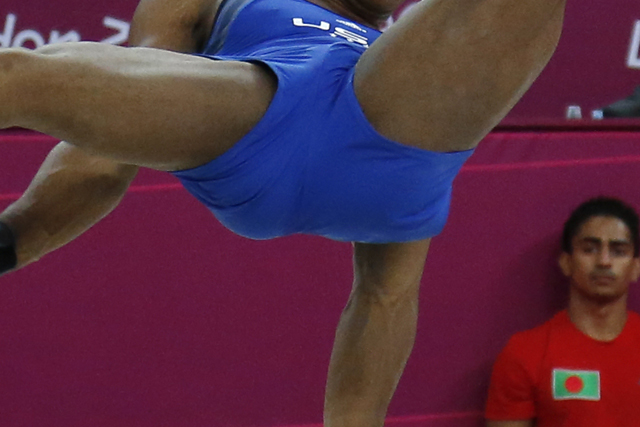
(via ★mathowie)
On Twitter right now, Neil deGrasse Tyson is imagining how various Olympic events would work on Mars.
Women’s Beach Volleyball on Mars: No protective ozone layer there. Solar UV would irradiate all exposed legs, buns, & tummies
Gymnastics: On Mars, with only 38% of Earth’s gravity, the Vault & other spring-assisted leaps would resemble circus cannons.
(via @jaycer17)
You may remember a small chunk of this video from its brief appearance in Get Him to the Greek…happy to find the whole thing.
Newer posts
Older posts





Socials & More