kottke.org posts about remix
It is the assertion of The Walk of Life Project that the Dire Straits song Walk of Life is the perfect thing to play at the end of movies. I have watched more than a dozen of these and they are all great, but I picked Lost in Translation, There Will Be Blood, and Terminator 2 to embed here.
From Candice Drouet, a short film called Last Word, a story told with the last words from 129 movies.
In 2009, Curb Your Enthusiasm centered on Larry David doing another season of Seinfeld. The four main Seinfeld stars (plus Newman) were all on the show, in character. From the various clips and bits shown, Topher Grace edited together a nine-minute “missing” Seinfeld episode. It’s actually pretty good. I didn’t know how much I’d missed the show until I watched this. (thx, greg)
What a great idea. I just wish it were better executed. The weird music they use for the end credits of each movie is too much…it would have been better to just play it straight and let the gag stand by itself. (via cynical-c)
Twitter user @dilsexia posted the first one with the caption “The Revenant”:

Polish blogger Dawid Adamek ran with the idea and created several more Pooh/Oscar mashups:


The Chickening is a surreal visual remix of Stanley Kubrick’s The Shining done by Nick DenBoer and Davy Force. It mostly defies description, so just watch the first minute or so (after which you won’t be able to resist the rest of it). The short film is playing at this year’s Sundance Film Festival.
But seriously, WTF was that?! (via @UnlikelyWorlds)
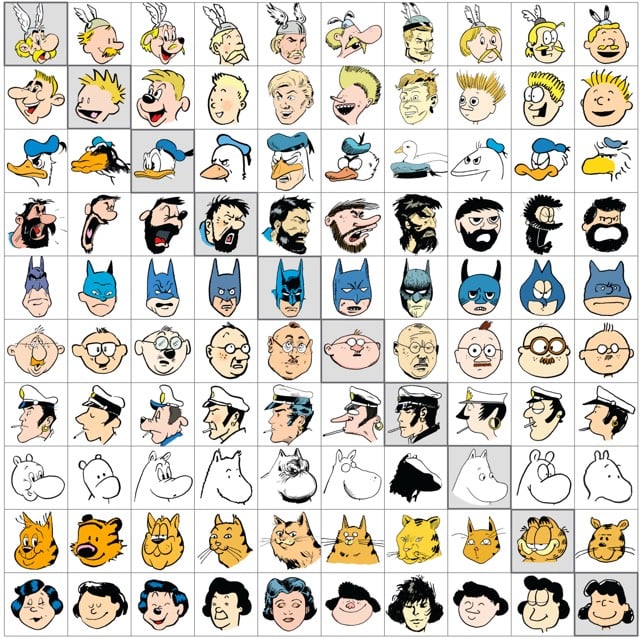
Artist Jaakko Seppälä drew 10 of his favorite comic characters in each other’s distinctive styles, e.g. Lucy van Pelt in the style of Calvin and Hobbes or Garfield in the style of Donald Duck.
Update: See also the Great Comic Switcheroo of 1997, where a bunch of comic authors drew each others’ comics for a day. (via @craigpatik)
Harry Potter and the Half-Blood Prince reimagined as a wacky teen comedy. Excellent editing and music choice elevate this above similar efforts.
This month, HBO is airing a special edition of The Godfather that presents scenes from the first two movies in chronological order with some deleted scenes mixed in for good measure. It’s more than 7 hours long. It’s not listed anywhere on HBO’s site, but supposedly it’ll run all month on HBO and their online and on-demand services.
Jordan Hanzon made an edit of Inside Out showing only the “outside” parts of the film…so, none of the stuff with Joy, Sadness, Anger, etc. I bet Pixar had an internal cut like this just to make sure the outside stuff hung together independent of the inside. (via devour1)
Of Oz the Wizard is the entire Wizard of Oz movie presented in alphabetical order by dialogue. So it starts with all the scenes where Dorothy and the gang say “a”, “aaiee”, “along”, and proceeds through “you’re” and “zipper”. Even the words on each of the title cards are sorted alphabetically.
(I feel like I’ve posted this before — or something like it — but I can’t find it in the archives. Anyone?)
Update: Ah yes, I was thinking of this alphabetized version of Star Wars (which I’ve seen before but somehow never posted):
Another example is Thomson & Craighead’s The Time Machine. Matt Bucy, the creator of Of Oz the Wizard, seems to have pioneered this technique (the Vimeo page indicates it was completed in April 2004) but didn’t post the video online until a few days ago. (via @Mister_Milligan, @sannahahn)
YouTube user darman212 used iOS coding app Hopscotch and Final Cut Pro X to make a version of the Star Wars: The Force Awakens teaser trailer entirely out of emoji. BB-8 is a soccer ball with a bowl of ramen on his head!

(via @marcprecipice)
Star Wars Minus Star Wars is a video essay on the original film that doesn’t use a single shot, sound, or snippet of music from the original movie. Instead, it strings together scenes and sounds from movies that influenced George Lucas in making the film and also from movies that have been influenced by Star Wars.
It’s impossible to overstate the impact of Star Wars. Its arrival in theaters on May 25th 1977 marked the end of one chapter in film history and the beginning of another. It’s a hinge on which film history swings. Upon its release, critic Pauline Kael derided the film as “an assemblage of spare parts-it has no emotional grip… an epic without a dream” Twenty years after its release critic Roger Ebert remarked that the film “colonized our imaginations, and it is hard to stand back and see it simply as a motion picture, because it has so completely become part of our memories.”
They’re both right. Star Wars succeeded because of its roots in film history and mythology, and its influence over generations of filmmakers can be felt in countless works that came after it. For better or worse, Star Wars engulfs the past and future of moviemaking.
That was super-fun to watch. See also Where did Star Wars come from? and Paul’s Boutique Minus Paul’s Boutique. (via @tonyszhou, who calls it “the best Star Wars video essay ever”)
Update: This might be even more impressive. John D’Amico made a full-length shot-for-shot remake of Star Wars using material that influenced (or may have influenced) Lucas in making the film. Very cool.
(thx, jim)
From Henning Lederer, a series of 55 vintage book covers gently animated. Lederer previously did an animation of Fritz Kahn’s famous poster, Der Mensch als Industriepalast.
Some amazing person has collected the full tracks of the songs that were sampled by the Beastie Boys on six of their best-known albums and provided them as a downloadable zip file. That’s 286 tracks, 22 hours of music, and encoded between 256kbps and 320kbps.
Obviously not every sample or drum break can or ever will be identified, but this is about as close as it’s gonna get! With the completion of this eighteen year long ongoing project, I want to personally thank each and every single person out there that has lent insight, shared knowledge, or provided me with any of the tracks that were used to compile this amazing piece of history. It goes without saying that much love, gratitude, and respect is owed to the Beastie Boys for introducing me (and you) to some amazing music via sampling that may otherwise not be heard, let alone acknowledged in this light.
Some of the included tracks:
Led Zeppelin - When The Levee Breaks
Kurtis Blow - Christmas Rappin’
Johnny Cash - Folsom Prison Blues
The Beatles - Sgt. Pepper’s Lonely Hearts Club Band
Jimi Hendrix - Foxey Lady
Stephen Sondheim - Act I: Company
Peggy Lee - Sittin’ On The Dock Of The Bay
See also Paul’s Boutique Without Paul’s Boutique, where Tim Carmody provides some context behind the Beasties’ sampling:
The remix is fun to listen to, but mostly, it just reminds you that Paul’s Boutique sounds amazing because its sampled sources were amazing. Like De La Soul’s Three Feet High and Rising, released the same year, Paul’s Boutique lifts tracks that would cost a small mint to borrow from today. (Three Feet High has never had an official digital release because the rights holders still can’t sort out the royalties.) The Beatles, The Supremes, The Ramones, Curtis Mayfield, Dylan, Hendrix, Sly, Bernard Hermann, and James Brown (of course) are all there. But mostly, it’s a love letter to old-school New York City hip hop: Kurtis Blow, Afrika Bambaataa and the Jazzy 5, The Sugarhill Gang, The Funky 4 +1, and contemporaries like Run-DMC, Boogie Down Productions, and Public Enemy are the glue that holds the whole project together.
Now, if you know Paul’s Boutique well, you can’t hear those older songs any more without hearing Paul’s Boutique. There’s specific moments in those songs that hide there waiting for you to trip over them, like quotations of ancient Greek in an Ezra Pound or TS Eliot poem. Beastie Boys didn’t just find a way to make older music sound new; they found a way to invent their own precursors.
(via @tcarmody)
Newer posts
Older posts




Socials & More