kottke.org posts about politics
As Eric Levitz writes in a piece called Millennials Need to Start Voting Before the Gerontocracy Kills Us All, younger Americans are under-represented in American political life.
The United States, circa 2018, looks like a place run by people who know they’re going to die soon.
As “once in a lifetime” storms crash over our coasts five times a year - and the White House’s own climate research suggests that human civilization is on pace to perish before Barron Trump — our government is subsidizing carbon emissions like there’s no tomorrow. Meanwhile, America’s infrastructure is already “below standard,” and set to further deteriorate, absent hundreds of billions of dollars in new investment. Many of our public schools can’t afford to stock their classrooms with basic supplies, pay their teachers a living wage, or keep their doors open five days a week. Child-care costs are skyrocketing, the birth rate is plunging, and the baby boomers, retiring. And, amid it all, our congressional representatives recently decided that the best thing they could possibly do with $1.5 trillion of borrowed money was to give large tax breaks to people like themselves.
See also Dear Young People: Don’t Vote. As Levitz says though, one of the reasons that young people don’t vote is that it’s often more difficult for them than for older people. Making it easier for everyone to vote would alleviate many of these concerns and result in higher turnout, more political engagement, and better representation for young Americans.
Millennials in the U.S. are more underrepresented than their peers in most other developed countries. Primary responsibility for this fact lies with our nation’s political parties, which have made America an exceptionally difficult place to cast a ballot. If Democrats wish to increase turnout among the young, they’d be well advised to implement automatic voter registration, a new Voting Rights Act, and a federal holiday on the first Tuesday in November, when and if they have the power to do so.
Inflexible work schedules, lack of transportation, voter ID laws, fewer polling places, etc…it amounts to voter suppression of young people.
Voter suppression is often, correctly, viewed through a racial or class-based lens — however, these same laws also target younger people. A group that tends to vote more often for third-party and Democratic candidates.
For example, states such as Texas and Ohio require voter identification at the polling place — a college or university ID doesn’t qualify. In Wisconsin, voter ID laws permitted college IDs but not out-of-state drivers licenses, which, local news reported, resulted in many university students getting turned away in the April 2016 primary. In North Carolina, another key state in the Electoral College, hundreds of students cast provisional ballots in 2016, unsure whether their vote would even count because of their strict voter ID laws — which were struck down this year by the Supreme Court, but not before disenfranchising potentially thousands of American citizens.
(thx kate & @lauraolin)
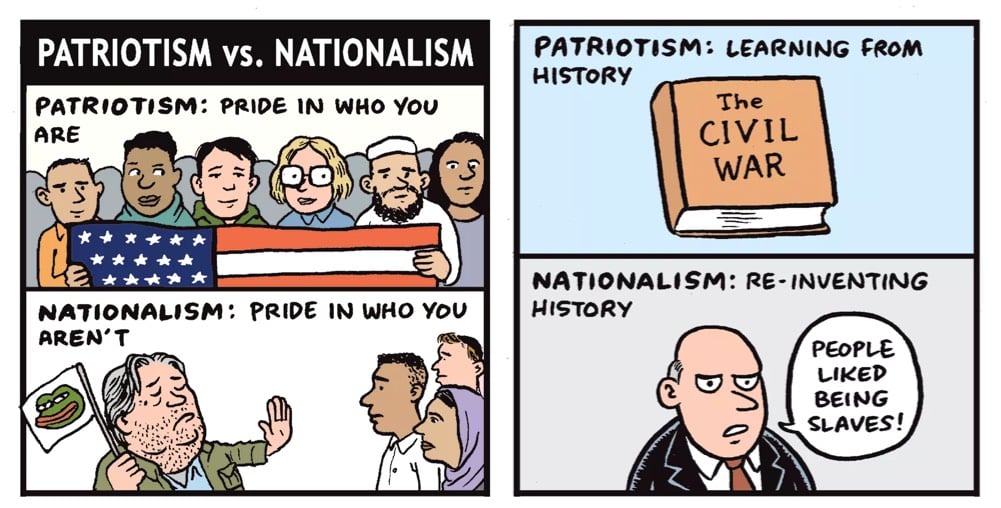
At a time when fascism & authoritarianism are creeping into the global politics of the developed world, it’s useful for us to reacquaint ourselves with the difference between nationalism and patriotism. In the wake of World War II, George Orwell wrote an essay called Notes on Nationalism (available in book form here). The first two paragraphs define nationalism and contrast it with patriotism:
Somewhere or other Byron makes use of the French word longeur, and remarks in passing that though in England we happen not to have the word, we have the thing in considerable profusion. In the same way, there is a habit of mind which is now so widespread that it affects our thinking on nearly every subject, but which has not yet been given a name. As the nearest existing equivalent I have chosen the word ‘nationalism’, but it will be seen in a moment that I am not using it in quite the ordinary sense, if only because the emotion I am speaking about does not always attach itself to what is called a nation — that is, a single race or a geographical area. It can attach itself to a church or a class, or it may work in a merely negative sense, against something or other and without the need for any positive object of loyalty.
By ‘nationalism’ I mean first of all the habit of assuming that human beings can be classified like insects and that whole blocks of millions or tens of millions of people can be confidently labelled ‘good’ or ‘bad’. But secondly — and this is much more important — I mean the habit of identifying oneself with a single nation or other unit, placing it beyond good and evil and recognizing no other duty than that of advancing its interests. Nationalism is not to be confused with patriotism. Both words are normally used in so vague a way that any definition is liable to be challenged, but one must draw a distinction between them, since two different and even opposing ideas are involved. By ‘patriotism’ I mean devotion to a particular place and a particular way of life, which one believes to be the best in the world but has no wish to force on other people. Patriotism is of its nature defensive, both militarily and culturally. Nationalism, on the other hand, is inseparable from the desire for power. The abiding purpose of every nationalist is to secure more power and more prestige, not for himself but for the nation or other unit in which he has chosen to sink his own individuality.
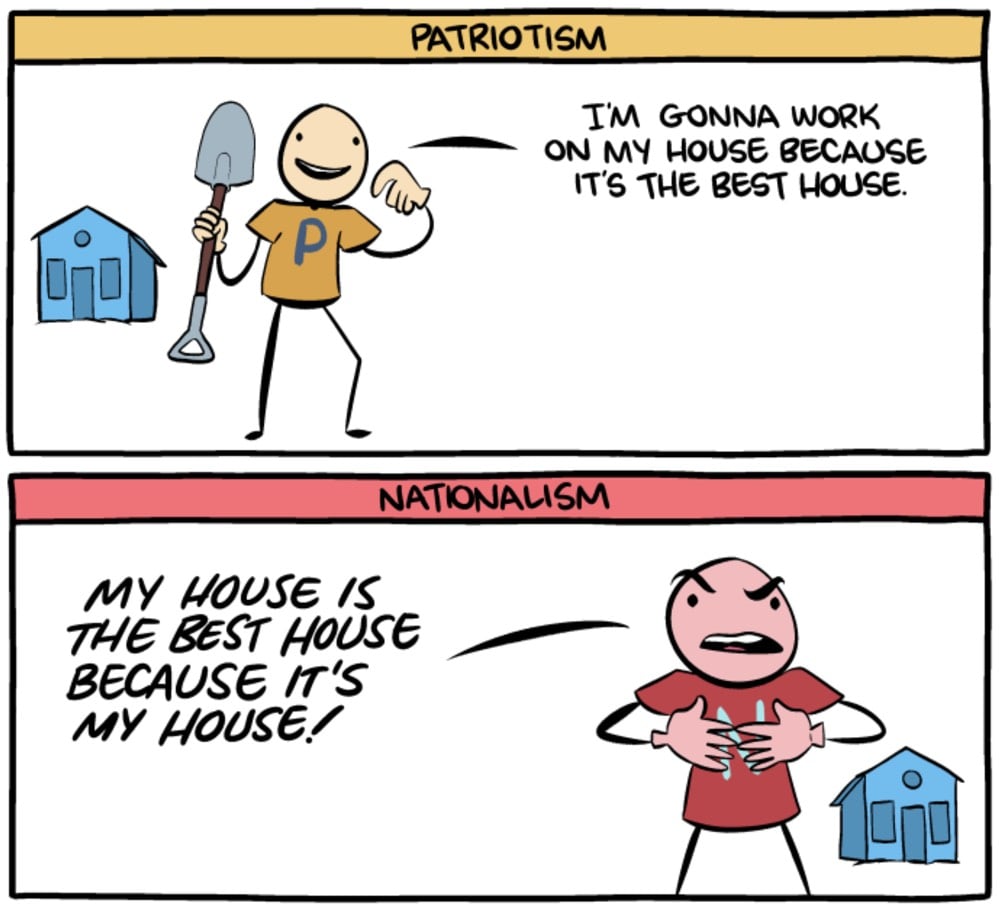
The whole essay is worth a read; you’ll find yourself nodding in recognition at many points. More succinctly, Jen Sorensen’s Patriotism vs. Nationalism comic (excerpted above) and Zach Weinersmith’s An Important Distinction comic (below) cover some of the same ground.
See also a more progressive definition of freedom.
Vox has updated their video on how US politicians talked about climate change over the past 12 years. Until recently, climate change was more or less a bipartisan issue. Democrats and Republicans alike publicly acknowledged that climate change was happening, that humans were at least partially responsible, and that we needed to do something about it. Perhaps Republicans were a little less sincere in their desire for action and all politicians were not as urgent in their response as the situation required, but at a minimum, they all believed what scientists were saying.
Then, as this video shows, after the election of Barack Obama in 2008 and the Republican victories in the 2010 midterms, things shifted. Republicans increasingly came out saying, well, the science isn’t settled on this, we don’t know what is causing climate change, so we’re not going to do anything about it. They did this in part because their big political donors wanted them to.
Those divisions did not happen by themselves. Republican lawmakers were moved along by a campaign carefully crafted by fossil fuel industry players, most notably Charles D. and David H. Koch, the Kansas-based billionaires who run a chain of refineries (which can process 600,000 barrels of crude oil per day) as well as a subsidiary that owns or operates 4,000 miles of pipelines that move crude oil.
Government rules intended to slow climate change are “making people’s lives worse rather than better,” Charles Koch explained in a rare interview last year with Fortune, arguing that despite the costs, these efforts would make “very little difference in the future on what the temperature or the weather will be.”
I posted about the first installment of this video last year and watching it again hit me about as hard as it did the first time around. The amount of cynicism and lack of integrity & sense of duty here is staggering. What tiny tiny minds. [Insert a lot of swearing about Republicans here that I will get email about so I’ll just save us all some time and skip it. But seriously, fuck these assholes.]
In his Rolling Stone article on John McCain’s failed campaign for the 2000 Republican nomination for President, David Foster Wallace wrote about how not voting is like shooting yourself in the foot.
If you are bored and disgusted by politics and don’t bother to vote, you are in effect voting for the entrenched Establishments of the two major parties, who please rest assured are not dumb, and who are keenly aware that it is in their interests to keep you disgusted and bored and cynical and to give you every possible psychological reason to stay at home doing one-hitters and watching MTV on primary day. By all means stay home if you want, but don’t bullshit yourself that you’re not voting. In reality, there is no such thing as not voting: you either vote by voting, or you vote by staying home and tacitly doubling the value of some Diehard’s vote.
Please check your registration status and register to vote…it takes two minutes. Voter registration deadlines are fast approaching in many US states — there are deadlines tomorrow in Arizona, Arkansas, Florida, Georgia, Indiana, Kentucky, Louisiana, Michigan, Mississippi, New Mexico, Ohio, Pennsylvania, Tennessee, and Texas. If you don’t see your state in that list, don’t assume you have all the time in the world…check your status and register to vote anyway.
See also Dear Young People: “Don’t Vote”. (via nitch)
The trailer for Adam McKay’s upcoming movie about Dick Cheney and the Bush administration just came out this morning. The movie promises an “untold story” and the casting is kind of amazing: Christian Bale as Cheney, Steve Carell plays Donald Rumsfeld, Amy Adams plays Lynne Cheney, and Sam Rockwell is pretty spot on as George W. Bush.
VICE explores the epic story about how a bureaucratic Washington insider quietly became the most powerful man in the world as Vice-President to George W. Bush, reshaping the country and the globe in ways that we still feel today.
I loved McKay’s The Big Short, so despite never wanting to think about any of those horrible men ever again, I am looking forward to watching this.
At this point, reading about how incompetent the Trump campaign and White House have been and continue to be — perhaps knowingly, given the viewpoint of some of his advisors and backers about wanting to weaken the federal government — is getting tiring, but Michael Lewis is always worth paying attention to. His newest book, The Fifth Risk, is about how unprepared the incoming Trump administration was to govern the country, to “take control of the portfolio of existential risks managed by the US government” as he puts it. The Guardian has an excerpt:
Chris Christie was sitting on a sofa beside Trump when Pennsylvania was finally called. It was 1.35am, but that wasn’t the only reason the feeling in the room was odd. Mike Pence went to kiss his wife, Karen, and she turned away from him. “You got what you wanted, Mike,” she said. “Now leave me alone.” She wouldn’t so much as say hello to Trump. Trump himself just stared at the TV without saying anything, like a man with a pair of twos whose bluff has been called. His campaign hadn’t even bothered to prepare an acceptance speech. It was not hard to see why Trump hadn’t seen the point in preparing to take over the federal government: why study for a test you will never need to take? Why take the risk of discovering you might, at your very best, be a C student? This was the real part of becoming president of the US. And, Christie thought, it scared the crap out of the president-elect.
Not long after the people on TV announced that Trump had won Pennsylvania, Jared Kushner grabbed Christie anxiously and said: “We have to have a transition meeting tomorrow morning!” Even before that meeting, Christie had made sure that Trump knew the protocol for his discussions with foreign leaders. The transition team had prepared a document to let him know how these were meant to go. The first few calls were easy — the very first was always with the prime minister of Great Britain — but two dozen calls in you were talking to some kleptocrat and tiptoeing around sensitive security issues. Before any of the calls could be made, however, the president of Egypt called in to the switchboard at Trump Tower and somehow got the operator to put him straight through to Trump. “Trump was like … I love the Bangles! You know that song Walk Like an Egyptian?” recalled one of his advisers on the scene.
Ho. Ly. Shit. Incredibly, Lewis’ very next line is: “That had been the first hint Christie had of trouble.” — which makes Chris Christie the most tone-deaf individual in the world? (Probably…Christie was fired the next day, a complete surprise to him.)
The book comes out tomorrow…you can pre-order from Amazon here.
Hello everyone. Today is my birthday, and I’m taking the day off. My pal Tim will be here tomorrow to share some knowledge and perspective with you.
Since it’s my birthday, I think the rule is that I get to ask you a favor. If you’re an eligible US citizen, please take just two minutes to register to vote in the November elections. If you believe you’re already registered, please check your status because some areas of the country are aggressively removing people from electoral rolls. If you’re all set, please reach out to a friend, family member, or coworker to make sure they’re registered. In conclusion:

Thank you.
The old white people of America have a message for the young adults of America: we’ll be dead soon but if you don’t vote, you’re letting us determine what kind of world you’ll live in.
Everything’s fine the way it is. Trump…that was us. He’s our guy. Tax cuts for the rich? Hell yeah, I’m rich as fuck. Climate change? That’s a “you problem”…I’ll be dead soon. Sure, school shootings are sad, but I haven’t been in a school for 50 years.
A look at the voter participation rates in Presidential election years confirms that the 65 and older cohort votes at a much higher rate than the 18-29 group.
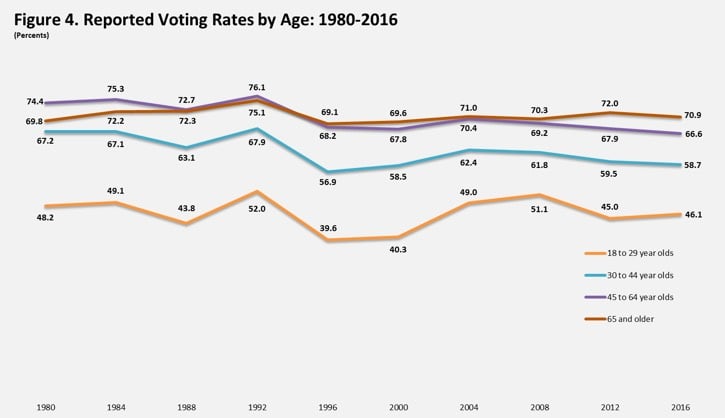
If young people voted at a higher rate, our government would look a lot different. (via df)
Even though the diversity of the US Congress has increased in recent years, a trend that looks to continue after the midterm elections in November, overall the 538 people who serve in Congress are not actually that representative of the US population as a whole. Congress is still way more white, male, and Christian than the US as a whole.
In 2016, Ken Flerlage looked at the gender, religious, and racial diversity of the United States and compared it to that of Congress.
Congress has 104 women (19%) and 431 men (81%) while the United States population is 51% female and 49% male. In order to be truly representative, in terms of gender, 168 seats currently held by men would need to be won by women (taking the number to 272 women and 263 men). It is also worth noting that, of the 104 women, 76 are Democrat (73%), while only 28 are Republican (27%).
And here is the visualization for religion:
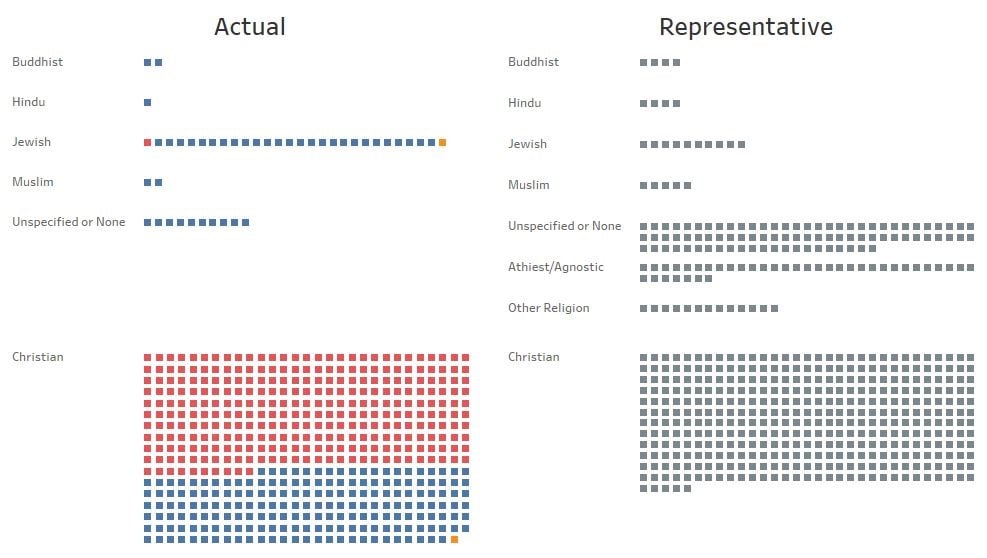
7.1% of the population are atheist or agnostic and 2.4% ascribe to “other” religions (this includes “don’t know”, other world religions, Pagan, Wiccan, Native American religions, and numerous others), yet not a single member of Congress falls into any of these categories.
When you hear people saying that America is still largely a patriarchal & white supremacist society, this is what they are talking about. It’s not just people being hyperbolic.
You could easily expand on this analysis by breaking it down by age, income, education, urban vs rural, sexual orientation, and occupation. You could guess that a truly representational Congress would be younger, waaaay more poor, less accredited, more urban, less straight, more working class, and, when you consider the gender & racial factors, much more politically progressive, but it would be illuminating to see the actual numbers. I’d love to see the NY Times (maybe The Upshot?), FiveThirtyEight, or The Pudding tackle this analysis.
P.S. It’s also worth noting a truly representational Congress would include full voting members from Puerto Rico and Washington DC as well as from other US territories. And maybe separate Native American representation?

My friend, the novelist/fabulist/media inventor Robin Sloan, has a charming new short story that imagines how Dwayne “The Rock” Johnson will become President, first by playing the role in an imaginary movie. Along the way, there are some poignant thoughts about the nature of our political imaginations, the role of new media like Instagram in shaping public perception, and the ways leadership can, spell-like, be brought into being.
Here is the meager gift tucked into the disaster that is Donald Trump: now, anyone can be elected president, so anyone will be elected president. We might never have another lawyer in that office again. Donald Trump broke the seal, but Dwayne Johnson will fulfill the prophecy.
Can you imagine him on the debate stage? The way he’ll look alongside his opponents in the primary? A line of normal, rumpled humans, and then this towering figure. A political revolution: his suit will fit.
If he runs, he will win, and he will run, so the question isn’t, will Dwayne Johnson be president; rather, it’s: what kind of president will Dwayne Johnson be?
“Give me the place to stand, and I shall move the earth,” said Archimedes, maybe. With this book, we’ll set our feet and push.
The story and its narrator are so cynical and idealistic at once that it’s hard to characterize. Wasn’t the Emma Lazarus poem “The New Colossus” a self-invention of sorts? the story’s narrator asks. Couldn’t a new myth, a new colossus, reanimate that central idea, that openness to all peoples and possibilities, again?
The fact that on the one hand, America is “a nation of Presidents,” creating its own institutions, rules, and leaders, and a nation that could swoon for The Scorpion King because his Instagram videos are just so damned good, just illustrates one of hundreds of central contradictions about this place.
Are those contradictions hindrances to us? Do they fuel us? Or are they just unavoidable, constituent elements to the place and its peoples?
I don’t know. But I’m glad this story is poking those contradictions with a stick.
At The Atlantic, Yoni Applebaum argues that a decline in democracy isn’t just about voter disenfranchisement, gerrymandering, and radical inequality, but also the decline of smaller civic institutions. The 19th century saw a boom in democratic governance of public/private associations, not just local and federal government:
By the latter half of the 19th century, more and more of these associations mirrored the federal government in form: Local chapters elected representatives to state-level gatherings, which sent delegates to national assemblies. “Associations are created, extended, and worked in the United States more quickly and effectively than in any other country,” marveled the British statesman James Bryce in 1888. These groups had their own systems of checks and balances. Executive officers were accountable to legislative assemblies; independent judiciaries ensured that both complied with the rules. One typical 19th-century legal guide, published by the Knights of Pythias, a fraternal order, compiled 2,827 binding precedents for use in its tribunals.
The model proved remarkably adaptable. In business, shareholders elected boards of directors in accordance with corporate charters, while trade associations bound together independent firms. Labor unions chartered locals that elected officers and dispatched delegates to national gatherings. From churches to mutual insurers to fraternities to volunteer fire companies, America’s civic institutions were run not by aristocratic elites who inherited their offices, nor by centrally appointed administrators, but by democratically elected representatives…
This nation of presidents—and judges, representatives, and recording secretaries—obsessed over rules and procedures. Offices turned over at the end of fixed terms; new organizations were constantly formed. Ordinary Americans could expect to find themselves suddenly asked to join a committee or chair a meeting. In 1876, an army engineer named Henry Robert published his Pocket Manual of Rules of Order for Deliberative Assemblies, and it improbably became a best seller; within four decades, more than 500,000 copies were in print. It was, a Boston newspaper declared, “as indispensable as was the Catechism in more ecclesiastical times.”
We were, as the University of Georgia’s Walter Hill said in 1892, “a nation of Presidents.” And the decline of those traditions, those rituals of democracy, tracks a corresponding decline in respect for and interest in political democracy. That, at least, is Applebaum’s take.
I’m less sure. I think the history and sociology of these voluntary associations is fascinating, and deserves to be part of what we talk about when we talk about democracy writ large. But I think (and I would guess this would probably be taken as a friendly amendment) we also have to think about the transformations in other institutions we know are connected to democracy, like the media, public schools, and public institutions like libraries. Places that don’t necessarily have elected officers, but likewise help preserve certain rituals of democracy that we all have to learn in order to interact in a democratic society. How we read, how we think, how we share space — all of this matters, the anthropology as much as the law.
In other words, there’s a formal and informal side to democracy, and neither one of them is necessarily more important than the other. Not to mention that elections and officers are features of only a certain kind of democracy, and there are other, more radical forms of democracy that are available to us — all of which were experimented with in the 18th and 19th centuries too, by anarchists, socialists, and other people who didn’t take the US’s electoral model has having definitively solved the question of what a democratic society might look like.
The broader truth I take from this is that, to borrow from Aristotle, we are what we do repeatedly. If we’re not a nation of Presidents any more, it means we’ve become a different kind of democracy, not necessarily an un-democracy. And that’s significant. We’ve mutated into something else: a different kind of mass democracy, linked together by a different set of institutions with a different set of principles, leading to a different set of possibilities.
Bob Woodward’s much-anticipated book, Fear: Trump in the White House, comes out next week. The Washington Post somehow “obtained” a copy (did they swipe it off Woodward’s desk?) and provided a summary of some of the book’s main points.
A central theme of the book is the stealthy machinations used by those in Trump’s inner sanctum to try to control his impulses and prevent disasters, both for the president personally and for the nation he was elected to lead.
Woodward describes “an administrative coup d’etat” and a “nervous breakdown” of the executive branch, with senior aides conspiring to pluck official papers from the president’s desk so he couldn’t see or sign them.
Again and again, Woodward recounts at length how Trump’s national security team was shaken by his lack of curiosity and knowledge about world affairs and his contempt for the mainstream perspectives of military and intelligence leaders.
The degree to which the people around Trump handle and describe him like a small child is still, after more than a year and a half of this nightmare, completely batshit insane and unbelievable. Arrested development.
Update: All other considerations about the anonymous NY Times opinion piece written by “a senior official in the Trump administration” aside, it’s another example of Trump being treated like a toddler by his staff.
From the White House to executive branch departments and agencies, senior officials will privately admit their daily disbelief at the commander in chief’s comments and actions. Most are working to insulate their operations from his whims.
Meetings with him veer off topic and off the rails, he engages in repetitive rants, and his impulsiveness results in half-baked, ill-informed and occasionally reckless decisions that have to be walked back.
“There is literally no telling whether he might change his mind from one minute to the next,” a top official complained to me recently, exasperated by an Oval Office meeting at which the president flip-flopped on a major policy decision he’d made only a week earlier.
“Half-baked, ill-informed and occasionally reckless decisions that have to be walked back” … “literally no telling whether he might change his mind from one minute to the next” — is he 3 or 72?
Pete Buttigieg is the mayor of South Bend, Indiana. He is a progressive Democrat, Rhodes scholar, served a tour of duty in Afghanistan during his time as mayor, and is openly gay. In a recent interview with Rolling Stone, Buttigieg talked about the need for progressives to recast concepts that conservatives have traditionally “owned” — like freedom, family, and patriotism — in more progressive terms.
You’ll hear me talk all the time about freedom. Because I think there is a failure on our side if we allow conservatives to monopolize the idea of freedom — especially now that they’ve produced an authoritarian president. But what actually gives people freedom in their lives? The most profound freedoms of my everyday existence have been safeguarded by progressive policies, mostly. The freedom to marry who I choose, for one, but also the freedom that comes with paved roads and stop lights. Freedom from some obscure regulation is so much more abstract. But that’s the freedom that conservatism has now come down to.
Or think about the idea of family, in the context of everyday life. It’s one thing to talk about family values as a theme, or a wedge — but what’s it actually like to have a family? Your family does better if you get a fair wage, if there’s good public education, if there’s good health care when you need it. These things intuitively make sense, but we’re out of practice talking about them.
I also think we need to talk about a different kind of patriotism: a fidelity to American greatness in its truest sense. You think about this as a local official, of course, but a truly great country is made of great communities. What makes a country great isn’t chauvinism. It’s the kinds of lives you enable people to lead. I think about wastewater management as freedom. If a resident of our city doesn’t have to give it a second thought, she’s freer.
Clean drinking water is freedom. Good public education is freedom. Universal healthcare is freedom. Fair wages are freedom. Policing by consent is freedom. Gun control is freedom. Fighting climate change is freedom. A non-punitive criminal justice system is freedom. Affirmative action is freedom. Decriminalizing poverty is freedom. Easy & secure voting is freedom. This is an idea of freedom I can get behind.
On Twitter, @InstantSunrise wrote an entertaining thread “in which I drag every single US president in order”. She starts off with The Founding Fathers:
Thomas Jefferson: Motherfucker owned slaves, and was a rapist, committed forced removal against Native Americans. Started an actual war in North Africa and a trade war with Britain that would eventually escalate into an actual war.
Andrew Jackson is deservedly dragged more than most:
Ohhhhhh my god. This absolute motherfucker garbage president. Literally committed genocide. Owned slaves, gave govt. jobs to people who gave him money. Decided that a central bank was a bad idea and closed it in 1837, breaking the entire economy.
Teddy Roosevelt gets a B/B-:
Did some good busting trusts and monopolies with his big dick energy. Discovered that if you bait the media with “access” they’ll eat up whatever shit you say. Had a lot of policies that were racist as shit, like banning all Japanese ppl from entering the US.
Woodrow Wilson gets a Jackson-esque OMG:
Ohhhhhh my god. Dude was like super fucking racist. So racist that his election emboldened racists enough where they literally revived the KKK. His AG, Palmer, loved to deport leftists for no reason. There’s so much shit about Wilson I can’t fit it into 280 chars.
I think she could have gone in on Nixon a bit harder (for creating the war on drugs for example):
Created the southern strategy and stoked racial tensions. Sabotaged the peace negotiations for Vietnam in order to get elected, then prolonged the war. Bombed the shit out of Laos and Cambodia for no real reason. Also watergate.
Only Lincoln and John Quincy Adams get off relatively unscathed.
Beto O’Rourke is running against Ted Cruz for one of Texas’ two Senate seats. At a recent event, he was asked if he thought that NFL players kneeling during the national anthem to protest police violence against black people was disrespectful.
I kind of wanted to know how you personally felt about how disrespectful it is — like, you have the NFL players kneeling during the national anthems. I wanted to know if you found that disrespectful to our country, to our veterans, and anybody related to that.
O’Rourke’s answer, which connects this protest to past non-violent protests undertaken by black Americans, is pitch-perfect — honest, respectful of the questioner & the audience, and inclusive.
I can think of nothing more American than to peacefully stand up, or take a knee, for your rights anytime, anywhere, any place.
That’s how you politic.
P.S. In his campaign against Cruz, O’Rourke is relying solely on individual donors, no PAC money. If you’d like to help him out, you can donate to his campaign here.
Newer posts
Older posts





Socials & More