I can’t figure out if Meryl Streep is almost nailing her Julia Child impression or completely blowing it. Also, Streep is ~5’7”….I don’t know what they’re doing in the movie to make her look so tall, but it doesn’t work.
Sport Science recently tested to see whether professional golfer Padraig Harrington could drive the ball further than normal by employing a Happy Gilmore swing.
The good stuff doesn’t get going until around 3:00. The running swing technique increased Harrington’s distance by an average of 30 yards but his accuracy suffered. The split-screen view of his stationary and running swings is amazing…it’s the same swing.
Our nation’s food supply is now controlled by a handful of corporations that often put profit ahead of consumer health, the livelihood of the American farmer, the safety of workers and our own environment. Food, Inc. reveals surprising — and often shocking truths — about what we eat, how it’s produced, who we have become as a nation and where we are going from here.
The whole-earth nature documentary space is quickly becoming crowded. We’ve got:
The Blue Planet, 2001
Deep Blue, 2003
Planet Earth, 2006
Earth, 2009
Nature’s Great Events, 2009
Oceans, 2010
The last one on the list is from Disney. If you watch the trailer, the company is attempting to say, “Planet Earth? Ha! Disney was down with nature all along!” Pfft. A point in Disney’s favor however is that Oceans is being done by Jacques Perrin, the man responsible for Microcosmos and Winged Migration. Points against: the film has cost $75 million so far (for a documentary!), the footage in the trailer looks like it was lifted directly from The Blue Planet and Planet Earth, and no David Attenborough narration.
Update: I added Earth to the list, also from Disney. Here’s the trailer. BBC and Discovery are listed as partners so it’s likely that the footage in the film is from Planet Earth. (thx, @gjdsalinger)
At the restaurant, on the phone with the Maitre D’ he says, “This is Sgt. Peterson, Chicago Police.” Violation of 720 ILCS 5/32-5.1: False Personation of a Peace Officer. A person who knowingly and falsely represents himself or herself to be a peace officer commits a Class 4 felony.
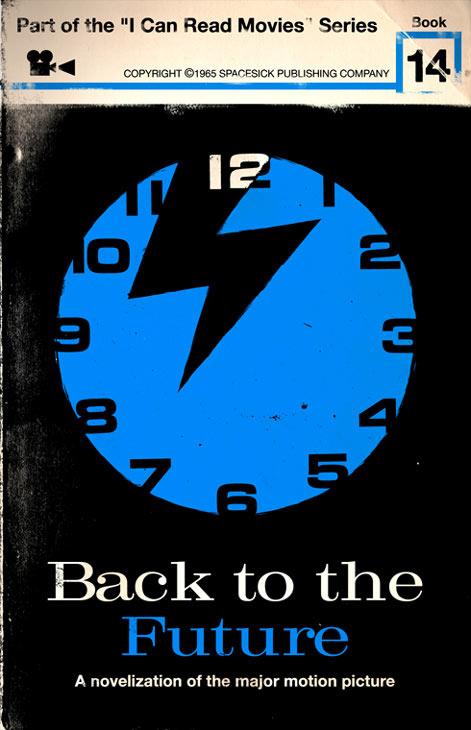
Recently a number of efforts have been made at re-imagining the packaging for movies, books, video games, and other media, mostly mashups and in the illustration style of typical of Saul Bass’ movie posters or Penguin Classics book covers. I’ve collected several examples below.
In his I Can Read Movies series, spacesick imagines Penguin-like book covers for movies like Close Encounters of the Third Kind, Sixteen Candles, and Back to the Future.
Wait, Steven Soderbergh is directing the film adaptation of Michael Lewis’ Moneyball? When did this wonderfulness happen?!! Last I heard, the director was the guy who did Marley & Me. Perhaps Pitt put the kibosh on that and lobbied for Soderbergh? (via fimoculous)
Matt Zoller Seitz has completed his five-part look at Wes Anderson’s influences.
Part 1: Bill Melendez, Orson Welles, and Francois Truffaut Part 2: Martin Scorsese, Richard Lester, and Mike Nichols Part 3: Hal Ashby Part 4: J.D. Salinger Part 5: The Royal Tenenbaums, annotated
Seek out the video links in the right sidebar; they’re better than just reading the text. From the Salinger segment:
Detractors say Anderson’s dense production design (courtesy of regular collaborator David Wasco) overwhelms his stories and characters. This complaint presumes that in real life our grooming and style choices aren’t a kind of uniform — visual shorthand for who we are or who we want others to think we are. This is a key strength of both Anderson and Salinger’s work. Both artists have a knack for what might be called “material synecdoche” — showcasing objects, locations, or articles of clothing that define whole personalities, relationships, or conflicts.
The fifth part, where Seitz annotates the beginning segment of The Royal Tenenbaums with text, images, and video, is particularly fun to watch.
[Ed note: This is a piece by Matt Bucher, written a few years ago for the now-defunct andbutso.com. Reprinted with permission.]
The Royal Tenenbaums (RT) opens with a shot of a book, titled The Royal Tenenbaums, and immediately a narrator (Alec Baldwin) begins to read the opening paragraph of the book. Throughout the film, we are led to believe that this narrator is reading us the story of the book The Royal Tenenbaums. While that prose-form screenplay serves as the narration, I believe that another book, Infinite Jest (IJ), manages to influence the film in a number of general and specific parallels. In no way could I substantiate the claim that Wes Anderson and Owen Wilson have read Infinite Jest or that they are in any way aware of the specific connections between their film and Wallace’s book (or even that Anderson and Wilson are the exclusive authors of the RT screenplay). {However, Anderson and Wilson are natives of Austin, TX and DFW wrote in a postcard to Rachel Andre [2001] that he loves Austin — “especially the bat caves at sunset”.} Taken piece-by-piece, it seems clear that any correlation between IJ and RT is coincidental at best. However, considered as a whole, the resemblances between the two reach the heights of the uncanny.
Rather than provide a close reading of all 1,079 pages of Infinite Jest, I will look here only at those sections pertaining to the mirror-image of the Tenenbaum family, mostly the Incandenza family.
“The Royal Tenenbaums” is the story of a family, and, as the movie opens, we are introduced to its members. The children — all prodigies in their own right — are Margot, the adopted, but award-winning playwright; Richie, the tennis champion; and Chas, the real-estate and business tycoon. The patriarch of the family, Royal, and his wife, Etheline, separated immediately after the children were born and two decades of betrayal, deceit, and failure, erased the brilliance of the young Tenenbaums.
In IJ, the parallel family of the Tenenbaums is the Incandenzas. When we meet the Incandenza family we learn matriarch and patriarch are no longer married, but unlike Royal and Etheline, who split for obvious personality differences, James O. Incandenza (JOI) and Avril M. Incandenza (AMI) are no longer married because JOI is dead. Like the Tenenbaums, the Incandenzas produced three offspring: Orin, the womanizing tennis-prodigy turned football punter; Hal, eidetic tennis prodigy; and Mario, kind-hearted, bradykinetic, homodontic dwarf. There are qualities of each Incandenza that correspond to qualities and traits found in the Tenenbaums, but also the correspondence falls outside of the two families to the extended families of in-laws and friends (Eli Cash, Dudley, Raleigh St. Claire, Pagoda, etc.). Here is a quick run-down.
Marlon Bain is a regular fixture at the Incandenza residence as a child, just as Eli Cash, as a child, is a regular fixture at the Tenenbaum residence. Eli admits that he always wanted to be a Tenenbaum, but one gets the feeling that Marlon Bain got away from the Incandenzas as soon as possible. Eli sleeps with Margot (Richie’s sister and object of Richie’s affections), but in IJ, Orin sleeps with Bain’s sister (without there being any apparent affection involved — witnessed by Orin’s classification of her as just another “Subject”). Eli is eccentric at the very least, but Bain suffered from “the kind of OCD you need treatment for” (similar to Avril’s compulsions).
Margot Tenenbaum loses a finger to an axe, just as Trevor Axford loses a finger (or two) to a fireworks incident.
Margot Tenenbaum is a long-term smoker, who hides this from everyone, just as Hal Incandenza is a regular pot smoker who hides this fact from almost everyone.
Richie Tenenbaum is a tennis prodigy, just as Hal and Orin Incandenza were; and Richie’s on-court breakdown could be compared to Hal’s near loss to Stice or Pemulis’s dosing of his opponent or pretty much any other breakdown in the book.
One child in each family produces a drama: Margot Tenenbaum and Mario Incandenza.
The suicide attempt of Richie Tenenbaum seems reminiscent of Joelle Van Dyne’s, as both take place alone in a bathroom.
Both JOI and Royal Tenenbaum have rival suitors (Tavis, for one, and Mr. Henry for Etheline) and both patriarchs die in the course of the book / movie.
Eli Cash is a drug addict of the highest type, much like Gately, Hal, and the varied addicts of IJ. Eli is nonchalant about his drug use, but also feels the need to hide it from those closest to him.
The Incandenzas have a dog loved primarily by a family member (S. Johnson and Avril) as do the Tenenbaums (Buckley by Ari and Uzi). Both dogs die.
Chas subjects Ari and Uzi to Schtitt-like physical-education routines. The sight of Ari and Uzi in their jogging suits, doing endless calisthenics, brings to mind the ETA students pushed to their limits during star drills.
There is incest (Richie and Margot Tennenbaum; Avril and Tavis). Although Royal would be quick to point out that Richie and Margot are not technically blood related since Margot is adopted, Richie feels the incest taboo. Avril’s taboo is more Gertrude than Margot, one gets the feeling that Avril would find Etheline Tenenbaum to be a kindred spirit. Avril’s misdeeds with John NR Wayne (off-screen except one illicit interruption) seem similar to Margot’s being caught with Eli Cash in her bedroom. Although Avril isn’t Wayne’s teacher, Anderson did address that subject in “Rushmore.”
The first article to address the relationship between The Royal Tenenbaums and IJ is this one. While Sidney Moody plays up some of the basic similarities, I take issue with his/her assumption that Avril “fends off many suitors after Dr. Incandenza’s death” (and there is little evidence that Royal Tenenbaum was a “once-brilliant litigator”). Moody also equates Eli Cash to Don Gately because they both have drug problems and Cash’s friends try to force him into rehab, but I see a closer comparison to be Eli Cash and Marlon Bain, despite Bain not having as prominent of a role in IJ as Cash does in RT.
I am hoping that Moon will be awesome and not just a mashup of 2001 and Solaris. The score is by Clint Mansell, who has scored all of Darren Aronofsky’s movies, most notably Requiem for a Dream. Moon opens on June 12 in NYC and LA. (via sarahnomics)
- Rob Walker, who writes the Consumed column for the NY Times Magazine, was my favorite person in the movie. I particularly liked his idea for a million-dollar marketing campaign for the stuff we already own. Paraphrasing from memory: “You already own all these wonderful things. Enjoy them today.”
- The best comment during the Q&A after the film was from a man who said that the film made him feel physically sick. Not that the movie was bad but that it was powerful. The man was a product designer and the film raised a lot of issues for him with regard to the waste — both physical trash and human energy, if I was catching his drift correctly — produced during the course of making these billions of mass produced items, most of which end up in landfills in pretty short order. He seemed to be asking himself and the audience: how can we, as designers, in good conscience, keep doing this to ourselves?
- The film addressed that question a bit at the end as did the panelists during the Q&A. Dan Formosa of Smart Design, echoing Walker’s marketing idea, said that some designers in the future will shift from designing new products and start to design experiences for people to make better decisions about the objects they introduce into their lives or to better utilize the products they already have. The sales and support process at many many product companies are ripe for a designer’s guiding hand. It’s mind-boggling to me that companies spend billions and billions of dollars designing and building products and then leave the selling of those products to sales people who are largely untrained and unmotivated and the support to a call center in Bangalore. Zappos, Apple, Amazon, and similar companies have realized this with spectacular results.
- What didn’t work for me: 1) The IDEO stuff. They had 12 people brainstorming about how to build a better toothbrush that people won’t throw away and in addition to all of the time they’re spending talking about it, they went through dozens of Post-It notes, and had purchased what looked like hundreds of toothbrushes for research purposes that were likely to get thrown away as well. The whole thing seemed super wasteful (and maybe that was the point of showing it). 2) Karim Rashid. He said a lot of things that sounded good but when you look at his work, I don’t know that he actually believes any of it. 3) Marc Newson. What the hell was he on about?
How to Take a Beloved Children’s Classic Book and Screw It All Up, Exhibit A: based on the trailer, Cloudy With a Chance of Meatballs. Except for the food falling from the sky, they changed everything else. But it’s IN 3-D!!! *pffft*
My selections are movies featuring fairly large herds of individuals who clash or collude directly, whose lives intersect or intertwine, who sustain the illusion of continuing to lead their lives beyond the frame, long after the credits roll.
The initial selections include Gosford Park and LA Confidential with the commenters adding many more excellent suggestions like Ocean’s Eleven, Glengarry Glen Ross, Big Night, and Do the Right Thing.
This may be the big blockbuster film of 2009, and one we really need right now. It’s miles easier to understand than “The Dark Knight,” and tremendously more emotional. Hood simply did an outstanding job bringing Wolverine’s early life to the screen.
Fox News is owned by News Corp. 20th Century Fox, the company putting out Wolverine, is also owned by News Corp. You can see where this is heading. Friedman is now out of a job and a large media company has once again made its priorities clear:
We’ve just been made aware that Roger Friedman, a freelance columnist who writes Fox 411 on Foxnews.com — an entirely separate company from 20th Century Fox — watched on the Internet and reviewed a stolen and unfinished version of ‘X-Men Origins: Wolverine.’ This behavior is reprehensible and we condemn this act categorically — whether the review is good or bad.
Translation: we’re more concerned with piracy than with the quality of the film as perceived by the audience. I bet the filmmakers are happy that someone really liked the film.
Trailer for a new film called Guest of Cindy Sherman. It’s a documentary about a man who becomes romantically involved with the famous artist, only to find that his ego can’t handle her fame. I wonder if we actually get to see the real Sherman in the film…the trailer is very teasing about it.
City Secrets offers reflections and discoveries from the authors, artists, and historians who know each city best. Movies takes this intimate, insider’s approach to the arts, featuring brief essays and recommendations by esteemed figures in the film industry — including actors, directors, producers, and critics — and other writers and figures in the arts. Some have written on a film, or an aspect of a film (a performance, style, or theme) that they feel is overlooked or underappreciated. Others have chosen a well-known film for which they can offer personal insights or behind-the-scenes observations. Contributors include Woody Allen, Martin Scorsese, Wes Anderson, Ken Auletta, Milos Forman, Anjelica Huston, Barbara Kopple, Sidney Lumet, Simon Schama, and many others.
When I interviewed Anderson for a 1998 Star-Ledger article about A Charlie Brown Christmas, directed by the late animator Bill Melendez, Anderson cited Melendez as one of three major influences on his work, so we’ll start there. Anderson told me that he and his screenwriting collaborator, Owen Wilson, conceived Rushmore hero Max Fischer as Charlie Brown plus Snoopy. He said that Miss Cross, the teacher Max adores and will draw into a weirdly Freudian love triangle with the industrialist Mr. Blume, is a combination of Charlie Brown’s teacher and his unattainable love object, the little red-haired girl.
The video (located in the right sidebar) takes longer to watch than it does to read the text, but the visual comparisons are worth it. I can’t wait to read parts 2-5. (via the house next door)
According to this interview, Tom Tykwer, director of Run Lola Run and the recent The International, is working on a film version of Dave Eggers’ What Is the What, his semi-biographical novel about Sudanese refugee Valentino Achak Deng. (via crazymonk)
Gwyneth Paltrow runs an online lifestyle site/newsletter called GOOP. It has both been widely panned by snarky news outlets and proved successful at attracting subscribers who would otherwise shy away from such things. (Hello, A & M!)
Anyway, the most recent GOOP newsletter shares DVD rental picks from some of Gwyneth’s friends…you know, Sofia Coppola, Steven Spielberg, Wes Anderson. The inexplicable crush I have on Gwyneth was only strengthened by this bit of her introduction:
I’m not one of those film people who can tell you who the cinematographer was on On The Waterfront or who most influenced Truffaut. When it comes to knowledge of film history, I’m semi-rubbish (a friend of mine once left the dinner table when I admitted I had never seen one of the most famous and most well-regarded films of all time). I can do the whole rap at the end of The Revenge of the Nerds and all of Jeff Spicoli’s dialogue, but sadly, my expertise ends there.
Like I said, inexplicable. If you could only see the fun time she and I are having in my head as we quote memorable Fast Times at Ridgemont High moments to each other. She loves my Spicoli impression!
Vendela Vida, Dave Eggers, Sam Mendes, John Krasinski, Maya Rudolph, Jeff Daniels, Maggie Gyllenhaal, Allison Janney, Catherine O’Hara. Movie. Trailer.
Hustwit has said that the key to interviewing people is “not to ever interview them,” and, like Errol Morris, he’s pretty damn good at (not) doing it. Nobody hangs themselves here, but they’re presumably given a ton of rope with which to construct bridges between disparate ideas, wrap up gifts, or tie Gordian knots.
But aside from what we see onscreen, the Ewoks are miserable little creatures for a completely different reason: they are the single clearest example of Lucas’ willingness to compromise the integrity of his Trilogy in favor of merchandising dollars. How intensely were the Ewoks marketed? Consider this: “Ewok” is a household word, despite the fact that it’s never once spoken in the film.
When I was a kid, I had a friend who knew all the names of even the most minor characters from the Star Wars movies and had no idea where he got that information. Was there a fourth movie I didn’t know about? It wasn’t until much later that I realized his extensive collection of SW action figures had filled in all the blanks for him.
When it comes to the crunch it really is about having actors who are totally able to think deeply about their characters while at the same time, once we developed those characters, for them to be absolutely organic and able to respond emotionally to anything that comes their way. When it comes to thinking about how a character talks, there are literary and language considerations. For actors to be able to differentiate between themselves and the characters they are playing while at the same time remain in character and spontaneous requires a sophisticated combination of skills and spirit. The bottom line is this: For those that can do it, it’s a natural combination and they don’t think twice about it. For those that can’t do it, they can bang their heads against a brick wall from now till kingdom come and they still won’t get there.
Leigh’s acting example — that there are two distinct people at work, the actor and the character — is interesting to think about in the context of sports. I wonder if any athletes approach working on their games in this way, differentiating between the player who performs and the person who analyzes the playing. Plenty of athletes refer to themselves in the third person (Rickey Henderson!), I wonder if that’s why.
The Roku is a wee box that hooks up to your internet and TV over which you can stream movies and TV shows. Until recently, the Roku only worked with Netflix (the streaming is free and unlimited with your Netflix acct) but the Roku added support for Amazon’s Video On Demand service the other day, bringing Amazon’s 40,000+ movie titles into the mix. I have friends that love this thing.
BTW, Amazon is getting good at closing the loop on this stuff. Like Apple (Apple TV / iTunes Store), they’re not only selling the media but also the device.
Terrence Malick is supposedly working on a new film with Brad Pitt and Sean Penn called The Tree of Life. It’s a movie about time but the Wikipedia page doesn’t say anything about the dinosaurs.
Note: If you are a member and tried to log in, it didn't work, and now you're stuck in a neverending login loop of death, try disabling any ad blockers or extensions. Or try logging out and then back in. Still having trouble? Email me!









Socials & More