The film is set in St. Louis Park, Minnesota in the year 1967, and is intended in some ways to reflect the childhood of the Coen brothers as they recall it.
This is their first film in quite awhile with no big-name actors…Alan Adam Arkin is the only name I recognize among the cast. I wonder if that contributed to the filming wrapping “ahead of schedule and within budget”. (thx, david)
In 1980, Boeing employee Loren Carpenter presented a film called Vol Libre at the SIGGRAPH computer graphics conference. It was the world’s first film using fractals to generate the graphics. Even now it’s impressive to watch:
That must have been absolutely mindblowing in 1980. The audience went nuts and Carpenter, the Boeing engineer from out of nowhere, was offered a job at Lucasfilm on the spot. He accepted immediately. This account comes from Droidmaker, a fascinating-looking book about George Lucas, Lucasfilm, and Pixar:
Fournier gave his talk on fractal math, and Loren gave his talk on all the different algorithms there were for generating fractals, and how some were better than others for making lightning bolts or boundaries. “All pretty technical stuff,” recalled Carpenter. “Then I showed the film.”
He stood before the thousand engineers crammed into the conference hall, all of whom had seen the image on the cover of the conference proceedings, many of whom had a hunch something cool was going to happen. He introduced his little film that would demonstrate that these algorithms were real. The hall darkened. And the Beatles began.
Vol Libre soared over rocky mountains with snowy peaks, banking and diving like a glider. It was utterly realistic, certainly more so than anything ever before created by a computer. After a minute there was a small interlude demonstrating some surrealistic floating objects, spheres with lightning bolts electrifying their insides. And then it ended with a climatic zooming flight through the landscape, finally coming to rest on a tiny teapot, Martin Newell’s infamous creation, sitting on the mountainside.
The audience erupted. The entire hall was on their feet and hollering. They wanted to see it again. “There had never been anything like it,” recalled Ed Catmull. Loren was beaming.
“There was strategy in this,” said Loren, “because I knew that Ed and Alvy were going to be in the front row of the room when I was giving this talk.” Everyone at Siggraph knew about Ed and Alvy and the aggregation at Lucasfilm. They were already rock stars. Ed and Alvy walked up to Loren Carpenter after the film and asked if he could start in October.
Carpenter’s fractal technique was used by the computer graphics department at ILM (a subsidiary of Lucasfilm) for their first feature film sequence and the first film sequence to be completely computer generated: the Genesis effect in Star Trek II: The Wrath of Khan. The sequence was intended to act as a commerical of sorts for the computer graphics group, aimed at an audience outside the company and for George Lucas himself. Lucas, it seems, wasn’t up to speed on what the ILM CG people were capable of. Again, from Droidmaker:
It was important to Alvy that the effects support the story, and not eclipse it. “No gratuitous 3-D graphics,” he told the team in their first production meeting. “This is our chance to tell George Lucas what it is we do.”
The commercial worked on Lucas but a few years later, the computer graphics group at ILM was sold by Lucas to Steve Jobs for $5 million and became Pixar. Loren Carpenter is still at Pixar today; he’s the company’s Chief Scientist. (via binary bonsai)
Due to blinking, viewers of a 2.5 hour-long film like the latest Harry Potter will have their eyes shut for up to 15 minutes. But researchers have found that movie goers synchronize their blinks:
The synchronised blinks occurred at “non-critical” points during the silent movie — at the conclusion of an action sequence or when the main character had disappeared from view. “We all commonly find implicit breaks for blinking while viewing a video story,” Nakano says.
In In the Blink of an Eye, film editor Walter Murch wrote about the blink as a natural place to cut between scenes, a marker of the boundary between two ideas.
Strange Maps has a map of What’s On Earth Tonight, basically a TV Guide for the Milky Way. The map is not that big yet because TV signals have only been sent out from Earth since the late 1920s.
The first tv images of World War II are about to hit Aldebaran star system, 65 light years [ly] away. If there’s anybody out there alive and with eyes to see it, the barrage of actual and dramatised footage of WW2 will keep them shocked and/or entertained for decades to come. Which is just as well, for they’ll have to wait quite a few years to catch the first episodes of such seminal series as The Twilight Zone and Bonanza (both 1959), just about now hitting the (putative) extraterrestrial biological entities of the Mu Arae area (appr. 50 ly). The Cosby Show, Miami Vice and Night Court (all 1984) should be all the rage on Fomalhaut (25 ly). Meanwhile, the sentient, tv-watching creatures near Alpha Centauri (4.4 ly), our closest extrasolar star, are just recovering from the infamous “wardrobe malfunction” during Janet Jackson and Justin Timberlake’s halftime show during the 2004 Superbowl.
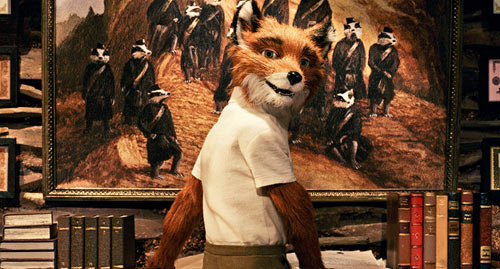
I didn’t know The Fantastic Mr. Fox, directed by Wes Anderson, was scheduled to come out so soon…IMDB says it’ll be out on November 13 of this year. Here’s a screenshot:
It’s a stop-motion animation film based on a story by Roald Dahl. The main character is voiced by George Clooney, with Michael Gambon, Meryl Streep, Bill Murray, Owen Wilson, Willem Dafoe, Jason Schwartzman, Adrien Brody, Anjelica Huston, Brian Cox, Roman Coppola, Jarvis Cocker, and Mario Batali providing some of the other voices. According to Wikipedia, a trailer will be out on July 31.
Several times in Last Year at Marienbad, the characters play a game called Nim. The gameplay is simple: a) players take turns removing objects from rows, b) they can remove as many objects as they want from a single row in one turn, and c) the player who removes the last object loses. The strategy is somewhat more difficult to understand, even though the player who goes first and follows the optimal strategy will always win. Although somewhat less glamourous than the film version, a Flash version of Nim is available to play.
The September Issue is the much-anticipated documentary that follows Anna Wintour and her staff at Vogue through the process of creating the magazine’s September issue, AKA the world’s thickest magazine issue.
An apt demonstration that an editor/curator’s main job is saying no to almost everything.
Let’s take a look at who’s still alive here. Brad Pitt: yes. Aaron Sorkin: yes. Steven Soderbergh: no. Expected soon: Michael Bay, Alan Ball, Sam Mendes, McG, and M Night Shamalamadingdong. (thx, david)
The world of the movie is one in which everyone tells the truth all the time…until Gervais invents lying. It also stars every other Hollywood actor and comic in the world, including Jennifer Garner, Jason Bateman, Patrick Stewart, Jeffrey Tambor, Tina Fey, Christopher Guest, Rob Lowe, Louis C.K., and John Hodgman. (You know it’s quite an august list when you have to stick “and John Hodgman” on the end of it.)
The Great Ghostbusters Campaign must start today. Here. Starting with this inarguable, scientific fact: Ghostbusters is still the most successful comedy film of all time, with a 1984 box-office return of $229.2 million. But this, of course, in turn, makes it the most successful film OF ALL TIME, FULL STOP — given that comedy is the supreme genre, and rules over every other format, such as “serious”, “foreign” or “black and white”.
IFC lists the 50 greatest trailers of all time. Trailers are like episodes for Law & Order for me — ten minutes after viewing and I can’t remember a thing about them — so I don’t really have any favorites, but this list seems like a solid collection.
Robert McNamara, former Secretary of Defense during a large portion of the Vietnam War, died early today at 93. Errol Morris’ documentary on McNamara, The Fog of War, is well worth checking out if you haven’t seen it.
Errol Morris, Werner Herzog and over 30 of today’s top documentary filmmakers provide an in-depth look at non-fiction filmmaking and the steps to making a documentary. These masters of the craft reflect upon the nature of documentary as a form of storytelling and offer insight into their approach to the ‘truth.’
Accounts from more than a dozen people involved with the film, who spoke on the condition of anonymity to avoid damaging professional relationships, described a process in which the heady rush toward production was halted by a studio suddenly confronted by plans for something artier and more complex than bargained for.
Sony was probably looking for something more BIG RED TEXTish.
Once upon a time, Luke | Kirk | Neo | Harry was living a miserable life. Feeling disconnected from his friends and family, he dreams about how his life could be different. One day, he is greeted by Obi Wan | Captain Pike | Trinity | Hagrid and told that his life is not what it seems, and that due to some circumstances surrounding his birth | birth | birth | infancy he was meant for something greater.
Pay phones ring for no reason, and they don’t stop. Dead relatives call their families in the middle of the night. People, horrifically, even call themselves— but it’s the person they used to be, phoning out of the blue, warning them about future misdirection.
Every once in a while, though, something genuinely bad happens: someone answers the phone… and they go a little crazy.
Thing is — spoiler alert — halfway through the film, the Ghostbusters realize that NYNEX isn’t a phone system at all: it’s the embedded nervous system of an angel — a fallen angel — and all those phone calls and dial-up modems in college dorm rooms and public pay phones are actually connected into the fiber-optic anatomy of a vast, ethereal organism that preceded the architectural build-up of Manhattan.
Manhattan came afterwards, that is: NYNEX was here first.
Update: It’s not quite a statistical analysis, but a couple of folks have guessed at the impact. First, from Tyler Cowen:
With five entries there are usually only two or maybe three real contenders. Strategic voting is present but manageable. There can be split votes across a particular actor or genre. With ten entries it is much harder to tell which picture will win. Counterintuitively, it might be harder for “odd” pictures to be nominated because they might end up winning. Popular movies like The Dark Knight will win more often because it will be hard not to nominate them (it didn’t even receive a nomination).
With more Best Picture slots open, studios and indies alike could be pushing harder to get their movies seen. What does that mean to you, the home viewer? It might — just might — mean that some smaller movies get longer runs in the big city arthouses, and even end up finding their way into the hinterlands. Everyone knocks the taste of the Academy (and often with good reason), but it’s not like everything that gets nominated is dowdy and self-serious and simplified. And it’s certainly true that plenty of excellent movies contend for the honor of contending each season. More of those excellent-but-low-priority movies may put up more than just a token campaign, and as a result, the average movie fan may become more aware of them, and may even get to see them.
In all about 300 films were eligible for awards in 2008. Were that to hold going forward, roughly one of every 30 films would become a best-picture nominee.
The trailer for Ponyo, the latest animated feature film from Hayao Miyazaki (Princess Mononoke, Spirited Away, etc.). The film opened in Japan last year and made more than $150 million at the box office. The American version is dubbed and I don’t know if a subtitled version will made it to theaters in the US or not. There was a theatrical release of a subtitled Mononoke but that was a long time ago.
Jim Capobianco’s end credits to Andrew Stanton’s “WALL-E” are essential; they are the actual ending of the film, a perfect and fantastically optimistic conclusion to a grand, if imperfect idea. Humanity’s past and future evolution viewed through unspooling schools of art. Frame after frame sinks in as you smile self-consciously. It isn’t supposed to be this good but there it is. This is art in its own right. Peter Gabriel and Thomas Newman’s song, “Down to Earth” indulges you with some incredibly thoughtful lyrics and, from the Stone Age to the Impressionists to the wonderful 8-bit pixel sprites, you are in the midst of something special.
Not quite a building, but the monumental quality of its form and its polygonal facades lend this Jawa Sandcrawler a building-like presence. These large treaded vehicles have inspired buildings from a Tunisian hotel to Rem Koolhaas’ Casa de Musica in Porto.
Death to Smoochy
The Boondock Saints
The Karate Kid, Part III
Cool as Ice
Dice Rules
Basic Instinct 2
Gigli
SuperBabies: Baby Geniuses 2
From Justin to Kelly
The Hottie & the Nottie
Glitter
Car 54, Where Are You?
Son of the Mask
Leonard Part 6
Lady in the Water
Norbit
Swept Away
White Chicks
Anacondas: The Hunt for the Blood Orchid
Spice World
Jaws 3-D
Bratz: The Movie
Troll 2
Howard the Duck
Battlefield Earth
The Postman
I Know Who Killed Me
Kazaam
Rambo III
Freddy Got Fingered
Stop! Or My Mom Will Shoot
Striptease
Caddyshack II
The Adventures of Pluto Nash
Barb Wire
Ishtar
Bio-Dome
Jingle All the Way
Catwoman
Disaster Movie
Rocky V
BloodRayne
Deuce Bigalow: European Gigolo
The Love Guru
Crossroads
Book of Shadows: Blair Witch 2
The Flintstones in Viva Rock Vegas
It’s Pat!
Batman & Robin
Speed 2: Cruise Control
Note: If you are a member and tried to log in, it didn't work, and now you're stuck in a neverending login loop of death, try disabling any ad blockers or extensions. Or try logging out and then back in. Still having trouble? Email me!






Socials & More