kottke.org posts about medicine
Rates of breast cancer and melanoma in humans are on the rise and appear to favor the left side of the body. A suspected cause is that the box springs in our beds act as antennas to focus the EM radiation from FM radio and broadcast television directly into the left sides of our bodies. No, really:
Electromagnetic waves resonate on a half-wavelength antenna to create a standing wave with a peak at the middle of the antenna and a node at each end, just as when a string stretched between two points is plucked at the center. In the U.S. bed frames and box springs are made of metal, and the length of a bed is exactly half the wavelength of FM and TV transmissions that have been broadcasting since the late 1940s.
(thx, anna)
Update: So, you know when you run across something about some current scientific theory or hypothesis on a blog or in a magazine or newspaper or even in a scientific journal, there’s a fair chance that whatever the article says is misleading, misstated, or even incorrect. That’s just how it is and if you didn’t know, now you do. Take this stuff with a grain of salt. It’s why I use phrases like “suspected cause” instead of something like “box springs and FM radio proven to cause cancer”.
I don’t post things like this because I think they’re right, I post them because I think they are interesting. The geometry of TV signals and box springs causing cancer on the left sides of people’s bodies in Western countries…that’s a clever bit of hypothesizing, right or wrong.
In this case, an organization I know nothing about (Vetenskap och Folkbildning from Sweden) says that Olle Johansson, one of the researchers who came up with the box spring hypothesis, is a quack. In fact, he was “Misleader of the year” in 2004. What does this mean in terms of his work on box springs and cancer? I have no idea. All I know is that on one side you’ve got Olle Johansson, Scientific American, and the peer-reviewed journal (Pathophysiology) in which Johansson’s hypothesis was published. And on the other side, there’s Vetenskap och Folkbildning, a number of commenters on the SciAm post, and a bunch of people in my inbox. Who’s right? Who knows. It’s a fine opportunity to remain skeptical. (thx, tom)
When Jane McGonigal got a concussion last year, her recovery was taking longer than expected and she got discouraged. Then she decided to make her recovery process into a game called SuperBetter.
SuperBetter is a superhero-themed game that turns getting better in multi-player adventure. It’s designed to help anyone recovering from an injury, or coping with a chronic condition, get better, sooner - with more fun, and with less pain and misery, along the way.
The game starts with five missions. You’re encouraged to do at least one mission a day, so that you’ve successfully completed them all in less than a week. Of course, you can move through them even faster if you feel up to it.
McGonigal recently gave a short talk about SuperBetter:
and has plans to make a SuperBetter game guide so that anyone can play. (via mr)
A great article on gender and children and the tough choices parents have to make when their children show signs of being transgender.
A recent medical innovation holds out the promise that this might be the first generation of transsexuals who can live inconspicuously. About three years ago, physicians in the U.S. started treating transgender children with puberty blockers, drugs originally intended to halt precocious puberty. The blockers put teens in a state of suspended development. They prevent boys from growing facial and body hair and an Adam’s apple, or developing a deep voice or any of the other physical characteristics that a male-to-female transsexual would later spend tens of thousands of dollars to reverse. They allow girls to grow taller, and prevent them from getting breasts or a period.
Scientists have developed a gel that rebuilds teeth. It could replace drilling & filling as the treatment of choice for cavities.
The gel or thin film contains a peptide known as MSH, or melanocyte-stimulating hormone. Previous experiments, reported in the Proceedings of the National Academy of Sciences, showed that MSH encourages bone regeneration.
Bone and teeth are fairly similar, so the French scientists reasoned that if the MSH were applied to teeth, it should help healing as well.
To test their theory, the French scientists applied either a film or gel, both of which contained MSH, to cavity-filled mice teeth. After about one month, the cavities had disappeared, said Benkirane-Jessel.
Scientists are working on two fronts toward a cure for AIDS: 1) neutralizing HIV in the human body so that regular medication is unnecessary, and 2) eradicating all traces of HIV in the body.
Human immune-system stem cells are transplanted into pups bred from these mice when they are two days old, and over the next few months, those cells mature and diversify into a working immune system. Then the mice are infected with HIV, which attacks the immune cells. But before transplanting the original human cells, the researchers introduce an enzyme that interferes with the gene for a protein the virus needs to stage the attack. This modification makes a small percentage of the mature immune cells highly resistant to HIV, and because the virus kills the cells it can infect, the modified cells are the only ones that survive over time. Thus, the HIV soon runs out of targets. If this strategy works, the virus will quickly become harmless and the mice will effectively be cured.
Here’s what the New Yorker writer and doctor told the graduating class of the Stanford School of Medicine.
Half the words you now routinely use you did not know existed when you started: words like arterial-blood gas, nasogastric tube, microarray, logistic regression, NMDA receptor, velluvial matrix.
O.K., I made that last one up. But the velluvial matrix sounds like something you should know about, doesn’t it? And that’s the problem. I will let you in on a little secret. You never stop wondering if there is a velluvial matrix you should know about.
Since I graduated from medical school, my family and friends have had their share of medical issues, just as you and your family will. And, inevitably, they turn to the medical graduate in the house for advice and explanation.
I remember one time when a friend came with a question. “You’re a doctor now,” he said. “So tell me: where exactly is the solar plexus?”
I was stumped. The information was not anywhere in the textbooks.
“I don’t know,” I finally confessed.
“What kind of doctor are you?” he said.
(via snarkmarket)
Maciej Ceglowski tells the story of how the cure for scurvy was discovered, lost, and finally redsicovered, but not before it disrupted Robert Falcon Scott’s 1911 expedition to reach the South Pole.
This is a good example of how the very ubiquity of vitamin C made it hard to identify. Though scurvy was always associated with a lack of greens, fresh meat contains adequate amounts of vitamin C, with particularly high concentrations in the organ meats that explorers considered a delicacy. Eat a bear liver every few weeks and scurvy will be the least of your problems.
But unless you already understand and believe in the vitamin model of nutrition, the notion of a trace substance that exists both in fresh limes and bear kidneys, but is absent from a cask of lime juice because you happened to prepare it in a copper vessel, begins to sound pretty contrived.
A pair of companies have developed a bio-printer that works just like a regular 3-D printer but instead of using polymer, it uses human tissue to print out skin, blood vessels, and livers.
To start with, only simple tissues, such as skin, muscle and short stretches of blood vessels, will be made, says Keith Murphy, Organovo’s chief executive, and these will be for research purposes. Mr Murphy says, however, that the company expects that within five years, once clinical trials are complete, the printers will produce blood vessels for use as grafts in bypass surgery. With more research it should be possible to produce bigger, more complex body parts. Because the machines have the ability to make branched tubes, the technology could, for example, be used to create the networks of blood vessels needed to sustain larger printed organs, like kidneys, livers and hearts.
(via @bobulate)
Some scientists have developed a promising method for targeting and destroying individual cancer cells without harming the tissue around them. Tiny (like nano tiny) gold-plated iron-nickel discs are attached to cancer-seeking antibodies. The antibodies attach themselves to the cancer cells and when an alternating magnetic field is applied, the metal nano-discs vibrate and literally shake the cancer cells to death.
Since the antibodies are attracted only to brain cancer cells, the process leaves surrounding healthy cells unharmed. This makes them unlike traditional cancer treatment methods, such as chemotherapy and radiation, which negatively affect both cancer and normal healthy cells.
(thx, @richardjellis)
In 1961, surgeon Leonid Rogozov was the only physician stationed on an isolated 12-man Soviet base in Antarctica when he developed appendicitis. He had to remove his appendix himself.
“I didn’t permit myself to think about anything other than the task at hand. It was necessary to steel myself, steel myself firmly and grit my teeth. In the event that I lost consciousness, I’d given Sasha Artemev a syringe and shown him how to give me an injection. I chose a position half sitting. I explained to Zinovy Teplinsky how to hold the mirror. My poor assistants! At the last minute I looked over at them: they stood there in their surgical whites, whiter than white themselves. I was scared too. But when I picked up the needle with the novocaine and gave myself the first injection, somehow I automatically switched into operating mode, and from that point on I didn’t notice anything else.
Anticipating cries of “photos or it didn’t happen”, his assistants documented the scene: here’s Rogozov operating on himself (and another).
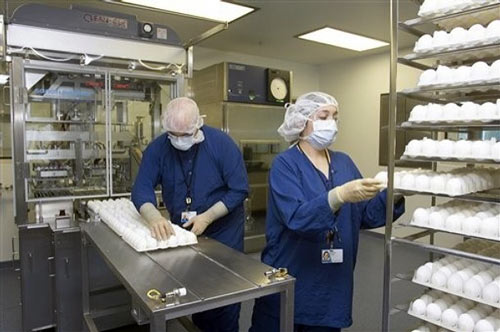
The eggs for the swine flu vaccine are produced by dozens of farms classified by the US government as part of our country’s “critical infrastructure”.
To ensure it had enough eggs to meet pandemic-level demand, the government invested more than $44 million in the program over five years; more than 35 farms are now involved in this feathered Manhattan Project. No signs advertise the farms’ involvement in the program, and visits from the outside world are discouraged. The government won’t disclose where the farms are located, and the farmers are told to keep quiet about their work — not even the neighbors are to know.
These don’t exactly sound like free-range operations:
After nine months of service, [the chickens] are typically euthanized because they can no longer lay “optimal eggs,” Mr. Robinson said. “They’ve served their government,” he said.
(thx, micah)
Whoa, I had no idea that giving birth at home without a doctor or midwife was a thing that people were doing now.
After giving birth to her first baby in the hospital, Schoenborn, 31, chose to have her next four children at home — by herself. Although her husband was in the house during the births, he didn’t help with the deliveries.
“My hospital births were very managed,” says Schoenborn. “I wanted privacy and to be free of internal exams. I wanted to give birth in an upright position and they want you to lie down. I feel birth is an instinctive process and in the hospital they treat women like they’re broken and birth like an illness.”
The most striking feature of the H1N1 flu vaccine manufacturing process is the 1,200,000,000 chicken eggs required to make the 3 billion doses of vaccine that may be required worldwide. There are entire chicken farms in the US and around the world dedicated to producing eggs for the purpose of incubating influenza viruses for use in vaccines. No wonder it takes six months from start to finish. But we’ll get to that in a minute.
The most commonly used process for manufacturing an influenza vaccine was developed in the 1940s — one of its co-inventors was Jonas Salk, who would go on to develop the polio vaccine — and has remained basically unchanged since then. The process is coordinated by the World Health Organization and begins with the detection of a new virus (or rather one that differs significantly from those already going around); in this instance, the Pandemic H1N1/09 virus. Once the pandemic strain has been identified and isolated, it is mixed with a standard laboratory virus through a technique called genetic reassortment, the purpose of which is to create a hybrid virus (also called the “reference virus strain”) with the pandemic strain’s surface antigens and the lab strain’s core components (which allows the virus to grow really well in chicken eggs). Then the hybrid is tested to make sure that it grows well, is safe, and produces the proper antigen response. This takes about six to nine weeks.
[Quick definitional pause. Antigen: “An antigen is any substance that causes your immune system to produce antibodies against it. An antigen may be a foreign substance from the environment such as chemicals, bacteria, viruses, or pollen. An antigen may also be formed within the body, as with bacterial toxins or tissue cells.” So, when the H1N1 vaccine gets inside your body, the pandemic strain’s surface antigens will produce antibodies against it.]
At roughly the same time, a parallel effort to produce what are referred to as reference reagents is undertaken. The deliverable here is a standardized kit provided to vaccine manufacturers so that they can test how much virus they are making and how effective it is. This process serves to standardize vaccine doses across manufacturers and takes four months to complete. WHO notes that this part of the process is “often a bottleneck to the overall timeline for manufacturers to generate the vaccine”.
Once the reference virus strain is produced, it is sent to pharmaceutical companies (Novartis, Sanofi Pasteur, etc.) for large-scale production of the vaccine. The companies fine-tune the virus to increase yields and produce seed virus banks that will be used in the bulk production.
And this is where the 1.2 billion chicken eggs come in. A portion of the seed virus is injected into each 9- to 12-day old fertilized egg. The virus incubates in the egg white for two to three days and is then separated from the egg.
For the shot vaccine, the virus is sterilized so that it won’t make anyone sick. This is the magic part of the vaccine: it’s got the pandemic virus antigens that make your body produce the antibodies to fight the virus but the virus is inactive so it won’t make you ill. For the nasal spray vaccine, the virus is left alive and attenuated to survive only in the nose and not the warmer lungs; it’ll infect you enough to produce antibodies but not enough to make you sick. Either way, the surface antigens are separated out and purified to produce the active ingredient in the vaccine. Each batch of antigen takes about two weeks to produce. With enough laboratory space and chicken eggs, the companies can crank out an infinite amount of purified antigens, but those resources are limited in practice.
[Side note. You may have noticed that the H1N1 vaccine has been difficult to find in some places around the US. The vaccine manufacturers have said that the Pandemic H1N1/09 virus when combined with the standard laboratory virus does not grow as fast in the eggs as they anticipated. The batches of antigens from each egg have been smaller than expected, up to five or even ten times smaller in some cases. Hence the slow rollout of the vaccine.]
The purified antigen is then tested against the aforementioned reference reagents once they are ready. The antigen is diluted to the required concentration and placed into properly labelled vials or syringes. Further testing is performed to make sure the vaccine won’t make anyone ill, to confirm the correct concentration, and for general safety. At this point clinical testing in humans is required in western Europe but not in the United States. Finally, each company’s vaccine has to be approved by the appropriate regulatory body in each country — that’s the FDA in the case of the US — and then the vaccine is distributed to medical facilities around the country.
Sources and more information: WHO, WHO, WHO, WHO, CDC, Time, Washington Post, The Big Picture, Influenza Report, NPR, Wikipedia, Wikipedia, Wikipedia, Wikipedia.
Update: Included in a recent 60 Minutes segment on the H1N1 vaccine is a look at the manufacturing process. (thx, @briandigital)
The process of inoculation against diseases like smallpox has been known for at least 1200 years. An 8th-century Indian book contains a how-to chapter on smallpox inoculations. Chinese use of the technique dates back to the first millennium as well. The technique was imported to Europe via the Ottoman Empire in 1721 and reached America at about the same time.
The practice is documented in America as early as 1721, when Zabdiel Boylston, at the urging of Cotton Mather, successfully inoculated two slaves and his own son. Mather, a prominent Boston minister, had heard a description of the African practice of inoculation from his Sudanese slave, Onesimus, in 1706, but had been previously unable to convince local physicians to attempt the procedure. Following this initial success, Boylston began performing inoculations throughout Boston, despite much controversy and at least one attempt upon his life. The effectiveness of the procedure was proven when, of the nearly three hundred people Boylston inoculated during the outbreak, only six died, whereas the mortality rate among those who contracted the disease naturally was one in six.
In a criticism of inoculation that would not seem so out of place regarding vaccination today, Voltaire takes his countrymen to task for not inoculating their children.
It is inadvertently affirmed in the Christian countries of Europe that the English are fools and madmen. Fools, because they give their children the small-pox to prevent their catching it; and madmen, because they wantonly communicate a certain and dreadful distemper to their children, merely to prevent an uncertain evil. The English, on the other side, call the rest of the Europeans cowardly and unnatural. Cowardly, because they are afraid of putting their children to a little pain; unnatural, because they expose them to die one time or other of the small-pox. But that the reader may be able to judge whether the English or those who differ from them in opinion are in the right, here follows the history of the famed innoculation, which is mentioned with so much dread in France.
Wired has a long piece by Amy Wallace about the anti-science anti-vaccine crowd.
Ah, risk. It is the idea that fuels the anti-vaccine movement — that parents should be allowed to opt out, because it is their right to evaluate risk for their own children. It is also the idea that underlies the CDC’s vaccination schedule — that the risk to public health is too great to allow individuals, one by one, to make decisions that will impact their communities. (The concept of herd immunity is key here: It holds that, in diseases passed from person to person, it is more difficult to maintain a chain of infection when large numbers of a population are immune.)
Update: I am on Team Tom Scocca on this issue:
Anti-vaccine activists are degenerate idiots who deserve to get polio and live out their days in iron lungs while Child Protective Services takes away their children to be properly raised. Or tetanus. Get lockjaw and shut up and die. What’s the point of living in 21st-century America if not to avoid dying of stupid, easily preventable disease?
And Slate has an article about the effects of unvaccinated children on those with weak immune systems.
Ordinarily I wouldn’t question others’ parenting choices. But the problem is literally one of live or don’t live. While that parent chose not to vaccinate her child for what she likely considers well-founded reasons, she is putting other children at risk. In this instance, the child at risk was my son. He has leukemia.
(thx, cedar)
Update: Ben Goldacre on anti-vaccine scares as a cultural thing, not a science thing:
There’s something very interesting about vaccine scares. These are cultural products. They’re not about evidence. If vaccine scares were about genuine scientific evidence showing that a vaccine caused a disease, then the vaccine scares would happen all around the world at exactly the same time, because information can disseminate itself around the world very rapidly these days. But what you find is that vaccine scares actually respect cultural and national boundaries.
(via lined and unlined)
Newer posts
Older posts






Socials & More