

15 ways to improve your newspaper business. “1. Go out in street, see news, write it up.”

Advertise here with Carbon Ads
This site is made possible by member support. 💞
Big thanks to Arcustech for hosting the site and offering amazing tech support.
When you buy through links on kottke.org, I may earn an affiliate commission. Thanks for supporting the site!
kottke.org. home of fine hypertext products since 1998.
Beloved by 86.47% of the web.
kottke.org posts about journalism
Gothamist Maps uses Google Maps to pinpoint news alerts (fires, robberies, car accidents, etc.) on a map of NYC. Pretty cool.
R.W. Apple, longtime and beloved political and food writer for the NY Times, died early this morning aged 71. “In the interests of efficiency, The New York Times recently equipped its main office with…a 185-pound, water-cooled, self-propelled, semi-automatic machine called R. W. Apple Jr.” Here’s Apple’s last piece for the Times, on the cuisine of Singapore.
Update: The NY Times put up a piece that Apple filed right before he entered the hosptial that they were going to run later in the fall: The Global Gourmand.
Update: Ed Levine wrote a nice personal remembrance of Apple. See also Trillin’s article on Apple from the New Yorker.
Michael Kinsley: do newspapers have a future? “
Michael Kinsley: do newspapers have a future? “Newspapers on paper are on the way out. Whether newspaper companies are on the way out too depends.”
Poincare conjecture battle continues
Last month I covered the hubbub surrounding the still-potential proof of the Poincare conjecture. The best take on the situation was a New Yorker article by Sylvia Nasar and David Gruber, detailing the barest glimpse of the behind-the-scenes workings of the mathematics community, particularly those involving Grigory Perelman, a recluse Russian mathematician who unveiled his potential Poincare proof in 2002 and Shing-Tung Yau, a Chinese mathematician who, the article suggested, was out for more than his fair share of the credit in this matter.
After declining the Fields Medal, the Nobel Prize of mathematics, Perelman has quit mathematics and lives quietly in his native Russia. Yau, however, is upset at his portrayal (both literally and literary) in the New Yorker article and has written a letter to the New Yorker asking them to make a prominent correction and apologize for an illustration of Yau that accompanied the article. From the letter:
I write in the hope of enlisting your immediate assistance, as well as the assistance of The New Yorker, in undoing, to the extent possible, the literally world-wide damage done to Dr. Yau’s reputation as a result of the publication of your article. I also write to outline for you, on a preliminary basis, but in some detail, several of the more egregious and actionable errors which you made in the article, and the demonstrably shoddy “journalism” which resulted in their publication.
The letter, addressed to the two authors as well as the fact-checker on the article and CC’d to David Remnick and the New Yorker’s general counsel, runs 12 pages, so you may want to have a look at the press release instead. A webcast discussing all the details of the letter is being held at noon on September 20…information on how to tune in will be available at Dr. Yau’s web site. (thx, david)
Oh, rejoice and be glad…there will be a season five of The Wire. “Balancing small audiences again critical acclaim, HBO has picked up a fifth season of drama The Wire.” The season may focus on the media’s role in politics. (thx, mark)
State of Emergency photo shoot from the September 2006 issue of Vogue Italia. The editorial of these fashion photos exceeds that of much photography found in more conventional US news media. (via bb)
Adrian Holovaty, who works at the Washington Post, has some advice for how the news media should function: “newspapers need to stop the story-centric worldview”. Holovaty argues for more structured data to be offered, not just the typical written story. Matt Thompson previously argued that the press needs a new paradigm, a shift from searching for hidden information (a la Watergate) to interpreting the massive amounts of publicly available data for patterns and stories (a la Enron/WorldCom/etc).
A short interview with Grigory Perelman, the Russian mathematician who proved the Poincare conjecture and turned down the Fields Medal. “Newspapers should be more discerning over who they write about. They should have more taste.” (thx pedro)
Steven Johnson lists Five Things All Sane People Agree On About Blogs And Mainstream Journalism (So Can We Stop Talking About It Now?) Like Steven, I get frustrated with the rehashing of the same old points around this issue.
Henry Abbott: bloggers give credit, journalists typically don’t. “When Sports Illustrated breaks a story that blogs catch on to, SI gets its name and inbound links all over the blogosphere. When blogs break stories, I don’t see why mainstream media shouldn’t reciprocate.”
A couple of months ago, the Guardian ran an article about Timothy Leary that used a “factoid” from gullible.info, a site trafficking in fake facts. The editor of gullible.info alerted the Guardian to the error, but they still haven’t corrected the article claiming that Leary discovered a new primary color called gendale.
Independent infographic
The Independent has a great infographic on its cover today depicting which countries support the immediate ceasefire in the Middle East demanded by the UN and which do not:
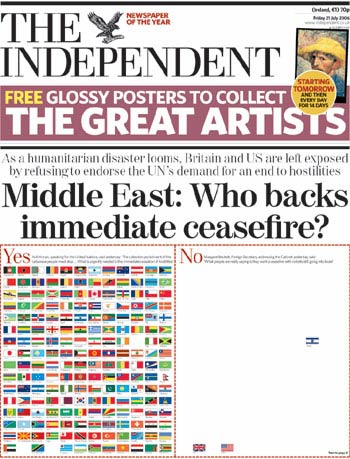
That message would take up less space as words, but somehow the impact wouldn’t be quite the same. (thx, g)

Socials & More