kottke.org posts about food
The Shake Shack gets a lukewarm one-star review from Pete Wells at the NY Times…the main problem was consistency.
How the burger could change lives I never divined, but on occasion it was magnificent, as beefy and flavorful as the outer quarter-inch of a Peter Luger porterhouse.
More often, though, the meat was cooked to the color of wet newsprint, inside and out, and salted so meekly that eating it was as satisfying as hearing a friend talk about a burger his cousin ate.
Even when the burgers were great, they could be great in one of two distinct ways. In the classic Shake Shack patty, a tower of ground beef is flattened against a searing griddle with a metal press and made to stay there, spitting and hissing, until one surface turns all brown and crunchy. A patty handled this way takes command of a Shackburger, standing up to its tangy sauce, its crisp lettuce, its wheels of plum tomato.
Sometimes, though, the grill cook hadn’t had the energy needed for smashing and searing. Instead the patty was tall, soft and melting, so pink inside that its juices began to soak the bun at the first bite. Good as this version was, it was anomalous.
The Shack Burger is still my favorite hamburger and sitting in Madison Square Park eating one on a warm night with friends — hell, even waiting in line for 45 minutes catching up — is one of my favorite NYC activities.
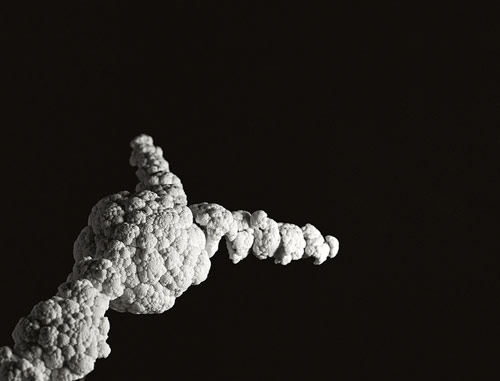
I love these cauliflower explosions done by Brock Davis…you can find them in his Food Stuff set on Flickr. Here’s the Challenger explosion in cauliflower:
(via @josephholmes)
The NY Times has a short documentary film by Errol Morris on El Wingador, a five-time winner of the Wing Bowl. My favorite line from the film, uttered by an off-camera Morris:
Wait a second. That’s cannibalism!
Though his several wins came early on in the competition’s history, El Wingador is still competing in the Wing Bowl. In the 2012 competition, held today, El Wingador came in third while Takeru Kobayashi completely demolished the competition in his first attempt, eating 337 wings in the process.
From the This Must Be the Place series, a lovely short film about the Prime Burger Restaurant in midtown Manhattan. The restaurant opened in 1938 and one of the servers, Artie, has been there since 1952.
For many of the guys that work here, the restaurant is like a second home — some of them have been slinging burgers, making shakes, and waiting on customers at this location for decades. Opened in 1938, the place hasn’t been altered since the early ’60s, and it looks all the better for it. Here the waiters and workers of Prime Burger discuss their views on their chosen profession, and the unique nature of the place itself.
(via @daveg)
Update: Over at Serious Eats, Ed Levine gives some advice on how to order properly at Prime Burger.
So why the need to order right? Because to keep up with the fast food chains, the DiMicelis started par-broiling their burgers. Par-broiling produces a less juicy burger. So when you order at Prime Burger specify you want your burger ($5.25 for a hamburger, $5.95 for a cheeseburger) made from scratch, and that you’re willing to wait the extra few minutes.
Well some of them are. The plain old American Oreo didn’t sell so well in China, so Kraft had to rethink everything about the cookie.
It turns out that if you didn’t grow up with Oreos and develop an emotional attachment to the cookie, it can be a weird-tasting little thing. And this started a whole process in the Chinese division of Kraft of rethinking what the essence of an Oreo really is.
Key terms in this article include “the essence of Oreoness” and “Twist, Lick, Dunk”.
I don’t know if the nudie playing cards are absolutely essential, but this trick is pretty neat.
(via @itscolossal)
Micro-Macro is a Powers of Ten-style video in which the various scales are depicted with food.
(via ★glass)
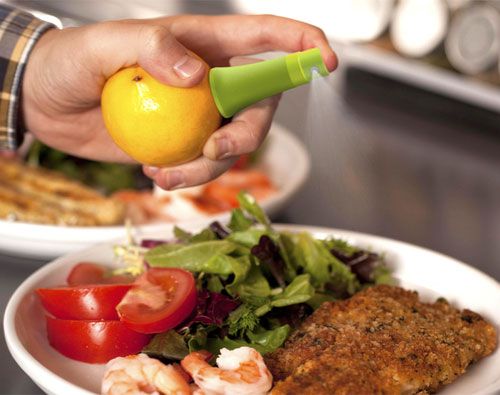
When life gives you lemons, turn them into spray bottles. This nifty little attachment lets you do just that.
The Planet Money podcast explores why lard fell out of favor for cooking and baking. Upton Sinclair and Crisco each take some of the blame. (thx, jim)
From New Scientist, a list of eight different ways to lose weight that actually work. Because science!
If your idea of a holiday workout is lifting glasses of beer late into the night, then it’s not just the extra calories you need to worry about. Randy Nelson and his team at Ohio State University in Columbus found that mice exposed to light at night weighed 10 per cent more at the end of the eight-week study than mice that had experienced a standard light/dark cycle, even though they ate the same total number of calories and did the same amount of exercise.
(via @daveg)
On last week’s This American Life podcast, chef Dan Barber shared the story of Eduardo Sousa, who is producing foie gras in Spain by natural means (i.e. not through force-feeding). Barber also gave a talk about this at Taste3 a few years ago.
In recent years, authors have claimed that many seemingly boring things have changed the world but a particularly strong case can be made for the potato and Charles C. Mann makes it.
The effects of this transformation were so striking that any general history of Europe without an entry in its index for S. tuberosum should be ignored. Hunger was a familiar presence in 17th- and 18th-century Europe. Cities were provisioned reasonably well in most years, their granaries carefully monitored, but country people teetered on a precipice. France, the historian Fernand Braudel once calculated, had 40 nationwide famines between 1500 and 1800, more than one per decade. This appalling figure is an underestimate, he wrote, “because it omits the hundreds and hundreds of local famines.” France was not exceptional; England had 17 national and big regional famines between 1523 and 1623. The continent simply could not reliably feed itself.
The potato changed all that. Every year, many farmers left fallow as much as half of their grain land, to rest the soil and fight weeds (which were plowed under in summer). Now smallholders could grow potatoes on the fallow land, controlling weeds by hoeing. Because potatoes were so productive, the effective result, in terms of calories, was to double Europe’s food supply.
Mann talks more about the potato in his excellent 1493: Uncovering the New World Columbus Created.
Over at Edible Geography, Nicola Twilley documents the banana ripening process at a facility in the Bronx.
During our visit, Paul Rosenblatt told us that he aims to ripen fruit in five days at 62 degrees, but, to schedule fruit readiness in accordance with supply and demand, he can push a room in four days at 64 degrees, or extend the process to seven days at 58 degrees.
“The energy coming off a box of ripening bananas could heat a small apartment,” Rosenblatt explains, which means that heavy-duty refrigeration is required to keep each room temperature-controlled to within a half a degree. In the past, Banana Distributors of New York has even experimented with heating parts of the building on captured heat from the ripening process.
To add to the complexity, customers can choose from different degrees of ripeness, ranging from 1 (all green) to 7 (all yellow with brown sugar spots). Banana Distributors of New York proudly promise that they have “Every Color, Every Day,” although Rosenblatt gets nervous if he has more than 2000 boxes of any particular shade.
In thinking about making meals completely from scratch, Waldo Jaquith realizes that making a simple cheeseburger would have been nearly impossible before the twentieth century.
Tomatoes are in season in the late summer. Lettuce is in season in in the fall. Mammals are slaughtered in early winter. The process of making such a burger would take nearly a year, and would inherently involve omitting some core cheeseburger ingredients. It would be wildly expensive-requiring a trio of cows-and demand many acres of land. There’s just no sense in it.
A cheeseburger cannot exist outside of a highly developed, post-agrarian society. It requires a complex interaction between a handful of vendors-in all likelihood, a couple of dozen-and the ability to ship ingredients vast distances while keeping them fresh.
(via stellar)
Famed pizzeria Grimaldi’s is being forced out of their space under the Brooklyn Bridge and is moving up the block…without their coveted coal oven. But now comes word that Patsy Grimaldi, former owner of Grimaldi’s, is moving into the old space with a new restaurant called Juliana’s. If I recall correctly, about half of the Grimaldi’s menu is devoted to a telling of the Patsy’s/Grimaldi’s feud…looks like they’re gonna need another page or two.
Newer posts
Older posts






Socials & More