kottke.org posts about food
The baguette is one of the foods most commonly associated with France, so it’s surprising that for a long time, the French baguette was uncommonly bad. Samuel Fromartz travelled to Paris to apprentice with a baker and discovered how the baguette got its groove back.
“For years I had watched the sensorial quality of French bread palpably deteriorate,” he told me. The decline first set in, he said, when bakers switched from levain to commercial yeast in order to shorten the bread-making process. Yeast could work as an acceptable substitute for levain, but instead of relying on minute amounts of yeast and letting the dough ferment over 24 hours- as Delmontel does with his baguettes-bakers added more yeast and cut the rise period to as little as one hour, “suppressing the first fermentation that is the source of all taste,” Kaplan said.
The situation worsened in the 1950s, when bakers started using intensive kneading machines that satisfied consumer desire for an ever-whiter crumb. They started sprinkling in additives such as vitamin C to spike fermentation, and heaps of salt to mask the absence of flavor. In short, while pursuing the promises of modernity-efficiency, speed, and whiter bread-what French bakers lost was the one indispensable ingredient: time.
“For me, bread was a crucial dimension of what the French proudly call their ‘cultural exception,’” or national identity, said Kaplan. “They did not seem to be aware that they were putting it in grave peril.” By the 1980s, the French ate less and less bread. Boulangeries folded; those that remained competed with supermarkets, which baked frozen baguettes and sold them as loss leaders.
Corby Kummer investigates how breakfast cereals are made and how the big food companies are working to make them healthier. As he discovers, it’s a tricky business.
The area of experimentation that most caught my interest uses enzymes to break down whole grains and cereals into easier-to-digest powders that can be sneaked into foods like cake mixes and light breads in which whole grains would be unpalatably heavy, and into foods where you’d never expect to find them: soups, sauces, puddings and creamy fillings that already have starch in some form. “Why not whole-grains starch?” asked Monica Fischer, head of the food science and technology department. Breaking down the grains can also create sweetness, which raises the possibility of substituting whole grains for sugar in certain products. I saw packages of two Peruvian cereal drinks: Ecco and Nesquik, both marked “con cereales Andinos” (containing Andean cereals), including corn, quinoa and amaranth. Those and other grains from affiliates in South America and Abidjan, Ivory Coast, are being studied to understand how and whether they can be extruded into pasta and noodles and used in place of northern European wheat.
Because the research is basic, Nestle doesn’t know yet which of its hundreds of food businesses will apply its findings-the actual testing of products takes place in 300 “application groups” around the world. But Nestle already buys locally grown grains in the U.S. and Canada and will likely increase the percentage. Not long from now we might find Stouffer’s turkey tetrazzini with whole grains in both the noodles and the sauce; one of those cereal drinks on a local supermarket shelf; amaranth in a health drink; and more fiber and whole grains in Purina pet food, a big part of Nestle business. (Nestle won’t talk about its future marketing plans.) Or whole-grain Kit Kats, which Nestle has already marketed in England. Or Buitoni quinoa fusilli, which the rising number of gluten-intolerant people will certainly welcome. But will Ecuadoreans?
The research I saw at the world’s largest and sixth-largest food companies will, of course, come at a price. Processing, even to restore a food’s natural ingredients or not remove them in the first place, always adds to a food’s cost. Another potential threat of the new food research is that these products could co-opt traditional markets, like the ones for quinoa and amaranth, and begin to erase native foods, which can be made for a fraction of the cost and have been shown for millennia to be healthful and practical. And there are plenty of other costs I’m leaving out: the treatment of labor, the environmental costs of packaging and transport, the general destruction of small businesses as large corporations grab local markets with lower prices and often bad-for-you food, deceptive claims and advertising, the checkered political history of all these companies.
Some Californians are shoving foie gras down their throats so fast they look like stuffed geese. As of Sunday, that food is outlawed.
Despite the prospect of a $1,000-per-day fine, a few of Lefebvre’s chef peers are rumored to be stashing away foie gras to quietly serve to favored customers, he said, and some have considered charging a fee to prepare foie gras brought in by patrons. Lefebvre won’t sell any of the product, but plans to “investigate” his options.
This. This is what happens to an egg 60 feet under water.
This is gonna revolutionize poaching eggs! (via ★adamkuban)
Adam Roberts, aka The Amateur Gourmet, has a new book coming out in the fall called Secrets of the Best Chefs. For the book, Roberts traveled the US cooking with some of the country’s best chefs, including Marco Canora, Alice Waters, Anita Lo, and José Andres.
The culmination of that journey is a cookbook filled with lessons, tips, and tricks from the most admired chefs in America, including how to properly dress a salad, bake a no-fail piecrust, make light and airy pasta, and stir-fry in a wok, plus how to improve your knife skills, eliminate wasteful food practices, and create recipes of your very own. Most important, Roberts has adapted 150 of the chefs’ signature recipes into totally doable dishes for the home cook. Now anyone can learn to cook like a pro!
Adam, maybe it’s time to upgrade yourself to the Semi-Pro Gourmet?
This is a long zoom look at how pizza gets delivered to hungry people. It starts by looking at the routes taken by a Dominos delivery person during a typical night and slowly zooms out to reveal the pizza giant’s national supply chain.
Embark with Kwon on a trip that begins with a pizza delivery route in New York City, then goes across the country to California’s Central Valley, where nearly 50 percent of America’s fruits, nuts and vegetables are grown, and into the heartland for an aerial look at our farmlands.
Why does McDonald’s food look so much better in the ads than at the restaurant? Watch as the director of marketing for McDonald’s Canada buys a Quarter Pounder at McDonald’s and compares that to a burger prepared by a food stylist and retouched in post by an image editor.
Short answer: the burger at the restaurant is optimized for eating and the photo burger is optimized for looking delicious. (via ★interesting)
On the label of most Hebrew National meat products, the company (which is actually now a division of ConAgra) proclaims that, “We answer to a higher authority.” In the short run, that higher authority will be a civil court where ConAgra will defend itself against claims that its hot dogs are not actually kosher at all. Next we’ll find out that Ballpark Franks don’t really plump when you cook ‘em.
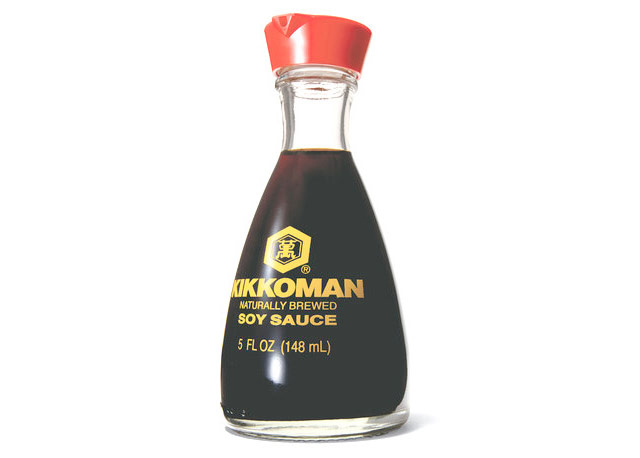
The iconic bottle was designed by Kenji Ekuan and his team at GK Design.
It took three years for Ekuan and his team to arrive at the dispenser’s transparent teardrop shape. More than 100 prototypes were tested in the making of its innovative, dripless spout (based on a teapot’s, but inverted). The design proved to be an ideal ambassador. With its imperial red cap and industrial materials (glass and plastic), it helped timeless Japanese design values — elegance, simplicity and supreme functionality — infiltrate kitchens around the world.
Here’s a weird story, and let’s not bury the lede: Cooked squid retain the ability to implant spermatophores in your mouth. We all know how eating raw squid runs this risk, but a recently published report (“Penetration of the oral mucosa by parasite-like sperm bags of squid: a case report in a Korean woman.”) details the first known case of spermatophores from cooked squid implanting. Read this post on Squid a Day for a much more nuanced explanation of what exactly a spermatophore is.
In order not to leave calamari connoisseurs unduly freaked out, I should clarify two points. First, most Western squid preparations remove the internal organs and serve only the muscle, so there’s no danger of accidentally ingesting spermatophores. Second, it’s perfectly fine to handle spermatophores—just don’t put them in your mouth. The skin on your hands, and most of the rest of your body, is much too thick to get stuck. I’ve probably had hundreds of spermatophores ejaculate on my fingers and never felt a sting.
This is Friday Squid Blogging material for sure.
Squids and octopi are not the same creature, and cephalopodian purists will disdain, but for the purpose of this post let’s agree that, especially to the layblogger, they share certain similar characteristics. Please allow an octopus link to follow a squid link. Here’s a little explainer about how octopus camouflage works. Be sure to watch the video. (via @neilhimself)
In the vast cheese warehouses of Europe, robots are employed to flip the cheeses as they age. Here’s a Gruyere flipper:
The food truck trend has invaded Paris, where young people use the phrase “très Brooklyn” to denote food that combines “informality, creativity and quality”.
On a bright morning last month at the Marché St.-Honoré, a weekly market in an elegant residential section of Paris, several sleekly dressed women struggled to lift the thick burgers to their mouths gracefully. (In French restaurants, and sometimes even fast-food joints, burgers are eaten with utensils, not hands.) A few brave souls were trying to eat tacos with a knife and fork. “C’est pas trop épicé,” said one, encouraging a tentative friend — “It’s not too spicy,” high praise from the chile-fearing French.
Street food itself isn’t new to France. At outdoor markets like this one, there is often a truck selling snacks like pizza, crepes or spicy Moroccan merguez sausages, cooked on griddles and stuffed into baguettes.
But the idea of street food made by chefs, using restaurant-grade ingredients, technique and technology, is very new indeed.
Not content to ban cigarettes, educate the public on calorie counts, and grade the city’s restaurants, the Bloomberg administration wants to ban the sale of large sugary drinks.
The proposed ban would affect virtually the entire menu of popular sugary drinks found in delis, fast-food franchises and even sports arenas, from energy drinks to pre-sweetened iced teas. The sale of any cup or bottle of sweetened drink larger than 16 fluid ounces — about the size of a medium coffee, and smaller than a common soda bottle — would be prohibited under the first-in-the-nation plan, which could take effect as soon as next March.
The measure would not apply to diet sodas, fruit juices, dairy-based drinks like milkshakes, or alcoholic beverages; it would not extend to beverages sold in grocery or convenience stores.
Over my dead fat diabetic body!
According to a recent study, the cause of Pine Mouth (where eating pine nuts can make food taste horrible for days afterwards) is still unknown. The full text of the study is behind a paywall but The Awl has a short summary of the findings.
Now, a new publication by the Journal of Agricultural & Food Chemistry finds esteemed scientists literally throwing up their hands. They learned a lot about pine nuts and their composition! But nothing useful.
cc: Megnut.
Earlier in the year I shared a lovely short film about Prime Burger, a midtown Manhattan institution.
For many of the guys that work here, the restaurant is like a second home — some of them have been slinging burgers, making shakes, and waiting on customers at this location for decades. Opened in 1938, the place hasn’t been altered since the early ’60s, and it looks all the better for it.
Sadly, as of Saturday, Prime Burger is no more, booted out by the new ownership of their building.
Prime Burger, the 74-year-old coffee shop and restaurant, run for 36 years by the DiMiceli family, is closing. And though Michael DiMiceli spoke hopefully on Friday of finding a new space in which to reinstall Prime Burger’s futuristic “Jetsons”-era d’ecor, the family has scarcely had time yet to look or to strike a deal. The small building in which Prime Burger is a tenant was sold recently, and the new owners sent the restaurant packing.
Newer posts
Older posts





Socials & More