kottke.org posts about computing
Nobody writes about health care practice from the inside out like Atul Gawande, here focusing on an increasingly important part of clinical work: information technology.
A 2016 study found that physicians spent about two hours doing computer work for every hour spent face to face with a patient—whatever the brand of medical software. In the examination room, physicians devoted half of their patient time facing the screen to do electronic tasks. And these tasks were spilling over after hours. The University of Wisconsin found that the average workday for its family physicians had grown to eleven and a half hours. The result has been epidemic levels of burnout among clinicians. Forty per cent screen positive for depression, and seven per cent report suicidal thinking—almost double the rate of the general working population.
Something’s gone terribly wrong. Doctors are among the most technology-avid people in society; computerization has simplified tasks in many industries. Yet somehow we’ve reached a point where people in the medical profession actively, viscerally, volubly hate their computers.
It’s not just the workload, but also what Gawande calls “the Revenge of the Ancillaries” — designing software for collaboration between different health care professionals, from surgeons to administrators, all of whom have competing stakes and preferences in how a product is used and designed, what information it offers and what it demands. And most medical software doesn’t handle these competing demands very well.
Holy moly, these photographs of vintage computers & peripherals by “design and tech obsessive” James Ball are fantastic.


He did a similar series with early personal computers subtitled “Icons of Beige”.

(via @mwichary)

Maybe it’s because I’m part of the cassette generation, but I’m just charmed by IBM researcher Mark Lantz’s ode to that great innovation in data storage, magnetic tape. What could be seen as an intermediate but mostly dead technology is actually quite alive and thriving.
Indeed, much of the world’s data is still kept on tape, including data for basic science, such as particle physics and radio astronomy, human heritage and national archives, major motion pictures, banking, insurance, oil exploration, and more. There is even a cadre of people (including me, trained in materials science, engineering, or physics) whose job it is to keep improving tape storage…
It’s true that tape doesn’t offer the fast access speeds of hard disks or semiconductor memories. Still, the medium’s advantages are many. To begin with, tape storage is more energy efficient: Once all the data has been recorded, a tape cartridge simply sits quietly in a slot in a robotic library and doesn’t consume any power at all. Tape is also exceedingly reliable, with error rates that are four to five orders of magnitude lower than those of hard drives. And tape is very secure, with built-in, on-the-fly encryption and additional security provided by the nature of the medium itself. After all, if a cartridge isn’t mounted in a drive, the data cannot be accessed or modified. This “air gap” is particularly attractive in light of the growing rate of data theft through cyberattacks.
Plus, it writes fast (faster than a hard drive), and it’s dirt cheap. And hard drives are up against some nasty physical limits when it comes to how much more data they can store on platters. This is why cloud providers like Google and Microsoft, among others, still use tape backup for file storage, and why folks at IBM and other places are working to improve tape’s efficiency, speed, and reliability.
Lantz describes how the newest tape systems in labs can read and write data on tracks 100 nanometers wide, at an areal density of 201 GB per square inch. “That means that a single tape cartridge could record as much data as a wheelbarrow full of hard drives.” I’ve never needed a wheelbarrow full of hard drives, but I think that is pretty cool. And I’m always excited to find out that engineers are still working to make old, reliable, maybe unsexy technologies work better and better.
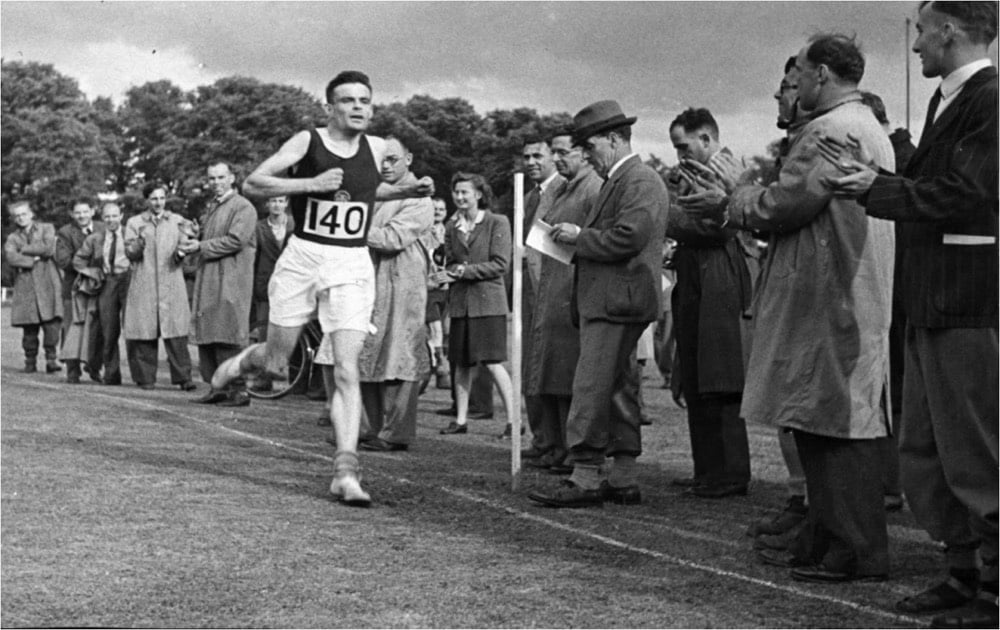
Computer scientist, mathematician, and all-around supergenius Alan Turing, who played a pivotal role in breaking secret German codes during WWII and developing the conceptual framework for the modern general purpose computer, was also a cracking good runner.
He was a runner who, like many others, came to the sport rather late. According to an article by Pat Butcher, he did not compete as an undergraduate at Cambridge, preferring to row. But after winning his fellowship to King’s College, he began running with more purpose. He is said to have often run a route from Cambridge to Ely and back, a distance of 50 kilometers.
It’s also said Turing would occasionally sometimes run to London for meetings, a distance of 40 miles. In 1947, after only two years of training, Turing ran a marathon in 2:46. He was even in contention for a spot on the British Olympic team for 1948 before an injury held him to fifth place at the trials. Had he competed and run at his personal best time, he would have finished 15th.
As the photo above shows, Turing had a brute force running style, not unlike the machine he helped design to break Enigma coded messages. He ran, he said, to relieve stress.
“We heard him rather than saw him. He made a terrible grunting noise when he was running, but before we could say anything to him, he was past us like a shot out of a gun. A couple of nights later we caught up with him long enough for me to ask who he ran for. When he said nobody, we invited him to join Walton. He did, and immediately became our best runner… I asked him one day why he punished himself so much in training. He told me ‘I have such a stressful job that the only way I can get it out of my mind is by running hard; it’s the only way I can get some release.’”
I found out about Turing’s running prowess via the Wikipedia page of non-professional marathon runners. Turing is quite high on the list, particularly if you filter out world class athletes from other sports. Also on the list, just above Turing, is Wolfgang Ketterle, a Nobel Prize-winning physicist who ran a 2:44 in Boston in 2014 at the age of 56.
As if you already didn’t know that Radiohead are a bunch of big ole nerds, there’s an easter egg on a cassette tape included in the Boxed Edition of OK Computer OKNOTOK 1997 2017. At the end of the tape recording, there are some blips and bleeps, which Maciej Korsan interpreted correctly as a program for an old computer system.
As a kid I was an owner of the Commodore 64. I remember that all my friends already were the PC users but my parents declined to buy me one for a long time. So I sticked to my old the tape-based computer listening to it’s blips and waiting for the game to load. Over 20 years later I was sitting in front of my MacBook, listening to the digitalised version of the tape my favourite band just released and then I’ve heard a familiar sound… ‘This must be an old computer program, probably C64 one’ I thought.
The program turned out to run on the ZX Spectrum, a computer the lads would likely have encountered as kids.
Glenn and Shannon Dellimore own at least two original Apple I computers built in 1976 by Steve Wozniak, Dan Kottke, and Steve Jobs. The couple recently purchased one of the computers at auction for $365,000 and then lent it to London’s Victoria and Albert Museum for an exhibition. The hand-built machine is in such good condition that they were able to boot it up and run a simple program.
The superlative rarity of an Apple-1 in this condition is corroborated by this machine’s early history.The owner, Tom Romkey, owned the “Personal Computer Store” in Florida, and was certified as an Apple level 1 technician in 1981. One day, a customer came into his shop and traded in his Apple-1 computer for a brand new NCR Personal Computer. The customer had only used the Apple-1 once or twice, and Mr. Romkey set it on a shelf, and did not touch it again.
The Apple I was the first modern personal computer: the whole thing fit on just one board and used the familiar keyboard/monitor input and output.
By early 1976, Steve Wozniak had completed his 6502-based computer and would display enhancements or modifications at the bi-weekly Homebrew Computer Club meetings. Steve Jobs was a 21 year old friend of Wozniak’s and also a visitor at the Homebrew club. He had worked with Wozniak in the past (together they designed the arcade game “Breakout” for Atari) and was very interested in his computer. During the design process Jobs made suggestions that helped shape the final product, such as the use of the newer dynamic RAMs instead of older, more expensive static RAMs. He suggested to Wozniak that they get some printed circuit boards made for the computer and sell it at the club for people to assemble themselves. They pooled their financial resources together to have PC boards made, and on April 1st, 1976 they officially formed the Apple Computer Company. Jobs had recently worked at an organic apple orchard, and liked the name because “he thought of the apple as the perfect fruit — it has a high nutritional content, it comes in a nice package, it doesn’t damage easily — and he wanted Apple to be the perfect company. Besides, they couldn’t come up with a better name.”
In other words, Woz invented the Apple computer, but Jobs invented Apple Computer. Here’s a longer video of another working Apple I:
This one is also in great condition, although it’s been restored and some of the original parts have been replaced. If you’d like to play around with your own Apple I without spending hundreds of thousands of dollars at an auction, I would recommend buying a replica kit or trying out this emulator written in Javascript. (thx, chris)
Missed this early this month while I was on vacation: Computer Show is back with a new episode, partnering with HP to showcase one of their fast color printers. Yes it’s an ad, but yes it’s still funny.
From Feminist Frequency, a quick video biography of Ada Lovelace, which talks about the importance of her contribution to computing.
A mathematical genius and pioneer of computer science, Ada Lovelace was not only the created the very first computer program in the mid-1800s but also foresaw the digital future more than a hundred years to come.
This is part of Feminist Frequency’s Ordinary Women series, which also covered women like Ida B. Wells and Emma Goldman.
From the BBC, an hour-long documentary on Ada Lovelace, the world’s first computer programmer.
You might have assumed that the computer age began with some geeks out in California, or perhaps with the codebreakers of World War II. But the pioneer who first saw the true power of the computer lived way back, during the transformative age of the Industrial Revolution.
Happy Ada Lovelace Day, everyone!
Seymour Papert, a giant in the worlds of computing and education, died on Sunday aged 88.
Dr. Papert, who was born in South Africa, was one of the leading educational theorists of the last half-century and a co-director of the renowned Artificial Intelligence Laboratory at the Massachusetts Institute of Technology. In some circles he was considered the world’s foremost expert on how technology can provide new ways for children to learn.
In the pencil-and-paper world of the 1960s classroom, Dr. Papert envisioned a computing device on every desk and an internetlike environment in which vast amounts of printed material would be available to children. He put his ideas into practice, creating in the late ’60s a computer programming language, called Logo, to teach children how to use computers.
I missed out on using Logo as a kid, but I know many people for whom Logo was their introduction to computers and programming. The MIT Media Lab has a short remembrance of Papert as well.
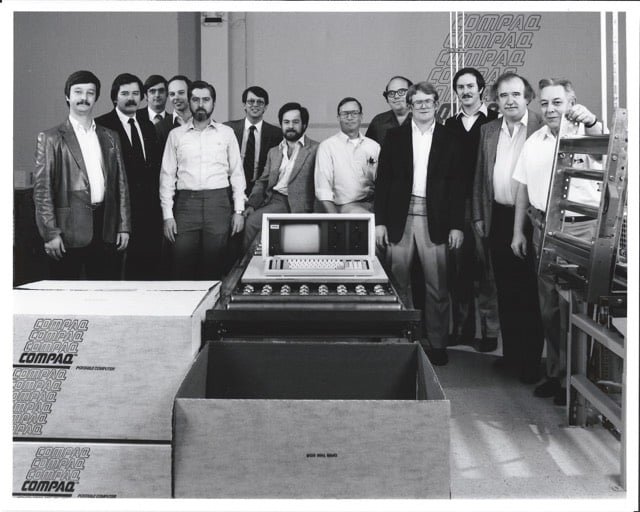
Silicon Cowboys is an upcoming documentary about Compaq Computer, one of the first companies to challenge IBM with a compatible computer.
Launched in 1982 by three friends in a Houston diner, Compaq Computer set out to build a portable PC to take on IBM, the world’s most powerful tech company. Many had tried cloning the industry leader’s code, only to be trounced by IBM and its high-priced lawyers. SILICON COWBOYS explores the remarkable David vs. Goliath story, and eventual demise, of Compaq, an unlikely upstart who altered the future of computing and helped shape the world as we know it today. Directed by Oscar(R)-nominated director Jason Cohen, the film offers a fresh look at the explosive rise of the 1980’s PC industry and is a refreshing alternative to the familiar narratives of Jobs, Gates, and Zuckerberg.
There’s no trailer yet, but the film is set to debut at SXSW in March. The first season of Halt and Catch Fire had a lot of influences, but the bare-bones story was that of Compaq.
Many reviews mention the similarity of the characters to Apple founders Steve Jobs and Steve Wozniak, but the trio of managers from Texas Instruments who left to form Compaq in the early 80s are a much closer fit. The Compaq Portable was the first 100% IBM compatible computer produced.
From Adam Lisagor’s Sandwich Video comes Computer Show, a present-day send-up of a personal computing show set in 1983. The guests and their products are contemporary and real, but the hosts are stuck in 1983 and don’t really know what the web is, what Reddit is, what links are, or anything like that.
“Computer Show” is a technology talk show, set in 1983. The dawn of the personal computing revolution. Awkward hair and awkward suits. Primitive synths and crude graphics. VHS tapes. No Internet. But there’s a twist.
The guests on this show are tech luminaries — experts, founders, thinkers, entrepreneurs…from 2015. They are real, and they are really on “Computer Show” to talk about their thing. Will it go well? Can they break through to the host Gary Fabert (played by Rob Baedeker of the SF-based sketch mainstay Kasper Hauser) and his rotating cast of co-hosts, who know of neither iPhone nor website nor Twitter nor…hardly anything?
The first episode, featuring Lumi, is embedded above and here’s the second episode with Reddit cofounder Alexis Ohanian.
Hopefully they’ll get to make more.
Update: In an interview with Inc., Lisagor shares how Computer Show came about.
So it just became clear to Roxana and Tony, there was something here. Roxana had the idea to make something in this universe. To produce a show like “The Computer Chronicles”.
One day, over Slack, Roxana asked me for the contact info of a producer I know. When I asked why, she told me she had this idea, and also asked if I’d maybe be a contributor on it. When I got more info out of her (she tends to be a little private about her personal projects) and explained to me that she had this idea of a tech talk show set in the early 80’s, where the guests would interview people from modern day, I just about flipped out and lost my mind I was so excited.
Update: While we not-so-patiently await new episodes of Computer Show, at least we can buy the t-shirt.

The Silicon City exhibit at the New York Historical Society takes a look at the long history of computing in NYC.
Every 15 minutes, for nearly a year, 500 men, women, and children rose majestically into “the egg,” Eero Saarinen’s idiosyncratic theater at the 1964 World’s Fair. It was very likely their first introduction to computer logic. Computing was not new. But for the general public, IBM’s iconic pavilion was a high profile coming out party, and Silicon City will harness it to introduce New York’s role in helping midwife the digital age.
The exhibit opens on November 13, 2015 and runs through next April. The museum is using Kickstarter to help bring the Telstar satellite back to NYC for the exhibit.

From the August 1968 issue of Computers and Automation magazine, the results of their Sixth Annual Computer Art Contest (flip to page 8).


It’s also worth paging through the rest of the magazine just for the ads.
Update: Looks like The Verge saw this post and did a followup on the history of the Computer Art Contest.
In any given issue, Computers and Automation devoted equal time to the latest methods of database storage and grand questions about the future of their “great instrument,” but the Computer Art Contest was soon a regular event. A look back through old issues of the journal (available at Internet Archive) shows how the fledgling discipline of computer art rapidly evolved. At the time, computers were specialized tools, most commonly used by individuals working in research labs, academia, or the military — and this heritage shows. Both the first and second prizes for the inaugural 1963 competition went to designs generated at the same military lab.
Lonnie Mimms has a gigantic collection of vintage computers, software, and peripherals. You don’t realize the scope of the collection until you see him walking around the Apple pop-up exhibit he built inside of an abandoned CompUSA.
Newer posts
Older posts





Socials & More