



Awesome trippy video made in 1971 that demonstrates through dance the process of amino acids linking to form protein. Skip ahead to ~3:30 for the dance itself. This film is still being shown in class at MIT. (thx, jeff)

Advertise here with Carbon Ads
This site is made possible by member support. 💞
Big thanks to Arcustech for hosting the site and offering amazing tech support.
When you buy through links on kottke.org, I may earn an affiliate commission. Thanks for supporting the site!
kottke.org. home of fine hypertext products since 1998.
Beloved by 86.47% of the web.
kottke.org posts about biology
We’ve heard from the sex workers about the Spitzer affair. Now the psychologists. This article compiles many ideas about why Spitzer did what he did:
Psychologist Christopher Ryan, author of “Sex in Prehistory,” says the desire for sex with more than one person has always been there — for leaders and followers alike. “The desire is not a function of status or power — it’s a question of availability.”
What’s relatively new to the human race, he said, is the ability to exercise power and the connection between power and sex.
That’s because, for most of human existence, there was only so far a man could coerce others when food was essentially free and hard to hoard. And until relatively recently, sex with multiple partners was the norm. “It would have been very unusual 100,000 years ago for a person to have one sexual partner for 30 years,” said Ryan in an interview from Barcelona.
And here’s the evolutionary psychological point of view:
She points out that, while powerful men throughout western history have married monogamously (they had only one legal wife at a time), they have always mated polygynously (they had lovers, concubines, and female slaves). Many had harems, consisting of hundreds and even thousands of virgins. With their wives, they produced legitimate heirs; with the others, they produced bastards (Betzig’s term). Genes and inclusive fitness make no distinction between the two categories of children. While the legitimate heirs, unlike the bastards, inherited their fathers’ power and status and often went on to have their own harems, powerful men sometimes invested in their bastards as well.
As a result, powerful men of high status throughout human history attained very high reproductive success, leaving a large number of offspring (legitimate or otherwise), while countless poor men in the countryside died mateless and childless.
(thx, anne)
Update: And one more from Natalie Angier:
Yet as biologists have discovered through the application of DNA paternity tests to the offspring of these bonded pairs, social monogamy is very rarely accompanied by sexual, or genetic, monogamy. Assay the kids in a given brood, whether of birds, voles, lesser apes, foxes or any other pair-bonding species, and anywhere from 10 to 70 percent will prove to have been sired by somebody other than the resident male.
Nurture is really kicking ass these days….
Nurture is really kicking ass these days….first the IQ thing and now this.
The offspring of expensive stallions owe their success more to how they are reared, trained and ridden than good genes, a study has found. Only 10% of a horse’s lifetime winnings can be attributed to their bloodline, research in Biology Letters shows.
That suggests, a la Moneyball, that buying horses with so-so lineages and training them really well could make for a better return on investment.
Chart of the possible shapes and forms of leaves. For instance, you could have a leaf of lanceolate shape with a crenate margin and reticulate veins.

Update: kottke.org reader Flip passes along this article about the wavy edges of flowers, leaves and even garbage bags, summarizing it thusly:
Basically, as the leaf grows it is constrained to a 2-d surface, but the cells of some leaves reproduce fast enough to require more surface area than a pi-r-squared plane surface can provide. Its only recourse is to buckle out-of-plane, giving the wrinkles. Since the exuberant growth continues as the leaf grows outward, the buckling process repeats and you get the multi-scale (ripples on ripples on ripples) shape that you see in kale and daffodils.
(thx, flip)
As part of a 2006 Shuttle mission, researchers sent salmonella germs into space to see how they were affected. The result: 167 genes changed in the salmonella during the short trip and “mice fed the space germs were three times more likely to get sick and died quicker than others fed identical germs that had remained behind on Earth.” Holy crap!
Flores Man research
Some recent research on the wrist bones of the so-called hobbit skeleton suggests that Flores man is an ancestor of modern humans and not just diseased homo sapiens. The debate continues. (via npr)
Bee space
Langstroth’s crucial insight — “I could scarcely refrain from shouting ‘Eureka!’ in the open streets,” he wrote of the moment of revelation — was the concept of “bee space.” He realized that while honeybees will seal up passageways that are either too large or too small, they will leave open passages that are just the right size to allow a bee to pass through comfortably. Langstroth determined that if frames were placed at this “bee-space” interval of three-eighths of an inch, bees would build honeycomb that could be lifted from the hive, rather than, as was the practice up to that point, sliced or hacked out of it. He patented L. L. Langstroth’s Movable Comb Hive in 1852. Today’s version consists of a number of rectangular boxes-the number is supposed to grow during the season-open at the top and at the bottom. Each box is equipped with inner lips from which frames can be hung, like folders in a filing drawer, and each frame comes with special tabs to preserve bee space.
So says Elizabeth Kolbert in an article about colony-collapse disorder, a bee disease that’s wreaking havoc on beehives and food production around the US. Bee space! I’m unsure whether similar research has been done to determine the proper “human space”, although the placement of houses in a suburb, tables in a restaurant, blankets at the beach, or social space in elevators might provide some clues as to the proper measurement.
But returning to the bees, a coalition of scientists working on the problem has found a correlation between bee deaths and Israeli acute paralysis virus. An infusion of bees from Australia in 2004 may also have contributed to the disorder’s development. Full details are available on EurekAlert.
The social life of plants: plants can tell their relatives from strangers. “Plants grown alongside unrelated neighbours are more competitive than those growing with their siblings — ploughing more energy into growing roots when their neighbours don’t share their genetic stock.”
The results from a recent Gallup poll show that more Americans accept creationism than do evolution. Among registered Republicans, almost 7 in 10 don’t believe in evolution. (via cynical-c)
Global warming + evolution = species explosion!!!
Cities are often thought of as organisms or ecosystems, but the authors of a new study find that metaphor lacking. “The one thing that we know about organisms whether it be elephants or sharks or frogs, is that as they get large, they slow down. They use less energy, they don’t move as fast. That is a very important point for biological scaling. In the case of cities, it is actually the opposite. As cities get larger they create more wealth and they are more innovative at a faster rate. There is no counterpart to that in biology.”
Men look at crotches
Among the many interesting things in Online Journalism Review’s article about using eyetracking to increase the effectiveness of news article design is this odd result:
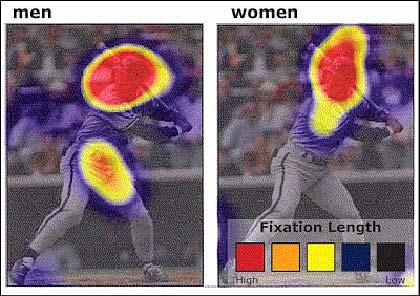
Although both men and women look at the image of George Brett when directed to find out information about his sport and position, men tend to focus on private anatomy as well as the face. For the women, the face is the only place they viewed. Coyne adds that this difference doesn’t just occur with images of people. Men tend to fixate more on areas of private anatomy on animals as well, as evidenced when users were directed to browse the American Kennel Club site.
That is absolutely fascinating. I’d love to hear an evolutionary biologist’s take on why that is.
I’m also heartened by the article’s first featured finding: that tighter writing, more white space, and jettisoning unnecessary imagery helps readers read faster and retain more of what they’ve read.
Why do we believe in God?
The cover story in this week’s NY Times Magazine is called Darwin’s God and covers, from an evolutionary biology standpoint, why people believe in God. Most scientists studying the matter believe that humans have a built-in mechanism for religious belief. For instance, anthropologist Scott Atran sometimes conducts an intriguing experiment with his students:
His research interests include cognitive science and evolutionary biology, and sometimes he presents students with a wooden box that he pretends is an African relic. “If you have negative sentiments toward religion,” he tells them, “the box will destroy whatever you put inside it.” Many of his students say they doubt the existence of God, but in this demonstration they act as if they believe in something. Put your pencil into the magic box, he tells them, and the nonbelievers do so blithely. Put in your driver’s license, he says, and most do, but only after significant hesitation. And when he tells them to put in their hands, few will. If they don’t believe in God, what exactly are they afraid of?
Or rather, why are they afraid? One possible reason is that humans are conditioned to be on the lookout for “agents” and we tend to find them even when they’re not there:
So if there is motion just out of our line of sight, we presume it is caused by an agent, an animal or person with the ability to move independently. This usually operates in one direction only; lots of people mistake a rock for a bear, but almost no one mistakes a bear for a rock.
What does this mean for belief in the supernatural? It means our brains are primed for it, ready to presume the presence of agents even when such presence confounds logic. “The most central concepts in religions are related to agents,” Justin Barrett, a psychologist, wrote in his 2004 summary of the byproduct theory, “Why Would Anyone Believe in God?” Religious agents are often supernatural, he wrote, “people with superpowers, statues that can answer requests or disembodied minds that can act on us and the world.”
Another reason for the instinctive religious impulse may be that people are able to put themselves in other peoples’ minds, to think about how another person might be feeling or thinking:
Folkpsychology, as Atran and his colleagues see it, is essential to getting along in the contemporary world, just as it has been since prehistoric times. It allows us to anticipate the actions of others and to lead others to believe what we want them to believe; it is at the heart of everything from marriage to office politics to poker. People without this trait, like those with severe autism, are impaired, unable to imagine themselves in other people’s heads.
The process begins with positing the existence of minds, our own and others’, that we cannot see or feel. This leaves us open, almost instinctively, to belief in the separation of the body (the visible) and the mind (the invisible). If you can posit minds in other people that you cannot verify empirically, suggests Paul Bloom, a psychologist and the author of “Descartes’ Baby,” published in 2004, it is a short step to positing minds that do not have to be anchored to a body. And from there, he said, it is another short step to positing an immaterial soul and a transcendent God.
There’s lots more in the article…it’s well worth a read.
Honeybee populations across the US are falling due to a mysterious disease. “Almond crops are immediately vulnerable because they rely on honeybee pollination at this time of year. And the insect decline could potentially affect other crops later in the year, such as apples and blueberries.”
Richard Dawkins answers some questions from readers of the Independent. “Terrible things have been done in the name of Christ, but all he ever taught was peace and love. What’s wrong with that?”
Socials & More