



Interesting hypothesis: young Hollywood starlets are dieting to retain exaggerated child-like features that, evolutionarily speaking, are more attractive to adults. The technical term for this is neoteny.

Advertise here with Carbon Ads
This site is made possible by member support. 💞
Big thanks to Arcustech for hosting the site and offering amazing tech support.
When you buy through links on kottke.org, I may earn an affiliate commission. Thanks for supporting the site!
kottke.org. home of fine hypertext products since 1998.
Beloved by 86.47% of the web.
kottke.org posts about biology
A classic article by Stephen Jay Gould on the changing biological features of Mickey Mouse. Over the years, Mickey has become more well-behaved and his appearance more juvenile (larger eyes, short pudgy legs, relatively large head, short snout, etc.). “When we see a living creature with babyish features, we feel an automatic surge of disarming tenderness.”
Researchers in Israel and Illinois say they’ve found a second code in DNA, one that deals with the positioning of proteins. Palimpsest anyone?
Natural deselection
Tom Coates recently checked out the Royal College of Art Summer Show in London and ran across this project by Tim Simpson:

…three plants compete to reach the light that feeds and nourishes them. The first one to succeed survives. The other two are automatically cut down in their prime.
First plant to grow close to the proximity sensors wins. A simple and elegant idea.
Sarah Trigg’s work combines geographic maps with biological forms. “The explorer system [in colonial North America] caused the Native American system to change its normal functioning, much like cancer cells do to normal cells.” More here. (via moon river)
Profile of Daniel Dennett, “Darwinian fundamentalist” and author of a new book that argues that “religion, chiefly Christianity, is itself a biologically evolved concept, and one that has outlived its usefulness”.
To Dr. David Hague, human pregnancy is a struggle between the fetus and mother. Evolutionarily speaking, the fetus “wants” as many resources as possible for itself while the mother “wants” to do what she can to spread her resources across as many children as possible. In theory, this is a cause of the many serious health problems surrounding pregnancy.
Update: Carl Zimmer has more about this on his blog.
This is fascinating…”sex might have evolved as a way to concentrate lots of harmful mutations into individual organisms so they could be easily weeded out by natural selection”.
Fractal bacteria
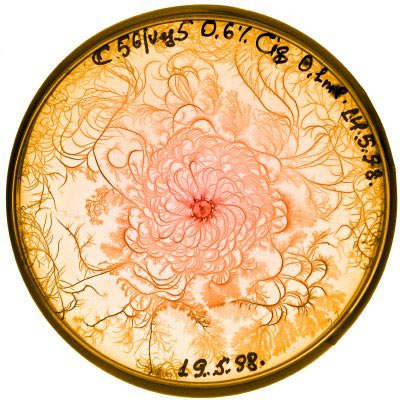
Pruned has collected some lovely petri dish scenes full of fractal patterns.
Billions and billions of bacterial landscape architects pruning — no less in environments poisoned with antibiotics — other bacterial landscape architects, dead or alive, to form dazzling arabesque parterres. The self-organizing embroidery of organisms in constant Darwinian mode.
More here. See also ferrofluid.
Justin reports on his family’s results of a neat project called the Geneographic Project, co-produced by National Geographic and IBM. If you purchase a testing kit, they’ll trace the specific genetic markers of your ancestors back to (possibly) our common African root.
Scientists find “lost world” of undiscovered animals in the Foja Mountains of western New Guinea. “Their finds included more than 20 new frogs, 4 butterflies and a number of plants, including 5 new palms and rhododendrons with the largest flowers on record.”
The world’s coolest parasite; it makes zombie cockroaches! When it wants to lay its eggs, the Ampulex compressa wasp stuns a cockroach, numbs its brain, steers it back to its nest, lays an egg inside it, and eventually a larvae forms, it lunches on the cockroach’s insides, and then hatches fully grown. Just…wow. (thx, tien)
Socials & More