

The pictures of the accused are startling in the banality of the faces. (While the spelling of many of the names — April, Britney, Brittini, Cara, Kayla, Mercades, Stephen, Zachary bring to mind a revived Mouseketeers.) A number of the girls look surprisingly similar, but minus the prison garb, they could just as easily be reacting to a berating for poor schoolwork. The boys, who were posted as lookouts while the girls carried out the beating, look a little more ready for jail.
The pictures are fascinating in the narrow range of emotion they convey, from self-pity to sullenness, but to my mind all stop before genuine contriteness. (I’m reading this in, of course, but I have a hunch I’m right.) Yet there’s an all-American look to these kids that can only remind us how narrow the line is between good and evil.

This site is made possible by member support. 💞
Big thanks to Arcustech for hosting the site and offering amazing tech support.
When you buy through links on kottke.org, I may earn an affiliate commission. Thanks for supporting the site!
kottke.org. home of fine hypertext products since 1998.
Beloved by 86.47% of the web.
kottke.org posts about art
As part of the the Takashi Murakami show at the Brooklyn Museum of Art, the artist is collaborating with Louis Vuitton to station street vendors — who typically sell counterfeit merchandise — outside the museum selling real LV bags designed by Murakami himself.
For scientist Dr. Anne Adams (and composer Maurice Ravel), a rare disease called frontotemporal dementia caused a burst of creativity.
The disease apparently altered circuits in their brains, changing the connections between the front and back parts and resulting in a torrent of creativity. “We used to think dementias hit the brain diffusely,” Dr. Miller said. “Nothing was anatomically specific. That is wrong. We now realize that when specific, dominant circuits are injured or disintegrate, they may release or disinhibit activity in other areas. In other words, if one part of the brain is compromised, another part can remodel and become stronger.”
Some of Adams’ work can be seen here…her portrait of pi contains a touch of synesthesia. (thx, cory)
Gorgeous maps and infographics by Stefanie Posavec that map the literary geography of Jack Kerouac’s On the Road.
The maps visually represent the rhythm and structure of Kerouac’s literary space, creating works that are not only gorgeous from the point of view of graphic design, but also exhibit scientific rigor and precision in their formulation: meticulous scouring the surface of the text, highlighting and noting sentence length, prosody and themes, Posavec’s approach to the text is not unlike that of a surveyor. And similarly, the act is near reverential in its approach and the results are stunning graphical displays of the nature of the subject. The literary organism, rhythm textures and sentence drawings are truly gorgeous pieces.
The sentence drawings are really worth checking out.
Update: Posavec’s analysis of Walter Benjamin’s The Work of Art in the Age of Mechanical Reproduction is available for sale at 20x200. Apropos!
Regal

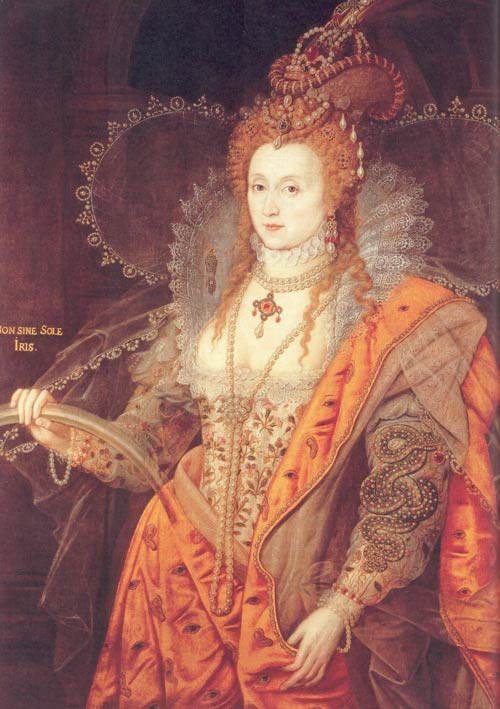
Top: Leslie Hall by Noah Kalina.
Bottom: The Rainbow Portrait of Queen Elizabeth I by Isaac Oliver. (thx, adriana)

Delicately knit human organs (brain, heart, intestines) by Sarah Illenberger. See also the Brain Bag. (via this is that)
Anders Weberg makes true P2P art. Weberg shares his videos on Bittorrent until a single other user downloads them. Then he stops sharing it and…
After that the artwork will be available for as long as other users share it. The original file and all the material used to create it are deleted by the artist. […] Feel free to don’t or download the film, watch it and share it for as long as you like. Or delete it immediately.
Permanent Vacation, a piece by Cory Arcangel consisting of “two unattended computers send endlessly bouncing out-of-office auto-responses to each other”. (via vitamin briefcase)
The world’s 50 best works of art and where to go to see them. Random Knowledge has links to all the art so you can check them out virtually in less time and for less money.
An article in the Times about the transition of sales in high-end galleries to the web.
Mr. Gupta said about half of his sales take place without the presence of the buyer. “Being in Chicago, without the walk-in traffic of a gallery in New York or even L.A., I can’t imagine working without digital images,” he said. “We have a ton of European collectors, and we reach them through art fairs and digital images, a combined effort.”
(via ev +/-)
Did you know that there’s a teensy museum on the moon?
Now I find out there was already an entire Moon Museum, with drawings by six leading contemporary artists of the day: Andy Warhol, Robert Rauschenberg, David Novros, Forrest “Frosty” Myers, Claes Oldenburg, and John Chamberlain. The Moon Museum was supposedly installed on the moon in 1969 as part of the Apollo 12 mission.
I say supposedly, because NASA has no official record of it; according to Frosty Myers, the artist who initiated the project, the Moon Museum was secretly installed on a hatch on a leg of the Intrepid landing module with the help of an unnamed engineer at the Grumman Corporation after attempts to move the project forward through NASA’s official channels were unsuccessful.
Scott King: How I’d Sink American Vogue. His approach would include stories like “How To Dress Angry”, “635 Poor People Upside Down!”, and “Karl Lagerfeld Discusses Various Cancers”, as well as a 14-page advertisement-free issue.
Why does the woman depicted in the Mona Lisa appear to be both smiling and not smiling at the same time? The smile part of the Mona Lisa’s face was painted by Leonardo in low spatial frequencies. This means that when you look right at her mouth, there’s no smile. But if you look at her eyes or elsewhere in the portrait, your peripheral vision picks up the smile. (via collision detection)
Proust Was a Neuroscientist
Proust Was a Neuroscientist is the story of how eight writers and artists anticipated our contemporary understanding of the human brain. From the preface:
This book is about artists who anticipated the discoveries of neuroscience. It is about writers and painters and composers who discovered truths about the human mind — real, tangible truths — that science is only now rediscovering. Their imaginations foretold the facts of the future.
I enjoyed the book quite a bit so I sent the author, Jonah Lehrer, a few questions via email. Here’s our brief conversation.
Jason Kottke: Your exploration of the intersection of neuroscience and culture begins with Proust; you were reading Swann’s Way while doing research in a neuroscience lab. Where did the idea come from for a collection of people who anticipated our modern understanding of the human brain? How did you find those other stories?
Jonah Lehrer: The lab I was working in was studying the chemistry of memory. The manual labor of science can get pretty tedious, and so I started reading Proust while waiting for my experiments to finish. After a few hundred pages of melodrama, I began to realize that the novelist had these very modern ideas about how our memory worked. His fiction, in other words, anticipated the very facts I was trying to uncover by studying the isolated neurons of sea slugs. Once I had this idea about looking at art through the prism of science, I began to see connections everywhere. I’d mutter about the visual cortex while looking at a Cezanne painting, or think about the somatosensory areas while reading Whitman on the “body electric”. Needless to say, my labmates mocked me mercilessly.
I’m always a little embarrassed to admit just how idiosyncratic my selection process was for the other artists in the book. I simply began with my favorite artists and tried to see what they had to say about the mind. The first thing that surprised me was just how much they had to say. Virginia Woolf, for instance, is always going on and on about her brain. “Nerves” has to be one of her favorite words.
Kottke: Which of your characters did you know the least about beforehand? Even a seeming polymath like yourself must have a blind spot or two.
Lehrer: Definitely Gertrude Stein. I actually found her through William James, the great American psychologist and philosopher. She worked in his Harvard lab, published a few scientific papers on “automatic writing,” and then went to med-school at Johns Hopkins before dropping out and moving to Paris to hang out with Picasso. So I knew she had this deep background in science, but I had only read snippets of her work. I then proceeded to fall asleep to the same page of “The Making of Americans” for a month.
Kottke: Are there other characters that you considered for inclusion? If so, why weren’t they included?
Lehrer: Lots of people were left on the cutting room floor. I had a long digression on Edgar Allen Poe and mirror neurons. (See, for instance, “The Purloined Letter,” where Poe has detective Dupin reveal his secret for reading the minds of criminals: “When I wish to find out how wise, or how stupid, or how good, or how wicked is any one, or what are his thoughts at the moment, I fashion the expression of my face, as accurately as possible, in accordance with the expression of his, and then wait to see what thoughts or sentiments arise in my mind or heart, as if to match or correspond with the expression.”) I also had a chapter on Coleridge and the unconscious, but I think that chapter was really just me wanting to write about opium. But, for the most part, I can’t really say why some chapters survived the editing process and others didn’t. I certainly mean no disrespect to Poe. If they let me write a sequel, I’ll find a way to include him.
Kottke: I noticed that three out of the eight main characters in the book are women. Surveying the usually cited big thinkers of the 19th and 20th centuries, it would have been easy to write this book with all male characters. Is there an implicit statement in there that science would be better off with a greater percentage of women participating?
Lehrer: While I certainly agree with the idea that the institution of science would benefit from more female scientists, I didn’t choose these female artists for that reason. I don’t think you need any ulterior motive to fall in love with the work of Virginia Woolf and George Eliot. Their art speaks for itself. That said, I think the psychological insights of women like Woolf were rooted, at least in part, in their womanhood. Woolf, for instance, rebelled against the stodgy old male novelists of her day. Their fiction, she complained, was all about “factories and utopias”. Woolf wanted to invert this hierarchy, so that the “task of the novelist” was to “examine an ordinary mind on an ordinary day.” There’s something very domestic about her modernism, so that the grandest epiphanies happen while someone is out buying flowers or eating a beef stew. Women might not be able to write novels about war or politics, but they could find an equal majesty by exploring the mind.
Plus, I think Woolf learned a lot about the brain from her mental illness. As a woman, she was subjected to all sorts of terrible psychiatric treatments, which made her rather skeptical of doctors. (In Mrs. Dalloway, she refers to the paternalistic Dr. Bradshaw as an “obscurely evil” person, whose insistence that the mental illness was “physical, purely physical” causes a suicide.) Introspection was Woolf’s only medicine. “I feel my brains, like a pear, to see if it’s ripe,” she once wrote. “It will be exquisite by September.”
Kottke: Are there other books/media out there that share a third culture kinship with yours? I received a copy of Lawrence Weschler’s Everything That Rises: A Book of Convergences for Christmas…that seems to fit. Steven Johnson’s books. Anything else you can recommend?
Lehrer: I’ve stolen ideas from so many people it’s hard to know where to begin. Certainly Weschler and Johnson have both been major influences. I’ve always worshipped Oliver Sacks; Richard Powers has more neuroscience in his novels than most issues of Nature; I just saw Olafur Eliasson’s new show at SFMOMA and that was rather inspiring. I could go on and on. It’s really an exciting time to be interested in the intersection of art and science.
But I’d also recommend traveling back in time a little bit, before our two cultures were so divided. We don’t think of people like George Eliot as third-culture figures, but she famously described her novels as a “a set of experiments in life.” Virginia Woolf, before she wrote Mrs. Dalloway, said that in her new novel the “psychology should be done very realistically.” Whitman worked in Civil War hospitals and corresponded for years with the neurologist who discovered phantom limb syndrome. (He also kept up with phrenology, the brain science of his day.) Or look at Coleridge. When the poet was asked why he attended so many lectures on chemistry, he gave a great answer: “To improve my stock of metaphors”. In other words, trying to merge art and science isn’t some newfangled idea.
—
Thanks, Jonah. You can read more of Lehrer’s writing at his frequently updated blog, The Frontal Cortex.
Homer Rembrandt
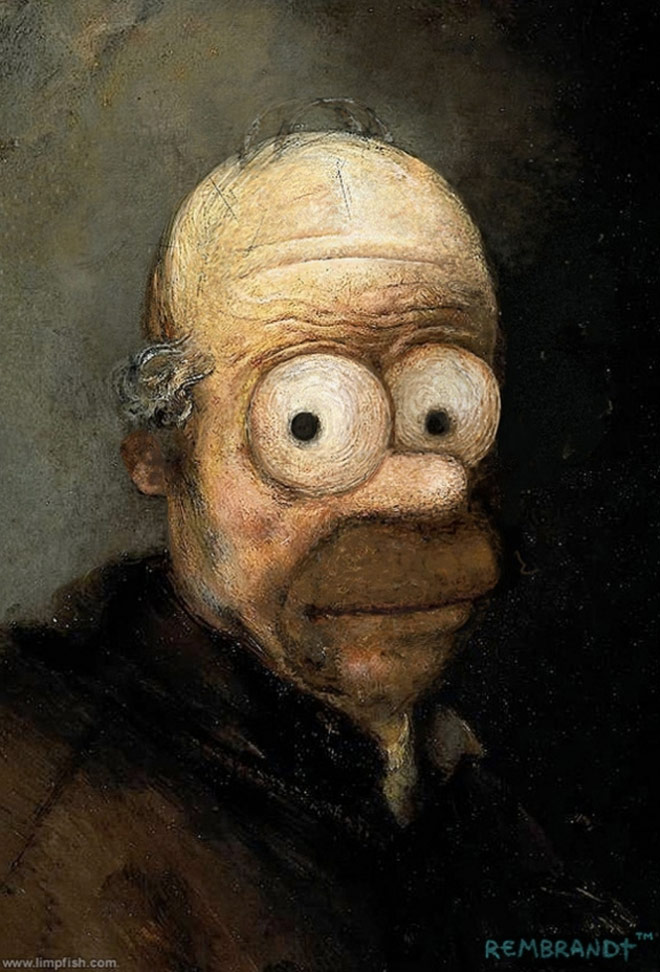
This portrait of Homer Simpson painted in the style of Rembrandt is strangely mesmerizing. Can’t look away from those giant eyes.
Socials & More