

Mathematical doodling
This is a wonderfully whimsical introduction to doodling by way of graph theory, snakes, Oroborous and mobius strips. Oh, and the Mobiaboros.
(via vulture)

This site is made possible by member support. 💞
Big thanks to Arcustech for hosting the site and offering amazing tech support.
When you buy through links on kottke.org, I may earn an affiliate commission. Thanks for supporting the site!
kottke.org. home of fine hypertext products since 1998.
Beloved by 86.47% of the web.
This is a wonderfully whimsical introduction to doodling by way of graph theory, snakes, Oroborous and mobius strips. Oh, and the Mobiaboros.
(via vulture)
For a piece called Metropolis II, artist Chris Burden is building a huge track and put 1200 Hot Wheels cars on it…the noise is deafening when they’re all circulating.
It includes 1,200 custom-designed cars and 18 lanes; 13 toy trains and tracks; and, dotting the landscape, buildings made of wood block, tiles, Legos and Lincoln Logs. The crew is still at work on the installation. In “Metropolis II,” by his calculation, “every hour 100,000 cars circulate through the city,” Mr. Burden said. “It has an audio quality to it. When you have 1,200 cars circulating it mimics a real freeway. It’s quite intense.”
(thx, aaron)
The Pierre Bergé – Yves Saint Laurent Foundation in Paris is currently displaying an exhibition of David Hockney’s iPhone and iPad drawings. The exhibition is on display through Jan 30, 2011.

Hockney uses the Brushes app to create his digital paintings and even has his suits made with a pocket just for the iPad:
He picks up his iPad and slips it into his jacket pocket. All his suits have been made with a deep inside pocket so that he can put a sketchbook in it: now the iPad fits there just as snugly. Even his tux has the pocket, he tells me.
Mosaic collages like this one — where each “pixel” is a tiny self-contained image — are fairly common but I haven’t seen too many like these before:
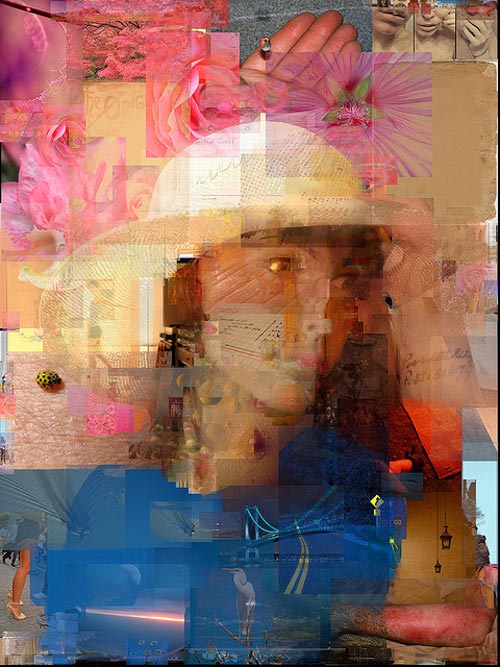
Lovely effect; they’re fun to look at zoomed in or out. (via matt)
Man, what if Spike Jonze had made Being Bill Murray instead? Casey Weldon did a series of paintings of Bill Murray as characters from Wes Anderson’s movies…but non-Murray characters like Max Fischer, Margot Tenenbaum, and the Baumer.

Prints are available. And these were a part of a show called Bad Dads, consisting of art inspired by various Anderson films. Again, prints are available.
Andy Denzler does these great paintings that look as though they’re highly compressed JPEGs with encoding issues.
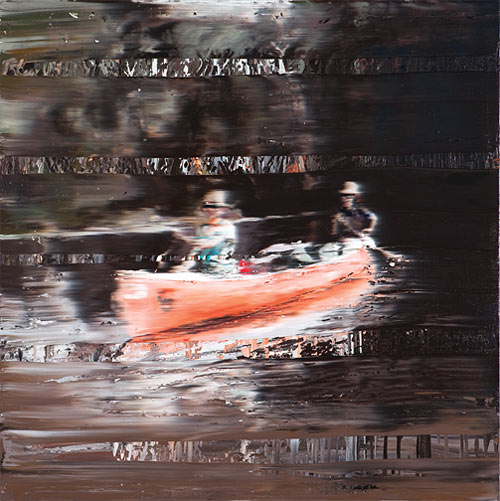
The newest exhibition in The Tate Modern’s cavernous Turbine Room is Ai Weiwei’s Sunflower Seeds:

The room is filled with millions of handcrafted ceramic sunflower seeds:
Each seed has been individually sculpted and painted by specialists working in small-scale workshops in the Chinese city of Jingdezhen. Far from being industrially produced, they are the effort of hundreds of skilled hands. Poured into the interior of the Turbine Hall’s vast industrial space, the 100 million seeds form a seemingly infinite landscape.
Porcelain is almost synonymous with China and, to make this work, Ai Weiwei has manipulated traditional methods of crafting what has historically been one of China’s most prized exports. Sunflower Seeds invites us to look more closely at the ‘Made in China’ phenomenon and the geo-politics of cultural and economic exchange today.
For the first couple of days, people could walk around on the tiny sculptures (as you can see on Flickr), but health concerns prompted the museum to put a stop to that. Still pretty cool, but this remains my favorite Turbine Hall exhibition. (via hilobrow)
If you liked the video mapping on the IAC building, this one might be even better. For the 600th anniversary of the construction of the tower clock in Prague, The Macula projected a really great video on the tower…watch at least through the brick stacking animation.
Love this. In 1936, a 16-year-old Dutch girl played a shooting gallery game at the fair: hit the target and a camera takes a photo, which the girl receives as a prize. Almost every year between then and now, Ria van Dijk shot the target and got her prize.
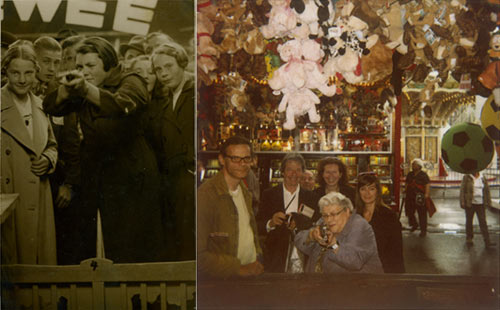
Van Dijk is now 88 and still shooting.
Last Saturday, the IAC building in Chelsea became the screen for a giant video art project.
Cassandra Jones takes photographs she finds online and stiches them together to form animations like this Eadweard Muybridge homage:
Really nice. Jones’ other work is worth a look as well. (via heading east)
Huh. The word “denim” comes from “serge de Nîmes”, a fabric made in Nîmes, France, and “blue jeans” comes from “Bleu de Genes”, blue pants made in Genoa (aka Genes). Both cities claim to have been manufacturing denim for centuries, but there has never been much proof in the way of artifacts and such. So the recent discovery of several paintings from the mid-1600s depicting people wearing jeans is surprising. Look at this jean jacket:
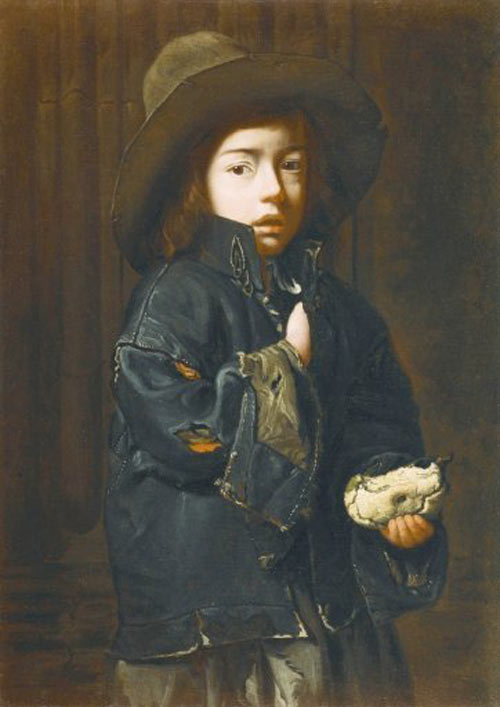
He’s even got his collar popped.
Rosmarie Fiore did this series of long exposure photographs of Atari games a few years ago.

Fiore did a similar project with pinball machines…instead of photos, the ball was covered in paint and left trails on vellum. Reminds me of some of the other time merge media I collected awhile back. (via @brainpicker)
Photographer Adam Magyar uses scanner cameras to take these huge panoramic photos which are a little difficult to explain.
Adam uses the same technologies as the finish line cameras at the Olympic Games, which take thousands of images a second and records through a 1 pixel wide slit. The time and space slices are then placed next to one another to generate an image without perspective. This method is capable of recording movement only, with static objects and buildings appearing as stripes and lines.
Here’s just a small slice of one of his photos…you’ll notice that it does look an awful lot like the photo-finish photos of sprinters.
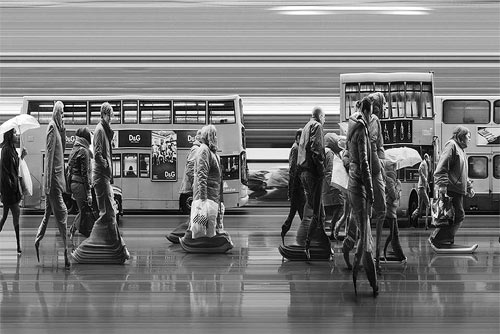
(via lens culture)

Socials & More