kottke.org posts about art
For the past five years, artist Jackie Sumell has been helping Herman Wallace, who has been in solitary confinement at the Louisiana State Penitentiary for the last 34 years, design his dream house, a house that will probably never be built. “Traces of a prison mindset crop up. When the placement of his computer meant his back would face the office door, Ms. Sumell said that he asked that a mirror be installed above, so he could see anyone entering the room. A sense of security is important to him, she explained. The master bedroom sits safely above the very center of the house. A wraparound porch adds a layer of perimeter, as does the surrounding garden. There is even a special door leading to an underground bunker, equipped with its own water supply.” A book on the project is available for a $20 donation and this PDF gives a good overview of the project.
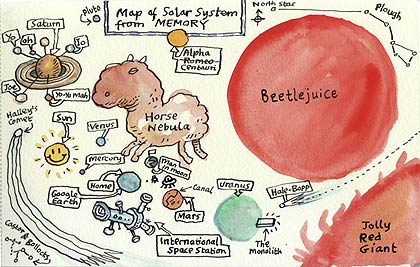
The first time I saw a world map drawn from memory was at Christopher Fahey’s apartment. I forget how long it took him to draw, but it was remarkably accurate and fairly large (a few feet across). Ever since then, I’ve kept an eye out for other hand-drawn maps (you know what they say: if you can’t do, collect). Via waxy this morning comes the From Memory Flickr group. My favorites from the group are this map of the male human body and a fanciful drawing of the solar system, both by Ellis Nadler:
Mapping.com has links to several maps from memory drawn by grade- and middle-school children; this world map by a 7th grade class is not too shabby. I’m struck by how much some of these world maps from memory resemble world maps drawn in the 16th and 17th centuries, like this Dutch map from 1689. All the parts are (mostly) there…it’s just that everything is a little wrong-sized and slightly skewed.
Lori Napoleon collects “personal maps” from various people. This tactical guide for nourishing yukio includes directions to the owner’s house, outlines of the two different keys (outside door, inside door), and what to feed the cat and when.
Also slightly related is the Fool’s World Map, a deliberately addled world map prompted by a question asked of the map-maker by a Texan: “How many hours does it take to go to Japan by car?”
Update: Despite having featured his work on kottke.org late last year, I completely forgot about Stephen Wiltshire’s super-realistic drawings from memory. Here’s video of Stephen drawing Tokyo from memory and Rome from memory. (thx, matt)
Update: Christopher Fahey uploaded a photo of his world map drawn from memory.
Quantitatively, the greatest women artists in the 20th century were, in order, Cindy Sherman, Georgia O’Keeffe, Louise Bourgeois, Eva Hesse, and Frida Kahlo. (via mr)
A commercial for the iPhone aired during the Oscars last night. Rick Silva noticed that it was a lot like artist Christian Marclay’s 1995 piece Telephones (the relevant clip starts at 3:40) and, to a lesser extent, Matthias Mueller’s film, Home Stories. Nice detective work!
Update: Here’s a list of all the actors in the iPhone commercial (except one).
Update: The missing “French Woman” is Audrey Tautou from Amelie. (thx to several folks who wrote in)
A friend of mine who works at the University of Nebraska-Lincoln emailed to let me know that they’ve posted both audio and video of a talk that Chris Ware gave at the school last week. If you’re short on time, the real meat of the video starts around 18:30 when Ware starts a slideshow that delves into his process. In addition to his series of Thanksgiving-themed New Yorker covers from last year, he also talks about some of his other work, including Rusty Brown and the strip he did for the NY Times Magazine.
Laser Tag is a new project from Graffiti Research Lab. The idea is that you use a high-powered laser pointer to trace a pattern on the side of a building, a camera captures that pattern, some software processes the capture, and a projector displays the graffiti-ized pattern back onto the side of the building, more or less in real-time. The effect is pretty cool. The process and source code are available here.
“Until a few decades ago, Gustav Klimt was relatively ignored by the art establishment. Now his paintings are among the most expensive ever sold. How did the Viennese painter’s prices rise so high so fast?”
Video of the World Freehand Circle Drawing Champion. I read somewhere recently that everyone seems to have a talent like this, something a little odd that they can do better than most people. I can spit watermelon seeds a great distance (I’ve won two contests!). What can you do?
Which of the following works would you choose to be lost, if only three could be saved: Michelangelo’s Pieta, Shakespeare’s Hamlet, Mozart’s Don Giovanni, or Einstein’s 1905 paper on relativity? Not so sure I agree with the conclusion here…surely Einstein’s paper stands as a work unto itself, apart from the discovery it contains. Plus, maybe someone else (or a group of someone elses) wouldn’t have given us relativity as elegantly and usefully as Einstein did. (via 3qd)
An appreciation of Picasso’s Les Demoiselles d’Avignon 100 years after it was painted. “It’s not just 100 years in the life of a painting, but 100 years of modernism. Les Demoiselles d’Avignon is the rift, the break that divides past and future. Culturally, the 20th century began in 1907.”
Just the other day I was thinking, “gosh it would be neat if they made a painting game for the Wii”. But a Bob Ross painting game for the Wii? Holy crap!
50 works of art you should see before you die, a list compiled by Guardian art critic Jonathan Jones and his readers. (via eyeteeth)
Hmm, perhaps Richard Taylor’s fractal analysis of Jackson Pollock paintings isn’t that useful after all.
The Shapes Project by Allen McCollum. “I’ve designed a new system to produce unique two-dimensional ‘shapes.’ This system allows me to make enough unique shapes for every person on the planet to have one of their own. It also allows me to keep track of the shapes, so as to insure that no two will ever be alike.” Part of McCollum’s project is on display at the Friedrich Petzel Gallery in NYC. (thx, scott)
Greg Allen gives us the scoop on how big art auctions work. “People come to me and want to bid with a signal that they don’t want anyone else to see. He may hold his pencil in his mouth, or say, ‘I’m bidding as long as I have my legs crossed.’ And I’ve got their number, and they never show a paddle. That’s the way it’s done.”
Genealogy of Influence: “a graph of biographical entries at Wikipedia with connections denoting creative influence between philosophers, social scientists, writers, artists, scientists, mathematicians”. Reminds me peripherally of Simon Patterson’s The Great Bear (a print of which is hanging behind me right now).
Newer posts
Older posts





Socials & More