kottke.org posts about World War II
Soon after the US dropped two nuclear bomb on Japan in 1945, a group of physicists at the University of Pennsylvania decided to investigate for themselves how nuclear fission and the bomb might work using non-classified materials. In doing so, they ventured into classified territory and raised questions about the nature of science and secrecy.
To what degree would nuclear research become shackled by the requirements of national security? Would the open circulation of new scientific knowledge cease if that knowledge was relevant to nuclear fission? Those questions were hardly idle speculation: From the fall of 1945 through the summer of 1946, the US Congress was crafting new, unprecedented legislation that would legally define the bounds of open scientific research and even free speech. The idea of restricting open scientific communication “may seem drastic and far-reaching,” President Harry S. Truman argued in an October 1945 statement exhorting Congress to rapid action. But, he said, the atomic bomb “involves forces of nature too dangerous to fit into any of our usual concepts.”
The former Manhattan Project scientists who founded what would eventually become the Federation of American Scientists were adamantly opposed to keeping nuclear technology a closed field. From early on they argued that there was, as they put it, “no secret to be kept.” Attempting to control the spread of nuclear weapons by controlling scientific information would be fruitless: Soviet scientists were just as capable as US scientists when it came to discovering the truths of the physical world. The best that secrecy could hope to do would be to slightly impede the work of another nuclear power. Whatever time was bought by such impediment, they argued, would come at a steep price in US scientific productivity, because science required open lines of communication to flourish.
At the University of Pennsylvania were nine scientists sympathetic to that message. All had been involved with wartime work, but in the area of radar, not the bomb. Because they had not been part of the Manhattan Project in any way, they were under no legal obligation to maintain secrecy; they were simply informed private citizens. In the fall of 1945, they tried to figure out the technical details behind the bomb.
The @RealTimeWWII Twitter account is tweeting the events of World War II as they happened 72 years ago. A sample tweet from a few hours ago:
Germany has announced (again) that it will respect the neutrality of Belgium & Holland; “No German troops will enter the Low Countries”
Meanwhile back in 1668, Samuel Pepys is having trouble with his wife because he had a dalliance with the maid.
To dinner. The girle with us, but my wife troubled thereat to see her, and do tell me so, which troubles me, for I love the girle.
Matthew Porter’s photo composite Empire on the Platte is arresting.
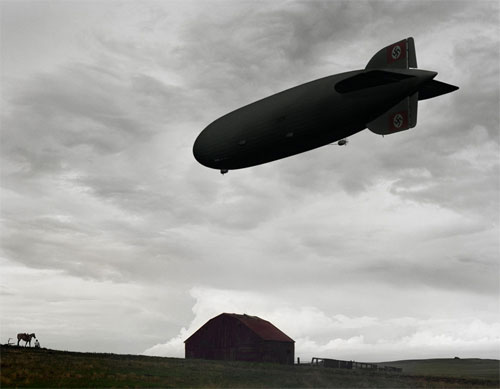
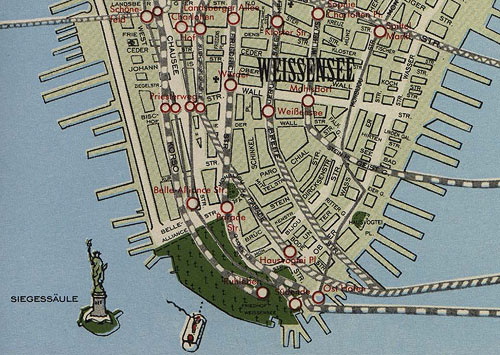
Pairs nicely with Melissa Gould’s Neu-York, “an obsessively detailed alternate-history map, imagining how Manhattan might have looked had the Nazis conquered it in World War II”.
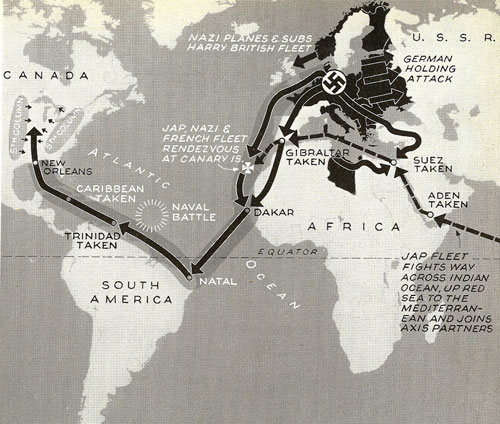
In 1942, Life magazine speculated about what an Axis invasion of North America might look like.
The standard form of Soviet war correspondence during WWII were letters folded into a triangular shape.
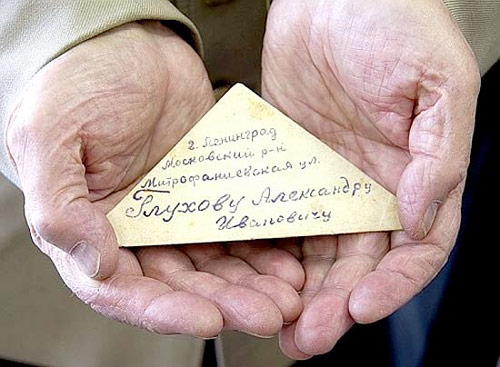
During the war, the mails were brought for free from the front to home. It could not have been differently, because probably the postage stamps would have been the last item the halting logistic support would have delivered to the front. Even so, postcards and envelopes were shortages. The soldiers’ genius has thus created, right in the first months of the war, the format that was a letter and its own envelope in one. The folding process is very similar to how we, in our childhood, folded our soldier’s shako, knowing nothing about the triangular soldier’s letters.
(via raul)
These color photos taken of London during WWII’s Battle of Britain are great.
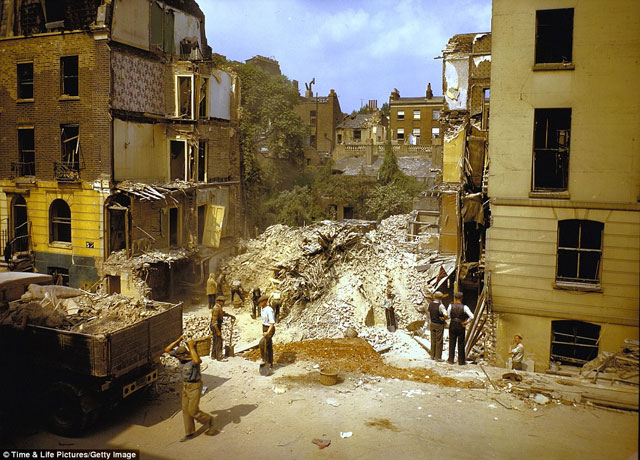
Alan Taylor recently covered the Battle of Britain over at In Focus as well…I love this “business as usual” photo.
As part of his new-ish gig as editor of In Focus at The Atlantic, Alan Taylor is running a 20-week series of photo essays on World War II. The first essay, Before the War, has been posted and is excellent.
The years leading up to the declaration of war between the Axis and Allied powers in 1939 were tumultuous times for people across the globe. The Great Depression had started a decade before, leaving much of the world unemployed and desperate. Nationalism was sweeping through Germany, and it chafed against the punitive measures of the Versailles Treaty that had ended World War I. China and the Empire of Japan had been at war since Japanese troops invaded Manchuria in 1931. Germany, Italy, and Japan were testing the newly founded League of Nations with multiple invasions and occupations of nearby countries, and felt emboldened when they encountered no meaningful consequences. The Spanish Civil War broke out in 1936, becoming a rehearsal of sorts for the upcoming World War — Germany and Italy supported the nationalist rebels led by General Francisco Franco, and some 40,000 foreign nationals traveled to Spain to fight in what they saw as the larger war against fascism.
(thx, david)
Kamikaze pilot Masanobu Kuno wrote a farewell letter to his young son and daughter the day before he flew to his death in the Battle of Okinawa. From the translation:
Your father will become a god and watch you two closely. Both of you, study hard and help out your mother with work. I can’t be your horse to ride, but you two be good friends.
I should have a “crying at work” tag for posts like this.
Malcolm Gladwell tells us about Operation Mincemeat, a caper undertaken by British intelligence to fool the Hitler and the Nazis into thinking the Allied invasion of mainland Europe would come from through Greece and not Sicily.
It did not take long for word of the downed officer to make its way to German intelligence agents in the region. Spain was a neutral country, but much of its military was pro-German, and the Nazis found an officer in the Spanish general staff who was willing to help. A thin metal rod was inserted into the envelope; the documents were then wound around it and slid out through a gap, without disturbing the envelope’s seals. What the officer discovered was astounding. Major Martin was a courier, carrying a personal letter from Lieutenant General Archibald Nye, the vice-chief of the Imperial General Staff, in London, to General Harold Alexander, the senior British officer under Eisenhower in Tunisia. Nye’s letter spelled out what Allied intentions were in southern Europe. American and British forces planned to cross the Mediterranean from their positions in North Africa, and launch an attack on German-held Greece and Sardinia. Hitler transferred a Panzer division from France to the Peloponnese, in Greece, and the German military command sent an urgent message to the head of its forces in the region: “The measures to be taken in Sardinia and the Peloponnese have priority over any others.”
An amazingly extensive Flash presentation of the eastern front in Europe during World War II. It takes a while for the Flash to load because of all the resources but well worth the wait if you’re at all interested in WWII. (thx, reis)
Kseniya Simonova won Ukraine’s Got Talent 2009 competition with her dramatization of Germany’s invasion of Ukraine during WWII, performed with sand on a giant lightbox. Sounds like the cheesiest thing, but this performance is amazing.
Watch until at least 1:06…that’s when my mouth dropped open a bit. The entire audience was in tears by the end. (via @jessicadeva)
Rochus Misch, now 92, recollects that he was in Adolf Hitler’s bunker when the German dictator committed suicide.
“Then Bormann ordered Hitler’s door to be opened. I saw Hitler slumped with his head on the table. Eva Braun was lying on the sofa, with her head towards him. Her knees were drawn tightly up to her chest. She was wearing a dark blue dress with white frills. I will never forget it.
In remembrance of the mass destruction of life and property due to the dropping of the first atomic bomb on Hiroshima 64 years ago today, The Big Picture presents a typically excellent selection of photos.
Update: From Design Observer about a year ago, Hiroshima, The Lost Photographs.
As a follow-up to the excellent Band of Brothers, HBO, Steven Speilberg, and Tom Hanks have teamed up to make The Pacific, a 10-part miniseries about the fighting in the Pacific during WWII from the perspective of a group of US Marines. The first trailer for the series has been released:
(via sarahnomics)
Update: So of course HBO made YouTube remove the video of the trailer. But they put up a smaller crappier version on their own site so it’s all ok, right? (Why do media companies not like people spreading their advertising around? That’s the fucking goal, yes?) Anyway, in the meantime I changed the link to the video above with a new one that hasn’t been removed yet. And if that one gets removed, you can probably find the newest ones here. (thx, greg)
Dueling book reviews! (Sort of.) First, a pair of books suggest, contrary to Robert Oppenheimer’s post-war views, that the US is the only nation to have developed atomic weaponry and that all the other nuclear nations have gotten their information from the US program.
All paths stem from the United States, directly or indirectly. One began with Russian spies that deeply penetrated the Manhattan Project. Stalin was so enamored of the intelligence haul, Mr. Reed and Mr. Stillman note, that his first atom bomb was an exact replica of the weapon the United States had dropped on Nagasaki.
Moscow freely shared its atomic thefts with Mao Zedong, China’s leader. The book says that Klaus Fuchs, a Soviet spy in the Manhattan Project who was eventually caught and, in 1959, released from jail, did likewise. Upon gaining his freedom, the authors say, Fuchs gave the mastermind of Mao’s weapons program a detailed tutorial on the Nagasaki bomb. A half-decade later, China surprised the world with its first blast.
The book, in a main disclosure, discusses how China in 1982 made a policy decision to flood the developing world with atomic know-how. Its identified clients include Algeria, Pakistan and North Korea.
This week’s New Yorker contains an article about a third book that’s the culmination of more than a decade of research on the workings of the atomic bombs dropped on Japan (subscribers only). From the abstract:
Coster-Mullen’s book includes more than a hundred pages of declassified photographs from half a dozen government archives. Coster-Mullen, who is a truck driver by profession, sees his project as a diverting mental challenge. “This is nuclear archeology,” he says.
Coster-Mullen goes on to add that “the secret of the atomic bomb is how easy they are to make”. His hand-bound book, Atom Bombs, is available from Amazon.
Harper’s has a translated excerpt from a 1942 letter detailing a list of recipes used by the residents of Leningrad during the city’s blockage by the Nazis in WWII (subscribers only). In addition to mustard cakes and leather-belt soup, here’s this:
Soup from pets and domesticated animals
Meat is ranked by taste in the following order: dog, guinea pig, cat, rat. Gut the carcass, wash well and place in cold water. Add salt. Cook for one to three hours. For aroma: bay leaf, pepper, any sort of herbs, and, if available, grain.
Newer posts
Older posts




Socials & More