kottke.org posts about Twitter
Important update: I’ve re-evaluated the Twitter data and came up with what I think is a much more accurate representation of what’s going on.
Further update: The Twitter data is bad, bad, bad, rendering Andy’s post and most of this here post useless. Both jumps in Twitter activity in Nov 2006 and March 2007 are artificial in nature. See here for an update.
Update: A commenter noted that sometime in mid-March, Twitter stopped using sequential IDs. So that big upswing that the below graphs currently show is partially artificial. I’m attempting to correct now. This is the danger of doing this type of analysis with “data” instead of data.
—
In mid-March, Andy Baio noted that Twitter uses publicly available sequential message IDs and employed Twitter co-founder Evan Williams’ messages to graph the growth of the service over the first year of its existence. Williams co-founded Blogger back in 1999, a service that, as it happens, also exposed its sequential post IDs to the public. Itching to compare the growth of the two services from their inception, I emailed Matt Webb about a script he’d written a few years ago that tracked the daily growth of Blogger. His stats didn’t go back far enough so I borrowed Andy’s idea and used Williams’ own blog to get his Blogger post IDs and corresponding dates. Here are the resulting graphs of that data.1
The first one covers the first 253 days of each service. The second graph shows the Twitter data through May 7, 2007 and the Blogger data through March 7, 2002. [Some notes about the data are contained in this footnote.]
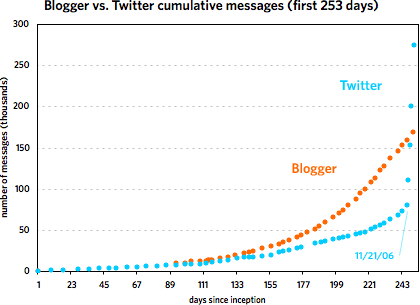
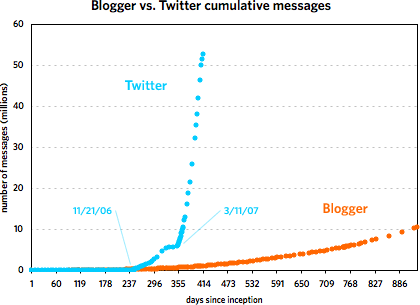
As you can see, the two services grew at a similar pace until around 240 days in, with Blogger posts increasing faster than Twitter messages. Then around November 21, 2006, Twitter took off and never looked back. At last count, Twitter has amassed five times the number of messages than Blogger did in just under half the time period. But Blogger was not the slouch that the graph makes it out to be. Plotting the service by itself reveals a healthy growth curve:
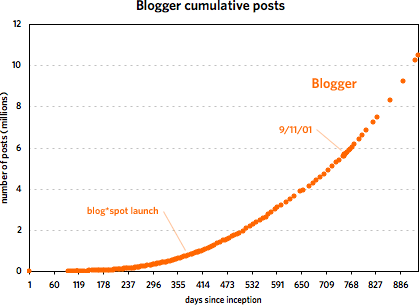
From late 2001 to early 2002, Blogger doubled the number of messages in its database from 5M to 10M in under 200 days. Of course, it took Twitter just over 40 days to do the same and under 20 days to double again to 20M. The curious thing about Blogger’s message growth is that large events like 9/11, SXSW 2000 & 2001, new versions of Blogger, and the launch of blog*spot didn’t affect the growth at all. I expected to see a huge message spike on 9/11/01 but there was barely a blip.
The second graph also shows that Twitter’s post-SXSW 2007 growth is real and not just a temporary bump…a bunch of people came to check it out, stayed on, and everyone messaged like crazy. However, it does look like growth is slowing just a bit if you look at the data on a logarithmic scale:
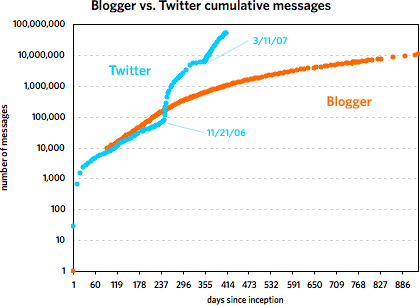
Actually, as the graph shows, the biggest rate of growth for Twitter didn’t occur following SXSW 2007 but after November 21.
As for why Twitter took off so much faster than Blogger, I came up with five possible reasons (there are likely more):
1. Twitter is easier to use than Blogger was. All you need is a web browser or mobile phone. Before blog*spot came along in August 2000, you needed web space with FTP access to set up a Blogger blog, not something that everyone had.
2. Twitter has more ways to create a new message than Blogger did at that point. With Blogger, you needed to use the form on the web site to create a post. To post to Twitter, you can use the web, your phone, an IM client, Twitterrific, etc. It’s also far easier to send data to Twitter programatically…the NY Times account alone sends a couple dozen new messages into the Twitter database every day without anyone having to sit there and type them in.
3. Blogger was more strapped for cash and resources than Twitter is. The company that built Blogger ran out of money in early 2001 and nearly out of employees shortly after that. Hard to say how Blogger might have grown if the dot com crash and other factors hadn’t led to the severe limitation of its resources for several key months.
4. Twitter has a much larger pool of available users than Blogger did. Blogger launched in August 1999 and Twitter almost 7 years later in March 2006. In the intervening time, hundreds of millions of people, the media, and technology & media companies have become familiar and comfortable with services like YouTube, Friendster, MySpace, Typepad, Blogger, Facebook, and GMail. Hundreds of millions more now have internet access and mobile phones. The potential user base for the two probably differed by an order of magnitude or two, if not more.
5. But the biggest factor is that the social aspect of Twitter is built in and that’s where the super-fast growth comes from. With Blogger, reading, writing, and creating social ties were decoupled from each other but they’re all integrated into Twitter. Essentially, the top graph shows the difference between a site with social networking and one largely without. Those steep parts of the Twitter trend on Nov 21 and mid-March? That’s crazy insane viral growth2, very contagious, users attracting more users, messages resulting in more messages, multiplying rapidly. With the way Blogger worked, it just didn’t have the capability for that kind of growth.
A few miscellaneous thoughts:
It’s important to keep in mind that these graphs depict the growth in messages, not users or web traffic. It would be great to have user growth data, but that’s not publicly available in either case (I don’t think). It’s tempting to look at the growth and think of it in terms of new users because the two are obviously related. More users = more messages. But that’s not a static relationship…perhaps Twitter’s userbase is not increasing all that much and the message growth is due to the existing users increasing their messaging output. So, grain of salt and all that.
What impact does Twitter’s API have on its message growth? As I said above, the NY Times is pumping dozens of messages into Twitter daily and hundreds of other sites do the same. This is where it would be nice to have data for the number of active users and/or readers. The usual caveats apply, but if you look at the Alexa trends for Twitter, pageviews and traffic seem to leveling out. Compete, which only offers data as recently as March 2007, still shows traffic growing quickly for Twitter.
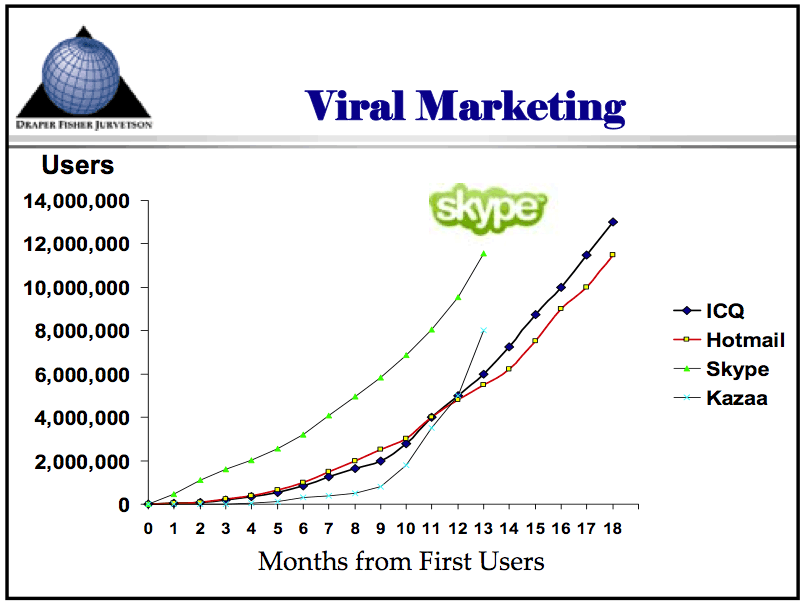
Just for comparison, here’s a graph showing the adoption of various technologies ranging from the automobile to the internet. Here’s another graph showing the adoption of four internet-based applications: Skype, Hotmail, ICQ, and Kazaa (source: a Tim Draper presentation from April 2006).
[Thanks to Andy, Matt, Anil, Meg, and Jonah for their data and thoughts.]
[1] Some notes and caveats about the data. The Blogger post IDs were taken from archived versions of Evhead and Anil Dash’s site stored at the Internet Archive and from a short-lived early collaborative blog called Mezzazine. For posts prior to the introduction of the permalink in March 2000, most pages output by Blogger didn’t publish the post IDs. Luckily, both Ev and Anil republished their old archives with permalinks at a later time, which allowed me to record the IDs.
The earliest Blogger post ID I could find was 9871 on November 23, 1999. Posts from before that date had higher post IDs because they were re-imported into the database at a later time so an accurate trend from before 11/23/99 is impossible. According to an archived version of the Blogger site, Blogger was released to the public on August 23, 1999, so for the purposes of the graph, I assumed that post #1 happened on that day. (As you can see, Anil was one of the first 2-3 users of Blogger who didn’t work at Pyra. That’s some old school flavor right there.)
Regarding the re-importing of the early posts, that happened right around mid-December 1999…the post ID numbers jumped from ~13,000 to ~25,000 in one day. In addition to the early posts, I imagine some other posts were imported from various Pyra weblogs that weren’t published with Blogger at the time. I adjusted the numbers subsequent to this discontinuity and the resulting numbers are not precise but are within 100-200 of the actual values, an error of less than 1% at that point and becoming significantly smaller as the number of posts grows large. The last usable Blogger post ID is from March 7, 2002. After that, the database numbering scheme changed and I was unable to correct for it. A few months later, Blogger switched to a post numbering system that wasn’t strictly sequential.
The data for Twitter from March 21, 2006 to March 15, 2007 is from Andy Baio. Twitter data subsequent to 3/15/07 was collected by me. ↩
[2] “Crazy insane viral growth” is a very technical epidemiological term. I don’t expect you to understand its precise meaning. ↩
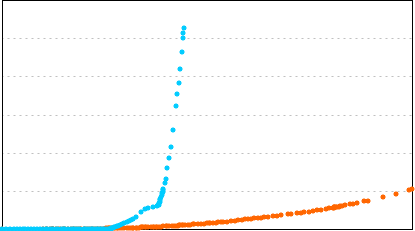
I’m working on a longish post for later today (or early tomorrow) about this graph:
More soon.
Update: The long post is done…the above graph is (roughly) the growth of Blogger (in orange) to the growth of Twitter (in blue).
It’s been awhile since I’ve done one of these. Here are some updates on some of the topics, links, ideas, posts, people, etc. that have appeared on kottke.org recently:
Two counterexamples to the assertion that cities != organisms or ecosystems: cancer and coral reefs. (thx, neville and david)
In pointing to the story about Ken Thompson’s C compiler back door, I forgot to note that the backdoor was theoretical, not real. But it could have easily been implemented, which was Thompson’s whole point. A transcript of his original talk is available on the ACM web site. (thx, eric)
ChangeThis has a “manifesto” by Nassim Taleb about his black swan idea. But reader Jean-Paul says that Taleb’s idea is not that new or unique. In particular, he mentions Alain Badiou’s Being and Event, Jacques Derrida, and Gilles Deleuze. (thx, paul & jean-paul)
When I linked The Onion’s ‘Most E-Mailed’ List Tearing New York Times’ Newsroom Apart, I said “I’d rather read a real article on the effect the most popular lists have on the decisions made by the editorial staff at the Times, the New Yorker, and other such publications”. American Journalism Review published one such story last summer, as did the Chicago Tribune’s Hypertext blog and the LA Times (abstract only). (thx, gene & adam)
Related to Kate Spicer’s attempt to slim down to a size zero in 6 weeks: Female Body Shape in the 20th Century. (thx, energy fiend)
Got the following query from a reader:
are those twitter updates on your blog updated automatically when you update your twitter? if so, how did you do it?
A couple of weeks ago, I added my Twitter updates and recent music (via last.fm) into the front page flow (they’re not in the RSS feed, for now). Check out the front page and scroll down a bit if you want to check them out. The Twitter post is updated three times a week (MWF) and includes my previous four Twitter posts. I use cron to grab the RSS file from Twitter, some PHP to get the recent posts, and some more PHP to stick it into the flow. The last.fm post works much the same way, although it’s only updated once a week and needs a splash of something to liven it up a bit.
The guy who played Spaulding in Caddyshack is a real estate broker in the Boston area. (thx, ivan)
Two reading recommendations regarding the Jonestown documentary: a story by Tim Cahill in A Wolverine Is Eating My Leg and Seductive Poison by former People’s Temple member Deborah Layton. (thx, garret and andrea)
In case someone in the back didn’t hear it, this map is not from Dungeons and Dragons but from Zork/Dungeon. (via a surprising amount of people in a short period of time)
When reading about how low NYC’s greenhouse gas emissions are relative to the rest of the US, keep in mind the area surrounding NYC (kottke.org link). “Think of Manhattan as a place which outsources its pollution, simply because land there is so valuable.” (thx, bob)
NPR did a report on the Nickelback potential self-plagiarism. (thx, roman)
After posting about the web site for Miranda July’s new book, several people reminded me that Jeff Bridges’ site has a similar lo-fi, hand-drawn, narrative-driven feel.
In the wake of linking to the IMDB page for Back to the Future trivia, several people reminded me of the Back to the Future timeline, which I linked to back in December. A true Wikipedia gem.
I’m ashamed to say I’m still hooked on DesktopTD. The problem is that the creator of the game keeps updating the damn thing, adding new challenges just as you’ve finally convinced yourself that you’ve wrung all of the stimulation out of the game. As Robin notes, it’s a brilliant strategy, the continual incremental sequel. Version 1.21 introduced a 10K gold fun mode…you get 10,000 gold pieces at the beginning to build a maze. Try building one where you can send all 50 levels at the same time and not lose any lives. Fun, indeed.
Regarding the low wattage color palette, reader Jonathan notes that you should use that palette in conjunction with a print stylesheet that optimizes the colors for printing so that you’re not wasting a lot of ink on those dark background colors. He also sent along an OS X trick I’d never seen before: to invert the colors on your monitor, press ctrl-option-cmd-8. (thx, jonathan)
Dorothea Lange’s iconic Migrant Mother photograph was modified for publication…a thumb was removed from the lower right hand corner of the photo. Joerg Colberg wonders if that case could inform our opinions about more recent cases of photo alteration.
In reviewing all of this, the following seem related in an interesting way: Nickelback’s self-plagiarism, continual incremental sequels, digital photo alteration, Tarantino and Rodriquez’s Grindhouse, and the recent appropriation of SimpleBits’ logo by LogoMaid.
Adam and David recently reminded me of pocket, an episode of 0sil8 I did back in 2001 (the second-to-last episode actually):

pocket was a broadcast mailing list for mobile phones. People signed up and then I sent them SMS messages on their phones periodically. As I recall it only lasted a few weeks before I shut it down; there just didn’t seem to be anything interesting about broadcasting short messages to a group of friends and strangers.
Get the weather report via Twitter for more than a dozen cities. Looks like it hasn’t been working for the past few days though…maybe once they get their scaling and IM issues figured out.
Marc Hedlund, founder of the intriguing Wesabe, recently made this interesting observation:
One of my favorite business model suggestions for entrepreneurs is, find an old UNIX command that hasn’t yet been implemented on the web, and fix that. talk and finger became ICQ, LISTSERV became Yahoo! Groups, ls became (the original) Yahoo!, find and grep became Google, rn became Bloglines, pine became Gmail, mount is becoming S3, and bash is becoming Yahoo! Pipes. I didn’t get until tonight that Twitter is wall for the web. I love that.
A slightly related way of thinking about how to choose web projects is to take something that everyone does with their friends and make it public and permanent. (Permanent as in permalinked.) Examples:
- Blogger, 1999. Blog posts = public email messages. Instead of “Dear Bob, Check out this movie.” it’s “Dear People I May or May Not Know Who Are Interested in Film Noir, Check out this movie and if you like it, maybe we can be friends.”
- Twitter, 2006. Twitter = public IM. I don’t think it’s any coincidence that one of the people responsible for Blogger is also responsible for Twitter.
- Flickr, 2004. Flickr = public photo sharing. Flickr co-founder Caterina Fake said in a recent interview: “When we started the company, there were dozens of other photosharing companies such as Shutterfly, but on those sites there was no such thing as a public photograph — it didn’t even exist as a concept — so the idea of something ‘public’ changed the whole idea of Flickr.”
- YouTube, 2005. YouTube = public home videos. Bob Saget was onto something.
Not that this approach leads naturally to success. Several companies are exploring music sharing (and musical opinion sharing), but no one’s gotten it just right yet, due in no small measure to the rights issues around much recorded music.
As I mentioned the other day, I recently joined Twitter. I’ve been poking around its nooks and crannies ever since. Here are some observations, presented in Twitter-sized chunks:
Playing with Twitter reminds me of blogging circa 2000. Back then, all weblogs were personal in nature and most people used them to communicate with their friends and family. If I wanted to know what my friends were up to back then, I read their blogs. Now I follow Twitter (and Flickr and Vox).
The reaction to Twitter mirrors the initial reaction to weblogs…the same tired “this is going to ruin the web” and “who cares what you ate for dinner” arguments.
Also like blogs, everyone has their own unique definition of what Twitter is (stripped down blogs, public IM, Dodgeball++, etc.), and to some extent, everyone is correct. Maybe that’s when you know how you’ve got a winner: when people use it like mad but can’t fully explain the appeal of it to others. See also: weblogs, Flickr.
For people with little time, Twitter functions like an extremely stripped-down version of MySpace. Instead of customized pages, animated badges, custom music, top 8 friends, and all that crap, Twitter is just-the-facts-ma’am: where are my friends and what are they up to?
Twitter’s like Flickr without the images.
When one thing (i.e. Twitter) is easier than something else (i.e. blogging) and offers almost the same benefits, people will use it.
Twitter brings back the “type words in one box and press submit” thing that made Blogger so popular back in the day. Compare with current blogging systems. To publish a post in MT, I’ve got to fiddle with 7-9 different text boxes and options. See immediately above.
Let’s not forget Dodgeball here, which was used extensively at SXSW in 2006. (In other words, all the Twittering at SXSW 2007 was not unprecedented. Chill.) It’s more focused on location and SMS though…by allowing updates in more ways and being more flexible about the type of message allowed, Twitter is attractive to a wider group of people.
If your friends are not on Twitter, I can’t imagine it would be that interesting.
Twitterholic tracks the top 100 Twitter users in terms of followers. I know, let’s not turn absolutely everything on the web into a popularity contest!! We already know Scoble is a big blowhard and has weak ties to lots of people…let’s move on, shall we?
I wonder what the average number of followers per person is? The folks with 5 zillion followers get all the attention, but as with blogging, those posting updates for their 20 friends form the bulk of the activity.
Lists of friends and followers are presented alphabetically. Does Anil attract more friends, on average, than Veen because he always shows up near the top of the listings?
I can see why Obvious dropped Odeo for Twitter. With podcasts, you’ve got all that data locked up in binary format (no easy cut-and-paste) and it takes you 20 listening minutes before you can react to it (by commenting, by linking, etc.). With blogs, the reaction time to a post is 1-2 minutes, with Flickr it’s 5 seconds, and Twitter is 2-3 seconds. The barrier to entry for reacting to and remixing podcasts is just so much higher.
Twitter is the first thing on the web that I’ve been excited about in ages. Like years. The last thing was probably Flickr. (Talk about burying the lede.) It’s just so damn simple but useful. Again, reminds me of weblogs in that way.
If you’re on a Mac and using Twitter, download Twitterific, a little app that sits on your desktop and displays updates from your friends. My only complaint: it doesn’t completely show updates, forcing you to the web to read the last 2-3 words of a longish message. Come on…it’s only 140 characters, show them all!
Twittermap displays recent Twitter messages on Google Maps. All you do is send Twitter a message with your location — like so…the “L:10003” is the important part — and Twittermap will pick it up.
Even more mesmerizing is Twittervision…a world tour of recent Twitter messages. Just sit back and watch the updates come in one at a time, displayed on a world map. (This is in beta and Twitter’s having some downtime issues right now, so the data may be less than fresh when you go.)
Twitter seems to work equally well for busy people and not-busy people. It allows folks with little time to keep up with what their friends are up to without having to email and IM with them all day. Those with a lot of time on their hands can spend a lot of time finding new people to follow, having back-and-forths with friends all day, and updating their status 40 times a day. Too many web apps fail because they only appeal to those with abundant free time.
I’m fascinated to see where Obvious takes this app once they get their scaling issues under control.
The default display of recent messages plus your own messages is genius. Makes it feel more like a conversation. The “with friends” display is great too…perfect for discovering other people to follow.
“Friends” still isn’t the right word.
Finally got around to checking out Twitter. Here’s my page: http://twitter.com/jkottke. Drink the Kool-Aid, sign up, and follow me (did I mention “drink the Kool-Aid?). More to come soon.
0sil8 appeared on Netscape’s What’s New page today. That’s kind of odd considering 0sil8 has been around since May 1996. Good review, though.
Newer posts







Socials & More