kottke.org posts about Timothy Snyder
There are many possible and plausible answers to this simple question. Timothy Snyder offers a useful perspective in helping answer it:
How do [we] understand the war with Iran? We must get away from the propaganda and ask why this might be happening, in light of the facts that we do know.
These facts suggest two interpretive frameworks: a foreign war as a mechanism to destroy democracy at home; and a foreign war as an element of personal corruption by the president of the United States.
From the United States, the most plausible angle of view is domestic politics, not foreign policy.
Trump is not a conventionally intelligent person and is losing his wits to age, but he remains an instinctual genius. There’s no grand plan here and there doesn’t need to be; he’s just moving towards his flame: enrichment for himself, entrenching power, and instability for everyone else.
At the end of March, I posted some news about three prominent scholars of fascism and authoritarianism who were leaving the United States to live and work in Canada. In this video for the NY Times, We Study Fascism, and We’re Leaving the U.S., Marci Shore, Timothy Snyder, and Jason Stanley explain their reasons for going. Here’s some of what they had to say:
I’m leaving to the University of Toronto because I want to do my work without the fear that I will be punished for my words.
The lesson of 1933 is you get out sooner rather than later.
My colleagues and friends, they were walking around and saying, “We have checks and balances. So let’s inhale, checks and balances, exhale, checks and balances.” And I thought my God, we’re like people on the Titanic saying our ship can’t sink. We’ve got the best ship. We’ve got the strongest ship. We’ve got the biggest ship. Our ship can’t sink. And what you know is a historian is that there is no such thing as a ship that can’t sink.
I want Americans to realize that this is a democratic emergency.
Toni Morrison warned us: “The descent into a final solution is not a jump. It’s one step. And then another. And then another.” We are seeing those steps accelerated right now.
Harvard is refusing to comply with Trump’s demands related to his regime’s racist, xenophobic political agenda, including a threat to cut $9 billion in research funding. From the AP:
Harvard President Alan Garber, in a letter to the Harvard community Monday, said the demands violated the university’s First Amendment rights and “exceeds the statutory limits of the government’s authority under Title VI,” which prohibits discrimination against students based on their race, color or national origin.
“No government — regardless of which party is in power — should dictate what private universities can teach, whom they can admit and hire, and which areas of study and inquiry they can pursue,” Garber wrote, adding that the university had taken extensive reforms to address antisemitism.
“These ends will not be achieved by assertions of power, unmoored from the law, to control teaching and learning at Harvard and to dictate how we operate,” he wrote. “The work of addressing our shortcomings, fulfilling our commitments, and embodying our values is ours to define and undertake as a community.”
You can read Garber’s letter and the letter Harvard received from the Trump regime.
I recently attended a virtual talk and Q&A with Timothy Snyder and when he was asked about Columbia and other schools capitulating to Trump’s demands and what needs to happen in order to stop it, he replied something along the lines of: “Some big school is gonna have to stick their neck out and take the hit. Say ‘no’ unequivocally to Trump and get their funding pulled. Lead by example and others will follow. Solidarity is the only way out of this.” Good on Harvard1 for helping to lead the way on this…hopefully more schools will find their backbone after this.
In this 10-minute video, John Lithgow reads each of the lessons from Timothy Snyder’s On Tyranny: Twenty Lessons from the Twentieth Century (Bookshop).
Number two: defend institutions. It is institutions that help us to preserve decency. They need our help as well. Do not speak of our institutions unless you make them yours by acting on their behalf. Institutions do not protect themselves. They fall one after the other unless each is defended from the beginning. So choose an institution you care about — a court, a newspaper, a law, a labor union — and take its side.
Snyder himself made a series of 20 videos a few years ago in which he reads each lesson and then provides more context on what it means. Here’s the first episode on anticipatory obedience (he starts reading after a short intro, at about the 2:40 mark):
Lesson number one is: do not obey in advance. Most of the power of authoritarianism is freely given. In times like these, individuals think ahead about what a more repressive government will want, and then offer themselves without being asked. A citizen who adapts in this way is teaching power what it can do.
So, this is the first lesson because it’s about the basic choice we make when we confront difficulty. It’s about the choice of all choices: are we going to go with the new flow or are we going to stand — if only a little bit, only hesitantly — as long as we can against the current?
Again, the whole series of 20 videos can be accessed from this playlist.
In the most recent issue of Garbage Day, Ryan Broderick writes about how Steve Bannon’s “flood the zone with shit” has been embraced by the Trump administration in both governance and in messaging.
The brain-breaking feeling you get watching something like the ASMR video or the time you waste trying to determine whether the image Musk shared is real or not is, like with Project 2025 and the executive orders, by design. It’s meant to initially trigger you and ultimately wear you down.
Stuff like this always makes me think of Hannah Arendt’s comments in this 1974 interview, particularly the last line (emphasis mine):
The moment we no longer have a free press, anything can happen. What makes it possible for a totalitarian or any other dictatorship to rule is that people are not informed; how can you have an opinion if you are not informed? If everybody always lies to you, the consequence is not that you believe the lies, but rather that nobody believes anything any longer. This is because lies, by their very nature, have to be changed, and a lying government has constantly to rewrite its own history. On the receiving end you get not only one lie — a lie which you could go on for the rest of your days — but you get a great number of lies, depending on how the political wind blows. And a people that no longer can believe anything cannot make up its mind. It is deprived not only of its capacity to act but also of its capacity to think and to judge. And with such a people you can then do what you please.
And of Toni Morrison on the true function of racism:
It’s important, therefore, to know who the real enemy is, and to know the function, the very serious function of racism, which is distraction. It keeps you from doing your work. It keeps you explaining over and over again, your reason for being. Somebody says you have no language and so you spend 20 years proving that you do. Somebody says your head isn’t shaped properly so you have scientists working on the fact that it is. Somebody says that you have no art so you dredge that up. Somebody says that you have no kingdoms and so you dredge that up. None of that is necessary. There will always be one more thing.
Timothy Snyder writing in the aftermath of January 6th:
When we give up on truth, we concede power to those with the wealth and charisma to create spectacle in its place. Without agreement about some basic facts, citizens cannot form the civil society that would allow them to defend themselves. If we lose the institutions that produce facts that are pertinent to us, then we tend to wallow in attractive abstractions and fictions.
Speaking of Timothy Snyder, Literary Hub published the first chapter (the one on not obeying in advance) of his 2017 book On Tyranny. It begins:
Do not obey in advance.
Most of the power of authoritarianism is freely given. In times like these, individuals think ahead about what a more repressive government will want, and then offer themselves without being asked. A citizen who adapts in this way is teaching power what it can do.
Anticipatory obedience is a political tragedy. Perhaps rulers did not initially know that citizens were willing to compromise this value or that principle. Perhaps a new regime did not at first have the direct means of influencing citizens one way or another. After the German elections of 1932, which permitted Adolf Hitler to form a government, or the Czechoslovak elections of 1946, where communists were victorious, the next crucial step was anticipatory obedience. Because enough people in both cases voluntarily extended their services to the new leaders, Nazis and communists alike realized that they could move quickly toward a full regime change. The first heedless acts of conformity could not then be reversed.
It’s also worth reading the original list posted by Snyder in November 2016 that became the basis of On Tyranny: Fighting Authoritarianism: 20 Lessons from the 20th Century.
10. Practice corporeal politics. Power wants your body softening in your chair and your emotions dissipating on the screen. Get outside. Put your body in unfamiliar places with unfamiliar people. Make new friends and march with them.
11. Make eye contact and small talk. This is not just polite. It is a way to stay in touch with your surroundings, break down unnecessary social barriers, and come to understand whom you should and should not trust. If we enter a culture of denunciation, you will want to know the psychological landscape of your daily life.
12. Take responsibility for the face of the world. Notice the swastikas and the other signs of hate. Do not look away and do not get used to them. Remove them yourself and set an example for others to do so.
13. Hinder the one-party state. The parties that took over states were once something else. They exploited a historical moment to make political life impossible for their rivals. Vote in local and state elections while you can.
Writing from Ukraine on his way to the front in the country’s war with Russia, Timothy Snyder muses about the differences in life & freedom on the Ukrainian & Russian sides of the war’s front line.
Yet, on this, the Ukrainian side of the line, people lead completely different lives than under Russian occupation or in Russia. Ukrainians say what they want, including about the war and about politics. Journalists cover the war and write about politics. There is fear, although less than you might think; but it is fear of bombs and missiles and violence from Russia, not of denunciations or oppression or of one’s own government. I have the strange feeling, this week in Kyiv, that Ukrainians are living freer lives now than Americans. At a book store where I was talking to a Ukrainian philosopher about freedom, a young woman put her hand on my arm and said “sorry about the U.S.”
Snyder then goes on to wonder if the United States is now headed towards a similar line:
I have in mind something deeper: the transformation of our public and private lives. As in Russia, we have let local newspapers and local media die. As in Russia, their place was taken by a few commercial operations. As in Russia, the media are owned by oligarchs, who then become close to government or submit to it (not all of the media in America, of course, are submitting, but far too many are). As in Russia, our daily lives are flooded by such a rushing river of contradictory lies that we have trouble knowing where we are, let alone what we should do. As in Russia, a president supported by oligarchs and their media power is trying to humiliate the other branches of government. The executive is seeking to marginalize the legislature — forever — by ruling without passing laws. The executive is seeking to marginalize the judiciary — forever — by ignoring court rulings. Those things, of course, have already happened in Russia.
This passage made my stomach drop:
As I close my tablet and go to sleep, I am safer than every single one of you reading this in the United States, and indeed safer than I would be in the United States. My train will stop in five hours. But America will keep hurtling.
It’s a great, provocative piece; read the whole thing.
Historian Timothy Snyder, author of On Tyranny, is urging people and the media to understand and acknowledge that what’s happening right now is definitely a coup.
Imagine if it had gone like this.
Ten Tesla cybertrucks, painted in camouflage colors with a giant X on each roof, drive noisily through Washington DC. Tires screech. Out jump a couple of dozen young men, dressed in red and black Devil’s Champion armored costumes. After giving Nazi salutes, they grab guns and run to one government departmental after another, calling out slogans like “all power to Supreme Leader Skibidi Hitler.”
Historically, that is what coups looked like. The center of power was a physical place. Occupying it, and driving out the people who held office, was to claim control. So if a cohort of armed men with odd symbols had stormed government buildings, Americans would have recognized that as a coup attempt.
And that sort of coup attempt would have failed.
Now imagine that, instead, the scene goes like this.
A couple dozen young men go from government office to government office, dressed in civilian clothes and armed only with zip drives. Using technical jargon and vague references to orders from on high, they gain access to the basic computer systems of the federal government. Having done so, they proceed to grant their Supreme Leader access to information and the power to start and stop all government payments.
That coup is, in fact, happening. And if we do not recognize it for what it is, it could succeed.
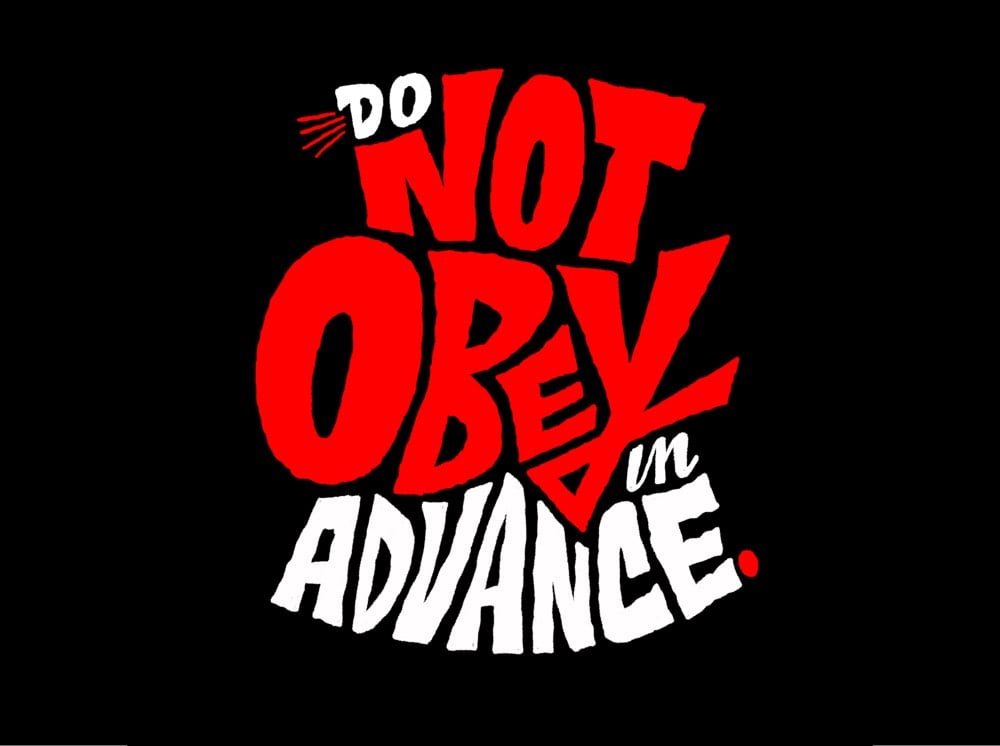
For The Observer, Carole Cadwalladr published a list of pointers on how to survive in Trumpist America, inspired by Timothy Snyder’s Fighting Authoritarianism: 20 Lessons from the 20th Century that was published in the wake of the 2016 election. Some of these are excellent:
1 When someone tells you who they are, believe them. Last week Donald Trump appointed a director of intelligence who spouts Russian propaganda, a Christian nationalist crusader as secretary of defence, and a secretary of health who is a vaccine sceptic. If Trump was seeking to destroy American democracy, the American state and American values, this is how he’d do it.
2 Journalists are first, but everyone else is next. Trump has announced multibillion-dollar lawsuits against “the enemy camp”: newspapers and publishers. His proposed FBI director is on record as wanting to prosecute certain journalists. Journalists, publishers, writers, academics are always in the first wave. Doctors, teachers, accountants will be next. Authoritarianism is as predictable as a Swiss train. It’s already later than you think.
5 You have more power than you think. We’re supposed to feel powerless. That’s the strategy. But we’re not. If you’re a US institution or organisation, form an emergency committee. Bring in experts. Learn from people who have lived under authoritarianism. Ask advice.
15 Remember. Writer Rebecca Solnit, an essential US liberal voice, emails: “If they try to normalize, let us try to denormalize. Let us hold on to facts, truths, values, norms, arrangements that are going to be under siege. Let us not forget what happened and why.”
This is a good time to revisit Snyder’s original list as well. Like Cadwalladr, I think about this one all the time:
1. Do not obey in advance. Much of the power of authoritarianism is freely given. In times like these, individuals think ahead about what a more repressive government will want, and then start to do it without being asked. You’ve already done this, haven’t you? Stop. Anticipatory obedience teaches authorities what is possible and accelerates unfreedom.
Note: Illustration by the awesome Chris Piascik.
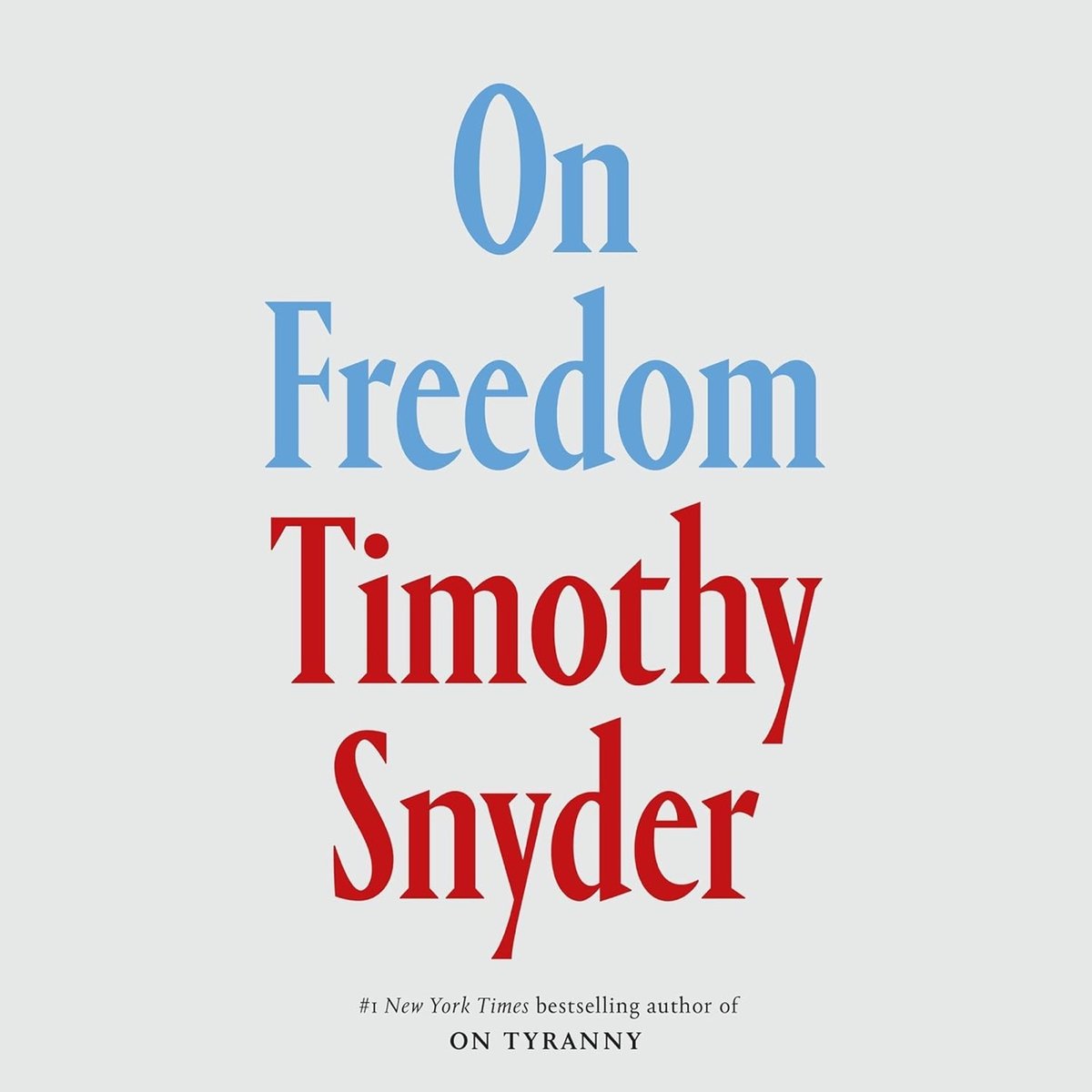
Historian and scholar of authoritarianism Timothy Snyder has a new book out called On Freedom (Bookshop.org), a companion to his 2017 bestseller On Tyranny: Twenty Lessons from the Twentieth Century.
Freedom is the great American commitment, but as Snyder argues, we have lost sight of what it means — and this is leading us into crisis. Too many of us look at freedom as the absence of state power: We think we’re free if we can do and say as we please, and protect ourselves from government overreach. But true freedom isn’t so much freedom from as freedom to — the freedom to thrive, to take risks for futures we choose by working together. Freedom is the value that makes all other values possible.
If you’ve been reading this site for any length of time, you’ll know that I am in favor of the type of freedom Snyder describes. This one is going on the list.
Historian Timothy Snyder (On Tyranny), who studies forced population movements, thinks we aren’t taking the Trump/Vance deportation plans seriously enough. (I agree.) The effects will be familiar to anyone who has read anything about totalitarian regimes and/or caste-based societies (like these very United States):
An attempt to rapidly deport twelve million people will also change everyone else. As Trump has said, such an action will have to bring in law enforcement at all levels. Such a huge mission will effectively redefine the purpose of law enforcement: the principle is no longer to make all people feel safe, but to make some people unsafe. And of course the diversion of law enforcement resources to deportation means that crimes will not be investigated or prosecuted. So some people will be radically less safe, but everyone regardless of status will in fact be less safe.
Such an enormous deportation will requires an army of informers. People who denounce their neighbors or coworkers will be presented as positive examples. Denunciation then becomes a culture. If you are Latino, expect to be denounced at some point, and expect special attention from a government that will demand your help to find people who are not documented. This is especially true if you are a local civic or business leader. You will be expected to collaborate in the deportation effort: if you do, you will be harming others; if you do not, you risk being seen as disloyal yourself. This painful choice can be avoided not at a later point but only now, by voting against mass deportations.
The Trump campaign is telling us straight out that this is their plan — they are not hiding it! at all! — and historians are letting us know what has happened in similar situations in the past and it’s just not all that confusing or complicated to understand. Even if they try and don’t succeed, it’s going to be absolutely brutal. Those are the stakes.
I’ve been waiting, sitting at my desk with hands tented, for historian Heather Cox Richardson to write about Project 2025 and just now I found out that she did so back in March, because of course.
In almost 1,000 pages, the document explains what these policies mean for ordinary Americans. Restoring the family and protecting children means making “family authority, formation, and cohesion” a top priority and using “government power…to restore the American family.” That, the document says, means eliminating any words associated with sexual orientation or gender identity, gender, abortion, reproductive health, or reproductive rights from any government rule, regulation, or law. Any reference to transgenderism is “pornography” and must be banned.
The overturning of the 1973 Roe v. Wade decision recognizing the right to abortion must be gratefully celebrated, the document says, but the Dobbs v. Jackson Women’s Health Organization decision accomplishing that end “is just the beginning.”
Dismantling the administrative state in this document starts from the premise that “people are policy.” Frustrated because nonpartisan civil employees thwarted much of Trump’s agenda in his first term, the authors of Project 2025 call for firing much of the current government workforce-about 2 million people work for the U.S. government-and replacing it with loyalists who will carry out a right-wing president’s demands.
On Friday, journalist Daniel Miller noted that purging the civil service is a hallmark of dictators, whose loyalists then take over media, education, courts, and the military. In a powerful essay today, scholar of authoritarianism Timothy Snyder explained that with the government firmly in the hands of a dictator’s loyalists, “things like water or schools or Social Security checks” depend on your declaration of loyalty, and there is no recourse. “You cannot escape to the bar or the bowling alley, since everything you say is monitored,” and “[e]ven courageous people restrain themselves to protect their children.”
It’s worth reading in full. I wish Richardson did better at citing her sources than an unordered list of links at the end of each article (and also, I wish she weren’t on Substack), so here’s the Daniel Miller note from the excerpt above:
You know who else purged the civil service: Orbán, Erdoğan, Chávez, Milosevic, Ayatollah Khomeini, Pinochet… There was also this guy in Germany in 1933 who purged the civil service months after taking power.
And here’s Timothy Snyder on dictators and declarations of loyalty:
The new bureaucrats will have no sense of accountability. Basic government functions will break down. Citizens who want access will learn to pay bribes. Bureaucrats in office thanks to patronage will be corrupt, and citizens will be desperate. Quickly the corruption becomes normal, even unquestioned.
As the fantasy of strongman rule fades into everyday dictatorship, people realize that they need things like water or schools or Social Security checks. Insofar as such goods are available under a dictatorship, they come with a moral as well as a financial price. When you go to a government office, you will be expected to declare your personal loyalty to the strongman.
If you have a complaint about these practices, too bad. Americans are litigious people, and many of us assume that we can go to the police or sue. But when you vote a strong man in, you vote out the rule of law. In court, only loyalism and wealth will matter. Americans who do not fear the police will learn to do so. Those who wear the uniform must either resign or become the enforcers of the whims of one man.
From Timothy Snyder again, this time on what lessons we can draw on to prevent America’s collapse into fascism.
4. Big business should support democracy. In the Germany of the 1930s, business leaders were not necessarily enthusiastic about Hitler as a person. But they associated democracy with labor unions and wanted to break them. Seeing Hitler as an instrument of their own profit, business leaders enabled the Nazi regime. This was, in the end, very bad for business. Although the circumstances today are different, the general lesson is the same: whether they like it or not, business leaders bear responsibility for whether a republic endures or is destroyed.
I loved his succinct conclusion:
It’s simple: recalling history, we act in the present, for a future that can and will be much better.
Historian and scholar Timothy Snyder, who wrote On Tyranny and this amazing piece about the fascism of Trump and the conservative movement, wrote about a crucial difference in how the media are covering Biden versus how they cover Trump.
It should seem odd that media calls to step down were not first directed to Trump. If we are calling for Biden to step aside because someone must stop Trump from bringing down the republic, then surely it would have made more sense to first call for Trump to step aside? (The Philadelphia Inquirer did). I know the counter-arguments: his people wouldn’t have cared, and he wouldn’t have listened. The first misses an important point. There are quite a few Americans who have not made up their minds. The second amounts to obeying in advance. If you accept that a fascist is beyond your reach, you have normalized your submission.
“Do not obey in advance” is Snyder’s very first lesson from his 20 Lessons from the 20th Century about fighting authoritarianism:
1. Do not obey in advance. Much of the power of authoritarianism is freely given. In times like these, individuals think ahead about what a more repressive government will want, and then start to do it without being asked. You’ve already done this, haven’t you? Stop. Anticipatory obedience teaches authorities what is possible and accelerates unfreedom.
Note: Illustration by the awesome Chris Piascik.
I just started a rewatch of Chernobyl and was struck by the opening lines of the first episode spoken by Jared Harris, who plays Soviet nuclear physicist Valery Legasov:
What is the cost of lies? It’s not that we’ll mistake them for the truth. The real danger is that if we hear enough lies, then we no longer recognize the truth at all. What can we do then? What else is left but to abandon even the hope of truth and content ourselves instead with stories? In these stories, it doesn’t matter who the heroes are. All we want to know is: Who is to blame?
Which reminds me of what historian and philosopher Hannah Arendt said in a 1974 interview:
The moment we no longer have a free press, anything can happen. What makes it possible for a totalitarian or any other dictatorship to rule is that people are not informed; how can you have an opinion if you are not informed? If everybody always lies to you, the consequence is not that you believe the lies, but rather that nobody believes anything any longer. This is because lies, by their very nature, have to be changed, and a lying government has constantly to rewrite its own history. On the receiving end you get not only one lie-a lie which you could go on for the rest of your days-but you get a great number of lies, depending on how the political wind blows. And a people that no longer can believe anything cannot make up its mind. It is deprived not only of its capacity to act but also of its capacity to think and to judge. And with such a people you can then do what you please.
And also what On Tyranny author Timothy Snyder wrote a few days after the January 6th attack on Congress:
Post-truth is pre-fascism, and Trump has been our post-truth president. When we give up on truth, we concede power to those with the wealth and charisma to create spectacle in its place. Without agreement about some basic facts, citizens cannot form the civil society that would allow them to defend themselves. If we lose the institutions that produce facts that are pertinent to us, then we tend to wallow in attractive abstractions and fictions. Truth defends itself particularly poorly when there is not very much of it around, and the era of Trump — like the era of Vladimir Putin in Russia — is one of the decline of local news. Social media is no substitute: It supercharges the mental habits by which we seek emotional stimulation and comfort, which means losing the distinction between what feels true and what actually is true.
Older posts





Socials & More