



Bunk and McNulty go skiing
We interrupt this vacation for an important message: there’s a new episode of The Wire where Bunk and McNulty go skiing. Here’s a screenshot.

This site is made possible by member support. 💞
Big thanks to Arcustech for hosting the site and offering amazing tech support.
When you buy through links on kottke.org, I may earn an affiliate commission. Thanks for supporting the site!
kottke.org. home of fine hypertext products since 1998.
Beloved by 86.47% of the web.
We interrupt this vacation for an important message: there’s a new episode of The Wire where Bunk and McNulty go skiing. Here’s a screenshot.
The history of the design and manufacture of the TiVo remote control.
Like any remote, the designers were adamant about keeping the remote’s button layout as simple as possible. But with the DVR’s numerous features, the designers needed to create lots of extra buttons. To keep things straight, each button needed to have a distinctive feel, giving the ability to control the remote without even looking at it, which Newby described as a “key Braille-ability” surprisingly helped by the “blank finger parking spots between keys” that were equally important.
(via waxy)
In case you’re still hung up on the ambiguous ending of The Sopranos, there’s this long self-proclaimed definitive explanation of “The End”.
“If you look at the final episode really carefully, it’s all there.” These are David Chase’s words regarding the finale of the Sopranos. He is right, it is “all there”. This is the definitive explanation of why Tony died in Holsten’s in the final scene of The Sopranos. The following is based on a thorough analysis of the final season of the show and will clear up one of the most misunderstood endings in film or television history. Chase took almost 2 years to construct the final season of the show after the fifth season ended in June of 2004. Part 1 will show how Chase directed, edited and scored the final scene of the Sopranos to lead to the interpretation that Tony was shot in the head in Holsten’s and how this ties into the “never hear it happen” concept that Chase hammered into the viewer before the show’s final scene.
(via house next door)
In Brazil, soap operas, and specifically the small families they depicted, might have been a form of birth control, lowering the fertility of the audience:
In 1960, the average Brazilian woman had 6.3 children. By 2000, the fertility rate was down to 2.3. The decline was comparable to China’s, but Brazil didn’t have a one-child policy. In fact, for a while it was even illegal to advertise contraceptives.
Many factors account for the drop in Brazilian fertility, but one recent study identified a factor most people probably wouldn’t consider: soap operas (novelas). Novelas are huge in Brazil, and the network Rede Globo effectively has a monopoly on their production…
Using census data from 1970 to 1991 and data on the entry of Rede Globo into different markets, the researchers found that women living in areas that received Globo’s broadcast signal had significantly lower fertility. (And yes, the study did control for all sorts of factors and addressed the concern that the entry of Globo might have been driven by trends that also contribute to fertility decline. I’ll spare you the gory econometric details.) Additionally, people in areas with Globo’s signal were more likely to name their children after novela characters, suggesting that it was the novelas specifically, and not TV in general, that influenced childbearing.
Update (by jkottke): The Sabido Method:
Named after the pioneer in application of this entertainment-education strategy, Miguel Sabido, the Sabido Method is based on character development and plot lines that provide the audience with a range of characters that they can engage with — some good, some not so good — and follow as they evolve and change. Sabido developed this methodology when we was Vice President for Research at Televisa in Mexico in the 1970s.
According to the Mexican government’s national population council, a soap opera called Acompaname was responsible for large increases in people requesting family planning information, contraceptive sales, and enrollment in family planning clinics. From 1977 to 1986, when these soap operas were on, Mexico’s population growth rate fell by 34%. The Sabido Method was also recently covered in the New Yorker. (thx, omegar)
David “The Wire” Simon’s new show, Generation Kill, starts on HBO on July 13 and will continue for six Sundays after that.
Whoa, a TV commercial for McDonald’s that features Line Rider. (via waxy)
Last night I was watching a rerun of Family Guy on TBS and right before the show went to commercial, this happened:
See what they did there? They paused the TV show, ran a little mini-commercial for some show that no one cares about, and then returned to the last two seconds of the segment before going to commercial. Jesus Christ. I realize that Time Warner doesn’t actually care about the people who watch their shows and that television programs are just the networks’ way of getting people to watch advertising, but this is too much. Do these things actually work or just piss people off in droves? Is there some marketing hot dog at Time Warner who thinks that Family Guy viewers want to watch the blue collar comedy stylings of Bill Engvall? I’m sorry that the DVR is ruining your business model, but can you kick the bucket a little more gracefully? (Digg this?)
As rumored yesterday, the iTunes Store has added some HBO shows to their lineup. The initial offerings are the first seasons of The Wire, Flight of the Conchords, Rome, and Deadwood, as well as seasons 1 and 6 of the Sopranos and all of Sex in the City. Prices are between $2-3 per episode. (thx, dhrumil)
The Final Jeopardy blog posts a video each day’s Final Jeopardy question. (thx, daniel)
There’s much to argue with on this list of the 50 greatest TV shows of all time. Too many 1 or 2 season shows and recent shows. And Buffy at #2? Christ, whatever.
A few drawings of characters from The Wire drawn in the style of The Simpsons. Here’s a scene from season one; D’Angelo tries to teach chess to Wallace and Bodie:
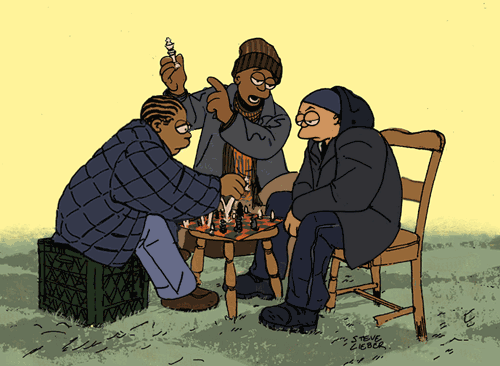
This might be my new favorite thing on the web. (thx, andy)
At the Web 2.0 conference, Clay Shirky gave a talk called Gin, Television, and Social Surplus. In it, he argues that the “social surplus” soaked up in the latter half of the 20th century by television is now being put to better use on the internet.
For the first time, society forced onto an enormous number of its citizens the requirement to manage something they had never had to manage before—free time. And what did we do with that free time? Well, mostly we spent it watching TV. We did that for decades. We watched I Love Lucy. We watched Gilligan’s Island. We watch Malcolm in the Middle. We watch Desperate Housewives. Desperate Housewives essentially functioned as a kind of cognitive heat sink, dissipating thinking that might otherwise have built up and caused society to overheat.
But maybe it’s possible that the internet is a slightly more sophisticated (or slightly more cognitive) cognitive heat sink?
Starcade was an 80s TV game show where contestants competed against each other on various arcade games like Joust, Burgertime, Dragon’s Lair, and Mr. Do. I watched it whenever I could and now they’ve put 15 full episodes online for your viewing pleasure. I found this on the Secret Fun Blog, written by the Vice-President of the official Starcade Fan Club.
On a Spring morning Brad showed up to homeroom with the crazed look of inspiration on his face. He erupted into babble and I sensed that he’d been waiting many hours to unload his revelation upon me. It was something about Starcade, and a club, and titles and duties, and other foreign concepts. I patronizingly agreed to his wishes and I even signed something. It was a letter…
Beginning May 5, the original Iron Chef is back on TV in the US. Set your DVRs for 11pm every weeknight on the Fine Living channel. (via eater)
Socials & More