kottke.org posts about TV
This is a reel from Mackevision, showing the visual effects they did for season 4 of Game of Thrones. I wasn’t expecting all the boats to be fake.
This reel does a better job than most in showing the process and how all the different elements fit together. Also interesting to see how much the digital greebles make everything seem way more realistic.
Update: And here’s another reel of VFX from season 4 by Rodeo FX.
Speaking of Halt and Catch Fire, the title sequence is pretty awesome:
I am also currently trying (and mostly failing) not to have a giant crush on Mackenzie Davis, who plays crack programmer Cameron Howe on the show, reads Infinite Jest in Brooklyn coffee shops, gets anxious about talking on the phone (me too!), and has recently read The Soul of a New Machine (me too!). Am I wrong to think we’d totes be BFFs?!
Update: The Art of the Title did a feature on the H&CF titles, which includes 55 photos of storyboards. Pretty cool to see the process. (via @ScottIvers)
Update: Halt’s opening sequence was nominated for an Emmy in Outstanding Main Title Design!
Television is in the midst of a protracted golden age. Anthropogenic climate change is beginning to affect the planet’s weather. Sarah Miller puts these two ideas together in a short piece of humor writing.
About half an hour later, a Boston Whaler was cruising down Ninth Avenue, and a man stood on the bow with a megaphone, shouting, “Please leave your buildings. Make your way to the nearest rooftop” in English, then in Spanish, then in Chinese. By this point, the water had risen to the top of the first floor. An emergency siren came on and stayed on. Irritated, Marci turned on the closed captioning. Then she wrote a short post about how watching “House of Cards” with subtitles revealed that, in domestic situations, people with less power spoke more words than those with more power but, in professional situations, it was the reverse. She posted it to her Tumblr. “This is so exactly what I was thinking about right now,” someone commented.
Watch as two players from the Japanese national soccer team try to score against 55 kids.
The kids had two opportunities to stop the pro players, once with 33 players and the second time with 55 players. This didn’t turn out how I expected, given how a similar stunt involving fencing ended.
This was posted on Marginal Revolution a few days ago and garnered several interesting comments about how much better professional athletes are than us regular folk. Here are a few:
Rugby: I played against an international player once. Watching him play, I’d seen a chap who ran in straight lines, a strong tackler with a weak kick. Playing against him revealed him to be skillful, agile and possessed of a howitzer kick.
Back in the 1980s a friend was watching a pickup basketball game in Boston and reported what happened when a player from the Celtics showed up. He was so much faster, more athletic, and more agile than the other players that it seemed like he was playing a different sport. The player turned out to be Scott Wedman, who by that time was old and slow by NBA standards, and mainly hung around the 3-point line to shoot outside shots after the defense had collapsed on Bird, McHale, et al. But compared to non-NBA players, he was Michael Jordan (or LeBron James).
My U-19 team (we were very good by local standards) had a practice with the New Zealand All Blacks, who were on some sort of tour. It was like they were from a different planet. I stood no chance of containing, or conversely getting past, the smallest of them under almost any circumstance.
Back in the olden thymes I was a pretty good baseball player. Early in my high school career I got the chance to catch a AAA pitcher. I went into thinking I would have no trouble. The first pitch was on top of me so fast I was knocked off balance. It took a bunch of pass balls before I got used to how to handle his breaking stuff.
The result in the video might also shed some light on the question of choosing to fight one horse-sized duck or 100 duck-sized horses.
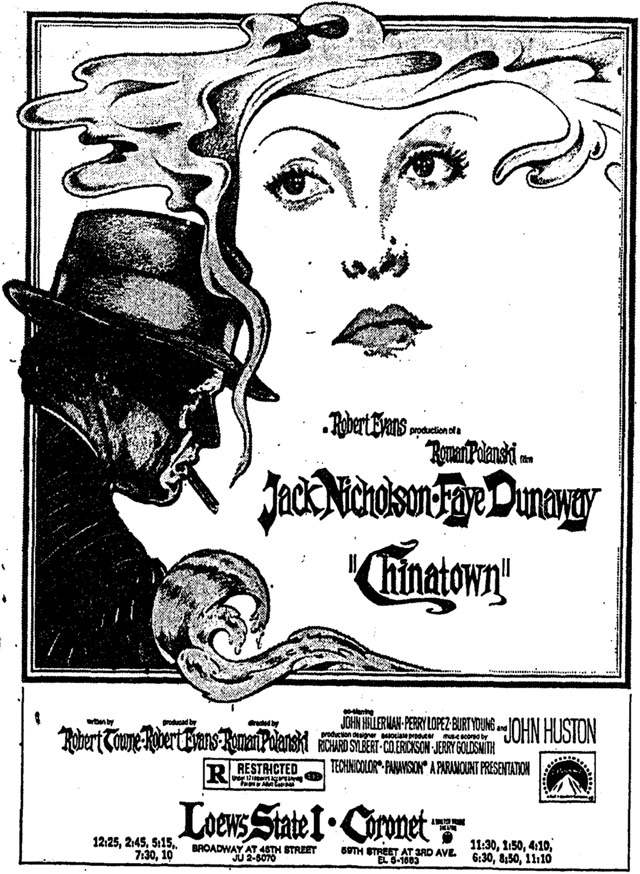
Yesterday, I did a round-up of movies, TV, and music available on this weekend in 1984. As a comparison, I thought looking at the same weekend from 1974 would be interesting. Tracking this information down was a little more difficult than with 1984, but I found most of what I needed in the June 23, 1974 edition of the NY Times.
Back in the 1970s (and probably particularly in NYC), movies stayed in theaters a lot longer than they do now. There was no home video market then…you either saw the movie in the theater or you missed it. This is a list of some of the movies available for viewing in theaters that weekend in NYC:
The Sting
The Exorcist
Parallax View
The Sugarland Express
The Conversation
Chinatown
Papillon
The Great Gatsby
The Sting, Papillon, and The Exorcist had been out since late 1973, The Great Gatsby since March, and The Sugarland Express (Spielberg’s directoral debut) and The Conversation since April. Only Parallax View and Chinatown had just opened. Interestingly, the year’s top-grossing film, Blazing Saddles, which opened in February, didn’t appear anywhere on the movie listing pages of the Times that week.
The top 10 on the Billboard chart for that week were:
Billy, Don’t Be A Hero - Bo Donaldson And The Heywoods
You Make Me Feel Brand New - The Stylistics
Sundown - Gordon Lightfoot
The Streak - Ray Stevens
Be Thankful For What You Got - William DeVaughn
Band On The Run - Paul McCartney & Wings
If You Love Me (let Me Know) - Olivia Newton-John
Dancing Machine - Jackson 5
Hollywood Swinging - Kool & The Gang
The Entertainer - Marvin Hamlisch/The Sting
And on TV that weekend, a number of classic shows, all reruns except for 60 Minutes:
Brady Bunch
Sanford and Son
Good Times
Upstairs, Downstairs
The Odd Couple
All in the Family
M*A*S*H
Mary Tyler Moore
60 Minutes
BTW, the entire copy of the Sunday Times was fascinating to page through. The ads for cigarettes, hand-held calculators, and color televisions, real estate listings, job openings, book listings, the NY Times Magazine, car ads, etc.
On this weekend 30 years ago, in the summer of 1984, you could stroll into a movie theater and choose between the following films:
Ghostbusters
Gremlins
Indiana Jones and the Temple of Doom
The Karate Kid
Star Trek III: The Search for Spock
Top Secret!
The Natural
Police Academy
Plus, Sixteen Candles and Footloose had just closed the weekend before. 1984 was generally a great year for movies. Musically, the following songs were in heavy rotation on the radio and on MTV that weekend:
The Reflex - Duran Duran
Time After Time - Cyndi Lauper
Let’s Hear It for the Boy - Deniece Williams
Dancing in the Dark - Bruce Springsteen
Self Control - Laura Branigan
The Heart of Rock & Roll - Huey Lewis
Jump - The Pointer Sisters
When Doves Cry - Prince
Eyes Without a Face - Billy Idol
Borderline - Madonna
On TV that weekend were mostly reruns and movies…networks only showed reruns in the summer back then. The shows airing included:
The Dukes of Hazzard
Fantasy Island
Webster
Dallas
Diff’rent Strokes
60 Minutes
The Tonight Show Starring Johnny Carson
Late Night with David Letterman
(via, no foolin’, the Stay Puft Marshmallow Man)
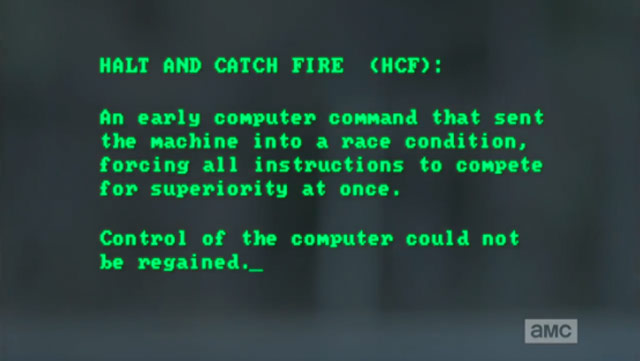
I’ve been hearing some good things about Halt and Catch Fire, which is three episodes into its first season on AMC. The show follows a group of 80s computer folk as they attempt to reverse engineer the IBM PC. The first episode is available online in its entirety.
Many reviews mention the similarity of the characters to Apple founders Steve Jobs and Steve Wozniak, but the trio of managers from Texas Instruments who left to form Compaq in the early 80s are a much closer fit. The Compaq Portable was the first 100% IBM compatible computer produced. Brian McCullough recently did a piece on Compaq’s cloning of the IBM PC for the Internet History Podcast.
The idea was to create a computer that was mostly like IBM-PC and mostly ran all the same software, but sold at a cheaper price point. The first company to pursue this strategy was Columbia Data Products, followed by Eagle Computer. But soon, most of the big names in the young computer industry (Xerox, Hewlett-Packard, Digital Equipment Corporation, Texas Instruments, and Wang) were all producing PC clones.
But all of these machines were only mostly PC-compatible. So, at best, they were DOS compatible. But there was no guarantee that each and every program or peripheral that ran on the IBM-PC could run on a clone. The key innovation that Canion, Harris and Murto planned to bring to market under the name Compaq Computer Corporation would be a no-compromises, 100% IBM-PC compatibility. This way, their portable computer would be able to run every single piece of software developed for the IBM-PC. They would be able to launch their machine into the largest and most vibrant software ecosystem of the time, and users would be able to use all their favorite programs on the road.
My dad bought a machine from Columbia Data Products; I had no idea it was the first compatible to the market. My uncle had a Compaq Portable that he could take with him on business trips. I played so much Lode Runner on both of those machines. I wonder if that disk of levels I created is still around anywhere… (via @cabel)
Update: I’m all caught up, five episodes into the season, and I’m loving it.
Louis C.K. sat down with Jonah Weiner for an extended interview where he discusses learning how to fix cars, tell jokes, fry chicken, and more. (Seriously, Medium is milking that whole time spent reading thing now.) He also gives some clues as to what he seems to be up to in the current season of Louie:
JW: You’ve talked about how you’ve had to explain moral lessons to your daughters, but do it in a catchy way. It’s almost as though you’re writing material for them. What’s the place of morality and ethics in your comedy?
I think those are questions people live with all the time, and I think there’s a lazy not answering of them now, everyone sheepishly goes, “Oh, I’m just not doing it, I’m not doing the right thing.” There are people that really live by doing the right thing, but I don’t know what that is, I’m really curious about that. I’m really curious about what people think they’re doing when they’re doing something evil, casually. I think it’s really interesting, that we benefit from suffering so much, and we excuse ourselves from it. I think that’s really interesting, I think it’s a profound human question…
I think it’s really interesting to test what people think is right or wrong, and I can do that in both directions, so sometimes it’s in defense of the common person against the rich that think they’re entitled to this shit, but also the idea that everybody has to get handouts and do whatever they want so that there’s not supposed to be any struggle in life is also a lot of horseshit. Everything that people say is testable.
At the LA Review of Books, Lili Loofbourow has a good essay about Louie’s abrupt shifts in perspective, in the context of its recent rape-y episodes. There’s Louie the dad, who garners sympathy and acts as a cover/hedge/foil to Louie’s darker impulses. There’s standup Louie, who acts as a commentary and counterpoint to dramedy Louie… except when he doesn’t, and the two characters blur and flip.
Louie is — despite its dick-joke dressing — a profoundly ethical show… Louie is sketching out the psychology of an abuser by making us recognize abuse in someone we love. Someone thoughtful and shy, raising daughters of his own, doing his best. Someone totally cognizant of the issues that make him susceptible to the misogyny monster. Someone who thinks hard about women and men and still gets it badly wrong.
I had to stop watching Louie after Season 1. I raced greedily through those episodes, enjoying the dumb jokes and the sophisticated storytelling, and telling my friends, “this is like looking at my life in ten years.” Then my wife and I separated and that joke wasn’t funny any more, if it ever was. The things in Louie that are supposed to indicate the cracks in the fourth wall — the African-American ex-wife and the seemingly white children — are actually true in my life. His character is more like me than his creator is (except Louie has more money). No haha, you’re both redheads with beards. It’s an honest-to-goodness uncanny valley. I had to walk away.
At the same time, I feel like I understand Louis C.K., the comedian/filmmaker, better now than I did three years ago. If you read that interview, you see someone who’s more successful now than he’s ever been, who knows he’s good at what he does, but who’s never been certain that anyone’s ever loved him or if he’s ever been worthy of love.
Now America loves Louis C.K. and hangs on his every word: on gadgets, on tests in school, on what’s worth caring about. How can he not want to test those limits? How can he not want to punish his audience for caring about a character based on him that he doesn’t even like very much?
From 2009, the Royal Shakespeare Company’s modern-dress production of Hamlet, featuring David Tennant as Hamlet and Patrick Stewart as Claudius.
The site the BBC produced for the show contains more information on the production. (via @mulegirl)
Steven Johnson has been working on a six-part series for PBS called How We Got to Now. (There’s a companion book as well.) The series is due in October but the trailer dropped today:
And here’s a snippet of one of the episodes about railway time. I’m quite looking forward to this series; Johnson and I cover similar ground in our work with similar sensibilities. I’m always cribbing stuff from his writing and using his frameworks to think things through and just from the trailer, I counted at least three things I’ve covered on kottke.org in the past: Hedy Lamarr, urban sanitation, and Jacbo Riis (not to mention all sorts of stuff about time).
The next Ken Burns PBS long thing will be a seven-part series on the Roosevelts (Theodore, Eleanor, and Franklin).
This seven-part, fourteen hour film follows the Roosevelts for more than a century, from Theodore’s birth in 1858 to Eleanor’s death in 1962. Over the course of those years, Theodore would become the 26th President of the United States and his beloved niece, Eleanor, would marry his fifth cousin, Franklin, who became the 32nd President of the United States. Together, these three individuals not only redefined the relationship Americans had with their government and with each other, but also redefined the role of the United States within the wider world. The series encompasses the history the Roosevelts helped to shape: the creation of National Parks, the digging of the Panama Canal, the passage of innovative New Deal programs, the defeat of Hitler, and the postwar struggles for civil rights at home and human rights abroad. It is also an intimate human story about love, betrayal, family loyalty, personal courage and the conquest of fear.
Fall 2014. (via @tcarmody)
Homer Economicus is a new book which uses the fictional world of Springfield on The Simpsons to explain the basic concepts of economics.
Since The Simpsons centers on the daily lives of the Simpson family and its colorful neighbors, three opening chapters focus on individual behavior and decision-making, introducing readers to the economic way of thinking about the world. Part II guides readers through six chapters on money, markets, and government. A third and final section discusses timely topics in applied microeconomics, including immigration, gambling, and health care as seen in The Simpsons. Reinforcing the nuts and bolts laid out in any principles text in an entertaining and culturally relevant way, this book is an excellent teaching resource that will also be at home on the bookshelf of an avid reader of pop economics.
(via mr)
I watched the first episode of Band of Brothers last night to see if it held up (it does). The episode centers on the training and deployment to England of Easy Company of the 506th Parachute Infantry Regiment, led by Lt. Herbert Sobel. In the miniseries, Sobel is played by David Schwimmer and is depicted as a real hardass who earns the hatred of his men while pushing them to be the best company in the entire regiment.
In real life, Sobel rose to the rank of Lieutenant Colonel, fought in the Korean War, was awarded the Bronze Star, married and had three children. The part of Sobel’s Wikipedia entry about his later years is among the saddest things I have ever read:
In the late 1960s, Sobel shot himself in the head with a small-caliber pistol. The bullet entered his left temple, passed behind his eyes, and exited out the other side of his head. This severed his optic nerves and left him blind. He was later moved to a VA assisted living facility in Waukegan, Illinois. Sobel resided there for his last seventeen years until his death due to malnutrition on September 30, 1987. No services were held for Sobel after his death.
Rest in peace, Lieutenant Colonel Sobel.
A Japanese TV show took three expert fencers and pitted them against 50 amateurs.
I honestly didn’t think this would be that interesting and expected the Musketeers to easily get taken out right away or, if they survived more than 30 seconds, to handily finish off the rest of the crowd…nothing in between. But it’s fascinating what happens. The crowd, being a crowd, does not initially do what it should, which is rush the experts and take them out right away with little regard for individual survival. But pretty much every person fights for themselves. And instead of getting easier for the Musketeers near the end, it gets more difficult. The few remaining crowd members start working together more effectively. The survival of the fittest effect kicks in. The remaining experts get sloppy, tired, and perhaps a little overconfident. The ending was a genuine shock. (via digg)
I really liked this bit from Rolling Stone’s interview with Game of Thrones writer George R.R. Martin:
Ruling is hard. This was maybe my answer to Tolkien, whom, as much as I admire him, I do quibble with. Lord of the Rings had a very medieval philosophy: that if the king was a good man, the land would prosper. We look at real history and it’s not that simple. Tolkien can say that Aragorn became king and reigned for a hundred years, and he was wise and good. But Tolkien doesn’t ask the question: What was Aragorn’s tax policy? Did he maintain a standing army? What did he do in times of flood and famine? And what about all these orcs? By the end of the war, Sauron is gone but all of the orcs aren’t gone — they’re in the mountains. Did Aragorn pursue a policy of systematic genocide and kill them? Even the little baby orcs, in their little orc cradles?
(via mr)
Newer posts
Older posts





Socials & More